Top 5 Custom Pin Clutches for Different Buyer Use Cases
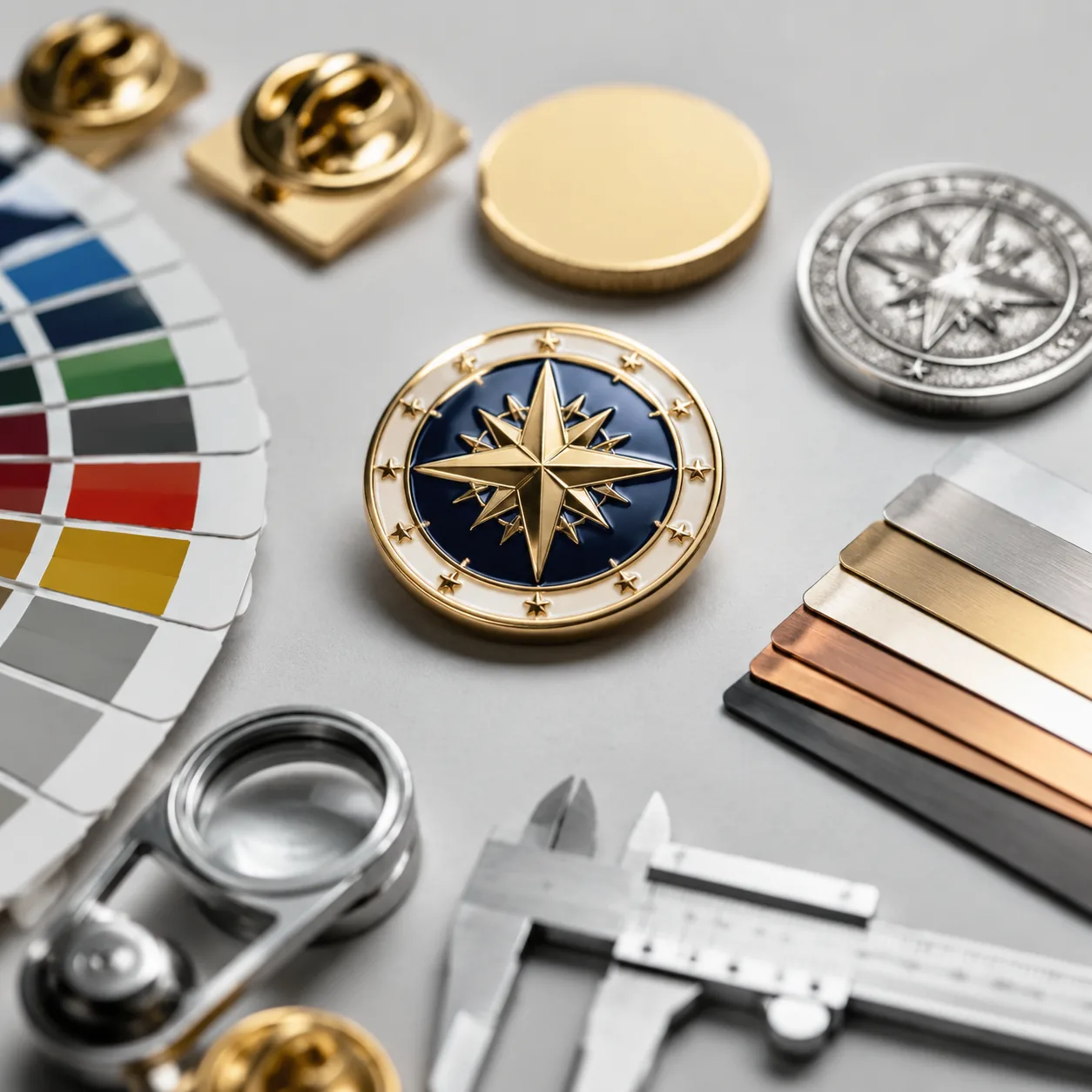
Choose the clutch by failure risk, not by habit
Most pin-back problems are not artwork problems. They are hardware-spec problems. A 32 mm hard or soft enamel pin can pass sample approval and still rotate on a polo, sag on fleece, scratch adjacent items in packing, or disappear during an event because the clutch type, post count, and post spacing were treated as default hardware instead of part of the engineered product.
For most B2B programs, buyers do not need twenty attachment options. They need a short list that maps to the real commercial risks: butterfly clutch, rubber clutch, deluxe clutch, locking clutch, and magnetic backing. Those five cover the majority of employee recognition, retail resale, conference giveaways, museum-shop pins, school programs, and delicate-fabric wear.
The right comparison is not which clutch looks best in isolation. It is which one performs on the actual garment, for the actual wearer, at an acceptable loss rate. A collector pin sold on a backing card has different priorities from a transit badge worn five days a week. Start with the use case, then specify the hardware around it.
How to compare clutch options: retention, rotation, fabric risk, and true unit economics
A clutch that saves $0.02 per piece is rarely the cheapest choice if it increases replacements, event-day losses, or uniform complaints. In practice, buyers should compare hardware across seven variables: pull retention, resistance to rotation, ease of removal, comfort in wear, garment compatibility, assembly impact, and likely failure mode.
- Retention strength: butterfly and rubber are usually the lowest-retention pierced options; locking clutches provide the highest practical retention on standard pin posts.
- Anti-rotation: one post can work for a 20-25 mm compact round pin, but 30-45 mm pins usually perform better with two posts spaced 18-28 mm center-to-center.
- Fabric impact: pierced hardware leaves a hole and can stress fine knits, while magnets avoid puncture but have lower shear stability on thick fabrics.
- User handling: event attendees, children, and temporary staff generally manage rubber more easily than locking clutches that require a release action.
- Weight compatibility: pins above about 10-12 g, or tall top-heavy silhouettes, should not rely on one basic clutch.
- Commercial impact: compare the hardware adder, any assembly labor, MOQ step-up, and the replacement rate if losses matter.
- Failure mode: loosening, snag release, rotation, magnet slip, or user inability to remove the clutch safely without damaging the garment.
For metal pin bodies, standard post diameter is typically 0.9-1.0 mm for stamped iron or brass and up to 1.1 mm on some die-cast builds. Post length is usually 8-10 mm for shirts, blazers, aprons, and light jackets; 10-12 mm may be needed for heavier outerwear, though longer posts can reduce comfort. Post location tolerance should generally stay within +/-0.20 mm. For two-post designs, center-to-center spacing tolerance should stay within +/-0.30 mm; larger variation increases lean and rotation complaints.
A practical outgoing inspection plan is AQL 2.5 for major defects and AQL 4.0 for minor defects. On sampled units, buyers should require attachment-security checks, 10-20 removal/reinsertion cycles, and simple garment wear trials on the intended fabric. For magnet styles, include a shear-slip check on the actual textile, not only a direct pull test on a bench sample.
Use realistic retention assumptions rather than marketing language. On typical 0.9-1.0 mm posts, butterfly and rubber clutches often separate in roughly the 0.8-1.8 kgf range depending on supplier, cap design, and wear condition. Deluxe clutches commonly test around 1.2-2.5 kgf. Locking clutches can exceed 3.0 kgf and often reach 4.0-5.0 kgf on compatible posts. Exact values vary by vendor, so treat these as RFQ benchmarks and require testing on the actual pin build, not a generic hardware sample.
Spec table: best clutch by use case, MOQ, lead time, and cost
| Rank | Clutch type | Best for | Typical MOQ | USD FOB adder vs butterfly | Lead-time impact | Typical limits |
|---|---|---|---|---|---|---|
| 1 | Locking clutch | Uniforms, staff awards, commuter wear, loss-sensitive programs | 100 pcs; usually no extra MOQ above 300 pcs | +$0.10 to +$0.28/pc | 0-2 calendar days | Slower to remove; poor fit for frequent swapping or wearers with limited hand strength |
| 2 | Rubber clutch | Events, schools, youth programs, casual wear | 100 pcs; commonly available from base MOQ | +$0.01 to +$0.03/pc | 0-1 day | Can loosen over time on heavy pins, aprons, backpacks, or outerwear |
| 3 | Deluxe clutch | Retail pins, museum shops, premium gift sets | 100 pcs | +$0.03 to +$0.08/pc | 0-1 day | Better feel than true security; can still release under snagging |
| 4 | Magnetic backing | Suits, silk, knitwear, no-hole dress requirements | 300 pcs typical; some factories can do 100 pcs with limited magnet options | +$0.18 to +$0.45/pc | 1-3 days | Lower shear stability on thick fabric; bulkier profile; not ideal for active uniforms |
| 5 | Butterfly clutch | Budget promos, launch giveaways, short-duration campaigns | Base MOQ, often 50-100 pcs | Base cost | 0 days | Highest accidental-loss risk in active use, especially with one-post pins |
This ranking assumes a common build: a 25-38 mm stamped iron or brass pin, 1.2-1.5 mm body thickness, 4-10 g finished weight, and nickel, black nickel, imitation gold, or dyed-black finish. Once the pin exceeds about 40 mm width, 12 g weight, or has an unbalanced silhouette, post layout becomes as important as clutch selection. In many cases, moving from one post to two posts improves field performance more than moving from butterfly to deluxe.
Visible rear hardware finish should also be specified on retail and premium programs. Deluxe and locking clutches are often plated to match the front finish. Cosmetic plating on decorative clutch surfaces is commonly around 0.03-0.05 microns for imitation-gold tones and 0.10-0.20 microns for nickel-family finishes. These figures matter mainly for appearance consistency and corrosion resistance in storage; clutch failure is usually mechanical rather than plating-related.
1) Locking clutch: best overall for uniforms and high-loss environments
If the buyer's main concern is preventing replacement cost, locking clutch is usually the best first quote. It provides the strongest practical retention among pierced options and is the safest default for employee uniforms, school recognition programs, transport staff, healthcare support teams, and hospitality operations where a missing pin creates both image and administrative problems.
Typical FOB adder is $0.10-$0.28 per piece depending on quantity, locking style, and finish match. At 500 pcs, many factories quote near the upper end; by 3,000 pcs, the adder often compresses toward the lower-middle of the range. MOQ is rarely the issue above 300 pcs. Usability is the real filter. Some locking styles use a pull-release barrel, while others use a push-button or spring-loaded release. All are slower than rubber or butterfly and should be user-tested if the wearer may be elderly, gloved, or expected to swap pins between garments.
Best-fit spec range is usually 25-45 mm pins worn repeatedly on polos, blazers, aprons, or lightweight jackets. For anything above 30 mm, two posts are strongly recommended. A practical configuration is a 32 mm stamped iron soft enamel pin, 1.5 mm thick, 7 g finished weight, with two 1.0 mm posts at 22 mm spacing and locking clutches. That setup typically performs much better against rotation than the same design built with one centered post.
The main field failure is usually not spontaneous release. It is partial engagement because the user did not fully seat the clutch, or difficulty during removal that leads the wearer to bend the post. Buyers should ask suppliers to deburr the post tip and confirm smooth post-end finishing. For staff programs, add a one-line instruction on the backing card or polybag insert: push until fully seated; release per mechanism type.
If the garment cannot be punctured, locking hardware is not the answer. In that case, magnetic backing is the no-hole option, but it should not be expected to match locking retention during active wear, bag-strap friction, or repeated snagging.
2) Rubber clutch: best value for events, schools, and safer handling
Rubber clutches are often treated as a budget choice, but they solve several real operational issues. They are easier to grip, gentler on fingers, quieter in bulk packing, and less likely to scratch nearby products than exposed metal backs. For conferences, school programs, fan merchandise, and welcome kits, that usability often matters more than maximum pull strength.
The usual FOB adder is only $0.01-$0.03 per piece over butterfly, and on some dark-finish builds rubber is already quoted as standard. Black rubber also pairs better visually with black nickel or dyed-black plating than a bright metal butterfly clutch, which can make the product feel mismatched from the rear on premium pins.
Rubber works best on 25-32 mm pins under about 8-10 g. A typical example is a 28 mm conference pin ordered at 2,000 pieces for a two-day event, packed on a card and handed to attendees at registration. In that scenario, rubber usually gives the best balance of cost, ease of use, and acceptable retention. The same front design, if converted into a daily apron pin for restaurant staff, should not keep the same backing spec.
Where rubber underperforms is long-term wear under repeated snagging or heavier loads. Backpack pins, food-service apron pins, and outerwear pins on fleece or softshell can gradually work loose, especially if the post surface is polished smooth and the rubber hole relaxes with repeated removals. Once the pin exceeds roughly 10-12 g, or the silhouette is tall and top-heavy, move to two posts and consider locking hardware. If the buyer insists on rubber for a larger pin, ask for wear testing on the actual garment over at least one work shift or several removal cycles.
3) Deluxe clutch: best for retail presentation and premium perceived quality
Deluxe clutches sit in the middle of the market. They feel more substantial than butterfly, present better in matched plating, and remove faster than locking styles. That makes them a common upgrade for retail pin cards, museum shops, artist merchandise, collector series, and boxed corporate gifts where perceived quality affects sell-through.
Typical FOB adder is $0.03-$0.08 per piece, usually manageable at 500+ pieces when the finished pin will retail above promo level. They pair well with hard enamel, imitation-gold plating, screen-print details, custom backing cards, PET sleeves, or rigid gift boxes. In those programs, a basic butterfly clutch can make the total product feel cheaper than intended even if the front decoration is excellent.
The key limitation is that deluxe is a merchandising upgrade first, not a security solution. It improves hand feel and presentation, but it is still vulnerable to snag release in active use. Buyers selecting deluxe for a museum shop are solving a different problem from HR teams buying service-award pins for daily wear.
As a rule of thumb, deluxe works well for 25-35 mm pins under about 10 g on light to medium garments. For collector sets with 40 mm+ pins, use two deluxe clutches or at least a two-post layout to control rotation both on display cards and when worn. If the pin is die-cast with deep raised relief and weighs 12-15 g, deluxe may still look premium but should not be specified without a double-post design and a clear acceptance threshold for movement.
4) Magnetic backing: best when fabric damage is unacceptable
Magnetic backing is the correct choice when the garment must not be pierced. Typical applications include executive-event lapels, silk scarves, fine knits, rental garments, and hospitality apparel where puncture marks, yarn pulls, or visible holes are unacceptable. In those use cases, the higher hardware cost is justified by avoiding garment complaints or replacement claims.
Typical FOB adder is $0.18-$0.45 per piece, with many factories quoting a 300-piece MOQ for standard 2-piece magnet sets. Production usually takes 1-3 extra calendar days because rear assembly is more complex and the supplier must verify magnet alignment, adhesive or mechanical fixing, and holding consistency. The rear of the pin also needs enough flat contact area for stable mounting. Irregular die-cast backs are less suitable unless a flat plate is engineered into the rear design.
Magnets work best on thin to medium fabrics and moderate pin weights, typically around 20-32 mm and under 6-8 g for reliable wear. On padded jackets, fleece, and thick woven outerwear, the magnetic gap increases and holding force drops quickly. Magnets also resist direct pull better than shear, so a pin that brushes against a bag strap or seat belt may slide out of position even if it does not fully detach.
For orientation-critical branding, test-wear on the actual garment before mass production. A 25 mm round logo on a smooth suit lapel may perform well with a standard magnet pair. A 38 mm vertical name badge on a textured knit may twist, droop, or slide unless the back plate is widened or the badge is redesigned to reduce height-to-width imbalance. On highly textured fabrics, buyers should ask for a pre-production wear sample rather than approving only a bench sample.
There are also compliance concerns. Magnets are not suitable for all wearers, and some organizations restrict them around medical devices, ID systems, or specialized equipment. That check should happen during RFQ and internal approval, not after samples are made or bulk goods are packed.
5) Butterfly clutch: best only when budget and speed clearly dominate
Butterfly clutch remains common because it is cheap, universally available, compact, and fast to assemble. For low-cost giveaways, launch-event handouts, and one-day campaigns where some loss is acceptable, it still has a valid use. If the brief is 5,000 pieces, lowest possible unit cost, simple packing, and short wear duration, butterfly may be the correct answer.
The problem is that butterfly often becomes poor value once the pin enters repeated wear. It generates more accidental-release complaints than the other pierced options, especially on single-post pins, heavier builds, and thicker garments. If the buyer is already paying for upgraded plating, custom backing cards, individual polybagging, or gift-ready presentation, saving a few cents on the clutch is often false economy.
The safe operating range is fairly narrow: light stamped pins around 20-25 mm, under about 8 g, with short wear duration and accepted loss risk. A 22 mm promo pin for a campus open day fits that range. A 35 mm staff-service award pin does not. For many buyers, simply moving from butterfly to rubber improves handling and lowers loss risk with only a minimal cost increase and no meaningful lead-time penalty.
If butterfly must be used, reduce risk by keeping the pin compact, using a balanced silhouette, and avoiding one-post layouts on wide horizontal shapes. Even at the promo tier, post placement still matters. A second post can add a small tooling or assembly impact, but on 30 mm+ shapes it often cuts rotation complaints far more effectively than changing only the clutch style.
How to quote correctly: RFQ checklist and scenario-based specing
The fastest way to avoid rework is to quote the same artwork with two or three hardware options against the real use case. Attachment failures usually come from the interaction of weight, post spacing, garment thickness, and user behavior, not the clutch alone. That is why the RFQ should describe wear conditions in addition to the front design.
- State pin size in mm, body thickness, and target finished weight in grams.
- Specify one post or two posts, post diameter, post length, and preferred post spacing if orientation matters.
- Name the garment: polo, blazer, apron, fleece, tote bag, knitwear, suit lapel, or backpack use.
- State wear frequency: one-day event, weekly use, or daily uniform wear.
- Clarify whether fabric puncture is allowed or prohibited.
- Define acceptable loss risk: promo tolerance, normal retail wear, or near-zero replacement target.
- Request pricing at practical quantity tiers such as 500, 1,000, and 3,000 pcs.
- Ask for FOB price, tooling charge if any, packing method, and production lead time in calendar days.
- For retail or staff programs, require random pull testing and list attachment security under AQL 2.5 major inspection points.
- For larger pins, request the supplier's recommended post-layout drawing before sample approval.
A practical RFQ example: 32 mm stamped iron soft enamel pin, 1.5 mm thickness, black nickel plating, estimated finished weight 7-8 g, two 1.0 mm posts at 22 mm spacing, compare rubber clutch, deluxe clutch, and locking clutch at 500 / 1,000 / 3,000 pcs, FOB China, packed with individual polybag and custom backing card. Ask the supplier to list MOQ differences, lead-time impact in calendar days, pull-test method, and whether finish matching on the rear hardware changes cost.
A simple decision rule works for most buyers: quote locking first for uniforms and loss-sensitive wear, rubber first for events and easy handling, deluxe first for retail presentation, magnetic first for no-hole dress requirements, and butterfly only when budget and speed clearly outrank retention. If the same front design will serve multiple channels, do not force one backing spec across all of them. The clutch should follow the use case, not the artwork alone.
Have a project? Send your artwork and target quantity and we’ll reply with a detailed quotation within 12 working hours.
Ready to get this made?
Send your sketch, target quantity and ship-date. Detailed quotation in 12 hours.



