Top 5 Custom Pin Closures for Uniforms and Daily Wear
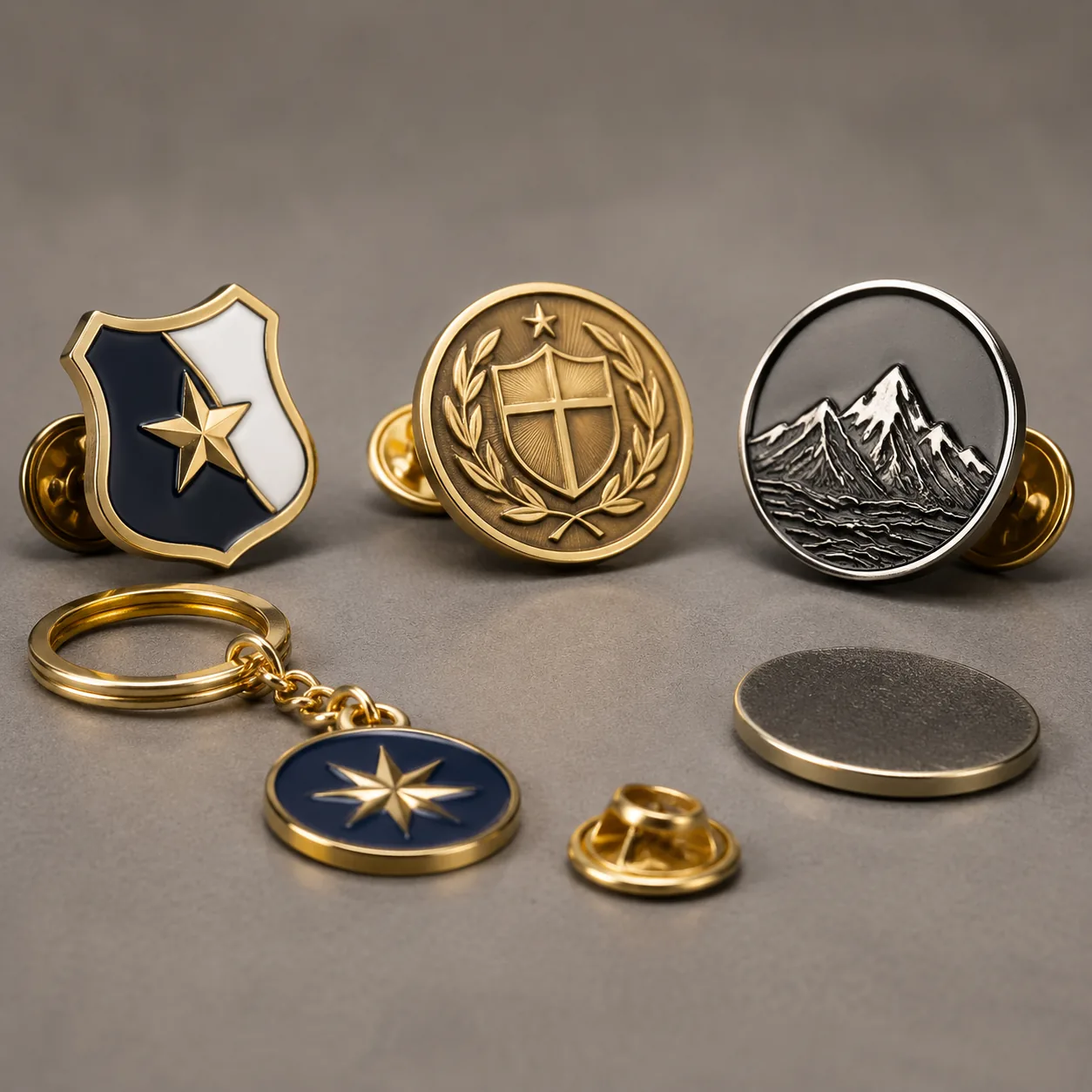
Back hardware is where many pin programs fail
Most pin problems start after the face side is already approved. Artwork is signed off, plating looks correct, enamel fill passes visual review, and then the order goes into mass production with a vague note such as standard back or pin clutch. At that point the factory will usually fit the lowest-cost stocked hardware. That is acceptable for a one-day giveaway. It is a poor default for a badge worn 5 days a week on aprons, fleece, knit polos, work shirts, or suit jackets.
For custom pins in the 20 to 35 mm range, closure choice affects four operating costs at once: badge loss, garment damage, assembly time, and replacement handling. On a 1,000-piece program, moving from a butterfly clutch to a locking clutch usually adds about USD 0.14 to 0.30 FOB per piece. That USD 140 to 300 hardware delta is often lower than replacing even 50 to 80 lost badges once freight, admin time, and reissue handling are counted. For uniform programs, the cheapest closure on the invoice is rarely the cheapest closure over 6 to 12 months of wear.
This comparison covers five common closure types used on die-struck, soft enamel, imitation hard enamel, and printed metal pins: butterfly clutch, rubber clutch, deluxe locking clutch, magnetic backing, and safety pin bar. The benchmarks assume a finished pin thickness of 1.2 to 1.8 mm, pin weight of roughly 4 to 10 g, and a standard post diameter of 0.9 to 1.1 mm, with FOB factory pricing from China for 2025 to 2026 buying cycles.
Retention ranking for repeated wear
For daily wear, retention matters more than familiarity. A closure that loosens after two weeks is not a low-cost option in practice. The ranking below compares each hardware type for repeated wear, with typical MOQ, FOB adder, lead-time effect in calendar days, and the failure mode buyers most often see in the field.
| Rank | Closure type | Best use case | Typical MOQ | FOB adder at 1,000 pcs | Lead-time impact | Main risk |
|---|---|---|---|---|---|---|
| 1 | Deluxe locking clutch | Uniform badges, employee pins, premium collector pins | 100 to 300 pcs | USD 0.16 to 0.32 | +1 to 3 days | Higher hardware cost and slower manual assembly |
| 2 | Rubber clutch | Light daily wear, caps, youth apparel, casual merch | 100 pcs | USD 0.03 to 0.07 | 0 to +1 day | Grip relaxes on heavier pins or in heat |
| 3 | Butterfly clutch | Promotional pins, school events, exhibition giveaways | 100 pcs | USD 0.02 to 0.05 | 0 days | Tabs loosen, pin rotates, accidental release |
| 4 | Safety pin bar | Brooch-style badges, larger textile badges, outerwear | 100 pcs | USD 0.08 to 0.18 | +1 to 2 days | Bulky profile and slower attachment |
| 5 | Magnetic backing | No-hole wear on suiting and delicate fabrics | 200 to 300 pcs | USD 0.20 to 0.42 | +2 to 4 days | Slides under shear on thick or curved fabric |
This ranking assumes the rear layout is correct. For compact pins under 25 mm and below about 6 g, one post is usually enough. For pins above 30 to 35 mm, above 8 g, or with tall vertical geometry, two posts spaced about 18 to 28 mm apart reduce rotation far better than simply increasing metal thickness from 1.2 mm to 1.8 mm. Many complaints blamed on the clutch are actually layout problems.
1. Deluxe locking clutch: best default for uniforms
For staff badges, school insignia, membership pins, and premium resale pins, the deluxe locking clutch is usually the best default. A good spring-lock or ball-lock clutch holds more consistently than a butterfly clutch during garment flex, repeated bending, commuting, and carton handling. On a properly made 1.0 mm post, it gives the most stable retention among standard clutch-style backs without requiring oversize hardware.
In practical use, one locking clutch is enough for a compact 20 to 30 mm pin with finished thickness of 1.2 to 1.5 mm and total weight below 6 g. For larger shapes, tall vertical badges, or pins above roughly 8 g, specify two posts. A solid working spec is post diameter 1.0 mm plus or minus 0.05 mm, post length 8 to 9 mm, and post perpendicularity within 0.3 mm. If the post leans off-axis, the lock can still engage but feel inconsistent, which creates complaints even when the hardware itself is acceptable.
Typical MOQ is 100 to 300 pieces depending on finish match and hardware stock. At 1,000 pieces, the usual FOB adder versus a basic butterfly clutch is USD 0.16 to 0.32. Lead time commonly increases by 1 to 3 calendar days because assembly is slower and functional inspection takes longer. For distributed uniform programs, that delay is usually justified because each lost badge becomes a service event rather than a simple unit replacement.
QC should be functional, not only visual. A practical standard is AQL 2.5 for major defects and 4.0 for minor defects, with checks for lock engagement, release consistency, plating chips around the solder joint, and post alignment. On higher-volume orders, buyers often ask for a pull-and-release sample check across at least 32 pcs per lot. That does not produce a lab retention value, but it does catch mixed hardware lots and weak spring action before shipment.
2. Rubber clutch: low-cost comfort for lighter pins
Rubber clutches are often treated as entry-level hardware, but they work well in the right weight range. On T-shirts, caps, lanyards, lightweight jackets, and youth apparel, they are a good balance of comfort, low scratch risk, and acceptable retention. They are softer against skin, quieter in transit, and less likely than loose metal clutches to mark polished nickel, gold-tone, or black nickel finishes inside the same polybag.
Performance depends on compound hardness and bore fit. Typical rubber clutch diameters are 8 to 11 mm, and common compounds fall in the 55 to 75 Shore A range. For general wear, 60 to 65 Shore A is usually the most usable band. Below that, removal is easy but long-term grip drops faster. Above that, initial grip may feel strong, but the clutch becomes less forgiving if post diameter varies even by 0.05 mm across batches.
For pins up to about 30 mm and under roughly 6 g, a well-fitted rubber clutch is generally acceptable for repeat wear. Above 8 g, or in warmer environments such as kitchens, outdoor summer events, or direct-sun storage above 40 C, retention falls faster because the material can relax under compression. Rubber is also a weak choice for security-sensitive badges, premium collector releases, or any program where wearers remove and reattach the pin every day.
Typical MOQ is 100 pieces, with FOB adders around USD 0.03 to 0.07 at 1,000 units and little to no lead-time impact. Standard colors are usually black or yellow. For repeat orders, the approved sample should record outer diameter, nominal bore fit, target hardness band, and color. A spec that says only rubber back leaves too much room for substitution.
3. Butterfly clutch: cheapest and fastest, but easy to overuse
The butterfly clutch remains the global default because it is cheap, familiar, and available at almost any quantity. For runs of 500 to 10,000 pieces, it rarely creates a sourcing bottleneck, requires no special tooling, and usually adds zero lead-time days. That makes it appropriate for campaign pins, exhibition giveaways, school-visit handouts, and low-cost promotions where some loss is expected.
Its weakness is duty cycle. A butterfly clutch is adequate for occasional wear, but it is a weak choice for aprons, backpacks, courier bags, outerwear, or knit uniforms that bend and rub continuously. The stamped tabs can lose grip with repeated use, especially if the post diameter runs below 0.95 mm or the clutch temper varies between hardware lots. On a 25 mm employee badge with one post, the most common field complaints are rotation, gradual loosening, and full release during movement.
There is also a packing issue that buyers often miss. Loose metal clutches packed in bulk can scratch polished finishes unless each pin is individually bagged or mounted on a backing card. That means the apparent hardware savings can be offset by higher cosmetic rejects or more careful packing. Typical FOB adder remains only USD 0.02 to 0.05, with MOQ starting around 100 pieces, which is why many factories still quote it automatically unless the RFQ states otherwise.
If a buyer still needs butterfly backs on a daily-wear program, rear layout becomes more important than usual. A two-post butterfly design often performs better than a one-post pin made with thicker metal, because rotation control matters as much as spring grip.
4. Safety pin bar and magnetic backing: two niche options with clear limits
Safety pin bar hardware solves a different problem from clutch-style backs. It spreads the load over a wider section of fabric, which helps on brooch-style badges, textile nameplates, commemorative pieces above about 35 mm, and heavier items above 10 g. Common bar lengths are 20 mm, 25 mm, and 32 mm. On larger formats, a bar pin usually hangs straighter and droops less than a single-post build.
The tradeoff is profile and convenience. A bar pin adds bulk, shows more from the side, and feels oversized on a small lapel badge. It also takes longer to put on and remove, so it is not ideal when staff move badges between garments every shift. Typical MOQ is 100 pieces, FOB adders are around USD 0.08 to 0.18, and lead time can increase by 1 to 2 days when bar assembly is handled outside the main pin line.
Magnetic backing is attractive because it avoids puncturing fabric. That makes it useful on suit jackets, silk-blend scarves, fine-gauge knits, rental uniforms, and garments where visible holes are unacceptable. But pull force should not be confused with wear stability. Many magnetic sets hold well in direct pull yet still slide under shear when the garment curves, the wearer bends, or the fabric stack gets thick.
Most magnetic assemblies use ferrite or neodymium magnets. Ferrite is cheaper but bulkier and weaker. Neodymium gives more holding force in a smaller footprint, but costs more and can trigger workplace restrictions around pacemakers, ID cards with magnetic stripes, or magnet-sensitive equipment. In practice, magnetic backing works best for light pins on thin, flat fabrics. It should be treated as a no-hole option, not an anti-loss option. Typical MOQ is 200 to 300 pieces, FOB adder is USD 0.20 to 0.42, and lead time usually extends by 2 to 4 days because the magnet set is sourced and assembled separately.
Critical specs to freeze before requesting final price
A closure name alone is not enough for a meaningful quote comparison. Two suppliers can both quote locking clutch or rubber back and deliver different performance because the post geometry, material grade, and rear layout are different. Buyers should freeze the back-side construction before final quotation, not after sample approval.
For most custom pins, post diameter should be specified at 0.9 to 1.1 mm, with 1.0 mm as the common target. Post length is usually 8 to 10 mm before clutch engagement. Rear-layout tolerance should normally stay within plus or minus 0.5 mm, and for two-post designs it is better to hold center-to-center spacing within plus or minus 0.3 mm when the pin must sit straight on a backing card or secondary mount. If the pin body is zinc alloy die cast rather than die-struck brass or iron, ask the supplier to confirm how post position is controlled after casting because dimensional drift is typically wider.
Plating requirements should also be written realistically. Decorative finishes such as nickel, imitation gold, black nickel, and antique brass on fashion pins are commonly about 0.03 to 0.10 microns on visible surfaces, depending on process and supplier. Back hardware may use a lighter cosmetic finish or a different base treatment entirely. Unless the quote states matching finish family for both pin body and closure, buyers should not assume the rear hardware will match the front exactly.
- Classify the program first: one-time giveaway, repeated daily wear, or premium resale
- Specify finished size in mm, metal thickness, and estimated unit weight before selecting the closure
- For pins above 35 mm, above 8 g, or with tall vertical geometry, review two posts or a bar pin
- State post diameter, post length, and post-spacing tolerance instead of naming only the closure type
- Request closure material and finish family so supplier quotes are directly comparable
- Set QC at minimum AQL 2.5 major and 4.0 minor, with functional retention checks included
- Define packing method up front because loose bulk packing increases scratch risk and clutch deformation
- Approve a production sample with the exact rear hardware and exact post layout, not a substitute back
How the ranking changes by use case
The ranking is not universal. For a low-cost event pin worn once on a tote bag or T-shirt, butterfly clutch can move to first place because budget and speed matter more than long-term retention. For a larger fashion badge on woven outerwear, a safety pin bar can outrank both butterfly and rubber because it manages weight and pendulum movement better. For hospitality suiting where fabric protection matters more than maximum retention, magnetic backing can become a top-two option despite weaker shear performance.
A common procurement mistake is forcing one back-hardware standard across every program. In practice, distributors, uniform buyers, and brand teams usually need at least two approved standards: one for giveaway economics and one for long-wear retention. That avoids paying locking-clutch pricing on disposable promotions while also avoiding standard butterfly backs on badges that staff will lose repeatedly.
Before issuing the PO, ask the supplier to quote two closure options side by side with MOQ, USD FOB adder, and lead-time impact in calendar days. Then compare them against actual wear conditions: fabric thickness, wearer movement, replacement burden, and target sell price or internal issue cost. That single comparison step prevents the most common failure in custom pin sourcing: approving the right front with the wrong back.
Have a project? Send your artwork and target quantity and we’ll reply with a detailed quotation within 12 working hours.
Ready to get this made?
Send your sketch, target quantity and ship-date. Detailed quotation in 12 hours.



