Tooling Fees for Custom Metal Giveaways: Budget Rules
Why Tooling Fees Distort Small Orders
The unit price is rarely the problem on a custom metal giveaway. The budget usually breaks when the buyer discovers, after artwork approval, that the order also needs a stamping die, trim die, backstamp plate, epoxy fixture, color screen, casting mold, insert mold, or plating rack setup. A 1,000-piece pin quoted at USD 0.68 FOB can still be commercially sound with a USD 80 die. The same die on 100 pieces adds USD 0.80 per unit before production, inspection, packing, or freight.
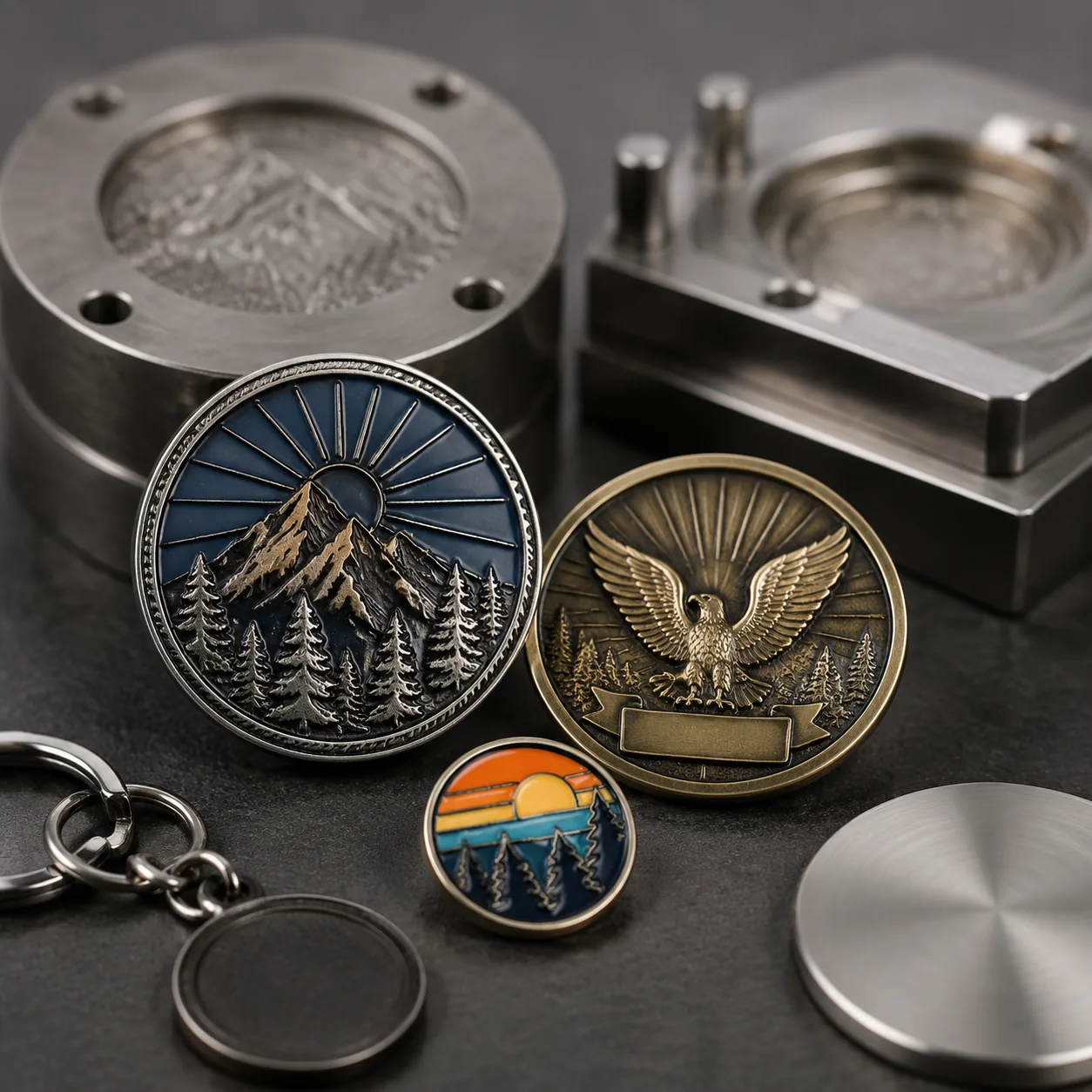
Tooling is the fixed cost required to make the exact shape, relief, logo, cavity, or assembly repeatable. It is not the same as a sample fee and it is not the same as the mass production unit price. ZheCraft separates tooling, sample, and unit cost on formal quotes because hiding a die charge inside the unit price makes reorders, quantity breaks, and supplier comparisons misleading.
Tooling is not automatically negative. A well-cut die stabilizes metal line width, reduces enamel overflow, improves edge definition, and makes reorders faster. For stamped enamel pins, a properly maintained die can hold the engraved tool detail close to ±0.05 mm, although the finished part should normally be specified at ±0.15 mm to ±0.25 mm because stamping pressure, polishing, plating, and enamel filling all add variation. The real risk is paying for the wrong tool, approving artwork before details are frozen, or comparing one supplier’s all-in price with another supplier’s tooling-excluded price.
What Counts as Tooling
For stamped soft enamel and hard enamel pins, the main tool is usually a steel die cut from approved vector artwork. A pin up to 30 mm commonly needs USD 45 to USD 90 in tooling. A 31 to 50 mm design often falls between USD 70 and USD 140. Oversized badges above 60 mm, deep relief, multiple pierced cutouts, or fine internal islands can push tooling to USD 160 to USD 300. If the pin needs a custom backstamp, add roughly USD 25 to USD 80 unless the supplier includes a simple shared backmark.
For challenge coins, tooling normally includes front and back dies. A 40 to 45 mm coin with 2D relief is commonly USD 120 to USD 260 for total tooling. A 50 mm coin with sculpted 3D relief can run USD 280 to USD 600 because the die needs more CNC passes and hand finishing. Rope edge, oblique edge, diamond-cut edge, sequential numbering, or recessed text on the edge may add USD 20 to USD 100 in setup or be priced into the unit cost. Ask clearly, because edge treatment is a frequent quote gap.
For metal keychains, tooling depends on construction. A flat die-struck keychain may use one die similar to a pin. A bottle opener, spinner, sliding part, rotating charm, trolley coin holder, or PVC-insert keychain may require multiple dies, an assembly jig, and a separate insert mold. Acrylic keychains are different: they usually use digital print and laser or CNC cutting, so setup may be USD 0 to USD 40, but the unit price increases with double-sided printing, epoxy dome, protective film, thicker acrylic, or stainless split-ring hardware.
| Product type | Common tooling items | Typical tooling range | Cost rises when |
|---|---|---|---|
| Soft enamel pin, 20-35 mm | Stamping die, trim outline, optional backstamp plate | USD 45-120 | Openwork, raised text below 0.8 mm, more than 4 enamel colors |
| Hard enamel pin, 20-35 mm | Stamping die, polishing allowance, color-fill setup | USD 60-150 | Flush polish areas, tight color separation, gold or black nickel finish |
| Challenge coin, 40-50 mm | Front die, back die, edge setup | USD 120-600 | 3D relief, antique finish, diamond edge, serial numbering |
| Metal keychain, 35-60 mm | Stamping or casting die, ring fixture, optional epoxy fixture | USD 60-240 | Moving parts, bottle opener geometry, thick zinc alloy body |
| Soft PVC magnet or charm | PVC mold, magnet or insert-position fixture | USD 80-350 | Layered 3D PVC, many color zones, large size |
| Woven or embroidered patch | Digitizing, border setup, optional laser-cut file | USD 20-90 | Metallic thread, irregular edge, hook-and-loop backing |
Tooling Versus Sample Fees
Buyers often combine tooling and sample charges in one mental bucket, but they pay for different work. Tooling covers the die, mold, or fixture. The sample fee covers short-run labor, machine setup, plating bath preparation, enamel mixing, polishing, assembly, inspection, and small-lot handling. For custom metal items, pre-production samples are usually 1 to 5 pieces, not a miniature production run.
For a custom enamel pin, a realistic pre-production sample charge is USD 40 to USD 90 plus tooling, with 7 to 10 days after final artwork approval. For a challenge coin, sample cost is commonly USD 80 to USD 180 plus tooling, with 10 to 15 days because polishing, plating, antique finishing, enamel curing, and edge work take longer. For a moving keychain or bottle opener keychain, sample cost can reach USD 120 to USD 250 if multiple components need separate finishing and assembly checks.
A fair quote should say whether the sample fee is refundable after mass production. Many factories credit sample labor at 500 or 1,000 pieces but do not refund tooling because the die has already been cut. Simple pins are more likely to qualify for a sample-credit policy. Complex coins, bottle openers, rotating keychains, and multi-part sets are often quoted case by case because setup time and scrap risk are higher. If a supplier claims the sample is free on a new 3D coin, check whether the charge has simply been loaded into the unit price.
MOQ Tiers and Real Unit Cost
Tooling is fixed, so its per-piece impact falls sharply as quantity increases. A USD 90 die on 100 pins adds USD 0.90 per piece. The same die on 1,000 pins adds USD 0.09. This is why low-volume metal giveaways can feel expensive even when the factory’s production price is competitive.
For budget planning, separate fixed and variable costs. Fixed costs include tooling, sample labor, artwork redraw, special packaging setup, and any custom fixture. Variable costs include base metal, enamel or print, plating, attachment, packaging, labor, in-line inspection, cartons, and inland delivery to the FOB port. For distributor quotes, show tooling as a separate line unless the client specifically asks for an amortized price.
The table below uses typical FOB China ranges for a 30 mm soft enamel pin made from iron or zinc alloy, with nickel or imitation gold plating at about 0.10 to 0.25 microns, one butterfly clutch, individual poly bag, and standard outgoing inspection. It is not a universal price list, but it shows the cost curve buyers should expect.
| Order quantity | Typical unit price FOB | Typical tooling | Tooling per piece | Budget read |
|---|---|---|---|---|
| 100 pcs | USD 0.95-1.80 | USD 60-100 | USD 0.60-1.00 | Suitable for VIP tests, costly for mass giveaways |
| 300 pcs | USD 0.62-1.15 | USD 60-100 | USD 0.20-0.33 | Common distributor trial tier |
| 500 pcs | USD 0.48-0.95 | USD 60-100 | USD 0.12-0.20 | Better balance for events and retail tests |
| 1,000 pcs | USD 0.36-0.78 | USD 60-100 | USD 0.06-0.10 | Typical point where tooling feels acceptable |
| 2,500 pcs | USD 0.29-0.62 | USD 60-120 | USD 0.02-0.05 | Good tier for repeat campaigns |
| 5,000 pcs | USD 0.24-0.55 | USD 60-120 | USD 0.01-0.02 | Unit price matters more than tooling |
Specifications That Change Tooling Cost
Size is the obvious driver, but geometry matters more than many buyers expect. A 25 mm round logo pin with one raised border is inexpensive to tool. A 25 mm pin with five cutouts, two floating islands, and 0.6 mm raised text can cost more because the die is fragile and polishing access is limited. For stamped pins, keep raised metal lines at 0.20 to 0.25 mm minimum and recessed enamel channels at 0.30 mm or wider. Text below 0.8 mm height may fill, blur, or require artwork simplification.
Relief depth also changes the die strategy. Standard 2D pin relief is usually about 0.3 to 0.5 mm between raised and recessed areas. Deep 3D coin relief may require multiple CNC passes and manual finishing, especially for faces, animals, buildings, vehicles, or mascots with smooth gradients instead of stepped levels. A coin that looks simple in a flat rendering may need expensive sculpting if the buyer expects realistic depth.
Finish choices can create hidden setup costs. Dual plating, such as nickel plus black nickel on the same item, may require masking or extra process control. Decorative pin plating is commonly specified around 0.10 to 0.25 microns. Heavy-use keychains are better specified around 0.25 to 0.50 microns, especially when the item rubs against keys, bags, or metal rings. Thicker plating improves wear resistance, but it does not correct a rough casting, poor polishing, or rounded detail from an overworked die.
- Confirm finished size in millimeters and define tolerance, such as ±0.20 mm for pins or ±0.30 mm for coins.
- Specify base metal family: iron for economical stamped pins, zinc alloy for thicker cast shapes, brass for premium coins.
- State plating finish, target thickness range, and whether nickel-free contact surfaces are required.
- List minimum line width, minimum text height, cutout width, enamel type, and Pantone references before tooling starts.
- Define attachment type, placement tolerance, and pull-force requirement because pin posts, magnets, and rings may need fixtures.
- Freeze backstamp, QR code, serial number, and legal marks before sample approval to avoid a second die.
When Hard Tooling Is the Wrong Choice
Hard tooling is not always the safest route. If the artwork is still being tested, the campaign quantity is below 100 pieces, or the client may change the logo within a month, a digitally printed acrylic keychain, printed lanyard, woven patch, paper insert badge, or printed magnet may reduce commercial risk. These products use print files, cutting paths, screens, or embroidery digitizing instead of a dedicated metal die.
For short-run campaigns, acrylic keychains can often be produced at 100 to 300 pieces with USD 0 to USD 40 setup and 7 to 12 days of production after proof approval. Sublimated lanyards work well at 100 to 500 pieces without metal tooling, although color control depends on polyester fabric, heat transfer, and the artwork profile. Printed fridge magnets are practical when flat graphics, low postage weight, and fast repeatability matter more than premium hand feel.
Do not choose a low-tooling method if the item must behave like a collectible. Printed acrylic scratches more easily than plated metal. Thin printed magnets do not carry the same perceived value as die-struck badges or antique coins. The economical choice is the one that matches the campaign life, handling conditions, brand position, and reorder probability, not simply the lowest setup charge.
Quote Terms to Lock Before PO
A tooling quote should answer ownership, storage, revision, and reorder questions before the purchase order is issued. Many factories retain dies for 2 to 3 years if there is reorder activity, but storage policies vary. If the program repeats annually, write the retention period, artwork revision, die reference, and reorder validity into the order file. If the tool is exclusive to your account, state that it cannot be used for any other buyer.
Define what happens if the sample fails. If the factory made the tool exactly to approved artwork but the buyer changes the logo, the second tool is normally chargeable. If the sample is outside the approved specification, such as 30.8 mm against a 30.0 mm ±0.20 mm tolerance, missing enamel, exposed base metal, sharp burrs, or unreadable backstamp, correction should be at the factory’s cost. This distinction prevents disputes after money and time have already been spent.
Tie approval to measurable quality terms. For general promotional metal items, many buyers use AQL 2.5 for major defects and AQL 4.0 for minor defects, with critical defects at 0 acceptance. Major defects should include wrong plating color, missing enamel, broken attachment, incorrect size beyond tolerance, unreadable logo, loose magnet, sharp edge, or visible corrosion. Minor defects may include small polishing marks, slight color shade variation within agreed Pantone tolerance, or tiny plating specks outside the main logo area.
- Ask whether tooling is separated, included, refundable, amortized, or waived only above a stated MOQ.
- Request die storage period, reorder reference, exclusivity, and the charge for future artwork revisions.
- Require pre-production sample approval before mass production, even if it adds 7 to 15 days.
- State who pays for retooling if the sample does not match the signed artwork and tolerance sheet.
- Keep approved vector files, sample photos, Pantone references, plating finish, packing method, and carton marks in one reorder file.
- Ask for price breaks at 300, 500, 1,000, 2,500, and 5,000 pieces so fixed tooling impact is visible.
RFQ Checklist for Reliable Budgets
Before requesting quotes, separate the item into fixed and variable cost lines. Send the factory the vector artwork, target size, thickness, base metal preference, plating finish, enamel or print type, attachment, packaging, quantity tiers, sample requirement, inspection standard, and delivery deadline. If you ask only for a unit price, you will not know whether the quote is low because tooling is missing, amortized, or under-specified.
For a first production run, select one target quantity and two comparison tiers. A practical RFQ might ask for 500, 1,000, and 2,500 pieces, FOB Ningbo or Shanghai, with tooling separated, sample lead time in days, mass production lead time in days, and AQL standard stated. For most pins and simple keychains, expect 7 to 10 days for samples and 12 to 25 days for mass production after approval. Complex coins, moving parts, dual plating, epoxy domes, or multi-item sets may need 20 to 35 days after sample sign-off.
If ZheCraft reviews a project, send the vector file and intended use case, not only a screenshot. Engineering can flag whether a cheaper die is safe, whether hard tooling should wait until the artwork is frozen, and where a small design change could save USD 50 to USD 300 before the die is cut. That review is most valuable before the purchase order because, once tooling starts, every artwork change becomes slower, more expensive, and easier to dispute.
Have a project? Send your artwork and target quantity and we’ll reply with a detailed quotation within 12 working hours.
Ready to get this made?
Send your sketch, target quantity and ship-date. Detailed quotation in 12 hours.



