Tariff-Resilient Spec Sheets for Custom Metal Products 2026
Why vague metal specs get more expensive when tariffs rise
Tariffs do not just raise landed cost. They magnify every unresolved assumption inside the RFQ. If a 35 x 30 mm soft enamel pin intended as a 1.5 mm stamped iron part is instead quoted and produced as a 2.0 mm die-cast zinc alloy part, the buyer pays three times: a higher FOB price, duty on that higher customs value, and usually higher freight because the part weighs more and packs less efficiently.
The same cost drift appears in less obvious changes: brass substituted for iron, a 3.0 mm coin delivered at 3.5 mm, upgraded backing cards added without approval, butterfly clutches replaced by magnetic fasteners, or production delays that force a partial air shipment. On a 5,000-piece order, a unit delta of USD 0.12 adds USD 600 to FOB before duty, brokerage, and inland freight. At a 25 percent duty rate, that becomes USD 750 before freight effects. If the revision also increases packed carton count by 15 to 20 percent, the total landed-cost gap widens further.
The answer is not a bloated specification. It is a controlled spec sheet that locks the variables responsible for most quote variance: manufacturing route, alloy, finished size, thickness tolerance, plating, color method, hardware, unit pack, carton density, inspection standard, and approval gates. Those are the lines where a small factory-side change turns into a real tariff problem.
1. Lock the manufacturing route before comparing prices
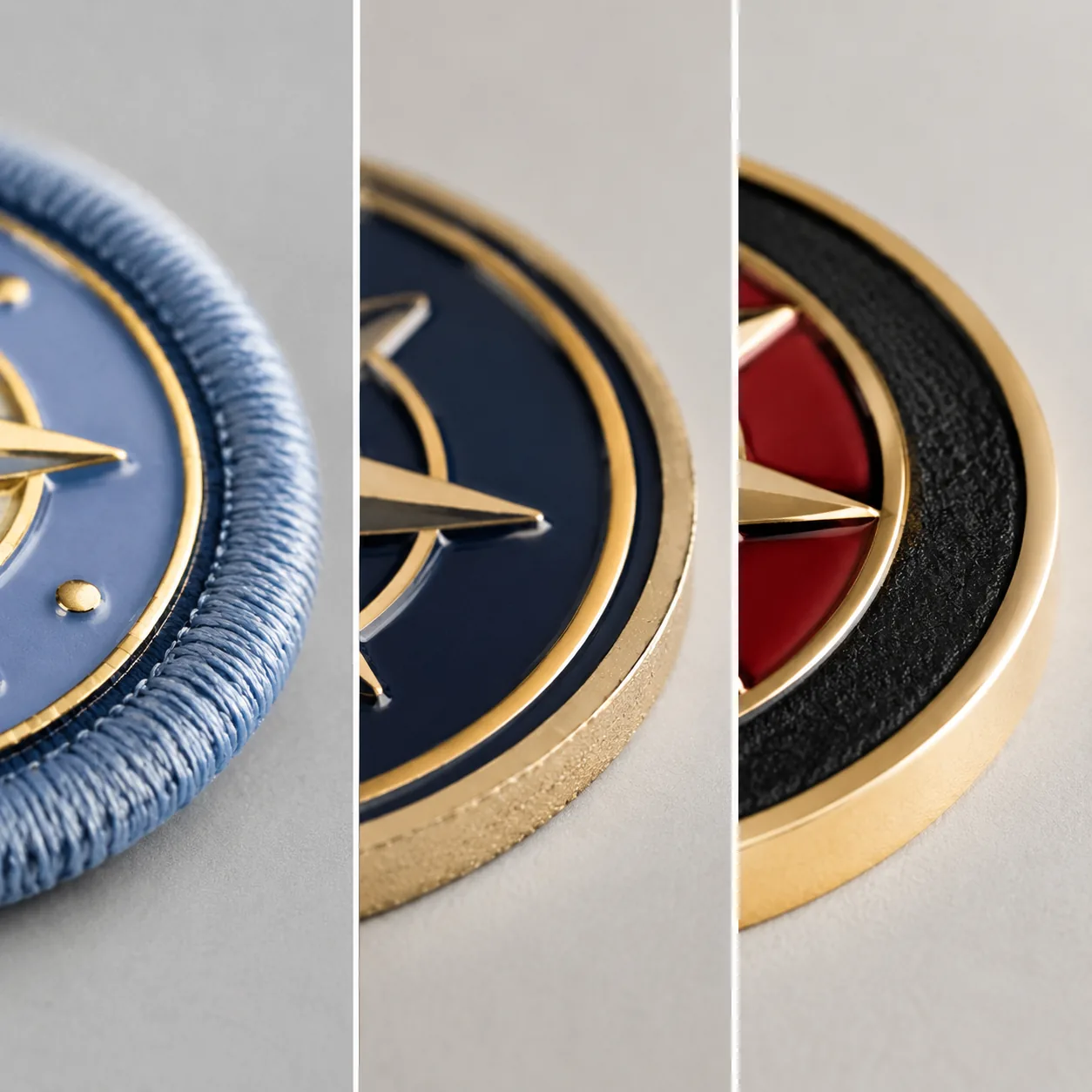
A quote for a custom pin, coin, magnet, or keychain is not comparable until the production route is fixed. The same artwork can be priced as stamped iron, stamped brass, die-struck brass, die-cast zinc alloy, photo-etched brass, or offset printed metal with epoxy. Those are materially different products with different tooling cost, detail limits, weight, reject risk, and freight profile.
For flat or lightly raised designs, stamped iron is usually the most tariff-resilient route because tooling is simple, unit weight is lower, and FOB pricing is relatively stable across normal MOQ bands. Brass is justified when the design needs finer lines, cleaner polished edges, or a premium hard-enamel finish. Zinc alloy is the right route for deep relief, rounded contours, cutouts, hollow backs, or sculpted 3D forms, but it usually increases mold cost, piece weight, and per-unit FOB by 20 to 60 percent versus a stamped equivalent.
A realistic benchmark: a 35 mm soft enamel pin at 500 pieces commonly prices at USD 0.32-0.58 FOB as stamped iron at 1.2-1.5 mm, with tooling around USD 45-90 and bulk lead time of 10-15 calendar days after approval. The same art in die-cast zinc alloy at 1.8-2.0 mm may quote at USD 0.52-0.88 FOB, with mold cost around USD 90-180 and production at 12-18 days. For a 45 mm challenge coin, a 2D die-struck brass coin at 3.0 mm may run USD 1.45-2.40 FOB at 300-500 pieces, while a 3D cast version often adds USD 0.70-1.30 per piece plus higher mold and polishing time.
State the approved route in plain language on the spec sheet: stamped iron soft enamel, die-struck brass imitation hard enamel, die-cast zinc alloy with antique nickel, photo-etched brass with screen print, or offset print with epoxy dome. If alternates are acceptable, list them in rank order and require separate line-item pricing. Do not allow route substitution inside a single bundled price.
| Product type | Preferred route for cost control | Typical thickness | Common MOQ tiers | Indicative FOB range |
|---|---|---|---|---|
| Soft enamel pin, 25-40 mm | Stamped iron | 1.2-1.5 mm | 100 / 300 / 500 / 1000 pcs | USD 0.25-0.60 |
| Hard enamel badge, 20-35 mm | Stamped brass or iron | 1.2-1.5 mm | 100 / 300 / 500 / 1000 pcs | USD 0.45-0.95 |
| Challenge coin, 40-50 mm | Die-struck brass or iron | 2.5-3.5 mm | 100 / 300 / 500 / 1000 pcs | USD 1.20-3.20 |
| 3D keychain charm, 40-60 mm | Die-cast zinc alloy | 2.0-4.0 mm | 100 / 300 / 500 / 1000 pcs | USD 0.80-1.80 |
| Metal-face fridge magnet | Stamped iron face plus ferrite or rubber magnet | 1.2-1.5 mm metal face | 100 / 300 / 500 / 1000 pcs | USD 0.60-1.50 |
2. Specify dimensions, alloy, tolerances, and target weight
Dimension lines should be written as inspection criteria, not design intent. State finished size in millimeters, define how it is measured, and assign tolerance. A strong line is: 35.0 x 28.0 mm overall at maximum width and height; thickness 1.50 mm excluding raised logo; tolerance +/-0.30 mm on length and width, +/-0.10 mm on base thickness. A weak line is: about 1.5 inches.
Alloy must also be fixed. Iron is usually the lowest-cost option for stamped pins and badges. Brass costs more but holds finer die detail, takes polishing better, and gives a cleaner finish on premium hard-enamel badges and coins. Zinc alloy should be reserved for cast geometry that stamping cannot reproduce economically. Leaving alloy open invites the supplier to solve a process problem by changing material without disclosing the tradeoff.
Weight control is one of the most effective anti-drift tools for coins, magnets, and large keychains. Add either a target or a ceiling: target 28 g, maximum 31 g per piece excluding unit pack. That forces discussion before thicker rims, larger loops, heavier chain, or oversized magnetic assemblies push both duty and freight upward. For coins above 45 mm, a 2 to 4 g weight drift is common if thickness and rim depth are not explicitly capped.
For magnets, specify the decorative metal face and the magnetic element separately. A 50 x 35 mm fridge magnet might use a 1.2 mm stamped iron face with a 0.8-1.0 mm rubber magnet sheet. A badge magnet may call for two N35 neodymium discs at 10 x 1.5 mm, fixed with foam adhesive plus mechanical pocketing or a bonded backing plate. Those constructions are not interchangeable in cost or holding force. If pull performance matters, add a use test such as no sliding for 30 minutes on a vertical painted steel panel with total assembled weight under 25 g.
For reorders, keep die line, thickness, and attachment location unchanged unless there is a clear commercial reason to revise them. Recutting tooling to gain 1 to 2 mm of visual space rarely pays back once new tooling charges, 5 to 10 additional sample days, and approval risk are included.
3. Make finish and color measurable
Decorative finish should be specified so the factory and inspector can verify it. Name the plating type, visual appearance, coating requirement, and intended use environment. On promotional metal goods, decorative electroplating thickness for bright nickel, black nickel, imitation gold, antique bronze, or antique copper is commonly around 0.03-0.08 micron. That is usually adequate for indoor promotional use, event distribution, and short-lifecycle campaigns. It is not equivalent to engineering-grade corrosion-resistant plating.
If the item will be handled repeatedly, stored in humid conditions, or sold at retail, add a protective topcoat requirement. A practical commercial line is: clear lacquer on exposed plated surfaces; no visible blistering, peeling, or red rust after 24-48 hours neutral salt spray. For premium keychains, long-retention coins, or e-commerce items expected to stay presentable for months, 48-72 hours is more defensible, but it narrows the supplier pool and can add USD 0.03-0.10 per piece depending on process.
Color method must be explicit. State whether the build is soft enamel, imitation hard enamel, cloisonne-style hard enamel, screen print, or offset print with epoxy dome. Include Pantone references and face-profile expectations. Example: soft enamel recessed 0.05-0.12 mm below metal lines, Pantone 186 C and Black C, no epoxy. Or: imitation hard enamel, polished flat face, color flush to metal within +/-0.03 mm visual step. Without that language, suppliers can flatten metal lines, add epoxy, or switch print method to protect margin.
Minimum manufacturable detail also belongs on the spec. For stamped metal, 0.20-0.25 mm minimum raised line width and 0.20 mm minimum recessed gap are reasonable commercial floors. For die-cast zinc, 0.25-0.30 mm is safer on front-face detail because polishing rounds edges. For printed inserts, require vector line art, 300 dpi minimum at final size for raster elements, and 2 mm bleed. Otherwise small text, thin borders, or fine logos may be enlarged, simplified, or merged without notice.
4. Treat hardware as a controlled BOM item
Hardware is not a minor accessory. It affects FOB, reject rate, perceived quality, and carton density. A basic butterfly clutch on a small pin may add only a few cents, while a deluxe locking clutch, magnetic backing, swivel claw, lobster clasp, or heavy split-ring assembly can materially change the cost. Typical upgrades run about USD 0.03-0.06 for deluxe pin clutches, USD 0.08-0.18 for magnetic badge fasteners, and USD 0.15-0.35 for heavier keychain hardware depending on finish, dimensions, and volume.
Write hardware by type, dimension, finish, and assembly method. Example: one 8 mm butterfly clutch, nickel plated, one post centered horizontally, post center 9.0 mm from top edge. Or: one 30 mm split ring plus 25 mm curb chain, 1.8 mm wire diameter, bright nickel, jump ring closed after assembly. That level of detail stops a supplier from substituting thinner wire, lighter chain, or mismatched finish hardware to hold margin.
For magnets, specify material, dimensions, grade where relevant, and placement. Ferrite is lower cost and suitable for standard fridge magnets. Neodymium is stronger and more compact, but more expensive and more sensitive in handling and packing. A request for magnetic backing without further detail can result in several different constructions with different cost, safety, and performance outcomes.
This is also where over-specification wastes money. A cast keychain with two jump rings and a swivel claw may look more premium in a sample photo, but for event distribution a simpler split-ring assembly often reduces both failure points and weight. Likewise, magnetic badge fasteners present cleanly but may underperform on heavy jackets or thick knitwear. Hardware should be specified for the use case, not copied from the last project.
5. Write packaging as a freight specification, not an afterthought
Packaging affects landed cost through material, labor, master-carton count, and cubic volume. A pin in an OPP bag or on a 300 gsm backing card packs far more efficiently than the same pin in a foam-lined acrylic box. The box may add only USD 0.20-0.60 in unit packaging cost, but it can also double or triple carton volume, reduce pieces per carton, increase inspection time, and raise damage exposure. Under tariff pressure, that packaging choice can erase the savings from aggressive FOB negotiation.
Separate unit pack from export pack. A usable line is: each pin on 300 gsm backing card in OPP bag; 100 pcs per inner polybag; 500 pcs per export carton; export carton maximum 45 x 30 x 25 cm; gross weight not over 12 kg. For heavier keychains and coins, a 15 kg master-carton cap is a sensible ceiling for manual handling and warehouse safety. If the order is shipped DDP or through a fulfillment partner, carton dimension control matters as much as unit packaging cost.
For mixed SKUs, state whether assortment is allowed by inner bag or only by master carton. If not defined, suppliers often create mixed-count masters that complicate receiving and increase counting errors. Also call out labor-sensitive requirements that routinely distort quote comparisons: barcode label format and placement, suffocation warning text, country-of-origin mark, carton shipping marks, insert collation sequence, and retail-ready assembly. These are cost lines, even when they look administrative.
For event giveaways, the most tariff-resilient pack is usually individual polybag or card plus OPP, then bulk export carton. For resale or commemorative gifting, rigid presentation boxes may still be justified, but request packed quantity per carton, estimated CBM, and gross weight before approval. A lower FOB item can still land more expensively if the packaging destroys carton efficiency.
6. Use approval gates, tolerances, and AQL to stop cost leakage
A spec sheet that controls construction but ignores approvals still leaks money. At minimum, define artwork approval, pre-production sample approval, and mass-production approval. Then state what can no longer change after each gate. Tooling edits after die approval often cost around USD 30-80 for a simple stamped pin die, USD 80-150 for a larger stamp tool, and USD 120-300 or more for cast mold revision depending on cavity count and relief depth. The bigger cost is usually schedule slip, especially for event-driven orders.
Sample criteria should be inspectable. Useful lines include: Pantone match under D50 or neutral daylight; logo text legible at final size; attachment centered within +/-0.50 mm; no sharp edges or burrs; no visible plating pits at 30 cm; enamel fill even with no exposed base metal in color-fill areas; count, carton marks, and packing list consistent. Those standards are objective enough to survive handoff between sourcing, QC, and the supplier.
For production acceptance, define the sampling plan. A practical default is ANSI/ASQ Z1.4, General Inspection Level II, AQL 2.5 for major defects and AQL 4.0 for minor defects. For retail-facing or brand-sensitive items, exposed base metal on the front face, incorrect Pantone family, wrong plating, missing hardware, detached magnet, or unreadable text should be classified as major defects. If the order includes individualized names, variable data, or serial numbers, specify whether 100 percent verification is required for those fields rather than relying on normal sampling.
- State whether photo approval is sufficient or whether a physical pre-production sample is mandatory
- Name the buyer approver for artwork, sample, carton marks, and shipping release
- Ban substitutions of alloy, plating, magnet grade, adhesive type, or hardware without written approval
- Require final packed carton count, dimensions, net weight, and gross weight before balance payment
- Retain one golden sample, approved artwork file, and final packing photo set for reorders
7. Build landed-cost inputs into the quote template
Most quote forms still collect only tooling and FOB, which is not enough when tariffs, freight, and handling costs are unstable. A usable template should require tooling charge, unit FOB by MOQ tier, sample fee, standard lead time in calendar days, rush surcharge, packed carton details, and all adders for backing cards, barcodes, boxes, upgraded hardware, magnet upgrades, and split shipments. Procurement needs that structure to compare like for like.
Useful MOQ tiers for custom metal products are typically 100, 300, 500, 1000, and 3000 pieces. For standard projects, tooling lead time is often 3-7 days, pre-production sample 5-10 days, and bulk production 10-18 days after sample approval. More complex items such as spinner keychains, boxed coin sets, multi-part assemblies, or individualized-name programs often require 18-25 production days. If plating is outsourced or packaging is retail-intensive, add buffer instead of assuming the shortest quoted lead time will hold.
The most useful quote comparison in a tariff-sensitive market is two or three controlled constructions priced side by side. Example: stamped iron versus die-cast zinc alloy; polybag versus backing card plus OPP; butterfly clutch versus magnetic backing. The tradeoff becomes visible before the PO is issued. If a supplier submits a lower price but changes thickness, hardware, magnet grade, or packaging density, it is not a cheaper quote for the same SKU. It is a different build with different landed-cost risk.
Start with a repeatable SKU, not the most experimental design in the pipeline. Freeze route, dimensions, alloy, finish, hardware, packaging, and inspection language first. Compare prices second. That sequence will not remove tariffs, but it will keep the spec sheet from quietly making them worse.
Have a project? Send your artwork and target quantity and we’ll reply with a detailed quotation within 12 working hours.
Ready to get this made?
Send your sketch, target quantity and ship-date. Detailed quotation in 12 hours.



