Sweat and Humidity Testing for Custom Metal Giveaways
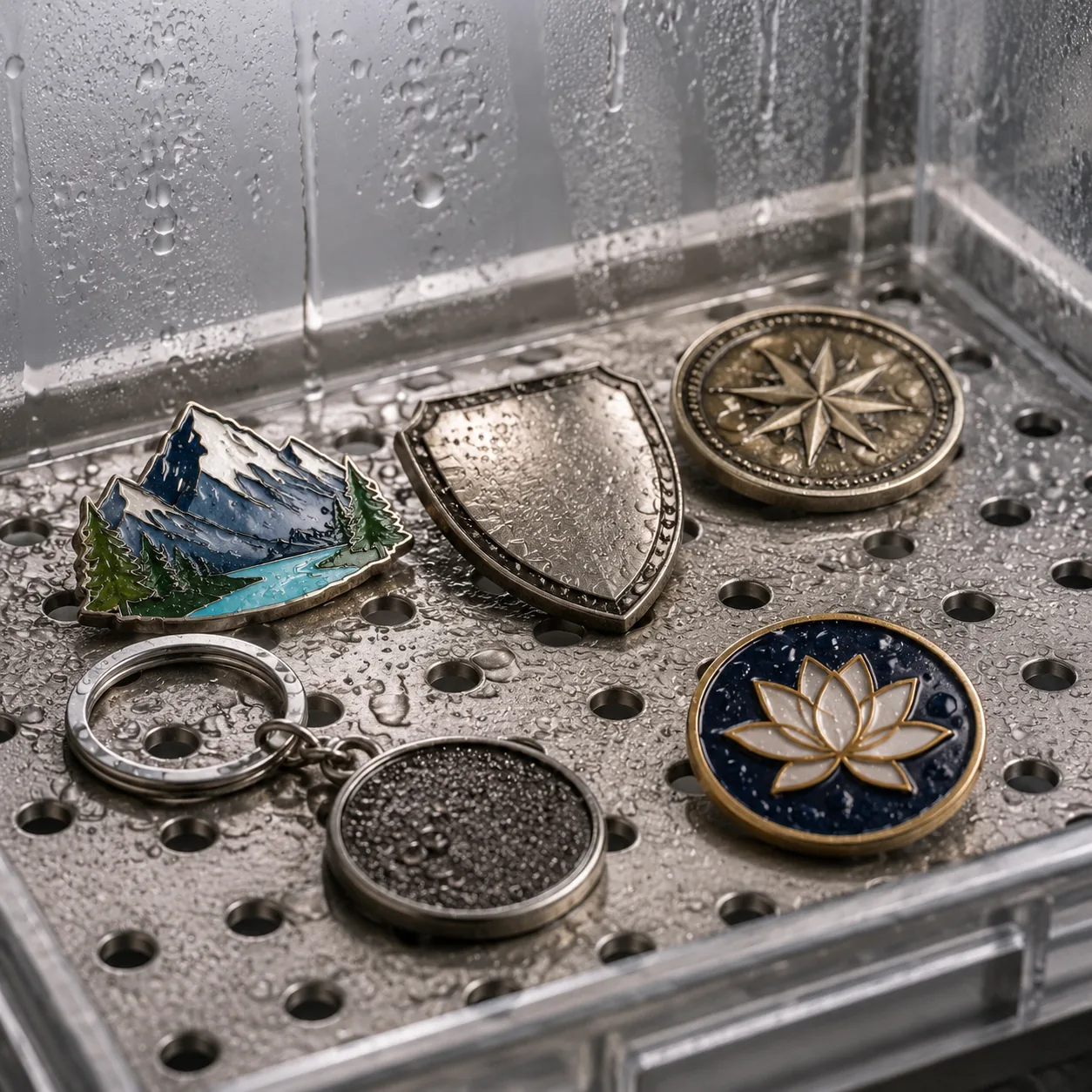
Why Good Samples Still Tarnish After Delivery
A polished gold enamel pin can look perfect at sample approval and still generate complaints after the first trade show if the clutch turns green, the split ring rusts, or antique recesses stain the backing card. In many cases the factory did not ignore quality; the RFQ only asked for a visual sample, so the quote was based on standard indoor promotional plating rather than a sweat- and humidity-resistant finish system.
Hand-contact metal giveaways have a different risk profile from display-only items. Pins, brooches, challenge coins, keychains, zipper pulls, lanyard hooks and magnet badges are exposed to salts from skin, moisture in warehouses, abrasion in pockets and residues from packaging. A bright plated sample proves color, shape and logo accuracy, but it does not prove that pin posts, clutches, rings, solder joints or recessed antique areas will survive 24 to 72 hours of warm, humid exposure.
The risk increases with flash plating, exposed steel accessories, dark antique finishes, glued magnets, epoxy domes, bulk polybag packing and shipping routes through coastal or tropical regions. Buyers should define the expected use environment before confirming price because corrosion resistance changes the base metal, plating thickness, accessory grade, drying time, packing method and inspection criteria.
Match the Test Level to the Product Risk
Not every giveaway needs the same corrosion specification. A one-day indoor conference pin, individually packed and distributed immediately, can often use standard iron stamping or zinc alloy with decorative plating. A daily-carry keychain, police challenge coin, school pin handled by children, gym merchandise item or brooch worn against clothing in summer needs a stronger specification because it faces sweat, friction and longer storage.
Sweat exposure is not the same as general humidity. Synthetic sweat contains chloride salts and weak acids that attack plating pores, scratches and poorly sealed edges. Humidity first attacks packaging, steel split rings, pin posts, spring clips, magnet cups and unsealed backs, especially when cartons sit in a hot warehouse or container for 20 to 40 days. Salt spray is harsher again and is best reserved for steel hardware, outdoor-use parts or buyer programs with known corrosion complaints.
| Product type | Common weak point | Practical minimum test |
|---|---|---|
| Soft enamel pin | Pin post, clutch, plating pores near raised metal | 24 h synthetic sweat plus 48 h humidity |
| Hard enamel pin | Polished raised metal, back clutch, edge plating | 24 h synthetic sweat plus tape adhesion check after drying |
| Keychain | Split ring, jump ring, swivel joint, chain link | 48 h humidity plus 24 h neutral salt spray on steel hardware |
| Challenge coin | Antique recesses, rim plating, polishing residues | 72 h humidity, no green corrosion in recessed metal |
| Brooch | Safety clasp, solder joint, fabric-contact back | 24 h sweat, 48 h humidity, clasp operation check |
| Magnet badge | Back plating, magnet cup, adhesive layer | 48 h humidity, no rust staining or magnet movement |
Test the surfaces that users touch and the components most likely to fail, not only the front logo. For pins, include the post, clutch and back face. For keychains, expose the assembled ring system with the charm. For coins, inspect rims, edges and antique recesses because finishing chemistry and polishing residues collect there.
Base Metal, Plating and Coating Choices
Base metal sets the starting risk. Iron is economical for stamped pins and badges, but any pore through the plating can expose rust-prone steel. Zinc alloy is common for die-cast 2D and 3D shapes and does not produce red rust like iron, but surface porosity can cause blistering if polishing and plating are rushed. Brass is more stable for premium coins, brooches and thin detailed pieces, although the raw material and freight cost are higher. Stainless steel is useful for rings and clips, but it may not color-match plated charms exactly.
Decorative promotional plating is measured in microns, not the heavy thickness used for industrial fasteners. Standard indoor flash gold, silver, nickel or black nickel may have a decorative top layer around 0.03 to 0.05 micron. For high-touch orders, specify 0.08 to 0.15 micron top plating where the process supports it, with sound copper or nickel underlayers and clean surface preparation. For nickel-sensitive markets, confirm whether nickel-free plating or a clear barrier coating is required before quoting.
Thicker top plating alone will not rescue a poor substrate. Pits in die-cast zinc alloy, unneutralized antique blackening solution, trapped polishing compound and sharp burrs can start corrosion below the visible finish. For keychains, challenge coins and premium badges, clear electrophoretic coating, baked lacquer or epoxy sealing can improve barrier protection. These coatings usually add 1 to 3 production days and may slightly change gloss, hand feel and antique contrast.
| Specification choice | Typical FOB impact at 1,000 pcs | Best use case |
|---|---|---|
| Standard decorative plating, 0.03–0.05 micron top color | Baseline; 25–35 mm pins often $0.35–$0.95 FOB | Indoor events, short distribution cycle |
| Upgraded decorative plating, 0.08–0.15 micron | Add $0.03–$0.12 per small pin or charm | Frequent handling, retail packaging, school or staff items |
| Clear e-coating or lacquer | Add $0.04–$0.18 per piece | Coins, keychains, antique finishes, humid routes |
| Brass instead of iron for small badges | Add $0.08–$0.30 per piece | Premium brooches, thin details, lower rust risk |
| Stainless split rings or clips | Add $0.02–$0.08 per keychain | Daily-carry keychains and coastal shipments |
Practical Test Methods for RFQs and POs
A useful RFQ does not need a 20-page laboratory protocol, but it must state the exposure, duration, sample quantity, evaluation timing and pass criteria. For most custom metal giveaways, three tests cover the main failure modes: synthetic sweat exposure for skin contact, constant humidity for warehouse and packaging risk, and neutral salt spray for steel rings, clips and chains.
For synthetic sweat, a buyer-friendly specification is 24 hours at 37 °C using artificial sweat solution at pH 4.7 to 5.5, followed by deionized-water rinse, 2 hours of drying at room temperature and inspection under 500 to 800 lux lighting. Include finished goods with real hardware attached. Do not test only plated blanks unless the order is still at material qualification stage.
For humidity, specify 40 °C ± 2 °C and 90% to 95% relative humidity for 48 hours for normal promotional goods. Use 72 hours for coastal destinations, sports merchandise, long warehouse storage or items packed with paper cards. For neutral salt spray, 24 hours is a practical promotional-grade requirement for steel accessories; 48 hours should be reserved for upgraded hardware or higher-value programs because it may require better alloy selection, passivation or coating.
- State exact exposure conditions: 24 h sweat, 48 h humidity and 24 h salt spray measure different risks.
- Test finished assemblies with clutches, rings, chains, magnets and cards when those parts ship together.
- Keep at least 5 tested samples and 5 untested controls from the same lot for comparison.
- Inspect immediately after drying and again after 24 h because stains can appear later in recesses.
- Photograph A surfaces, B surfaces and hardware before and after testing under consistent lighting.
- Record packing condition: individual OPP bag, backing card, bulk bag, desiccant or inner box.
Acceptance Criteria That Prevent Disputes
“Must pass corrosion test” is too vague. A supplier may accept slight discoloration on a back surface while a brand manager may reject the same mark as a visible defect. Define acceptable limits by surface class, defect size and function. The front logo face should have the strictest cosmetic limits. Hidden backs can allow minor staining only if it does not transfer to hands, fabric, cards or neighboring pieces. Functional hardware should have almost no tolerance for rust, sticking or looseness.
For final inspection, corrosion on the visible logo face, plating blisters and obvious color breakdown are normally major defects, often inspected at AQL 1.5 or 2.5 depending on brand risk. Sharp rust, detached magnets, broken clasps, split rings that open under normal pull and parts that stain skin or fabric should be treated as critical defects, commonly AQL 0.65 or zero acceptance for small high-risk orders. Minor pinhole staining on a hidden back may be classified as minor if the limit is measurable.
Use numeric wording wherever possible: no visible red rust on steel hardware after 24 h neutral salt spray; no green corrosion on A-surface plated metal after 24 h synthetic sweat; no blister larger than 0.5 mm; no more than two pinhole stains under 0.3 mm on a hidden back face; clutch retention and clasp operation unchanged after testing. These limits are realistic for well-made promotional products and easier to enforce than “premium finish” or “good quality.”
| Defect after exposure | Suggested classification | Practical acceptance limit |
|---|---|---|
| Green corrosion on front logo metal | Major | Not allowed on A surface |
| Red rust on split ring, chain or clasp | Critical or major | Not allowed if it can stain hands, fabric or packaging |
| Back-face pinhole stain under 0.3 mm | Minor | Allowed only within agreed minor AQL |
| Plating blister over 0.5 mm | Major | Not allowed on A or visible B surfaces |
| Clutch, clasp or swivel sticks after test | Major | Not allowed if normal operation is affected |
| Magnet shifts or adhesive softens | Critical | Not allowed for magnet badges or fridge magnets |
MOQ, Price and Lead-Time Impact
Corrosion control affects timing more than most buyers expect, but the price increase is usually manageable when specified before sampling. For custom enamel pins, small brooches and keychains, practical production MOQs often start at 100 pcs for sampling or small runs and 300 to 500 pcs for efficient mass production, depending on size, mold complexity and decoration. Challenge coins and heavier die-cast pieces are often economical from 100 to 300 pcs. Custom stainless accessories, special clutches or plated hardware may require 500 to 1,000 pcs if the factory must purchase nonstandard components.
An in-house sweat or humidity check can usually be built into pre-production sampling with 1 to 2 added days. Third-party laboratory testing generally adds 4 to 8 working days, including sample dispatch, queue time and report issue. If a test fails and the buyer changes base metal, plating thickness, hardware grade or clear coating, allow 3 to 7 days for re-sampling because the full finishing process must be repeated on real parts.
For a 25 to 35 mm soft enamel pin at 1,000 pcs, standard FOB pricing may be about $0.35 to $0.95 per piece depending on size, colors, plating, mold and attachment. Upgraded corrosion resistance may add $0.03 to $0.15 per piece for thicker plating, sealed backs, better clutches or individual packing. For metal keychains, upgraded rings, swivels or stainless components may add $0.04 to $0.20 per piece. This is usually cheaper than sorting, replacing or discounting a batch after rust complaints.
Packaging and Storage Are Part of the Spec
Good plating can still fail if finished goods are packed wet, handled with bare hands after final cleaning, or sealed in damp cartons. Individual OPP bags reduce abrasion and prevent sweat transfer between pieces, but sealed bags can trap moisture if parts are bagged before epoxy, lacquer or e-coating has cured. In humid production seasons, buyers should allow drying time after finishing rather than forcing same-day packing for urgent shipments.
For pins, coins and keychains, specify dry parts before packing, no visible polishing residue in recesses, clean backs and cartons stored away from floors, exterior walls and open loading doors. Silica gel helps during ocean freight, but it cannot compensate for wet goods. A practical high-risk packing instruction is 1 g to 2 g desiccant per inner bag or small carton compartment, individual OPP bags for plated items, and export cartons kept around 15 kg to 18 kg to reduce compression damage.
Avoid mixing loose steel accessories with plated logo pieces in the same bulk bag. Split rings, chains and clips should be pre-attached after cleaning or packed in dry inner bags. If backing cards are used, specify dry 250 to 350 gsm card stock and confirm that printing ink or lamination will not rub onto plated backs. Damp acidic paper can create stains during storage even when the metal finish itself is acceptable.
Use a Clear RFQ Template Instead of Over-Specifying
Over-specification wastes money when the use case does not justify it. A low-cost one-day indoor event pin does not need 48 h salt spray on every component if it is individually packed, distributed immediately and not intended for daily wear. Long salt-spray requirements can push the supplier toward thicker plating, stainless accessories and longer testing schedules without improving the campaign outcome.
Salt spray should not be used as a universal predictor of real life. It is useful for comparing steel hardware and coating systems, but it does not reproduce perfume, sunscreen, laundry chemicals, pocket abrasion or repeated bending of clutches and rings. For brooches and lapel pins worn on fabric, synthetic sweat plus humidity is usually more relevant than an aggressive salt-spray requirement.
For antique brass, antique copper, black nickel and intentionally aged finishes, define appearance tolerance before testing. Darkening agents sit in recessed areas, so some shade variation after humidity can be normal. If the design depends on a distressed effect, approve a control sample and specify measurable limits, such as ΔE 2 to 4 for main enamel colors while allowing controlled variation in antique recesses.
A practical RFQ line for high-touch metal giveaways is: finished goods with hardware attached to pass 24 h synthetic sweat at 37 °C, 48 h humidity at 40 °C and 90% to 95% RH, no visible corrosion on A surfaces, no red rust on hardware, no blister over 0.5 mm, no functional failure, inspection to AQL 2.5 major and AQL 4.0 minor unless otherwise agreed. Add destination climate, packing method, target FOB range and expected use so the factory can choose the right finish instead of guessing between promotional grade and handling grade.
Have a project? Send your artwork and target quantity and we’ll reply with a detailed quotation within 12 working hours.
Ready to get this made?
Send your sketch, target quantity and ship-date. Detailed quotation in 12 hours.



