Sustainable Promo Material Swaps Without Production Surprises
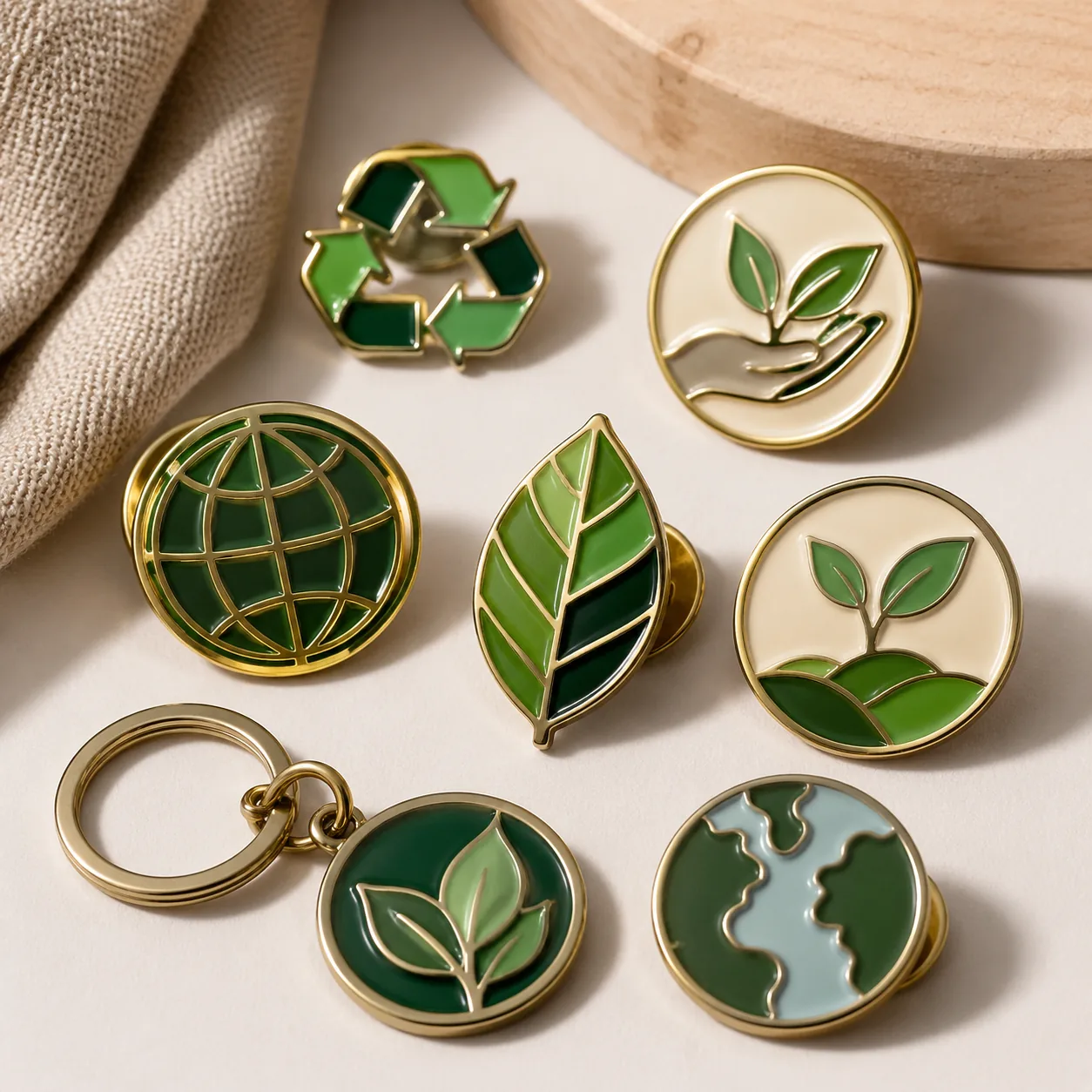
Freeze the Base Spec Before You Change Materials
A brand team needs 5,000 conference kits in eight weeks: one 30 mm hard enamel pin, one 50 mm metal keychain, one 70 mm woven patch and one 20 mm lanyard. The brief asks for lower-impact materials, less plastic packaging, no visible downgrade and no major cost increase. If procurement sends only that instruction to factories, the quotes will not be comparable. One supplier may quote stamped iron pins with recycled paper cards, another may quote recycled zinc alloy castings, and a third may offer rPET lanyards without dye-transfer data or batch documentation.
The sustainability request is not the problem. The risk is changing alloy, finish, textile, packaging and marketing claim at the same time while leaving performance undefined. A recycled alloy badge with rounded logo edges, a kraft card that scratches black nickel, or a navy rPET lanyard that transfers dye onto white shirts can create more scrap than the original construction.
Treat a 5,000 to 20,000 set order as a controlled substitution. Freeze artwork, outside dimensions, Pantone references, attachment function, packaging format, carton limit, inspection level and delivery date before asking for lower-impact alternatives. Then require suppliers to quote standard construction beside the proposed substitute. That comparison exposes the real trade-offs: MOQ, tooling, sample cost, reject allowance, production days, documentation and FOB price.
Days 1-3: Separate Plastic Reduction From Functional Risk
The first decision is where the material change delivers visible value with the least quality risk. In a mixed promo set, lanyards and packaging usually offer the clearest virgin-plastic reduction. Pins and keychains carry higher cosmetic and mechanical risk because metal choice affects stamping detail, casting shrinkage, plating adhesion, enamel fill, edge strength and hardware fit.
A practical baseline is to keep the 30 mm pin geometry stable, use a 50 mm keychain body at 2.5 to 3.0 mm thickness, move the 20 mm lanyard webbing to rPET, and replace individual OPP bags only where scratch risk is controlled. FSC-certified or recycled paper backing cards are useful when the buyer needs a visible, documentable packaging change, but the paper surface must be tested against the actual plating finish.
Do not use “eco,” “green” or “plastic-free” as an engineering spec. Use RFQ language a factory can price: “Quote standard material and lower-impact material side by side. Keep dimensions, attachment function, Pantone colors, carton drop target and AQL level unchanged. State MOQ, sample cost, tooling, production days, documentation, expected reject rate and FOB price.” This removes most quote ambiguity before sampling starts.
Days 4-7: Match Each Swap to the Component Role
For hard enamel pins, stamped iron or brass normally gives sharper metal lines than cast zinc alloy on small logos. Recycled zinc alloy can work for cast badges, medals and keychains, but it suits thicker 2D or shallow 3D relief better than tiny cloisonne-style detail. If metal dividers are below 0.30 mm, text strokes are below 0.80 mm, or enamel cavities are narrow, forcing a cast recycled alloy can raise cosmetic rejects by several points.
For keychains, recycled zinc alloy is practical when the shape has rounded edges, a 2.5 to 3.0 mm body thickness and no long unsupported arms below 2.0 mm. Stainless steel is durable and avoids decorative plating on the base surface, but it changes the process, edge feel, decoration method and price. For a bottle opener or flat hotel-style tag, 201 or 304 stainless may be a better long-life choice than decorative zinc casting. For detailed colored logos, zinc alloy with soft enamel remains easier to decorate.
For woven patches, recycled polyester yarn is workable for event badges, apparel trims and sponsor patches, but neon shades may lose brightness. Keep woven text at 1.2 mm minimum height and embroidered text at 2.0 mm minimum. For lanyards, rPET is usually the lowest-risk swap because the construction remains familiar: 15, 20 or 25 mm width, 0.9 to 1.2 mm webbing thickness, safety breakaway, detachable buckle and metal hook options.
| Component | Lower-impact option | Best use case | Avoid when | Typical MOQ | FOB price effect |
|---|---|---|---|---|---|
| Hard enamel pin | Stamped iron or brass with FSC or recycled paper card | 20-40 mm logos with clean metal lines and limited fine text | Outdoor use without defined plating, lacquer and salt-spray requirements | 300-500 pcs | USD 0.45-0.95; -5% to +5% versus common zinc options |
| Cast badge or medal | Recycled zinc alloy if batch segregation is available | 35-60 mm badges with simple 2D or shallow 3D relief | Text under 0.8 mm or very sharp cloisonne-style detail | 1,000 pcs | USD 0.65-1.60; +5% to +15% if segregated material is required |
| Metal keychain | Recycled zinc alloy or 201/304 stainless steel | 50-70 mm tags, bottle openers and compact logo shapes | Thin arms under 2.0 mm or large mirror-polished faces | 500-1,000 pcs | USD 0.70-1.80; +5% to +18% |
| Woven patch | Recycled polyester yarn with recycled or FSC paper backing | 70 mm event patches, sleeve labels and apparel trims | Neon colors or text below 1.2 mm woven height | 500 pcs | USD 0.35-0.90; +8% to +20% |
| Lanyard | rPET webbing with sublimation or screen print | 20 mm conference lanyards with repeat logos | Lowest-price giveaways where documentation is not valued | 500-1,000 pcs | USD 0.45-1.15; +10% to +25% |
| Packaging | Glassine sleeve, FSC card, recycled paper envelope or paper box | Conference handout sets and sponsor kits | High-polish plating touching rough paper in humid transit | 500 pcs | USD 0.03-0.55 per unit depending on structure |
Days 8-14: Lock Tolerances, Plating and Textile Tests
The original sizes can stay: 30 mm pin, 50 mm keychain, 70 mm patch and 20 mm lanyard. The material swap changes the tolerance discussion. For stamped metal pins, use outside dimension tolerance of +/-0.2 mm; for cast zinc alloy, +/-0.3 mm is more realistic. Pin body thickness tolerance should be +/-0.15 mm on a 1.5 to 2.0 mm body. For a 3.0 mm keychain body, use +/-0.2 mm thickness tolerance and specify deburred edges before plating.
Decorative plating must still be specified. Nickel, gold, black nickel and antique brass top layers are often thin, commonly 0.03 to 0.08 microns over copper, nickel or other base layers. Rub resistance depends on the full plating stack and lacquer, not the top color alone. For keychains carried with keys, require 200 dry rub cycles with no base metal exposure on the main logo face. For skin-contact items, specify nickel-release compliance separately; recycled content does not make a plated item nickel-safe.
For the lanyard, lock width, finished loop length, hook type, breakaway type, print method and logo size. A common event spec is 20 mm width, 900 mm finished loop length, one safety breakaway, one metal lobster hook, optional detachable buckle, double-sided sublimation print and 10 mm minimum logo height. Use width tolerance of +/-1.0 mm and length tolerance of +/-10 mm. Require dry and wet crocking checks before packing, especially for dark webbing worn against white shirts.
Days 15-22: Sample the Complete Packed Set
Sustainable substitutions often fail where materials touch. A recycled kraft card can scratch black nickel if the pin rotates during freight. A paper belly band can absorb moisture and warp around a patch. A glassine sleeve reduces plastic, but it will not protect a polished keychain as well as OPP unless the product has a smooth insert, tissue divider or fixed backing card.
The pre-production sample should include the final card, sleeve, lanyard hook, patch border, plating finish, carton divider and kit-packing method. Sampling only the metal item and approving packaging later is a poor shortcut because packaging can change scuffing, carton volume, moisture exposure and inspection criteria. For a mixed promo set, sample charges are commonly USD 80 to 250 depending on molds, plating, print plates and paper structure. Sample lead time is usually 10 to 14 days after artwork approval for common materials, or 15 to 22 days when certified paper stock, custom rPET webbing or segregated recycled alloy must be sourced.
- Approve one complete assembled set, including the final sleeve, card, envelope or paper box.
- Measure pin and keychain thickness after plating, not from raw blanks.
- Check lanyard print registration and edge quality on at least 10 pieces from the same print setup.
- Rub the plated keychain against the proposed paper sleeve for 30 hand cycles before approval.
- Confirm whether items are packed individually, as one kit, or bulk packed with dividers.
- Keep one signed golden sample and one sealed packaging sample for mass-production reference.
- Record acceptable color under D65 lighting and specify Pantone Coated or Uncoated matching.
- Confirm which claims can be supported for the exact batch, not only for the supplier’s general catalog material.
Days 23-45: Price MOQ, Rejects and Lead Time Together
A conventional quote may look cheaper because it assumes standard material flow, known packaging and familiar reject rates. A lower-impact version can still be commercially sensible, but procurement should compare the full landed risk, not only unit FOB. For 5,000 conference sets, typical FOB ranges are USD 0.45 to 0.95 for a 30 mm enamel pin, USD 0.70 to 1.80 for a 50 mm metal keychain, USD 0.35 to 0.90 for a 70 mm woven patch and USD 0.45 to 1.15 for a 20 mm rPET lanyard.
Packaging can move the total more than expected. A basic OPP bag may cost USD 0.01 to 0.03, a glassine sleeve USD 0.03 to 0.08, a recycled paper card USD 0.04 to 0.12, a paper envelope USD 0.08 to 0.20 and a small FSC-certified paper box USD 0.22 to 0.55 depending on board weight, print, insert and certification paperwork. Kraft appearance is not proof of recycled or FSC content. If the claim matters, ask for documentation tied to the material batch used for the order.
Material segregation affects MOQ and production days. A factory may need to buy more recycled alloy, certified board or rPET yarn than the order consumes. That can raise MOQ from 300 to 1,000 pieces for metal items or from 500 to 1,000 lanyards for a custom rPET color, width or weave. For 5,000 sets, plan 30 to 45 production days after sample approval, plus 5 to 10 days for final inspection, repacking if needed and export handling.
| Order size | Practical approach | Production lead time after approval | Inspection level | Main cost risk |
|---|---|---|---|---|
| 300-499 sets | Use standard metal and improve packaging only | 18-25 days | AQL 2.5 major / 4.0 minor if budget allows | Paper packaging unit cost is high |
| 500-999 sets | Use rPET lanyards and recycled paper cards; avoid special alloy unless stocked | 22-30 days | AQL 2.5 major / 4.0 minor | Material MOQ surcharge |
| 1,000-4,999 sets | Consider recycled zinc alloy for simple cast keychains | 25-35 days | AQL 1.5 major / 4.0 minor for visible brand items | Sampling delays from too many new materials |
| 5,000-20,000 sets | Lock the full packaging system and claim documentation before mass production | 30-45 days | AQL 1.5 major / 2.5 minor for sponsor or retail kits | Reject rate from new material and paper contact |
| 20,000+ sets | Run a pilot lot or first-article inspection before full release | 40-60 days | Inline plus final inspection with agreed defect photos | Carton strength, warehouse timing and batch consistency |
Days 46-55: Inspect Failures Sustainability Briefs Miss
Final inspection should go beyond piece count and logo color. For pins, inspect enamel overflow, low enamel, plating pits, backstamp clarity, clutch fit, attachment alignment and paper-fiber marks on the face. For keychains, check split ring closure, jump ring gap below 0.3 mm, burrs, plating rub and functional pull strength. A 50 mm zinc alloy keychain below 2.5 mm body thickness may feel weak unless the shape is compact.
For lanyards, inspect print color, webbing width, sewing at the breakaway and hook connection, odor after packing and dye transfer. rPET can be suitable for multi-day events, but it is not automatically softer than virgin polyester. Ask for a hand-feel sample and avoid rough woven edges on 25 mm straps. If badge holders are heavy, check that the hook and stitched loop withstand at least 5 kg static pull for 10 seconds without tearing or opening.
Paper-based packaging changes carton volume and moisture behavior. Keep export cartons below 15 kg gross weight for mixed promo sets, use inner cartons or dividers for plated metal, and run a basic carton drop check from 60 to 80 cm depending on carton weight. For sea freight or humid storage, add desiccant where kraft cards, patches or antique plating are exposed, but keep desiccant away from plated surfaces.
Use Lower-Impact Swaps Only Where They Improve the Order
Sometimes the better decision is to keep the conventional material and reduce waste elsewhere. If the logo has tiny metal lines, mirror gold plating and strict retail presentation, changing alloy and packaging together may create cosmetic rejects. If the event date is less than 30 days away and no approved sample exists, an unfamiliar material is usually a rush-order risk, not a sustainability improvement.
Do not choose paper packaging for every plated item by default. Paper can abrade mirror finishes, absorb humidity and shed fibers onto enamel. For premium black nickel, imitation rhodium or polished gold, a smooth liner may be needed, or the item may still require a thin protective bag. The better reduction may be a smaller bag gauge, kit packing instead of individual bags, or removing unnecessary outer cartons and foam inserts.
Be precise with claims. “Recycled,” “recyclable,” “biodegradable,” “compostable” and “FSC-certified” are different statements with different proof requirements. A supplier should make only claims it can support for the batch used in the order. When documentation is limited, keep wording factual: “rPET lanyard webbing,” “recycled paper backing card,” or “glassine sleeve,” and avoid broad environmental promises.
Before issuing the RFQ, send one base spec and ask for two versions: standard construction and proposed lower-impact construction. A strong RFQ line is: “Please quote 5,000 sets FOB Ningbo or Shanghai: 30 mm hard enamel pin, 50 mm metal keychain, 70 mm woven patch and 20 mm lanyard, with standard and lower-impact material options. Include MOQ, unit price, tooling, sample cost, production days, plating thickness range, packaging structure, carton gross weight, AQL level and claim documentation available for the exact material batch.” That gives the factory enough detail to engineer the order instead of selling a slogan.
Have a project? Send your artwork and target quantity and we’ll reply with a detailed quotation within 12 working hours.
Ready to get this made?
Send your sketch, target quantity and ship-date. Detailed quotation in 12 hours.



