Sustainable Material Swaps for Promo Sets: A 2026 Buyer Walkthrough
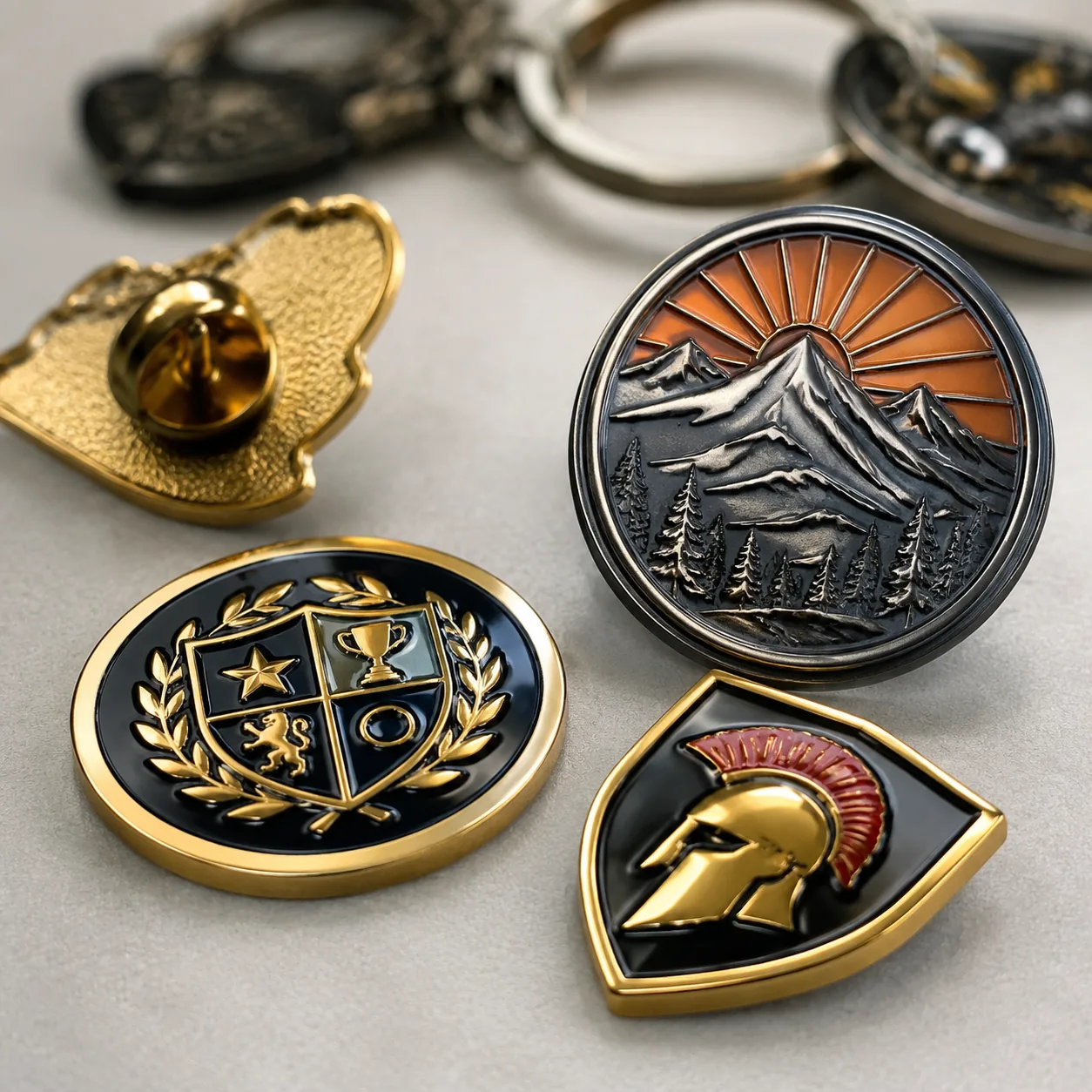
Late brief, fixed launch: reduce impact without reopening the set
Most 2026 promo-set revisions still start too late for a clean redesign. The common case is an event kit approved by marketing, then handed to sourcing 14 to 21 calendar days before PO release with a simple instruction: remove the highest-impact materials without changing artwork, assembly flow, launch date, or landed cost by more than a few percentage points. Typical contents are a die-struck pin, cast keychain, PVC patch, lanyard accessory, printed backing card, and individual bagging. Under those conditions, the job is not concept development. It is controlled substitution: keep silhouette, finished dimensions, attachment hardware, and pack count stable while replacing the materials that add avoidable plastic, vague environmental claims, or unnecessary compliance risk.
The main execution error is changing too many variables at once. A base-metal change plus a plating change plus a new attachment plus a new pack format creates four separate failure modes and slows root-cause analysis when the pre-production sample fails. For metal items below 50 mm, keep finished size within plus or minus 0.15 mm, hole position within plus or minus 0.10 mm, and clutch, jump-ring, or split-ring location unchanged. For paper and textile parts, hold cut size within plus or minus 1.0 mm and folding sequence exactly as approved. Review swaps in this order: packaging first, secondary components second, core substrate last. That sequence usually gives the fastest approvals because outer-pack changes rarely need tooling, while substrate changes affect edge condition, weight, color behavior, relief depth, and assembly settings.
At practical B2B order bands of 500, 1,000, and 3,000 sets, packaging substitutions can usually be quoted in 2 to 3 working days and approved from a blank sample or digital layout in another 2 to 4 days. Secondary changes such as recycled-polyester lanyards, recycled board cards, or glassine bags often need 4 to 7 working days for sample confirmation. Core changes such as replacing soft PVC with woven construction, or converting cast zinc alloy to stamped iron, usually add 7 to 12 working days because they alter tactile feel, relief geometry, and production route. If the factory is already in line-booking season before a major trade show, add 2 to 5 working days of buffer for sampling, plating queues, and final packing slot allocation.
Approve materials, not marketing language
Terms such as eco metal, green alloy, biodegradable PVC, sustainable plating, and low-impact plastic are not usable buying specifications. They cannot be inspected consistently, written clearly into a PO, or defended if the end customer challenges the claim. A real substitution must identify the exact substrate or fiber, thickness or basis weight, decoration method, whether tooling changes, and the visible or functional trade-off the user will notice.
The difference is straightforward. Changing a 20 x 900 mm lanyard from virgin polyester to recycled polyester is a real material swap because the yarn source changes while width, hook, buckle, breakaway, and sublimation process can stay constant. Replacing an individual 0.03 mm OPP bag with a 60 to 80 gsm glassine bag or a 300 to 350 gsm FSC-certified paper sleeve is also a real swap because plastic content, pack weight, and disposal route change measurably. By contrast, calling a zinc alloy keychain sustainable because it uses matte nickel instead of bright nickel is inaccurate. The finish changed; the substrate did not. Likewise, switching from gloss lamination to matte lamination is a surface-process change, not a lower-impact board conversion unless the laminate is removed entirely or replaced with an aqueous coating.
- Require the quote to state the exact material and grade where relevant: iron, zinc alloy, brass, recycled polyester, RPET felt, woven polyester, recycled white board, kraft board, glassine, silicone, or TPU.
- Require one sentence on the visible trade-off: lower gloss, drier hand feel, lighter weight, flatter relief, softer edge detail, lower moisture barrier, or slightly reduced color saturation.
- Separate material swaps from process swaps. A new substrate with the same print method is easier to control than a new substrate plus a new decoration method.
- Do not approve environmental claims that cannot be repeated in the PO, sample approval sheet, carton marks, and inspection checklist.
- Where a claim matters commercially, ask what evidence exists: recycled content declaration, FSC chain-of-custody claim for paper, REACH or Proposition 65 screening where required, and restricted-substance test data for the finished item.
Audit the set first: where lower-impact swaps usually work
In mixed promo sets, the best sustainability gains usually come from the surrounding parts rather than the hero item. The metal pin may need to stay metal because the design depends on enamel fill, edge crispness, and giftable perceived value, while the lanyard yarn, patch construction, insert card, and unit pack can often change with limited brand risk. Those are also the parts buyers reorder across campaigns, so the substitution compounds over multiple POs instead of saving material once.
A representative event set may include a 32 mm die-struck soft enamel iron pin at 1.5 mm thickness, a 45 mm zinc alloy keychain at 3.0 mm thickness, a 65 mm patch, a 20 x 900 mm lanyard with swivel hook and breakaway, a 350 gsm backing card, and individual bagging. If the objective is a lower-impact version without moving the event date, the first review should target lanyard yarn, patch substrate, board stock, and pack format. Those changes usually preserve artwork geometry, avoid new metal-tooling charges, and keep rework risk lower than altering the metal items.
The weakest late-stage candidates are products whose appearance depends on the original manufacturing method. A highly sculpted 3D coin cast in zinc alloy cannot simply become stamped iron without losing relief depth, sidewall shape, and mass. A molded PVC keychain with rounded undercuts and layered surfaces will not feel equivalent if converted to flat acrylic or woven construction. In those cases, changing packaging while keeping the core item stable is usually the better decision. It removes measurable waste without delivering a product that no longer matches the approved concept.
| Item | Standard spec | Practical 2026 swap | Typical MOQ tiers | FOB price range | Lead-time effect |
|---|---|---|---|---|---|
| Lanyard | 20 x 900 mm virgin polyester, full-color sublimation, metal swivel hook | 20 x 900 mm recycled polyester, same hardware and print; color tolerance approved on physical sample | 500 / 1,000 / 3,000 pcs | $0.58-$0.95 / $0.46-$0.80 / $0.40-$0.68 | 0 to 3 working days |
| Backing card | 350 gsm coated virgin board, 4C print, gloss lamination | 350-400 gsm recycled white board or kraft board, aqueous coating or no lamination | 500 / 1,000 / 3,000 pcs | $0.07-$0.14 / $0.05-$0.11 / $0.04-$0.09 | 0 to 2 working days |
| Unit pack | 0.03 mm OPP bag, self-adhesive flap | 60-80 gsm glassine bag or 300-350 gsm paper sleeve | 500 / 1,000 / 3,000 pcs | $0.03-$0.08 / $0.02-$0.06 / $0.02-$0.05 | 1 to 3 working days |
| Patch | 2D soft PVC, 2.0-2.5 mm thick | Woven patch, merrow or laser-cut edge, heat-seal or sew-on backing | 500 / 1,000 / 3,000 pcs | $0.32-$0.70 / $0.24-$0.54 / $0.19-$0.42 | 4 to 8 working days |
| Pin base metal | Zinc alloy cast, 2.5-3.0 mm | Iron stamped, 1.2-1.8 mm, soft enamel, same attachment layout | 500 / 1,000 / 3,000 pcs | $0.82-$1.38 / $0.66-$1.12 / $0.54-$0.95 | 5 to 9 working days |
Metal swaps: when iron can replace zinc alloy and when it cannot
Metal is where sustainability discussions often become technically weak. For flat enamel pins up to roughly 45 mm, iron is usually the first metal worth evaluating because it stamps cleanly, supports soft enamel or imitation hard enamel, and is generally lower in tooling and unit cost than cast zinc alloy. A 30 to 35 mm pin with mostly flat artwork can often move from zinc alloy cast at 2.5 to 3.0 mm to stamped iron at 1.2 to 1.8 mm, provided the design does not depend on deep sidewalls, full 3D sculpting, pierced cavities with heavy wall thickness, or a substantial edge radius.
The cost difference is usually meaningful. At 1,000 pieces, a 32 mm iron soft enamel pin with 4 to 6 colors, butterfly clutch, and individual bag commonly lands around FOB $0.38 to $0.72, while a zinc alloy cast version of similar face size is more often FOB $0.65 to $1.10. Tooling for simple stamped iron may sit in the $45 to $90 range, while cast zinc alloy molds for comparable shapes often land around $75 to $150, rising further if the back has relief or the outline needs multiple cavities. The trade-off is visible: stamped iron gives a flatter face, sharper stamped lines, and lower unit weight; cast zinc alloy gives more body, smoother sidewalls, and better 3D depth.
For keychains, the threshold is stricter because they take more impact in use and are more exposed to abrasion. If the design needs a bottle opener, spinner, cutout body with thick cross-sections, or layered 3D emblem, zinc alloy usually remains the safer choice. If the design is flat and logo-led, stamped iron can work, but the PO should specify plating and inspection points precisely. Decorative nickel, black nickel, gold-color, or antique finishes on promo hardware are often in the range of 0.03 to 0.05 microns, with a clear topcoat when color hold matters. For incoming inspection, AQL 2.5 major and 4.0 minor remains common for promo programs, with critical defects at 0. Check burrs, plating pits, jump-ring closure gap, split-ring spring-back, and enamel fill coverage instead of approving from photographs alone.
Textiles and flexible parts: easier wins, but still performance-led
Lanyards, patches, and badge accessories are usually the cleanest late-stage wins because tooling burden is low and MOQ is flexible. Recycled-polyester lanyards in 10, 15, 20, and 25 mm widths are now routine in export factories serving event and corporate programs. At 1,000 pieces, a 20 x 900 mm recycled-polyester sublimation lanyard with metal swivel hook, buckle release, and safety break typically lands around FOB $0.46 to $0.80, usually only $0.03 to $0.08 above virgin polyester depending on hardware and print coverage. MOQ is often 500 pieces per artwork, though some mills hold lower trial quantities at a surcharge.
The main caution is not print compatibility but consistency between yarn lots. Recycled yarn can vary slightly in surface smoothness and ink uptake, so dark navy, deep red, and bright orange should be approved against a physical sample under D65 or neutral office lighting, not screen artwork alone. If the lanyard includes a breakaway, buckle, or phone loop, test sewn-joint pull strength after the fiber change. A practical benchmark for standard event lanyards is no seam opening and no hardware release below 7 kgf on the stitched joint, with breakaway parts releasing in their intended safety range rather than at random low loads. The exact release point should still match end use and any local safety requirement.
For patches, woven or embroidered construction is a sensible alternative to PVC only when the artwork language still fits the process. Woven patches can usually hold flat logos, text, and linear iconography down to about 0.7 to 0.8 mm line width; below that, detail tends to close up. Embroidery gives a heavier texture but needs broader shapes, typically 1.0 mm lines or wider for reliable readability. Neither is a good substitute for molded cartoon forms, thick raised borders, or high-relief surfaces. On textile patches, specify overall size tolerance within plus or minus 1.0 mm, color target by Pantone bridge where practical, and edge condition after 10 manual bend cycles to confirm no unacceptable fray before approval.
Packaging moves fastest, but transit protection still decides cost
When schedule is tight, packaging changes usually give the best speed-to-impact ratio. Recycled insert cards, reduced plastic count, bulk inner packing, or paper sleeves can often be implemented without touching product tooling. For many programs, that is the correct first move because approval risk is low and the reduction is measurable in pack weight, single-use plastic pieces per set, and carton cube.
The common mistake is assuming every plastic removal is neutral in transit. Paper sleeves and glassine do not protect polished plated metal as well as sealed OPP in humid sea freight, especially on 25 to 35 day ocean shipments and in peak-season container conditions. If the polybag is removed on bright nickel, gold-color, or gunmetal finishes, specify tissue interleaving, anti-tarnish paper where needed, or a desiccant load in the master carton sized to the route and carton volume. Without that, surface rub, oxidation marks, or enamel abrasion can erase the savings from the packaging change in a single shipment.
For mixed promo sets, carton engineering matters more than eco language. A workable export baseline is a 5-layer corrugated carton sized to keep gross weight under about 12 kg for easier handling, with board grade matched to route and stacking load and inner separation where mixed hardware can collide. If the buyer has a drop-test requirement, write it into the specification rather than leaving it implied. In most cases, the real cost risk in sustainable packaging is not the sleeve or bag itself; it is product damage caused by removing protective material without replacing its protective function.
Quote, sample, and inspect the swap without slowing the PO
The RFQ should be issued as a controlled variance request, not an open request for ideas. Keep the approved item number and original dimensions, then list each proposed substitution line by line. State what remains unchanged: artwork, size, attachment, print colors, fold method, and carton standard. This prevents suppliers from quoting a hidden redesign with lighter hardware, reduced material thickness, or lower packing density that makes the price look better while changing the delivered product.
Inspection should target the failure modes introduced by the new material. For metal changes, check weight variation, edge feel, plating appearance, and attachment function. For textile changes, check color drift, seam integrity, and edge fray. For packaging changes, simulate shipment with finished goods, not loose components: pack five completed sets exactly as shipped, tumble or shake them for 60 seconds, then inspect for scratches, hardware marks, print rub, sleeve tearing, and card corner crush. That simple abrasion check catches a large share of avoidable issues before full packing starts.
- RFQ example: keep finished size 32 mm, keep 2 butterfly clutches, change base metal from zinc alloy cast 3.0 mm to iron stamped 1.5 mm, keep Pantone references and backstamp unchanged.
- Request a pre-production sample whenever the substrate changes, even if artwork does not.
- State inspection level in the PO: AQL 2.5 major, 4.0 minor, critical 0 remains common for promo products.
- Define realistic color acceptance. Recycled board and recycled textile surfaces may not hit coated Pantone exactly, so approve against physical material and lighting condition.
- Ask for FOB pricing at 500, 1,000, and 3,000 pieces so the neutral-cost volume point is visible.
- Record the approved substitute in the reorder sheet, approved-sample archive, and BOM so the next PO does not revert to the legacy material.
A practical 2026 buying sequence for lower-impact promo sets
If the brief arrives late, rank each component by two factors: waste-reduction potential and redesign risk. Start with packaging, then flexible accessories such as lanyards and patch constructions, and only then evaluate metal substrate changes where the artwork is flat enough to tolerate them. That order gives the best chance of protecting launch date, unit economics, and approved appearance.
A workable sequence is 2 to 3 working days for revised quotation, 5 to 7 working days for packaging or textile samples, and 7 to 12 working days where metal construction changes. Ask suppliers to quote the same dimensions, the same accessory hardware, the same pack count, separate tooling notes, and FOB pricing at 500, 1,000, and 3,000 pieces. Keep the option set narrow. In most sourcing reviews, three scenarios are enough: low-risk packaging only, packaging plus textile changes, and a full package that includes one metal conversion.
Approve the final substitute on measured performance, not on story language. Check tolerances, color, abrasion resistance, attachment function, packing security, and carton condition. In most event-kit programs, the best lower-impact result is not the most radical one. It is the version that removes obvious waste, survives transit, stays within AQL, and can be reordered next season from a locked specification without drifting back to the original materials.
Have a project? Send your artwork and target quantity and we’ll reply with a detailed quotation within 12 working hours.
Ready to get this made?
Send your sketch, target quantity and ship-date. Detailed quotation in 12 hours.



