Sustainable Material Swaps for Promo Metal Items in 2026
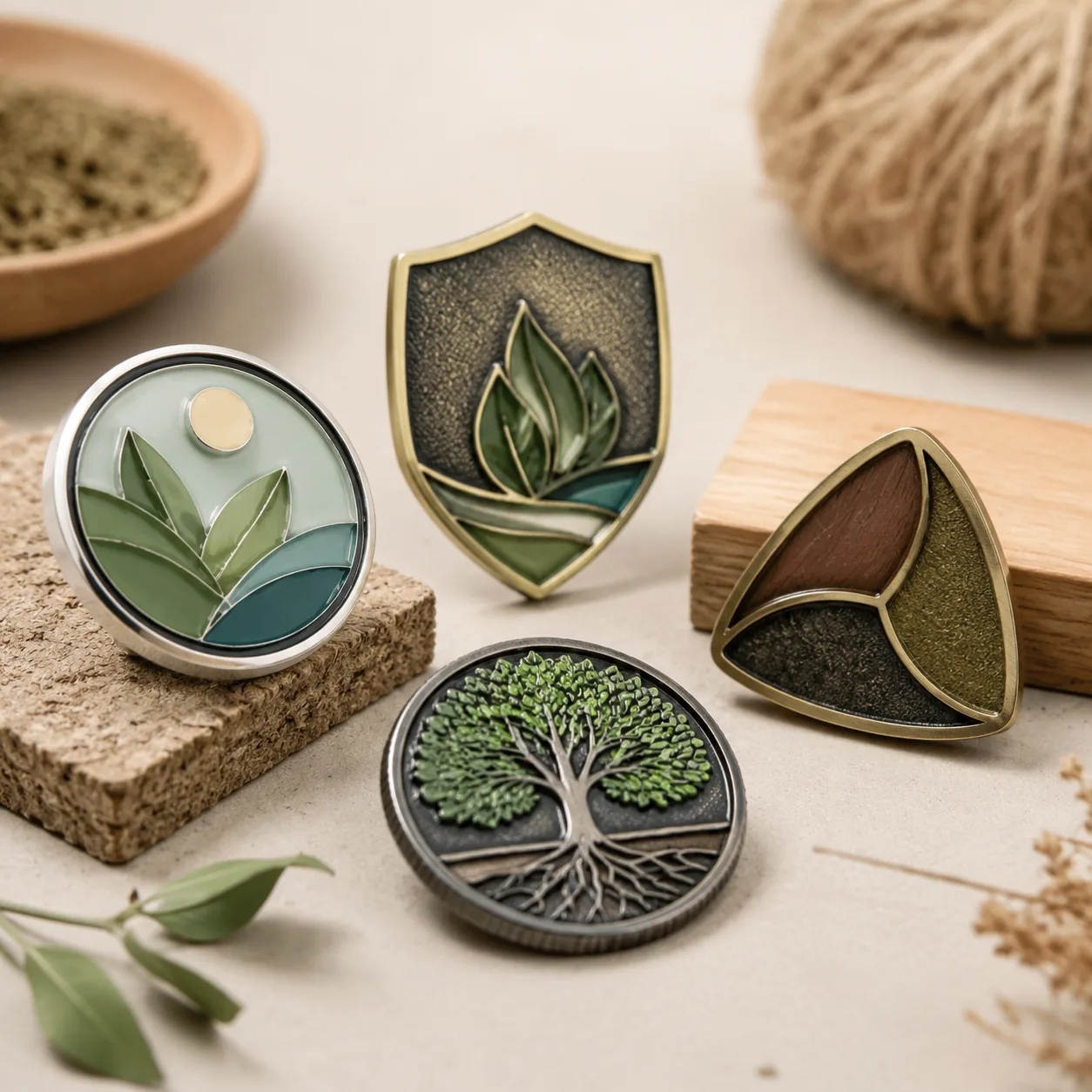
2026 sourcing brief: lower impact without changing the approved item
Most 2026 buyer requests are not full redesigns. They are requests for a lower-impact version of a promo metal item that brand, sales and event teams have already approved. The brief is usually tight: keep the same pin, keychain or badge format, hold Pantone-matched colour fills and the approved finish, stay inside the FOB ceiling, pass inspection, and still ship on time. That is a production-control exercise, not a branding exercise.
A realistic program might include 8,000 soft enamel pins at 32 mm, 3,000 die-cast zinc alloy keychains at 50 mm, and 2,000 bottle-opener challenge coins at 44 mm. The buyer wants less single-use plastic, lower virgin content where practical, FSC-certified or recycled paperboard where it does not weaken pack-out, carton barcoding, AQL inspection, and ex-factory completion within 32 to 38 calendar days. Under those constraints, the wrong material swap can create sample rejection, plating rework, transit damage or a missed vessel booking.
The safest sequence is to freeze artwork, size, thickness, finish target, attachment style, FOB ceiling and latest ex-factory date before discussing sustainability changes. Once those variables are fixed, review the build by component and rank each proposed swap by risk: low-risk changes that do not alter tooling or visible appearance, medium-risk changes that affect durability or finish response, and high-risk changes that can destabilize the process. On most promo metal programs, packaging and accessory changes deliver the fastest footprint reduction with the lowest quality risk.
Map the SKU by component, not by claim
Buyers often focus on the main metal body and overlook the smaller parts that drive plastic use, chemistry use and transit damage. A standard soft enamel pin can include a stamped iron or brass body, enamel fill, plated finish, pin post, clutch, backing card, individual bag and inner carton divider. A keychain may add a split ring, jump ring, swivel, PVC strap, acrylic charm, EVA insert and gift box. Each part has a different MOQ, lead-time effect and failure mode if changed.
A practical review splits the item into five layers: base material, decoration, hardware, protection and packaging. Then ask which layer creates the highest environmental load with the lowest technical justification. Replacing an OPP bag with glassine is usually low-risk. Replacing a proven zinc die casting with a new substrate on the same geometry is not. In many programs, the fastest plastic reduction comes from deleting PVC straps, EVA foam, acrylic add-ons and individual zip bags rather than changing the core metal body.
| Component | Conventional spec | Lower-impact swap | Typical MOQ | FOB effect | Lead-time effect | Process risk |
|---|---|---|---|---|---|---|
| Pin clutch | Rubber clutch or butterfly clutch with PVC cap | All-metal butterfly clutch or locking clutch | 500+ | USD 0.01-0.08 up | 0-2 days | Low |
| Individual pack | OPP polybag, 30-40 micron | Glassine bag 40-60 gsm, tissue wrap or paper band | 1,000+ | USD 0.00-0.03 up | 0-3 days | Low |
| Backing card | 350 gsm virgin SBS card | 350-400 gsm FSC mix or 60-100% recycled board | 500+ | Neutral to USD 0.02 up | 0-4 days | Low |
| Gift box insert | EVA foam insert | Die-cut paperboard insert, molded pulp where geometry allows | 500+ | Neutral to USD 0.15 down | 0-5 days | Low |
| Accessory strap | Virgin PVC strap | Delete part or replace with rPET webbing | 1,000+ | USD 0.03 down to USD 0.12 up | 0-5 days | Low to medium |
| Top coat | Full epoxy dome 0.3-0.5 mm | Delete epoxy if recess depth and artwork allow | 1,000+ | USD 0.03-0.08 down | 0-2 days | Medium |
| Base metal | Standard zinc alloy or iron | Recycled-content same-grade alloy with QC controls | 2,000-5,000+ | Neutral to USD 0.06 up | 3-7 days | Medium |
| Decorative add-on | Virgin acrylic charm or PVC tag | Delete part or use recycled acrylic | 1,000+ | USD 0.05 down to USD 0.18 up | 3-7 days | Medium |
| Main body redesign | Virgin soft PVC fob | Recycled acrylic or die-cast zinc where geometry allows | 2,000+ | USD 0.08-0.35 up | 7-14 days | High |
This component view prevents greenwashing. A supplier can claim recycled metal while still shipping every item in virgin plastic with EVA inserts and decorative PVC accessories. Buyers need the reverse discipline: identify the highest-volume and easiest-to-remove components first, then change only what still protects function, cosmetic standard and delivery reliability.
Start with low-risk plastic reduction in the first RFQ round
For deadline-driven merchandise, first-round changes should target plastics that do not affect the item’s core use. On an 8,000-pin order, replacing OPP bags with glassine sleeves or grouped paper bands can remove a large amount of single-use plastic without changing tooling or assembly. Recycled backing cards at 350 to 400 gsm generally perform well, but hole placement matters. For cards below 90 mm width, keep the slot or hole center at least 8 mm from the nearest edge; for heavier multi-post badges or items above 12 g, 10 to 12 mm is safer to reduce tearing on recycled stock.
Attachment hardware is another practical area, but the use case matters. Rubber clutches are usually more comfortable against skin and less likely to snag knitwear than all-metal butterfly clutches. If the pin is worn on uniforms, bags or outerwear, a locking clutch often improves retention, especially on pieces above 35 mm or above roughly 10 g unit weight, but it typically adds USD 0.03 to 0.08 per piece and 1 to 2 assembly days on larger runs.
For keychains, the avoidable plastic is often secondary rather than structural. A 50 mm zinc alloy keychain with a 30 mm split ring and 4 mm jump ring can often ship safely in tissue wrap plus partitioned inner cartons if the finish is matte nickel, antique nickel or antique brass. Bright nickel, bright gold and black nickel are less forgiving. Those polished finishes rub easily in transit, so some separation remains advisable. A paper wrap plus kraft partition is often enough; removing all protection from polished plating is a false saving if it increases rub marks and reject rate above the agreed AQL.
Specify recycled metal only where tolerance and finish can still be held
Recycled-content metal is worth specifying only when the supplier can maintain consistency on the actual geometry and finish. For die-cast keychains and opener coins, zinc alloy remains the standard because it fills cutouts, undercuts and relief well at wall thicknesses of about 2.0 to 4.0 mm. Relief depth is usually 0.3 to 0.8 mm, with finer logo recesses around 0.25 mm as a practical lower limit. A recycled-content zinc route can work, but porosity, gate trimming, polishing response and plating adhesion should be checked on approved samples, not assumed from a blanket declaration.
For stamped soft enamel pins, iron and brass remain the common options. Iron is usually the better-value choice and works well at 0.8 to 1.5 mm thickness with clear outlines. Brass costs more but polishes cleaner and supports finer detail. As a working guide, minimum line width around 0.30 to 0.35 mm is safer for iron, while 0.25 to 0.30 mm is often achievable in brass on well-maintained tooling. On a 32 mm pin, moving from iron to brass can add roughly USD 0.08 to 0.25 FOB at 1,000 units and often brings little service-life benefit for normal indoor promo use.
A workable specification is usually not '100% recycled metal' but 'recycled-content same-grade alloy acceptable provided approved appearance, plating adhesion, hardness and dimensional tolerance are maintained.' That gives procurement and the factory a realistic path. Typical tolerances still apply: +/-0.15 mm on stamped pins, +/-0.20 mm on most die-cast pieces, and up to +/-0.30 mm on larger or irregular cast shapes. Front-facing cosmetic surfaces should show no exposed base metal, no blistering, no plating skip, and no enamel voids beyond the agreed AQL. For many programs, AQL 2.5 major and 4.0 minor remains standard.
Prevent finish failures caused by oversimplified eco decisions
A common mistake is assuming that fewer coatings automatically make the item greener. In practice, deleting a clear protective layer from a polished nickel-look or brass-look keychain may reduce chemistry use per unit, but if the item scratches, oxidizes or discolours sooner, replacement demand rises. A short-lived item is not automatically a lower-impact item.
Plating choice matters more than many buyers expect. Antique nickel, antique brass and antique silver generally hide light abrasion better than bright nickel, imitation gold or black nickel. For heavily handled items such as keychains and opener coins, antique finishes are often the lowest-risk compromise because wear is less visible on relief depths around 0.3 to 0.6 mm. Highly polished finishes look premium but need better packing separation, tighter polishing control and closer inspection for edge consistency, rub marks and color-tone mismatch from lot to lot.
Decorative plated promo items typically use a plating stack rather than a single metal layer. Flash top layers are often around 0.03 to 0.10 microns for appearance finishes, but that number alone does not predict durability. Buyers should ask for the full stack: copper strike if used, nickel underlayer, top appearance layer, and whether a clear protective coat is applied. For sweaty-contact use, outdoor exposure or high-abrasion handling, a raw-minimal-finish concept usually underperforms. In those cases, stable plating plus simpler packaging is often the more credible sustainability compromise.
Approve the eco version like a production item, not a concept sample
Lower-impact alternatives should go through the same approval discipline as the standard build. For a three-SKU program, request one control sample in the current specification and one sustainable-option sample for each SKU using the same artwork, dimensions and hardware. Side-by-side review makes differences in color edge sharpness, enamel levelness, surface texture, unit weight and packing protection easy to spot before bulk production starts.
For pins and badges, inspect clutch retention, post alignment, edge smoothness, colour accuracy, fill completeness and backing-card tear resistance under neutral light around 5000K to 6500K. For keychains, measure jump ring closure gap, split ring spring tension and swivel movement over at least 20 to 30 opening or rotation cycles. For bottle-opener coins, test function on standard crown-cap bottles and inspect the opener lip for burrs or rolled edges. Burr problems often appear when a supplier reduces polishing steps after changing alloy source or finish sequence.
- Request actual unit weight in grams for old and new versions; a change above about 8% is noticeable in hand and can affect perceived value
- For plated items packed without polybags, run a transit rub test using at least 20 finished pieces in the intended inner pack for 30 minutes of carton vibration or equivalent manual agitation
- Confirm recycled board performance on the final die-cut shape, not only by gsm claim; stiffness, edge tear and slot strength matter more than the paper spec sheet
- Keep AQL unchanged unless the client explicitly accepts wider cosmetic variation on recycled-content material
- Ask for plating stack information, neutral-light finish photos and carton pack-out photos before shipment approval
- For enamel fills, confirm colour remains inside recess and does not sink more than roughly 0.1 mm below the surrounding metal line unless approved
- Use salt-spray or humidity testing only when end use justifies it; test conditions should match the actual product environment rather than serve as a generic sales claim
Lead time needs validation at sample stage. Typical 2026 schedules from China for standard promo metal items are about 7 to 10 days for pre-production samples, 10 to 14 days where custom paper engineering or mixed-material assembly is added, and roughly 12 to 22 days for bulk production after sample approval. Recycled-content sourcing, FSC-certified custom structures, or unusual plastic-free pack-outs can add 3 to 7 more days. On a 32 to 38 day total delivery window, that extra week can determine whether the shipment catches the planned departure.
Cost, MOQ and lead-time reality by SKU
Sustainable changes do not automatically raise cost. Some are neutral and some save money, especially where they remove unnecessary accessories. The expensive changes are usually low-volume specialty materials, new tooling for a different substrate, or certified custom packaging on small runs. To keep the premium auditable, quote each change separately instead of accepting a single vague eco-upgrade charge.
For reference, a 32 mm soft enamel iron pin at 1.2 mm thickness with one post, butterfly clutch, up to 4 enamel colours and standard card commonly sits around USD 0.38 to 0.75 FOB at 1,000 pieces and roughly USD 0.26 to 0.52 at 5,000 pieces, depending on plating, colour count and pack-out. A recycled card plus glassine bag usually adds only USD 0.01 to 0.04. A locking clutch adds around USD 0.03 to 0.08. Switching the same pin from iron to brass may add USD 0.08 to 0.25, and often more at low quantity, without meaningful end-user benefit unless finer detailing is required.
A 50 mm die-cast zinc alloy keychain at about 3.0 to 3.5 mm thickness typically lands around USD 0.95 to 1.80 FOB at 1,000 pieces and USD 0.72 to 1.45 at 3,000 pieces, depending on cutouts, enamel areas, ring hardware, swivel complexity and packaging. Removing a PVC strap can save USD 0.05 to 0.20. Replacing EVA with die-cut paperboard may be neutral or save up to USD 0.15 depending on the box design. Recycled acrylic inserts or FSC rigid gift boxes often add USD 0.10 to 0.45 and usually need at least 1,000 pieces to price efficiently.
For 44 mm bottle-opener coins in zinc alloy or stamped iron, standard FOB at 1,000 pieces is commonly around USD 0.85 to 1.60 depending on thickness, opener geometry, edge detail and plating. If the opener profile is already approved and functions reliably, changing only packaging is usually a safer sustainability move than changing base metal. Practical MOQ for basic eco-packaging starts around 500 to 1,000 pieces. Special material runs, FSC-certified custom structures or recycled-content alloy requests often need 2,000 to 5,000 pieces to avoid disproportionate setup and sourcing cost.
Build a low-risk swap plan instead of buying a label
For an existing promo program, do not try to redesign the whole catalog in one cycle. Start with one SKU family and one event date. Keep artwork, dimensions, attachment and finish fixed, then ask the supplier to quote three versions: current build, low-risk sustainable swap, and aggressive sustainable swap. That structure makes the trade-offs visible in FOB cost, MOQ, lead time, cosmetic risk and packing format.
For most buyers, the strongest sequence is simple. First reduce plastic packaging. Then replace virgin paper with recycled or FSC-certified board where stiffness is proven. Then remove unnecessary PVC, acrylic or foam accessories. Only after that should you evaluate recycled-content metal or plating changes. That order usually delivers measurable impact quickly without putting shipment reliability at risk.
The RFQ should be component-specific, not aspirational. State quantity by SKU, finished size in mm, thickness, target weight if relevant, base metal, plating finish, colour count, attachment, packaging format, whether plastic-free packing is preferred or mandatory, whether recycled-content material is preferred or mandatory, target AQL, carton barcoding requirements, sample deadline and latest ship date. A capable factory should be able to explain at component level which swap is cosmetic, which affects performance, which needs new tooling, and which should be rejected even if it sounds greener in a presentation.
Have a project? Send your artwork and target quantity and we’ll reply with a detailed quotation within 12 working hours.
Ready to get this made?
Send your sketch, target quantity and ship-date. Detailed quotation in 12 hours.



