Sustainable Material Swaps for Promo Metal: Failure Modes in 2026
Treat every sustainability swap as a new product construction
Most buyer-side failures start with one bad assumption: a greener revision changes only one input while the rest of the build stays stable. In production, that is rarely true. Swapping to recycled zinc, recycled brass, FSC board, glassine sleeves, lower-VOC inks or thinner plating changes the process window across the whole item. Polish response, casting porosity, plating adhesion, moisture behavior, cure time, scratch resistance, edge sharpness, assembly stress and pack-out friction all move together.
That is why a pin, badge or keychain that passed in 2025 can fail after a sustainability revision even when artwork, size and logo remain unchanged. A recycled alloy may cast with higher gas porosity. A recycled backing card may bow after assembly at 65% to 75% RH. A thinner decorative plating may pass final inspection yet rub through on split rings in 14 to 45 days of daily carry. QC then becomes subjective: dull tone, pits, thin feel, bent card, epoxy lift or transit scuffing.
The practical fix is to rewrite the specification line by line. Identify exactly which component is changing, restate the use case, update structural minimums, define measurable finish standards and split item lead time from packaging lead time. Treat every substitution as a new construction with its own pre-production sample, tolerances, test method and acceptance criteria. A note on an old PO is not enough.
Failure mode 1: recycled metal increases porosity, pits and plating rejects
Recycled brass, iron and zinc can all be commercially workable, but they are not interchangeable across every promo-metal architecture. The most common defect is visible porosity after polishing or plating, especially on die-cast zinc keychains, bottle openers and oversized badges above 45 mm. A raw casting can look acceptable, then show pinholes, bloom or sink marks after bright nickel at 0.5 to 0.8 micron. Dark bright finishes such as black nickel and gunmetal usually exaggerate those defects because they highlight pits and sanding variation.
Risk rises when the brief combines three demands: high recycled content, large mirror-finish fields and jewelry-like appearance. For broad flat faces, crisp 3D relief and premium bright plating, die-cast recycled zinc is usually the least forgiving route. Stamped recycled brass or stamped recycled iron is more stable for pins and badges at 1.2 to 1.8 mm thickness, especially with soft enamel, imitation hard enamel or antique textures. Recycled stainless steel is also a strong option for flat engraved or laser-marked tags because it avoids heavy decorative plating entirely.
Geometry should be tightened when recycled alloy is specified. For die casting, a safer commercial window is 2.0 to 3.0 mm overall thickness, recessed detail depth at least 0.25 mm, raised line width at least 0.30 mm and avoidance of mirror-finish open fields larger than 12 x 12 mm unless melt quality has been validated. For stamped brass pins, 0.25 mm line width and 0.20 mm recessed separation are more realistic than ultra-fine die-cast detailing. If appearance is critical, request a pre-production sample from the actual production melt batch, not just a CAD approval or standard-alloy sample.
Where plating is still required, specify the layers numerically. For decorative nickel on pins and badges, a common commercial range is copper strike plus nickel totaling 0.8 to 1.2 microns. For daily-carry keychains and bag charms, 1.0 to 1.5 microns on the wear-facing finish is safer, with 1.5 to 2.5 microns preferred on ring-contact zones if the factory can mask or overbuild those areas. If a supplier cannot hold acceptable surface grade on nominally 100% recycled alloy, a blended feedstock such as 30% to 70% recycled content is often the honest compromise rather than forcing a reject-prone build.
| Material swap | Typical failure mode | Safer spec window | MOQ / lead-time impact | Typical FOB range | When not to choose it |
|---|---|---|---|---|---|
| Recycled zinc alloy die casting | Porosity, pits, plating bloom, edge sanding variation | 2.0-3.0 mm thick; textured, antique or enamel-filled faces; avoid large mirror fields; relief depth >=0.25 mm | Usually no mold MOQ change; add 2-5 days for first-order melt confirmation | USD $0.55-$1.60 at 500 pcs for 45-60 mm keychain/badge | Mirror coins, jewelry-like badges, dark bright plating on large flat faces |
| Recycled brass stamping | Minor color variation pre-plate, harder polish on deep relief | 1.2-1.8 mm; lines from 0.25 mm; soft enamel or imitation hard enamel; bright or antique finish | MOQ 300-500 pcs common; sample 5-7 days; production 10-15 days after approval | USD $0.28-$0.95 at 500 pcs for 25-35 mm pin | Ultra-low-cost runs targeting FOB below USD $0.28 per pin |
| Recycled iron stamping | Burr sensitivity, oxidation at scratches, rust risk if finish breaks | 1.0-1.5 mm; painted or enamel-filled items; full plating or clear topcoat required; burr <=0.10 mm on exposed edges | MOQ 500 pcs typical; add 1-3 days if anti-rust topcoat is nonstandard | USD $0.22-$0.75 at 1,000 pcs for 25-35 mm pin | Outdoor or coastal use without topcoat; exposed raw edges |
| Recycled stainless steel tag | Limited forming depth, higher tooling wear, flatter profile | 1.0-1.5 mm flat tags with laser mark, etch or print; no heavy 3D relief; brushed finish Ra 0.8-1.6 um typical | MOQ 100-300 pcs; production often 10-15 days stable | USD $0.45-$1.20 at 500 pcs for flat tag/key fob | Soft-enamel pin styles, deep embossing, thick 3D charms |
Failure mode 2: lower-impact plating reduces corrosion margin and wear life
A common 2026 request is to reduce plating chemistry load by thinning decorative layers, removing an intermediate step or shifting from bright mirror finishes to lower-process alternatives. The problem is often not immediate red rust. More often, the item leaves the factory looking fine and then develops tarnish, edge discoloration or ring-contact rub-through after handling. Split rings, jump rings, clasp points, corners and pin edges usually fail first because those areas receive the thinnest deposit and the highest abrasion.
The right plating spec depends on actual use. An event lapel pin worn once can tolerate a lighter finish than a keychain carried against house keys for a year. For indoor badges and collectible pins, matte nickel, antique silver, antique brass and painted surfaces hide slight inconsistency better than bright mirror gold while reducing reject rates for hairlines. For daily-carry hardware, any decorative layer below about 0.5 micron should be treated as cosmetic only, not a wear surface.
Write performance in plain commercial terms. Example: no base-metal exposure on front-facing surfaces after 200 dry cotton rub cycles under approximately 9 N hand pressure; no obvious ring-contact rub-through after a 24-hour tumble simulation in a soft abrasion bag with three standard steel keys totaling 90 to 110 g; no red rust after 24-hour neutral salt spray on plated iron components intended for humid distribution. For coastal retail, 48 hours neutral salt spray is a more realistic minimum for plated iron, while stainless parts may not need decorative corrosion testing at all if left brushed and unplated.
A more reliable sustainability move is often a different finish architecture rather than simply thinner bright plating. Antique texture instead of mirror, brushed stainless instead of plated mild steel, or enamel-filled recessed areas instead of broad polished surfaces usually produces a more stable result. What tends to fail is stacking too many risks together: recycled base metal, minimal polishing and ultra-thin bright gold on a daily-use keychain.
Failure mode 3: recycled paper and plastic-free packaging add curl, moisture and scuff damage
Packaging is often the safest place to reduce environmental impact, but it still changes product behavior. Recycled polybags, glassine envelopes, molded paper trays, kraft gift boxes and recycled backing cards alter both moisture uptake and surface friction. A polished coin face can scuff inside rough paper packaging that would be acceptable for an antique finish. An uncoated 300 gsm recycled card may look flat at assembly and bow noticeably after 24 hours in humid conditions.
For pins on presentation cards, 350 to 400 gsm coated or lightly laminated paperboard is a dependable range when visual flatness matters. A workable flatness tolerance is bow or warp within 3 mm across 150 mm length after a 24-hour rest at 23°C ± 2°C and 50% ± 10% RH. If unlaminated recycled stock is required, ask for approval photos immediately after assembly and again after the 24-hour rest. Curl often appears later, not on the packing table. If the card carries a heavy die-cast badge above 18 g, 400 gsm plus a rear support patch is safer than 350 gsm alone.
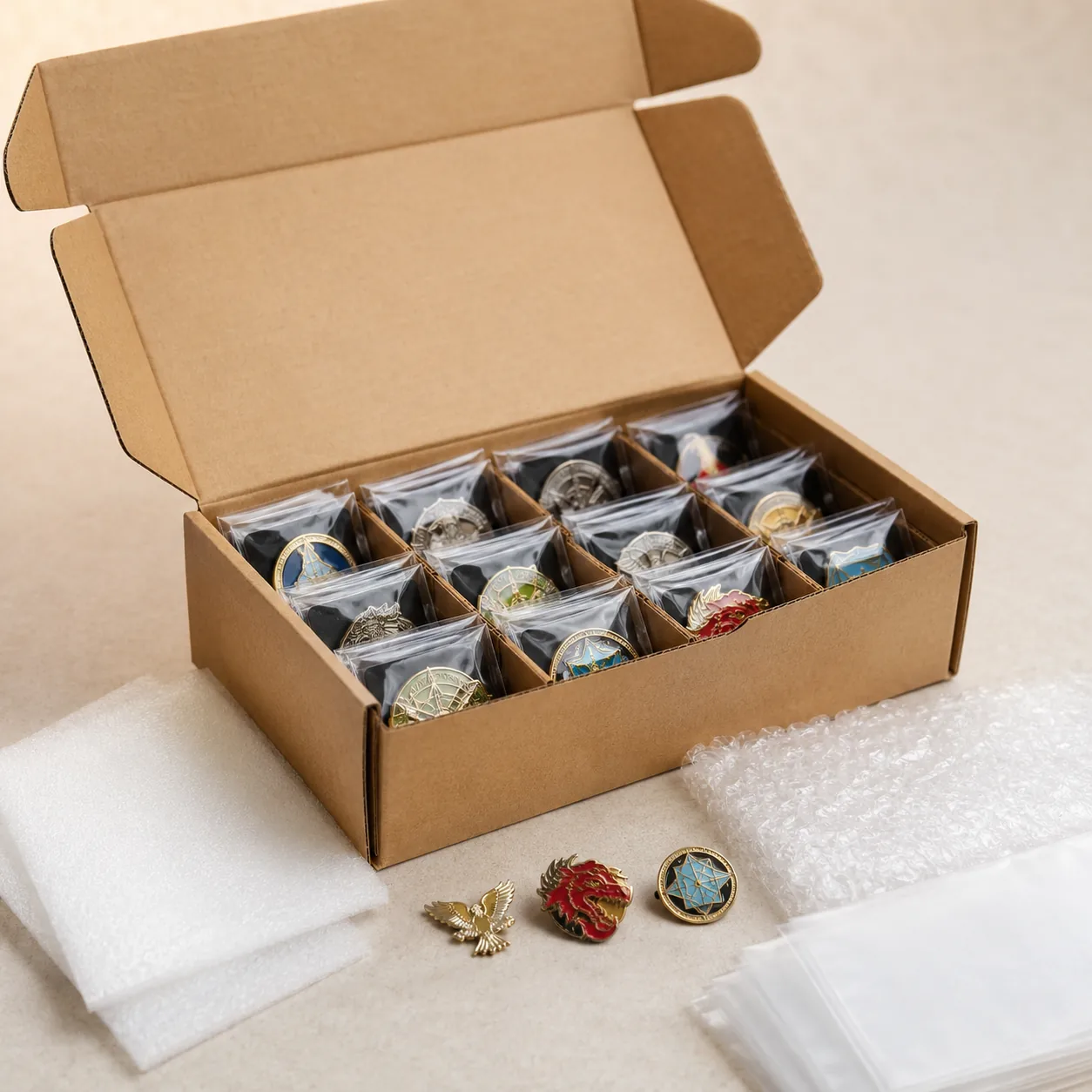
For challenge coins, mirror-plated keychains and epoxy-coated badges, glassine sleeves are usually safe only for matte, brushed or antique surfaces. Mirror nickel, bright gold and clear-epoxy faces should be isolated with soft PE film, tissue interleaf of 17 to 22 gsm or individual OPP sleeves to prevent face rub during carton vibration. Recycled master cartons are generally fine, but board grade still matters: use at least export-grade 5-layer corrugate for cartons above 12 kg gross weight and 7-layer for mixed gift-box loads above 18 kg. For sea freight in humid months, add inner poly bagging or 5 to 10 g desiccant per retail box set if the product includes paperboard or plated iron.
Sustainability language should not replace transport physics. If the route includes ocean freight during summer, condensation and carton moisture remain real risks. A greener outer box does not offset scratched plating, tarnished hardware or a bent card set that fails on arrival.
Failure mode 4: bio-based, bamboo and paper-composite parts crack at stress points
Plastic-free accessories present well in meetings, but many fail because the original geometry was designed for PVC or acrylic toughness and then copied directly into a more brittle substrate. Bamboo, molded fiber, paper composite and some bio-based sheets can work for decorative tags, inserts and short-life event tokens. They fail most often around holes, eyelets, split-ring connections and narrow neck sections.
The design changes are simple but non-negotiable. Increase hole-to-edge distance to at least 3.0 mm for paper composite and bamboo tags, and to 4.0 mm if part thickness is under 2.0 mm. Keep the neck width between body and hanging point at 6.0 mm minimum and preferably 8.0 mm for daily-carry pieces. Hole diameter should be at least 3.5 mm for standard 25 mm split-ring attachment, and metal eyelets should be used wherever possible on layered or fibrous materials. Unsupported slot holes are high risk for luggage tags and daily key use unless sample-tested.
Testing does not need to be expensive. A useful screen is a 200-cycle pull-and-twist test using the intended 25 mm split ring and short chain, followed by five 1.0 m drops onto a hard surface. If cracking, delamination, eyelet looseness or hole elongation above 0.5 mm appears, the material is wrong for the load point. In many programs, the better answer is hybrid construction: keep the stress-bearing frame and hardware in metal, and move the sustainability swap to the decorative insert, inlay panel or package.
This is also where honest product selection matters. A bio-based event token or short-life promo charm may be completely reasonable at FOB USD $0.35 to $0.90. A daily-use luggage keychain expected to survive repetitive torsion usually should remain stamped metal, with the eco improvement shifted elsewhere.
Failure mode 5: lower-VOC inks and coatings improve odor profile but expose color and rub issues
Water-based inks, lower-VOC clear coats and reduced-solvent print systems are now common on lanyards, backing cards and some printed metal or acrylic parts. Their usual failure mode is not dramatic delamination. It is slower cure, weaker wet-rub resistance or reduced brilliance compared with an older solvent-heavy standard. The dispute starts when the buyer approved only a digital proof and never approved a physical production standard on the real substrate.
For printed cards and lanyards, define a rub test numerically. A practical commercial standard is 20 dry rub cycles with no major ink transfer and 10 wet rub cycles with only minor acceptable change. For UV-printed metal inserts, key tags or acrylic panels, add a cross-hatch tape adhesion check after 24 hours cure on a non-critical area, targeting GT1 to GT2 or better on an ISO-style 0 to 5 adhesion scale. If edge chipping up to 0.5 mm is acceptable, say so; otherwise it becomes a subjective argument at inspection. For general promo goods, AQL 2.5 major and 4.0 minor is common, but critical defects such as wrong logo, missing part, sharp point or broken hardware should be zero-acceptance.
Color control also needs realism. If brand color is launch-critical, specify Pantone reference plus physical swatch approval under D65 lighting, not monitor matching only. Recycled dark board, bamboo and absorbent natural substrates often mute saturation by 5% to 15% versus coated white stock. When exact brilliance is mandatory, the greener move is often better made in recycled metal content, reduced over-packaging or finish architecture rather than in the print system itself.
Commercial impact: eco swaps often change MOQ, FOB cost and lead time
Another frequent mistake is assuming the sustainable version will keep the same MOQ, price curve and schedule as the standard item. Often the metal component can still run at 100 to 300 pieces, but the packaging component cannot. Recycled rigid boxes, molded paper trays, FSC specialty card stocks, bamboo tags with eyelets or certified recycled declarations from subsuppliers may only make economic sense at 500 or 1,000 sets. Certification paperwork can also add 1 to 3 working days if the buyer requests traceability statements before production release.
Lead-time risk shows up most on first orders. Standard enamel pins often sample in 5 to 7 days and mass-produce in 10 to 15 days after sample approval. Add a nonstandard recycled card, molded pulp insert or alternate hardware and the order can easily gain 3 to 7 extra days. In peak season, 7 to 12 extra days is common if packaging assembly is manual or if components come from different vendors. The safer quoting format is to split item production lead time from packaging lead time and identify one fallback material for each nonstandard component.
Use tiered FOB pricing instead of a single target number. As a planning range, simple stamped or die-cast pins commonly land around FOB USD $0.28 to $0.95 at 500 pcs and USD $0.22 to $0.78 at 1,000 to 3,000 pcs depending on size, attachment and finish. Keychains often run FOB USD $0.45 to $1.80 at 500 pcs and USD $0.38 to $1.45 at 1,000 pcs. Challenge coins typically sit around USD $1.20 to $3.80 at 500 pcs depending on diameter, edge detail and packaging. Recycled or plastic-free packaging usually adds USD $0.03 to $0.40 per unit, while specialty bio-based tag materials can add another USD $0.08 to $0.30 depending on thickness, eyelet hardware and finishing.
A useful RFQ structure is side by side: standard build, lower-impact build, MOQ by component, sample lead time in days, mass-production lead time in days, FOB at 300 / 500 / 1,000 pcs and substitute material if the preferred eco option is delayed. That format prevents avoidable air-freight upgrades and last-minute spec weakening.
Pre-sampling checklist: the numbers that prevent most sustainable-swap failures
- State exactly which component is changing: base metal, plating, print system, card, sleeve, tray, box, insert or hardware.
- Restate the use case: event-only pin, retail collectible, daily-carry keychain, outdoor badge or gift item. Finish expectations must match real wear.
- For recycled metal, specify process route and geometry limits: stamped brass, stamped iron, die-cast zinc or stainless tag; polished, textured or enamel-filled surface.
- Rewrite structural minimums after the swap: thickness, line width, relief depth, hole diameter, hole-to-edge distance, neck width, card gsm and card flatness tolerance.
- Request physical sample approval on the actual substituted material and finish, ideally from the intended production batch for recycled metals.
- Define measurable finish standards: plating thickness in microns, dry-rub cycles, pull-and-twist cycles, drop-test height, moisture-rest check and any salt-spray requirement.
- Keep QC language numerical: AQL 2.5 major and 4.0 minor is common for promo goods; define critical defects separately as zero-acceptance.
- Separate product protection from sustainability targets in packaging. If a polished face needs film, tissue or OPP isolation, do not remove it just to simplify pack-out.
- Confirm MOQ and lead time by component, not only by finished item. Ask whether the eco version changes sourcing, tooling compatibility or hand-assembly steps.
- Lock one fallback material per changed component before PO release so ship dates remain protected if the preferred option goes out of stock.
Best-practice path for 2026: choose lower-risk swaps first
For most B2B programs, the safest route is not a total material overhaul. It is two or three controlled substitutions with rewritten specifications. Start where risk is lowest and the claim is still meaningful: recycled or FSC-certified paper packaging, reduced plastic pack-out, flat stainless tags with minimal finishing, or recycled stamped brass instead of jumping directly to high-polish recycled zinc die castings with thin bright plating.
When briefing suppliers, ask them to quote both the standard build and the lower-impact alternative with size, thickness, attachment, finish, packing method, MOQ tier, target market and lead time shown side by side. Then approve by failure mode, not appearance alone. Ask what can pit, curl, crack, tarnish, scuff or delay, and write the preventive numbers into the PO. That is what makes lower-impact promo metal commercially usable rather than just cosmetically different.
Have a project? Send your artwork and target quantity and we’ll reply with a detailed quotation within 12 working hours.
Ready to get this made?
Send your sketch, target quantity and ship-date. Detailed quotation in 12 hours.



