Sustainable Material Swaps for Promo Items: Cost, MOQ and Lead Time
What Sustainability Swaps Actually Change
In 2026, most sustainability issues in promotional manufacturing are not caused by the word sustainable. They are caused by late changes to material, tooling, packaging or inspection after artwork, budget and event dates are already fixed. For custom pins, coins, keychains, patches, magnets and lanyards, the procurement risk depends on whether the swap preserves the same process route: stamping or die casting, polishing, plating, enamel filling, sewing, printing, inspection and pack-out.
Low-risk swaps keep the geometry and factory workflow stable. Recycled-content iron, brass or zinc alloy can usually run through normal metal production if the supplier already buys segregated ingot or sheet stock. RPET can run through standard lanyard weaving, sublimation and sewing. FSC-certified paper can replace standard backing cards, sleeves and insert cards without changing the product body. When material is stocked, these swaps normally add 0 to 5 calendar days and a small unit premium.
Higher-risk swaps change product behavior. PVC-free molded parts, molded pulp inserts, bamboo inlays, bio-based plastics and custom rigid recycled boxes can affect shrinkage, Shore hardness, odor, ink adhesion, insert fit, carton volume and export documentation. Treat these as development items. A realistic schedule adds 7 to 14 days before mass production, and 21 days is safer if the first sample must pass color, rub, fit or drop-pack testing.
Low-Risk Swaps That Keep Tooling Stable
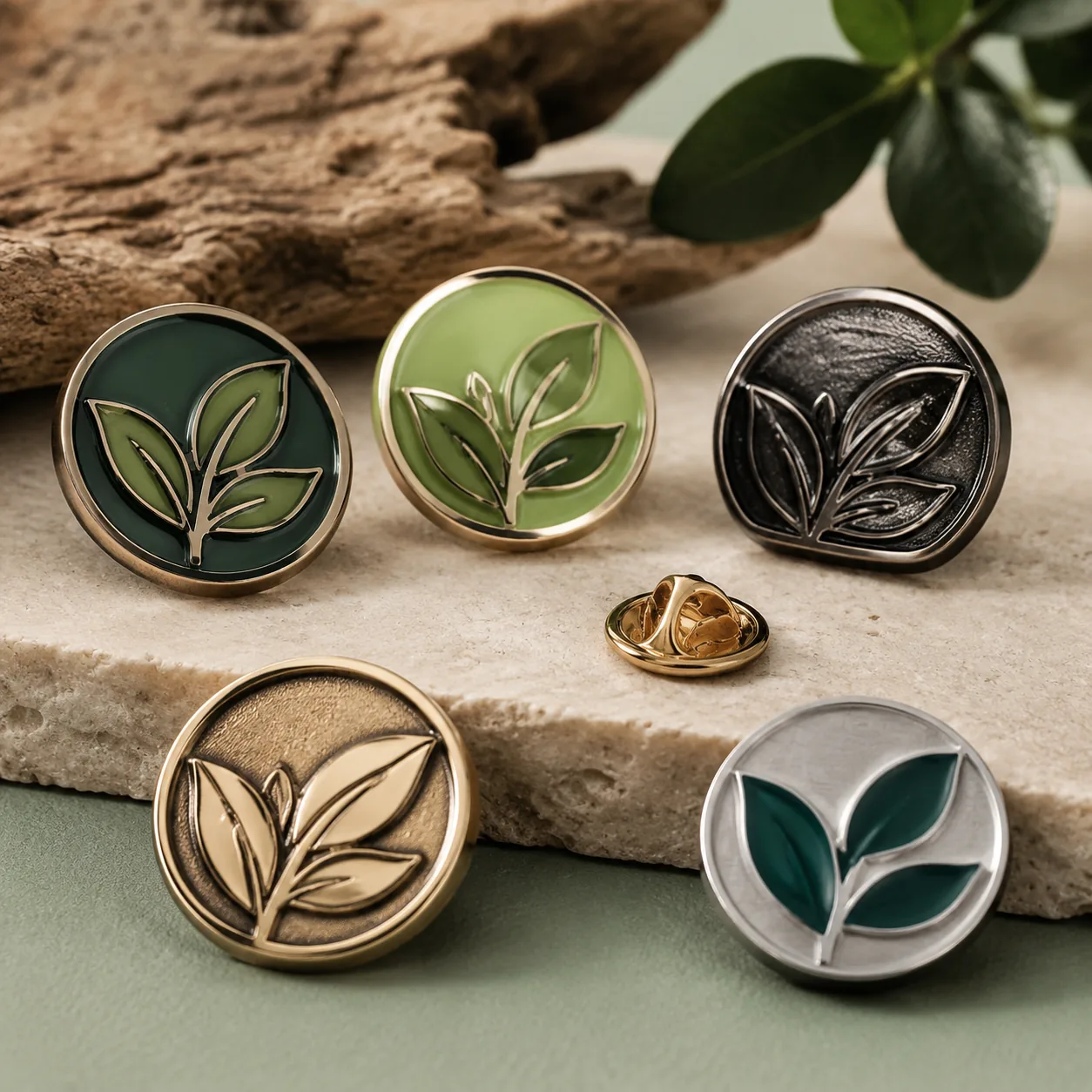
The easiest sustainable improvements do not disturb the die, mold or stitch pattern. A 30 mm soft enamel pin can often move from standard iron to recycled-content iron without changing the die, plating rack, enamel colors or clutch. A die-cast zinc alloy keychain can use recycled zinc alloy if the supplier controls alloy grade and keeps recycled feedstock within the same family. Buyers still need to approve finish expectations because recycled-content metal can show more pre-plating surface variation, especially under mirror nickel, imitation gold and black nickel finishes.
RPET is the most mature textile substitute for lanyards. A 20 mm x 900 mm sublimated RPET lanyard with metal lobster hook, safety breakaway and detachable buckle should hold finished width tolerance at +/-1 mm, length tolerance at +/-10 mm and print registration within +/-1.5 mm. Screen printing on darker RPET grounds can look duller than on virgin polyester, so logos under 8 mm high should use a white underbase or a sublimation proof approved under the same lighting as the final inspection.
Paper packaging is often the fastest visible improvement. FSC 300 to 400 gsm backing cards, unlaminated recycled paper sleeves, recycled kraft mailers and 1,000 to 1,200 gsm recycled greyboard inserts reduce plastic without changing pin plating, patch stitching or keychain molding. The cost caution is real: on a $0.60 pin, a custom sleeve or rigid insert can cost more than the recycled metal premium.
| Item type | Standard build | Lower-risk sustainable swap | Practical MOQ | Typical FOB impact | Added lead time |
|---|---|---|---|---|---|
| 30 mm enamel pin | Iron or brass, soft enamel, OPP bag | Recycled-content iron or brass plus FSC card | 100-300 pcs | +$0.04-$0.16 | 0-3 days |
| Die-cast keychain | Zinc alloy, nickel plating, OPP bag | Recycled zinc alloy plus recycled paper sleeve | 100-300 pcs | +$0.06-$0.22 | 1-4 days |
| Fridge magnet | Tinplate or PVC face, rubber magnet | Recycled paper pack; PVC-free face after testing | 300-500 pcs | +$0.05-$0.28 | 2-10 days |
| Woven patch | Polyester yarn, merrow edge, heat-seal backing | RPET yarn where available or FSC backing card | 100-300 pcs | +$0.03-$0.14 | 1-5 days |
| Lanyard | Polyester webbing, sublimation print | RPET webbing with same hardware | 300-500 pcs | +$0.04-$0.15 | 0-3 days |
| Challenge coin | Zinc alloy or brass, enamel, velvet box | Recycled metal content plus FSC insert card | 100-200 pcs | +$0.08-$0.30 | 1-5 days |
Where the FOB Premium Comes From
For small custom promo items, the price increase is rarely just raw material. It also comes from minimum material lots, segregated storage, incoming material checks, lower cosmetic yield, slower sorting and revised packaging. A recycled-content metal pin may add only a few cents in alloy cost, but a mirror-plated finish with tight scratch limits can require more polishing, higher rejection allowance and longer final inspection.
A 30 mm soft enamel pin at 1.2 to 1.5 mm thickness, iron base, 4 to 6 enamel colors, nickel or gold-tone plating, butterfly clutch and individual OPP bag commonly prices at $0.45 to $0.95 FOB China at 500 pieces. Recycled iron or brass content plus an FSC backing card typically adds $0.06 to $0.16 per unit. At 1,000 pieces, that premium often narrows to $0.04 to $0.12 if the factory already stocks the substrate and card stock.
A 20 mm x 900 mm sublimated lanyard with standard polyester, metal hook, breakaway and detachable buckle typically runs $0.45 to $0.85 FOB at 1,000 pieces. The RPET version usually lands at $0.52 to $0.95. At 3,000 pieces, the RPET premium often falls to $0.03 to $0.08 because yarn sourcing, setup and sewing loss are spread over more units.
Packaging can move the budget faster than the item body. Replacing an OPP bag with a recycled paper sleeve may add $0.05 to $0.12. A printed FSC card may add $0.03 to $0.08 versus a plain card. A rigid recycled greyboard gift box with wrapped paper shell and fitted insert can add $0.35 to $0.90 per unit. Molded pulp inserts may require a cutting die or forming tool, commonly $80 to $350 depending on cavity detail, wall depth and quantity.
MOQ Tiers and Lead-Time Rules
Small orders carry the highest sustainable premium because special material lots, custom packaging and separate stock handling are spread across too few units. A swap that adds 6 to 10 percent at 3,000 pieces can add 20 to 35 percent at 100 pieces. This is normal factory economics when the supplier must buy full rolls of RPET webbing, full reams of FSC board or separate recycled alloy stock for a small PO.
For custom metal items, 100 pieces is workable for standard production and basic recycled-content metal if the alloy is already in the supply chain. Around 300 pieces is the practical starting point for better pricing on printed FSC backing cards, paper sleeves and coordinated packaging. At 500 pieces and above, RPET lanyards, recycled box inserts and multi-SKU pack-outs become easier to source efficiently. PVC-free molded keychains or magnets usually need 500 to 1,000 pieces before pricing, color control and shrinkage data become stable enough for brand work.
Lead time should be planned by process risk, not by the material claim. Standard custom metal projects often need 7 to 12 days for a pre-production sample and 10 to 18 days for mass production after approval. Recycled metal content, FSC cards and RPET webbing usually add 0 to 4 days when stocked. A custom recycled rigid box may add 5 to 10 days for print approval, board wrapping, insert fit and drop-pack testing. PVC-free molded products can add 7 to 14 days because shrinkage, tack, odor, Shore A hardness and color adhesion need validation.
- 100-200 pcs: use simple swaps such as FSC cards, recycled paper mailers or recycled metal already used by the factory
- 300-500 pcs: suitable for RPET lanyards, printed recycled paper packaging and coordinated backing cards across several SKUs
- 500-1,000 pcs: more realistic for PVC-free molded items, rigid recycled gift boxes and projects needing material segregation
- 1,000+ pcs: best tier for reducing unit premium, consolidating packaging components and absorbing extra inspection time
- Under 21 days to in-hands: prioritize FSC packaging, recycled mailers and RPET; avoid untested polymers, bamboo inlays and new box structures
Specs That Prevent Quality Disputes
Sustainable projects fail when the buyer approves a claim but leaves the measurable specification open. The RFQ should define material family, recycled-content claim, size, thickness, finish, Pantone reference, tolerance, packaging grade, inspection level and acceptable variation. Otherwise the supplier may deliver a greener substitute that fails the brand’s visual or functional standard.
For pins and coins, specify base metal and tolerance. Small enamel pins commonly use +/-0.10 mm thickness tolerance and +/-0.3 mm outline tolerance after plating. Decorative nickel, black nickel, antique brass or imitation gold plating for promotional use is often around 0.03 to 0.08 microns; thicker plating should be quoted for retail handling, frequent wear or premium coin programs. Raised or recessed details below 0.25 mm line width should be sampled because polishing and plating can soften edges.
For appearance-led promo items, AQL 2.5 for major defects and AQL 4.0 for minor defects is a practical baseline. Major defects should include wrong artwork, wrong plating color, sharp edges, missing attachment, broken enamel, severe scratches, odor above approved sample or unusable packaging. Minor defects can include small surface marks, slight paper shade variation, mild plating tone variation within the approved sample range or registration drift inside tolerance.
For lanyards, state finished width tolerance of +/-1 mm, finished length tolerance of +/-10 mm, print registration tolerance of +/-1.5 mm and hardware pull expectations. Promotional breakaways are designed for easy release, not industrial load bearing, so the supplier should confirm the release range against the intended use. For FSC or recycled paper packaging, specify 300 to 400 gsm cards, 1,000 to 1,200 gsm greyboard shells for rigid boxes, ink coverage limits, matte or gloss varnish policy and whether plastic lamination is allowed.
When the Greener Option Is Wrong
Not every green-looking material is the better procurement decision. If the item requires premium cosmetic consistency, mirror plating, exact Pantone matching across mixed materials or very fine detail, some alternatives can increase scrap enough to erase the value of the claim. Retail pins, polished coins and executive gift keychains should be sampled before the full PO is released.
Bamboo and wood inserts are common problem areas. They can work on simple keychains or badges, but moisture movement, grain variation and edge chipping become visible when the insert sits inside a tight metal cavity. If the design has only 0.2 to 0.3 mm clearance, wood movement can cause gaps or assembly pressure. Safer engineering uses larger clearance, rounded inside corners and a physical sample made from the same wood grade intended for mass production.
PVC-free soft products also need caution. They may reduce PVC use, but they can behave differently in color stability, surface feel, odor, flexibility and heat exposure. If the product will ship in summer containers, sit in outdoor event packs or require exact color matching with printed cards and lanyards, sample aging and rub testing should happen before mass production. Buyers should ask whether the substitute changes Shore A hardness, mold shrinkage, ink adhesion, demolding time or carton blocking risk.
Avoid stacking too many changes in one PO. Changing the metal base, plating finish, backing card, insert tray and outer box at the same time makes root-cause analysis difficult if quality slips. A stronger path is to validate one major variable first, then expand it on the reorder or next campaign.
Budget Example: 1,000-Piece Recognition Set
Consider a 1,000-piece employee recognition set with a 35 mm enamel pin, a 20 mm x 900 mm lanyard and a printed backing card. In a standard build, the pin may price at $0.62 to $1.05 FOB depending on base metal, plating, enamel colors and attachment. The lanyard may price at $0.48 to $0.82, and the printed backing card at $0.06 to $0.14. The set therefore sits around $1.16 to $2.01 FOB before master-carton freight, duties and domestic delivery.
A lower-risk sustainable version using recycled-content brass or iron, RPET lanyard webbing and FSC 350 gsm card stock may add $0.15 to $0.39 per set if materials are already available. Lead time usually increases by 2 to 4 days. If the same set adds a rigid recycled greyboard gift box with fitted molded pulp insert, the cost can rise another $0.35 to $0.90 and the schedule can extend by 5 to 10 days. In that case, the box is the main cost and timing driver, not the pin or lanyard.
| Set component | Standard FOB | Sustainable swap FOB | Added days | Procurement note |
|---|---|---|---|---|
| 35 mm enamel pin | $0.62-$1.05 | $0.69-$1.19 | 0-3 | Confirm alloy, plating tone, enamel fill and AQL before approval |
| 20 mm x 900 mm lanyard | $0.48-$0.82 | $0.54-$0.94 | 0-3 | RPET premium narrows materially above 3,000 pcs |
| Printed backing card | $0.06-$0.14 | $0.08-$0.18 | 0-2 | FSC 350 gsm card is a low-risk visible swap |
| Rigid gift box | $0.45-$0.95 | $0.58-$1.35 | 5-10 | Insert fit and paper wrap approval drive the schedule |
| Total per set | $1.16-$2.01 | $1.31-$2.70 | 2-10 | Packaging choice creates most of the spread |
RFQ Controls for a Greener PO
The cleanest way to keep a sustainable order on schedule is to ask for two quoted versions: a low-risk version that keeps process and tooling stable, and a higher-ambition version that needs extra sample time. This gives brand, ESG and procurement teams a real comparison instead of a vague request to make the item eco. The quote should separate unit premium, tooling cost, sample days, production days, MOQ changes and packaging impact for each swap.
For mixed campaigns with pins, patches, lanyards and keychains, request one consolidated production schedule that shows the slowest component. A set cannot ship until the last insert, card, box or accessory is ready. If the in-hands date has less than three weeks of margin, keep the product body stable and move the sustainability effort into FSC cards, recycled mailers, reduced plastic packing and RPET webbing first.
- Quote standard and sustainable versions from the same approved artwork so cost differences are visible
- State quantity tiers, target FOB budget, in-hands date and required ship method in the RFQ
- Define material family, recycled-content claim, board weight, plating finish, tolerance and AQL level
- Approve one physical master sample for every material that changes color, texture, hardness or fit
- Add 3 buffer days for stocked low-risk swaps and 10 buffer days for new substrates or custom boxes
- Do not approve PVC-free molded items, bamboo inserts or molded pulp fitments without a tested sample
- Ask whether the swap changes tooling, shrinkage, adhesion, pack-out method, carton size or export paperwork
Have a project? Send your artwork and target quantity and we’ll reply with a detailed quotation within 12 working hours.
Ready to get this made?
Send your sketch, target quantity and ship-date. Detailed quotation in 12 hours.



