Sustainable Material Swaps for Promo Items: 2026 Spec Table
When a sustainability request hits an approved promo spec
In custom promo manufacturing, the challenge is rarely finding an alternative material. The challenge is changing one component without breaking the approved product on color, durability, compliance records, assembly flow, transit protection, or landed cost. A loose substitution creates predictable failures: RPET webbing that shifts shade between lots, felt key fobs that pill at the edge, magnets with weak hold because ferrite thickness was reduced to save cost, or recycled-content claims that cannot be supported by mill, purchase, or chain-of-custody records.
For 2026 buying, the useful question is not "what is the greenest option?" It is "what swap preserves function at an acceptable change in FOB, lead time, MOQ, and QC risk?" In practice, the lowest-risk wins are usually selective substitutions inside the current construction: RPET webbing instead of virgin polyester, FSC-certified backing card instead of virgin SBS, glassine or paper sleeve instead of OPP bag, or woven construction instead of PVC where weather resistance is not the primary requirement. These changes typically preserve tooling, finished dimensions, and most assembly steps while reducing virgin plastic use and making the environmental claim easier to document.
The guide below focuses on swaps buyers are actually quoting for pins, keychains, magnets, patches, and lanyards. Prices are indicative China FOB planning ranges for 2026 at common custom sizes, standard branding, and production-ready artwork. Final pricing still moves with size, plating, stitch count, print coverage, backing style, hardware, and pack-out density.
2026 spec table: practical swaps, MOQ tiers, lead times, and FOB impact
| Product | Standard build | Lower-impact swap | Typical MOQ tiers | Production lead time | Indicative FOB price | FOB delta vs standard | Key technical notes |
|---|---|---|---|---|---|---|---|
| Enamel pin / badge | Iron or zinc alloy, soft enamel, butterfly clutch, SBS backing card + OPP bag | Same die line with FSC card, glassine sleeve or bulk pack; optional recycled-content zinc alloy only if traceable | 100 / 300 / 1,000 pcs | Sample 5-7 days; mass 12-18 days | US$0.38-0.95 @300 pcs for 25-32 mm | Pack-out only: +US$0.01-0.03; recycled alloy claim: +3%-8% | Thickness 1.2-1.8 mm; decorative plating 0.03-0.08 micron; logo tolerance ±0.15 mm; AQL 2.5/4.0; carton rub test recommended if no polybag |
| Keychain strap | Virgin polyester webbing or soft PVC strap with split ring | RPET webbing, recycled felt, or cork-laminate strap with same metal ring | 300 / 500 / 2,000 pcs | Sample 5-7 days; mass 15-22 days | US$0.42-1.10 @500 pcs | RPET +6%-12%; felt/cork +10%-20% | Webbing 0.9-1.2 mm thick; width 20-25 mm common; overlap stitch 10-12 mm min; split ring wire dia. 1.6-1.8 mm; pull test 7-10 kgf for 10 sec recommended |
| Fridge magnet | Flexible rubber magnet with PVC top print | Tinplate shell + paper insert + ferrite magnet, or MDF/cork face on magnetic base | 300 / 500 / 1,000 pcs | Sample 4-6 days; mass 12-20 days | US$0.22-0.75 @500 pcs for 55-65 mm | Tinplate +5%-12%; wood/cork face +10%-20% | Ferrite sheet 0.4-0.8 mm common; sample should hold one 80 gsm A6 sheet on vertical steel for 24 hr; natural faces vary in grain and shade; delamination test needed |
| Patch | PVC patch with sew-on or hook backing | Woven patch or RPET embroidered patch with merrow or heat-cut edge | 100 / 300 / 1,000 pcs | Sample 4-6 days; mass 10-18 days | US$0.28-1.20 @300 pcs | Woven +5%-10%; RPET embroidery +8%-15% | Woven can resolve line width about 0.5-0.7 mm; edge tolerance ±1 mm; hook backing adds US$0.05-0.18 and 2-3 days; merrow border usually 2.5-3.5 mm |
| Lanyard | Virgin polyester sublimation lanyard with metal hook | RPET sublimation lanyard with same hardware and buckle set | 300 / 500 / 3,000 pcs | Sample 3-5 days; mass 10-15 days | US$0.45-0.95 @500 pcs for 20 x 900 mm | +4%-12% | Standard widths 15/20/25 mm; thickness 0.9-1.1 mm; width tolerance ±1 mm; color approval on actual webbing lot recommended above 5,000 pcs or for Pantone-critical programs |
| Packaging insert / pack-out | Virgin SBS card + OPP bag | FSC card, kraft envelope, paper sleeve, or glassine bag | 500 / 1,000 / 5,000 pcs | 7-12 days | US$0.03-0.18 per component | +2%-10% depending on print and structure | 300-400 gsm card common; kraft mutes CMYK saturation; paper-only pack-out may reduce scratch protection on plated items; glassine typically 35-60 gsm |
Use the table as a quoting framework, not a blanket recommendation. A backing-card update for pins, an RPET lanyard conversion, or a tinplate-shell magnet is usually low-risk. A heavy-use key fob, outdoor patch, or premium plated coin requires tighter engineering review because reorder success still depends on function, finish repeatability, and transit performance.
Pins, badges, and coins: start with pack-out before claiming recycled metal
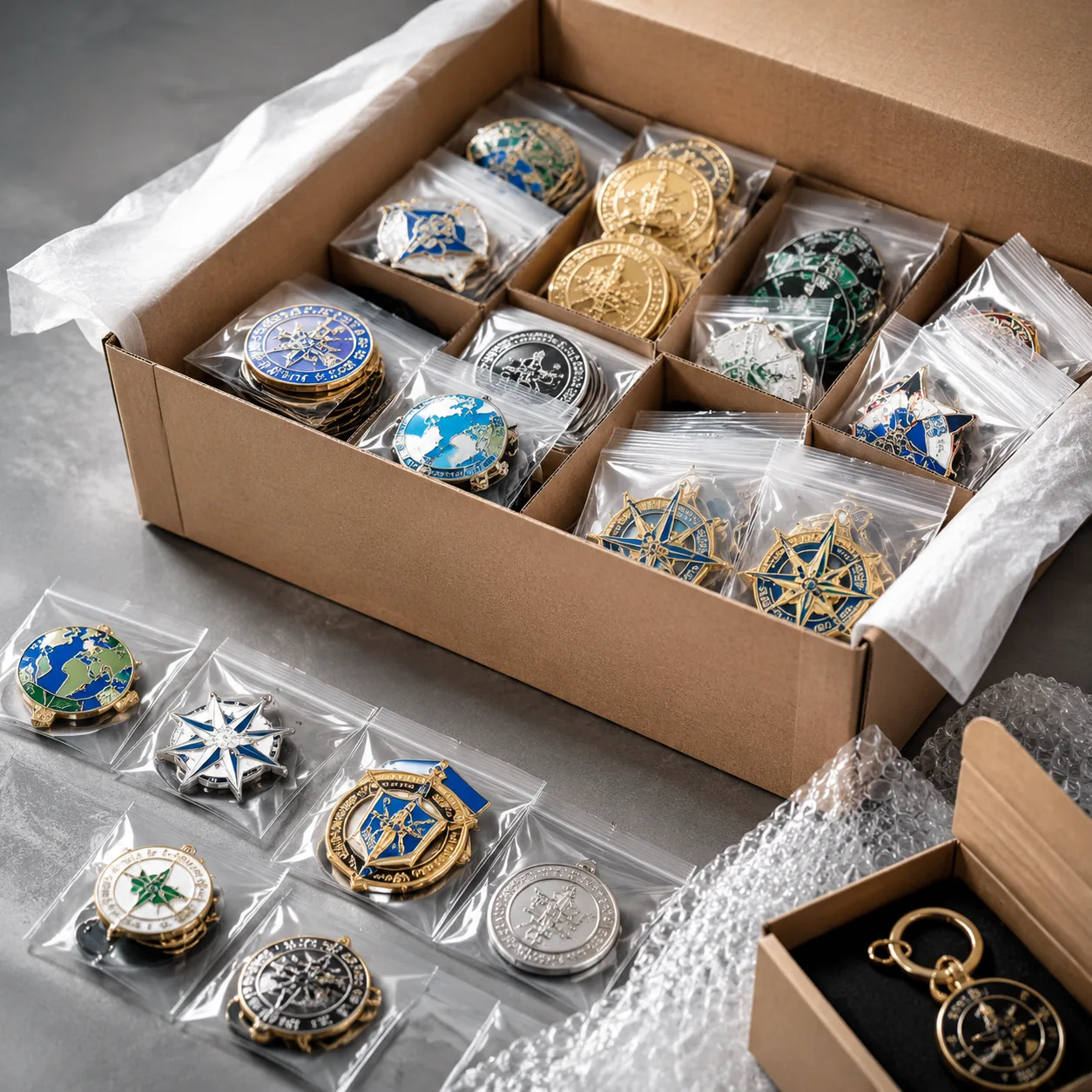
For metal promo items, packaging is usually the safest first swap. Replacing SBS card plus individual OPP bags with FSC-certified backing cards, paper bands, glassine sleeves, or controlled bulk pack can cut virgin plastic use without changing die line, clutch style, enamel fill, or plating workflow. On a 25-32 mm soft enamel pin quoted at US$0.38-0.95 FOB at 300 pcs, a paper-based pack-out change normally adds only US$0.01-0.03 per unit and often adds no production days if the card format stays within the factory's standard print size.
Recycled-metal claims require more discipline. Some suppliers can buy zinc alloy with recycled content, but fewer can support the claim by lot. If the brief requires a recycled-content statement, the PO should specify the alloy family, whether the claim is pre-consumer, post-consumer, or mixed, and what documentation supports it: upstream mill certificate, material supplier declaration, or internal blending statement. "Eco metal" is too vague to survive a customer audit.
The core engineering specs for promo-grade soft enamel pins usually do not change after a packaging-only swap. Typical thickness is 1.2-1.5 mm for basic giveaway pins and 1.5-1.8 mm for larger pieces above 35 mm or for a more premium hand feel. Decorative nickel, gold, black nickel, and antique finishes in this category are commonly 0.03-0.08 micron; they are cosmetic finishes, not wear plating. Dimensional tolerance on die-struck logo geometry is commonly around ±0.15 mm, and AQL 2.5 major / 4.0 minor remains the standard inspection level for this market.
The common mistake is adding a sustainability story to a finish-sensitive item without redefining risk. If the product needs jewelry-like polish, mirror-flat imitation hard enamel, or repeatable antique contrast across reorders, stabilize the metal, plating vendor, and pack-out first. Then make lower-risk gains in card stock, bag reduction, clutch count, or master-carton density.
RPET textiles: the most practical 2026 swap for lanyards and selected patches
RPET remains the most commercially mature textile substitution in promo goods. Supply is broad, visual differences versus standard polyester are usually small, and the change rarely requires new tooling. For lanyards, the most stable build is still a 20 x 900 mm folded sublimation strap, 0.9-1.1 mm thick, with swivel hook or lobster hook, plus optional safety breakaway and buckle release. At 500 pcs, a standard virgin-polyester version typically lands at US$0.45-0.95 FOB; RPET usually adds 4-12%, depending on width, hardware count, print coverage, and whether the webbing is stock white for sublimation or custom dyed before weaving.
The main trade-off with RPET is lot consistency, not everyday usability. Yarn whiteness, stiffness, and hand feel can vary slightly between batches, which matters for strict brand color programs. For orders above 5,000 pcs, or for accounts that control Pantone matching tightly, approve a strike-off on the actual webbing lot under D65 lighting rather than relying on a screen proof or an older standard-polyester sample. If the buyer's internal tolerance is below ΔE 2.0, put that approval method in the RFQ; otherwise many factories will treat color as visual-only approval.
For patches, the choice should follow artwork and use condition. Woven patches are usually better than embroidery when the design includes thin outlines, small text, or internal gaps around 0.5-0.7 mm. RPET embroidered patches work well for events, schools, clubs, and lifestyle merchandise, but thread palettes may be narrower than standard polyester embroidery and dense fill areas may show slightly less uniform sheen. Merrow borders are cheaper and hide edge irregularity well, but limit the shape to simpler outlines. Heat-cut edges suit angular or custom silhouettes, with edge tolerance typically around ±1 mm.
PVC should not be eliminated automatically. If the patch will face repeated flex, wet conditions, mud, or heavy abrasion on bags, uniforms, or outdoor gear, PVC may still be the better engineering choice. In that case, the more credible lower-impact move is often to keep the PVC patch and change the backing card, bag, or shipping configuration instead of forcing a textile construction that underperforms in use.
Magnets and keychains: specify the function, not just the face material
Magnets and keychains produce some of the fastest buyer complaints because the alternative material often photographs better than it performs. A cork-faced magnet with underspecified ferrite stock looks attractive in a quote sheet and fails on a refrigerator door. A recycled felt key fob may present a stronger marketing story than PVC, but if the seam opens, the edge pills, or the split ring deforms under daily use, the item stops representing the brand well.
For strap keychains, lock the construction numerically in the PO. A dependable promo baseline is 20-25 mm webbing width, 0.9-1.2 mm thickness, folded loop with at least 10-12 mm overlap, and box stitch or bar-tack reinforcement depending on strap width. Split ring wire diameter should usually be 1.6-1.8 mm for daily-use key sets; lighter rings feel weak and distort faster. At 500 pcs, US$0.42-1.10 FOB is common depending on hardware, attachment method, and print style, with RPET webbing typically adding 6-12% and cork or felt constructions adding 10-20%.
A simple factory test makes keychain quality less subjective: apply a 7-10 kgf pull load for 10 seconds at the stitched loop and confirm no seam opening, fabric tear, or ring detachment. That is not a formal laboratory standard, but it is practical and repeatable for promo-goods production.
For magnets, ask for the full stack-up rather than only the face material. The supplier should confirm face layer, insert stock or print method, adhesive type, magnet composition, and magnet thickness. A 60 mm tinplate-shell souvenir magnet with paper insert and ferrite backing is often a low-risk swap from PVC-top flexible magnet styles. Wood-, bamboo-, or cork-faced versions can look more premium but introduce grain variation, edge chipping, longer adhesive cure time, and higher appearance rejects. Ferrite sheet in the 0.4-0.8 mm range is common; moving thinner may save a few cents while reducing hold enough to trigger complaints.
If magnet performance matters, request a use-based pass/fail test instead of theoretical pull-force data. For example: approved sample must hold on a vertical painted steel panel for 24 hours without sliding and must support one 80 gsm A6 sheet without dropping. That requirement is usually clearer than an unverified pull-force number from a small factory.
What the swap really does to budget, MOQ, and schedule
Most lower-impact swaps in this category add a moderate premium, not a dramatic one. Buyers still underbudget because they focus on unit FOB only and ignore sampling, lot-specific sourcing, reject rates on natural surfaces, slower pack-out, and more detailed QC. The real delta should be considered across sample approval, mass production, and packing labor.
As a planning guide for 2026, RPET lanyards are commonly 4-12% above standard polyester at 500-3,000 pcs. RPET or recycled-fiber key straps usually add 6-18% depending on stitch reinforcement, hardware count, and whether the webbing is stock white, stock dyed, or custom dyed. FSC cards and paper sleeves are often the lowest-cost upgrades, commonly adding just US$0.01-0.05 per unit once volume exceeds 1,000 pcs. Natural materials such as cork, bamboo veneer, MDF face layers, and felt often add 10-20% because yield loss, surface selection, and manual finishing are less predictable.
Lead time shifts unevenly. Standard metal items with unchanged tooling can still ship in 12-18 production days after sample approval. Lanyards and woven patches often remain in the 10-15 day range at normal volumes. But special-order RPET yarn shades, custom die-cut paper structures, hook-backing conversion on patches, or layered magnet assemblies can add 2-5 working days. If the order is event-driven, test one converted SKU first, freeze the bill of materials, and reuse that exact BOM for reorders instead of reopening material choices every cycle.
MOQ can also move by component even when the finished-goods MOQ appears unchanged. A lanyard supplier may quote 300 pcs overall but require roughly 1,000-3,000 meters of a special dyed RPET yarn lot for exact shade control. A print vendor may accept 500 paper sleeves but require 1,000 custom FSC cards because of sheet setup and print efficiency. Ask what is actually driving the MOQ: material lot, outsourced print minimum, hardware color, or setup method.
QC checkpoints to tighten after any material substitution
Lower-impact specs often widen acceptable variation in color, texture, edge finish, and hand feel because recycled and natural inputs are less uniform than commodity virgin materials. That makes the inspection plan more important, not less. If a factory says the new version is "basically the same," the PO should become more specific, not more relaxed.
- Lock the material in the PO by exact name and measurable spec: for example, RPET webbing 20 mm width ±1 mm, thickness 1.0 mm ±0.1 mm, nickel swivel hook, black breakaway buckle.
- Approve one physical pre-production sample for color, hand feel, stitch quality, edge finish, hardware function, and pack-out. Digital proof is not enough for substituted materials.
- Set inspection criteria before production. AQL 2.5 major / 4.0 minor is common, but define major defects clearly: wrong material claim, delamination, weak stitching, odor, missing hardware, plating rub-through, or magnet hold failure.
- For plated pins or coins without polybags, run a transit rub test in the selected pack-out so card edges, clutches, or adjacent units do not scratch the face during shipment.
- For cork, wood, bamboo veneer, or felt, define acceptable grain, pore pattern, shade variation, edge roughness, glue squeeze-out, and chip tolerance in writing so natural variation does not become a post-shipment dispute.
- If packaging changes reduce cushioning or change weight distribution, review inner-carton count, divider use, polyfoam or tissue need, and outer-carton drop protection before mass production.
For larger brand programs, add an inbound batch check after factory QC: count, color, attachment function, packaging consistency, and claim labeling. Sustainable conversions often fail cumulatively rather than through one dramatic defect. Slightly lighter webbing, slightly weaker magnet stock, and slightly rougher card edges can each pass individually while making the finished item feel cheaper overall.
Best 2026 swaps by buyer type—and how to convert one SKU without creating a new problem
Promotional distributors usually benefit most from the least disruptive swap with the easiest sales story. That keeps RPET lanyards and FSC-based pack-out at the top of the list because they are easy to explain, widely available, and low-risk in production. Brand teams may accept higher premiums for more visible stories such as cork-face magnets or recycled felt key fobs, but those should be reserved for light-duty applications where functional demands are modest. Procurement teams managing repeat buys should prioritize swaps that preserve die line, width, hardware, and assembly sequence so the approved BOM remains stable across reorders.
Event organizers with fixed in-hands dates should be the most conservative. Avoid first-time natural materials in the final two weeks before ex-factory date, and avoid conversions that depend on special sourcing unless there is slack for sample approval. The most reliable 2026 swaps remain RPET sublimation lanyards for event use, FSC backing cards and glassine sleeves for pins and coins, and woven patches replacing PVC only when waterproofing and abrasion resistance are not critical.
The best next step is to convert one simple SKU, not the whole line. Keep artwork, dimensions, and hardware unchanged so the trial isolates the material change. Then send a short RFQ with the current spec, exact proposed swap, MOQ tier, target FOB, required lead time in calendar or working days, pack-out method, and documentation requirement for any recycled or FSC claim. Ask for one pre-production sample and one mass-production quote built to the same carton standard and AQL as the current version. If the sample passes function, finish, and transit pack-out, lock the BOM and reuse that exact structure for reorder business. The best sustainable upgrade is not the boldest claim; it is the one a buyer can reorder consistently without reopening quality arguments every time.
Have a project? Send your artwork and target quantity and we’ll reply with a detailed quotation within 12 working hours.
Ready to get this made?
Send your sketch, target quantity and ship-date. Detailed quotation in 12 hours.



