Sustainable Material Swaps for Custom Promo Products in 2026
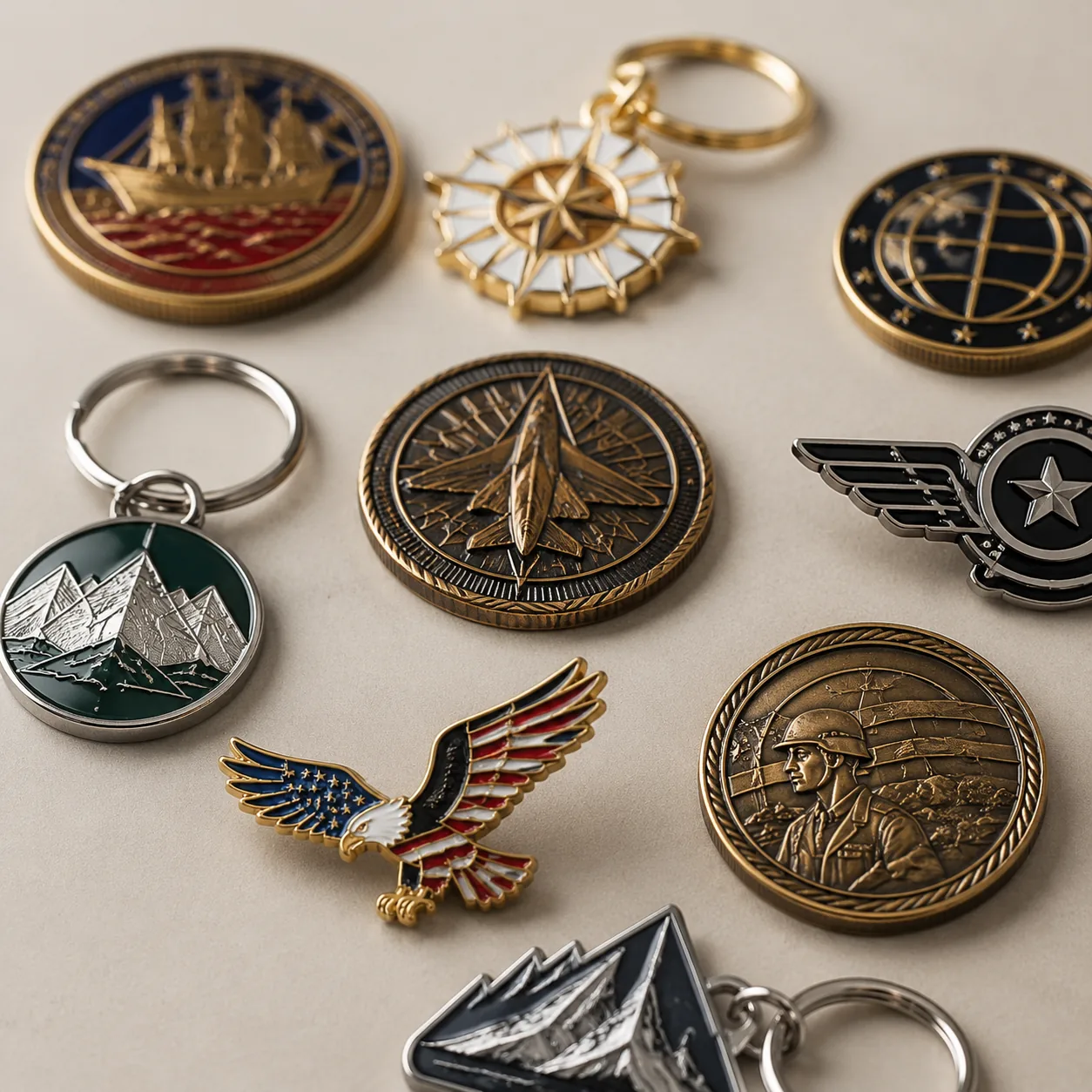
1. Map the Swap Zones Before You Specify Materials
Most rework on sustainable promo projects starts when buyers request an 'eco version' without defining which components can change without breaking function, finish, budget, or lead time. Split the product into five swap zones: base material, decoration method, attachment hardware, packaging, and freight density. This yields a realistic path to reduce virgin plastic, plating chemistry, or mixed-material waste without turning a durable giveaway into a short-life item.
For custom pins, coins, and brooches, the metal body is already durable. The highest-impact practical swaps are usually in backing cards, polybags, PVC pouches, and attachment choices rather than the badge itself. For keychains, lanyards, and patches, material substitution has more room because the product contains larger non-metal areas. At the factory level, the useful question is not 'do you have eco materials' but 'which component can we swap while keeping AQL, color control, pull strength, and delivery date stable?'
2. Metal Products: Simplify the Material Mix, Don't Weaken the Body
For enamel pins, brooches, challenge coins, or fridge magnets, the most reliable 2026 sustainability move is simplification, not reinvention. Zinc alloy, iron, brass, and stainless steel remain practical because they stamp or cast consistently, hold fine lines down to 0.2 mm, and survive years of use. Replacing metal with lower-strength alternatives usually creates denting, edge damage, or weak attachment retention—a poor trade if the item fails early and must be remade.
Reduce complexity around the metal. Eliminate mixed-material inserts, avoid unnecessary acrylic windows, switch from PVC pouches to FSC paper cards, and combine the same finish across a full order to reduce small-batch plating changes. For a 35 mm hard enamel pin at 1.5 mm thickness, a typical MOQ is 100 pcs, lead time is 12–18 days after artwork approval, and FOB ranges from USD 0.42–0.95 depending on plating, colors, and packaging. The greener win here is usually packaging reduction, not changing the pin body.
When not to push the swap: if your design needs mirror plating, deep 3D relief under 0.25 mm tolerance, or a long shelf life in humid retail channels, stay with proven metal plus controlled plating. Standard decorative plating thickness is 0.03–0.08 microns for gold or nickel appearance finishes. Functional anti-tarnish topcoats matter more than claiming the product is 'eco'. AQL 2.5 for major defects and 4.0 for minor defects remains a sensible inspection baseline for branded metal giveaways.
3. Keychains: Focus the Swap on the Largest Non-Metal Surface
Keychains are where buyers often overcomplicate the brief. If the logo panel is small but the strap, body, or insert is large, focus the swap there. Recycled zinc alloy can work for cast bodies, but the bigger wins come from replacing virgin acrylic, PVC, or PU leather with recycled acrylic, RPET strap material, FSC paper inserts, or certified recycled paper cards. Keep standard steel split rings and jump rings for reliability.
| Product type | Practical swap in 2026 | Typical MOQ (pcs) | Lead time (days) | FOB range (USD) | Main trade-off |
|---|---|---|---|---|---|
| Metal keychain with charm | Replace virgin acrylic/PVC add-on with recycled acrylic or FSC paper card insert | 100–300 | 12–20 | 0.65–1.60 | Recycled acrylic can show slightly more flow marks or color haze (Delta E 1.5–2.5) |
| Wristlet keychain | Swap polyester strap to RPET webbing, keep metal ring standard | 300–500 | 15–22 | 0.70–1.80 | Pantone match can drift by Delta E 1.5–2.5 vs virgin polyester |
| PVC keychain | Switch to layered recycled-content acrylic or zinc alloy if detail allows | 300+ | 15–25 | 0.80–1.90 | Loses soft-touch feel and 3D molded character |
| Leather-look key fob | Use recycled leather fiber or FSC paper composite instead of PU | 300–500 | 18–28 | 0.90–2.20 | Edge wear and water resistance may be weaker than PU |
Hardware is the wrong place to economize aggressively. A split ring should be carbon steel or stainless steel, 25–32 mm outer diameter with wire thickness 1.4–1.8 mm. Lobster clasps must pass pull checks and close cleanly. On incoming and pre-ship QC, ring gap consistency, plating adhesion, and jump ring closure affect returns far more than whether the charm panel contains recycled content.
4. Lanyards and Patches: Recycled Fibers Work Within Defined Color and Handfeel Limits
Lanyards are one of the easiest categories for sustainable swaps because the fabric area is large and the functional requirement is simple: tensile strength, print legibility, and skin comfort. RPET sublimation lanyards are a standard 2026 option for event and corporate use, typically at 15 mm or 20 mm width, 900 mm total length folded, with an MOQ of 300 pcs. Lead time is 10–16 days for standard hardware, and FOB ranges from USD 0.35–0.85 depending on safety breakaway, buckle, and print coverage.
The trade-off is color and texture control. RPET yarn prints well, but exact spot-color expectation should be looser than on high-grade virgin polyester. If your brand team needs a dead-on deep navy or fluorescent red, approve a physical color standard early. For patches, recycled-fiber woven grounds and RPET merrow thread are possible, but embroidered patches with dense fill (>70% coverage) can show greater lot-to-lot shade variance than standard polyester thread.
Buyers get stuck combining too many requirements: recycled yarn, exact Pantone, low MOQ, custom hardware color, and rush dispatch. Usually only three of those can be optimized at once. If the project is event-driven, prioritize timing and attachment reliability over squeezing the highest recycled-content claim into every component.
5. Avoid Swaps That Create Hidden Failure Modes
Some substitutions look good in a presentation deck but create problems in the field. Paper composite tags on keychains can swell at the hole under humidity if the eyelet area is not reinforced. Thin bamboo or wood veneer badges can crack at pin posts. Low-density cork can shed edges after bag abrasion. The test is simple: will the swapped material survive 90 days of handling, drops, rubbing, and climate exposure in the actual channel?
For practical factory control, request a mini validation plan before approving any new material: adhesion test for print layers (minimum 5 N peel force), 24-hour humidity hold at 40°C/90% RH, ring pull test (minimum 10 kg for split rings), edge abrasion rubs (100 cycles with 1 kg load), and carton drop simulation from 1.2 m. On brooches and pins, post-solder or glue areas should hold within a normal alignment tolerance of ±0.5 mm, and attachment pull failures must be treated as major defects. If the swap introduces a brittle layer, a porous edge, or a coating that scratches below normal AQL limits, it is not a good swap.
- Reject any 'eco' proposal that removes protective finish from outdoor or high-touch items.
- Do not switch to untested paper, cork, or wood around pin posts, eyelets, or magnet glue zones.
- Ask whether the substitute changes line-width limits, edge radius, or fill-depth consistency.
- Require a pre-production sample if recycled content exceeds what the factory normally runs.
- Use the same inspection plan as standard product: appearance, function, count, packaging, and drop resistance.
6. Packaging: The Fastest Path to a Measurable Improvement
If your internal team needs a lower-impact version fast, start with packaging because it rarely changes product performance. Replace individual OPP bags with bulk partition packing where the finish allows it, switch PVC pouches to paper envelopes, and reduce layered inserts. For pins and coins, a 300–350 gsm FSC paper backing card with soy-based or standard offset ink is simpler, cheaper, and easier to approve than redesigning the metal item itself.
Typical packaging swaps reduce both plastic use and carton volume. For 1,000 pins packed on backing cards, changing from card plus polybag to card-only in layered export cartons can shave several kilograms of packing weight and improve pack-out speed. FOB packing cost often drops by USD 0.02–0.08 per unit. The caution is surface protection: mirror-polished or black-nickel finishes scratch more easily in bulk, so keep individual bags for premium plating or use tissue separators.
When buyers want a practical sustainability adjustment without delaying launch, packaging is often the first recommendation because it needs less tooling change and fewer approval rounds. It also works across multi-item programs, so your pin, keychain, patch, and lanyard can ship with a consistent lower-waste presentation. That matters more operationally than making one hero item eco while the rest of the set remains overpacked.
7. Compare Total Landed Risk, Not Unit Price Alone
A sustainable swap that adds USD 0.06 per unit but removes a second packaging step or reduces airfreight cube can be a better commercial decision than a cheaper standard build. Compare four numbers together: unit FOB, tooling delta, lead-time delta, and defect risk. Recycled or alternative materials may carry slightly higher raw-material cost, but if they cut assembly complexity or help consolidate SKUs, the total program can still improve.
Use realistic planning ranges. New material qualification can add 3–7 days if sampling is required, and mixed-material products often need a tighter golden-sample process before mass production. If your program has a firm in-hands date, build the swap only where approval is fast. For example, RPET lanyard webbing or paper packaging can be approved quicker than a new recycled leather composite for key fobs.
| Buyer priority | Best swap zone | Why | When not to use it |
|---|---|---|---|
| Fast launch | Packaging | Low tooling risk, quick approval, broad SKU coverage | Premium polished items needing individual scratch protection |
| Strong sustainability message | Large non-metal area such as lanyard strap or keychain insert | Visible to end user and easier to explain internally | If exact brand color is non-negotiable |
| Lowest defect risk | Keep standard hardware and base metal, simplify extras | Protects functional performance and QC stability | If current packaging is causing damage or excess cost |
| Budget control | Material reduction plus bulk packing | Can lower pack cost and freight cube | If retail presentation requires unit-level bagging or premium boxes |
8. Brief Your Factory with a Ranked Swap Hierarchy
Do not ask for a generic eco option. Send a ranked brief listing what matters most: product life, recycled content, plastic reduction, Pantone accuracy, target FOB, MOQ, and in-hands date. Then ask the factory to propose one low-risk swap, one medium-risk swap, and one aggressive swap with clear differences in cost, lead time, and QC risk.
A practical RFQ note might read: '1,000 pcs, 35 mm pin or 20 mm RPET lanyard, target FOB under USD 0.80, no added lead time beyond 18 days, maintain AQL 2.5/4.0. Propose packaging reduction first, then recycled-content options that do not reduce attachment strength.' That format gets you usable answers instead of marketing language. It also lets a factory suggest component-level alternatives based on the actual process route rather than guessing what your sustainability team wants to hear.
If this is your first sustainable-material run, qualify one SKU before rolling the change across a full range. Approve a physical pre-production sample, lock the material callouts on the PO, and record any accepted trade-offs such as slight color drift or texture variation. The best 2026 sustainable promo programs are not the ones with the boldest claims; they are the ones that reduce waste or virgin material while still shipping on time, passing inspection, and lasting long enough to be worth making.
Have a project? Send your artwork and target quantity and we’ll reply with a detailed quotation within 12 working hours.
Ready to get this made?
Send your sketch, target quantity and ship-date. Detailed quotation in 12 hours.



