Sustainable Material Swaps for Custom Promo Products in 2026
Q: Where do sustainable swaps reduce impact without creating quality problems?
The best question is not "What is the greenest material?" but "Which construction change reduces virgin plastic, mixed-material waste, or disposable packaging without increasing defects, returns, or reorder variation?" For custom promo products in 2026, the safest gains still come from controlled substitutions rather than full redesigns.
For most B2B orders in the 300-10,000 piece range, the lowest-risk upgrades are consistent: rPET webbing instead of virgin polyester on lanyards, woven or embroidered patches instead of PVC where artwork allows, recycled or FSC-certified paper packaging instead of individual OPP bags, and simpler metal-forward assemblies that remove extra acrylic, foam, or PVC layers. These swaps usually preserve function, artwork position, and tooling logic while cutting plastic use and freight cube.
The weak candidates are materials with a good sustainability story but poor field durability. Cork veneers, low-density bamboo laminate, layered paper composites, and some reclaimed-fiber boards can pass approval photos yet chip, swell, fuzz, or delaminate in pocket use. If the item will be clipped to keys, exposed to sweat, packed tightly in export cartons, or handled daily, durability matters more than a generic eco label.
In practice, a good sustainability project is often a small engineering edit: remove the individual polybag, switch to 350-400 gsm recycled backing cards, specify 0.9-1.1 mm rPET lanyard webbing, replace a molded PVC patch with a woven patch, or simplify a keychain from three bonded materials to one die-cast metal body plus one insert. Those changes lower waste without forcing a new process family or a long qualification cycle.
Q: Which sustainable material swaps are realistic by product type in 2026?
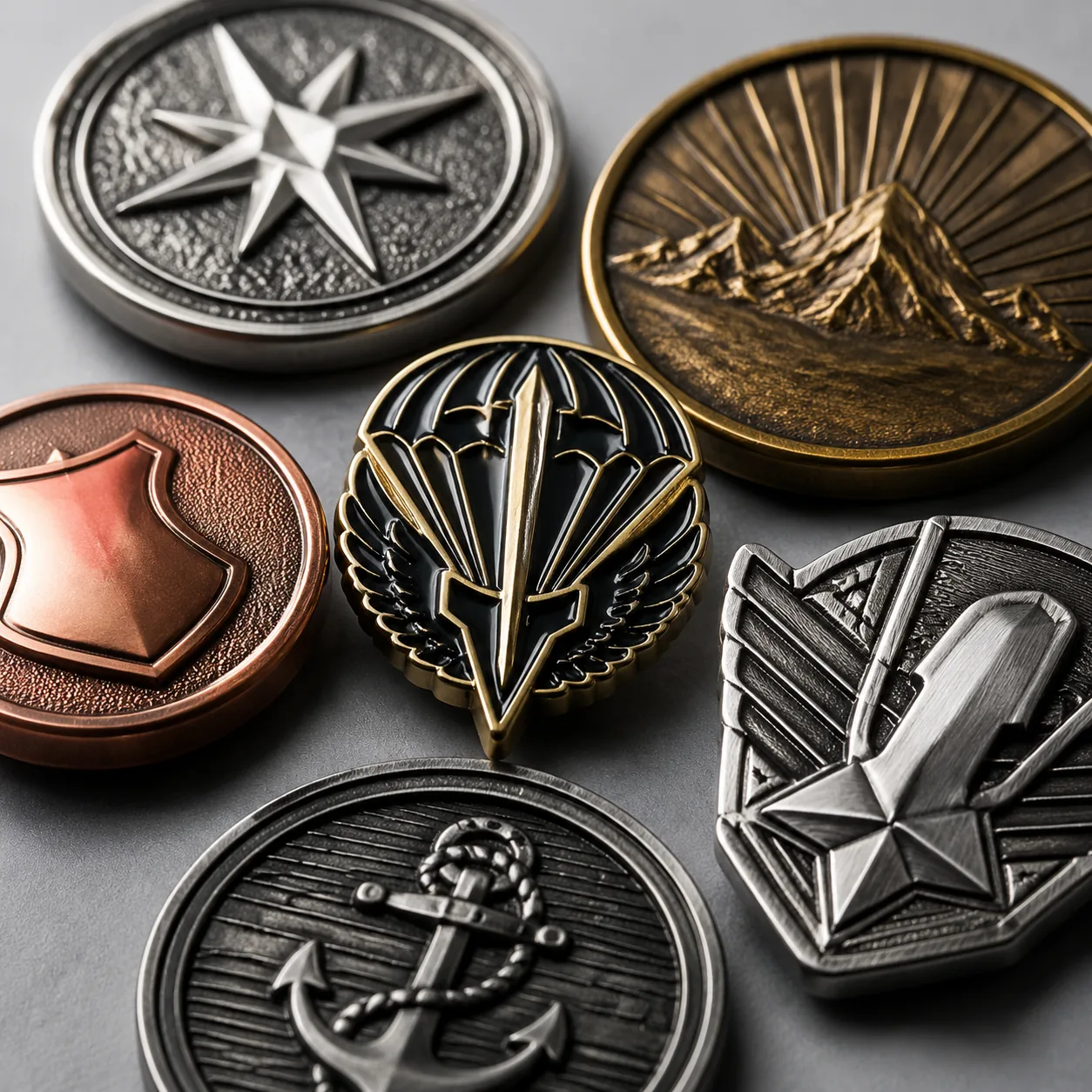
Different product families offer different substitution potential. Pins, badges, coins, and brooches are still mainly metal products, so the practical levers are service life, lower-plastic packing, simpler assemblies, and stable plating quality rather than inflated recycled-content claims. Lanyards, patches, magnets, and some keychains contain more textile, resin, paperboard, or flexible plastic, so they provide more meaningful material-swap opportunities.
| Product type | Best practical 2026 swap | Typical production spec | MOQ | FOB impact vs standard |
|---|---|---|---|---|
| Enamel pin | Keep iron or brass body; remove OPP bag; use 350-400 gsm recycled/FSC backing card; claim recycled base metal only if declared by component | Body 1.2-1.8 mm; plating 0.03-0.08 microns decorative finish; color fill tolerance ±0.15 mm; edge burr-free; AQL 2.5 major / 4.0 minor | 300 pcs | 0 to +8% |
| Keychain | Zinc alloy or iron body with FSC wood, bamboo plywood, or recycled paper insert instead of acrylic/PVC charm stack | Body 2.0-4.0 mm; ring 25-30 mm OD, wire dia. 1.8-2.2 mm; insert tolerance ±0.15-0.20 mm; adhesive contact width minimum 3 mm | 300 pcs | +3% to +15% |
| Fridge magnet | Tinplate face or laminated paperboard face with ferrite sheet instead of molded PVC magnet | Tinplate 0.23-0.30 mm plus ferrite 0.7-1.0 mm; bow tolerance max 2 mm per 100 mm; print registration ±0.20 mm | 500 pcs | -5% to +10% |
| Patch | Woven or embroidered patch on rPET twill or recycled polyester base instead of PVC patch | Finished thickness 0.6-1.5 mm; minimum text height 3.0-4.0 mm woven, 4.0-5.0 mm embroidery; merrow, laser, or heat-cut edge | 300 pcs | 0 to +12% |
| Lanyard | rPET webbing instead of virgin polyester with same hardware and breakaway option | Width 15/20/25 mm; thickness 0.8-1.2 mm; width tolerance ±1 mm; folded length typically 450 mm per side | 300 pcs | 0 to +6% |
| Badge or brooch | Metal body with mechanical clasp instead of decorative acrylic lamination or plastic build-up | Body 1.5-2.0 mm; pin length 8-20 mm; clasp retention check required; approved visual standard for plating consistency | 300 pcs | 0 to +10% |
For pins and coins, buyers often overfocus on recycled metal percentages that are hard to verify at finished-product level. In most sourcing programs, a better result comes from tighter finish control, burr-free edges, durable posts and clutches, and lower-plastic packing. A 25 mm pin that still looks good after 24 months of use is usually the lower-impact outcome than a fragile alternative with a higher reject rate and earlier replacement.
Lanyards are much more straightforward. rPET webbing performs close to standard polyester for sublimation, screen print, and heat transfer in 15 mm, 20 mm, and 25 mm widths. Stock-color programs usually run 10-14 days after artwork approval; custom PMS dyeing, detachable buckle sets, or alternate attachments often move production to 12-18 days. The most common failures are not in the rPET yarn itself but in weak stitching, low-grade swivel hooks, and inconsistent breakaway release force.
Q: When should buyers avoid a sustainable material swap?
Avoid forcing a swap when the item faces high wear, outdoor exposure, moisture, safety-sensitive use, or artwork already close to process limits. A trade-show keychain can tolerate some cosmetic aging. A staff ID accessory used daily for access control cannot. The same rule applies to magnets shipped into hot, humid markets and patches expected to survive repeated washing, abrasion, or industrial uniforms.
Natural or recycled substrates also become risky when the design requires tight process performance. Examples include mirror plating, exact Pantone matching on absorbent surfaces, die-struck lines below 0.25 mm, woven characters below 3 mm cap height, or sharp laser-cut openings in layered fiber materials. Recycled textiles, wood, and paper composites naturally introduce grain shift, flecking, minor shade variation, and rougher edges. Those characteristics can look premium on simple logos but work poorly for miniature or highly technical artwork.
Another reason to stay conservative is compliance. Child-directed giveaways, skin-contact wearables, magnetic items, and airport-security accessories can each trigger different chemical, pull-force, or packaging requirements depending on destination market. In those cases, keep the core product architecture proven and shift the sustainability effort to packaging, backing cards, carton efficiency, or the removal of non-critical decorative plastics. That usually cuts risk faster than redesigning the main item around an unproven substrate.
Checklist: What should procurement confirm before approving a greener option?
- Ask for the exact base material by component: webbing, body, insert, patch base, backing, ferrite, adhesive, and packaging. Do not accept a generic "eco material" label.
- If recycled content is claimed, request the percentage by component or by product weight. Example: webbing 100% rPET yarn, backing card 80% recycled fiber, ferrite unchanged.
- Confirm measurable specs and tolerances. Typical metal body tolerance is ±0.10 mm, lanyard width tolerance ±1 mm, wood or paper insert tolerance ±0.15-0.20 mm, and printed card stock tolerance ±5% GSM.
- Check artwork limits before sampling: minimum line width, minimum text size, maximum color count, embroidery coverage, and edge treatment.
- Request finish durability data for plated parts: plating thickness in microns, whether a clear protective topcoat is used, and whether anti-tarnish paper is sufficient instead of individual bagging.
- Confirm MOQ by variant, not just by product family. Stock rPET lanyards may start at 300 pcs, but custom-dyed webbing, FSC rigid boxes, or selected-grain wood inserts can move MOQ to 500-1,000 pcs.
- Ask for the lead-time effect in calendar days. Alternate inserts, custom paperboard, or non-stock hardware usually add 2-5 production days beyond a standard run.
- Set the inspection plan in writing. A practical default is AQL 2.5 major and 4.0 minor, plus photo examples of what counts as acceptable natural variation.
- Review whether the new construction creates a harder-to-recycle mixed assembly. A simple metal body or paperboard magnet is usually preferable to a stack of metal, glue, foam, acrylic, and PVC.
- Check reorder stability. Ask whether the same webbing shade, wood tone range, ferrite thickness, ring size, and backing card stock can be commercially repeated on the next PO.
Q: How do sustainable swaps change cost, MOQ, and lead time?
Most sustainable options in 2026 are cost-neutral to moderately more expensive, not dramatically cheaper. In the 300-5,000 piece range, extra cost usually comes from lower raw-material availability, slower assembly, extra proofing, or protective packing for visible natural inserts. The right comparison is total landed outcome: FOB price, sample cycle, reject risk, freight cube, and schedule stability.
Example 1: a 25 mm custom zinc alloy keychain at 3.0 mm thickness with nickel plating and a 30 mm split ring typically runs USD 0.65-1.10 FOB at 500 pcs. A zinc alloy frame with an FSC wood insert usually runs USD 0.80-1.30 FOB because of insert cutting, sanding, grain sorting, and secondary assembly. Example 2: a 20 mm soft enamel iron pin with butterfly clutch at 500 pcs often stays around USD 0.45-0.85 FOB even after replacing the OPP bag with a 350 gsm recycled backing card, because tooling, stamping, and fill processes remain unchanged.
Lead times depend more on process family than on the word sustainable. Straightforward metal pins, challenge coins, and tinplate magnets generally stay in the 10-18 day range after artwork approval if tooling is simple. rPET lanyards commonly run 10-16 days. Woven or embroidered patches are usually 9-14 days. Wood-insert keychains are commonly 12-18 days. Add 2-4 days for a pre-production sample and another 2-3 days if custom paper packaging needs die-line or structural approval.
| Item | Standard spec | Greener swap | Typical FOB at 500 pcs | Lead time after approval |
|---|---|---|---|---|
| 20 mm soft enamel pin | Iron, 1.5 mm, butterfly clutch, OPP bag | Same pin plus 350 gsm recycled card, no OPP bag | USD 0.45-0.85 | 10-15 days |
| 25 mm metal keychain | Zinc alloy, 3.0 mm, split ring | Zinc alloy frame plus FSC wood insert | USD 0.80-1.30 | 12-18 days |
| 20 mm fridge magnet | Molded PVC magnet | Tinplate face plus 0.7-1.0 mm ferrite sheet | USD 0.30-0.70 | 10-14 days |
| 75 x 25 mm patch | PVC patch with sewing line | Woven patch with heat-seal backing | USD 0.35-0.90 | 9-14 days |
| 20 mm lanyard x 900 mm folded | Virgin polyester sublimation with metal hook | rPET sublimation with same hook and breakaway | USD 0.50-1.00 | 10-16 days |
MOQ changes are usually driven by decoration method and raw-material batching. Stock-color rPET lanyards often start at 300 pieces. Custom PMS-dyed rPET webbing is more commonly 500 pieces and may reach 1,000 pieces on less common widths or hardware combinations. Woven patches can start at 300 pieces for one design, but multiple small variants may be costed separately if each design needs an individual loom setup. Wood-insert keychains may quote at 300 pieces, but if the buyer wants grain control, kraft sleeves, or tighter cosmetic sorting, the commercial minimum often moves upward.
Below 300 pieces, the best sustainability gain is often packaging reduction rather than a custom material run. Removing the polybag, consolidating inner packs, and standardizing a recycled backing card can save material immediately without adding the MOQ or lead-time burden of a non-stock substrate.
Q: What quality-control points change when you switch materials?
Alternative materials do not fail the same way as conventional ones, so the QC plan has to change with the build. Recycled textiles can show lot-to-lot shade drift. Woven patches can lose micro-detail compared with PVC. Wood inserts vary in grain direction, pore visibility, and ink absorption. Paperboard magnets can warp if packed before full adhesive cure or stored above roughly 60-65% RH. These are not automatic defects, but the acceptable range has to be defined before production starts.
For mixed-material products, assembly quality is usually more important than the sustainability claim. Adhesive bond zones must be wide enough for real handling; on small accessories, a 3-5 mm adhesive contact width is a practical minimum. Bonding surfaces should be clean and oil-free, and the factory should confirm full cure time before bulk packing. If the item includes split rings, lobster hooks, pin posts, breakaways, or magnet plates, require functional checks by batch rather than visual inspection alone.
A workable finished-goods inspection standard is AQL 2.5 for major defects and 4.0 for minor defects. Major defects typically include wrong artwork, detached hardware, sharp burrs, obvious delamination, failed stitching, breakaway misassembly, detached magnets, or plating flake visible at arm's length. Minor defects can include limited wood-tone variation, small recycled-paper flecks, slight webbing shade movement within approved tolerance, or shallow flow marks that do not affect function. On plated metal parts, request anti-tarnish storage only where the finish needs it; excessive separate bagging can cancel much of the packaging-reduction benefit.
For lanyards, measurable checks are better than vague promises. Useful criteria include hook gate closure, stitch count at attachment fold, breakaway release consistency, print centering within ±1.0 mm, and edge fray control after a simple hand-pull test. For patches, check edge sealing, backing adhesion, and whether text below the approved minimum has filled in. For metal items, ask for post alignment, clutch fit, edge smoothness, and plating consistency against the approved sample.
Q: How should you write the RFQ so suppliers quote the same sustainable option?
Many sourcing rounds fail because one supplier quotes true rPET, another quotes standard polyester, and a third quotes an undeclared blend. The RFQ should separate mandatory requirements from optional improvements and lock the construction tightly enough that quotes are comparable.
A strong RFQ line should state size, construction, material, thickness, finish, attachment, packing, inspection level, and whether substitutions are allowed. Example for a lanyard: 20 mm width x 900 mm folded length; rPET webbing thickness 0.9-1.1 mm; double-sided sublimation; nickel swivel hook; one safety breakaway; no individual polybag; pack 50 pcs per inner bag; 500 pcs total; pre-production photo or courier sample required. Example for a pin: 25 mm die-struck iron; 1.5 mm thickness; soft enamel; black nickel plating 0.03-0.05 microns plus clear topcoat; two posts; black rubber clutches; 350 gsm recycled backing card; no OPP bag; AQL 2.5 major / 4.0 minor.
If recycled content matters commercially, ask only for evidence your team will actually use: a product-level material declaration, identification of which component contains recycled content, and the packing specification. Where appearance is critical, require approval against a physical sample rather than a general claim sheet. That keeps the discussion on verifiable construction instead of broad sustainability marketing language.
What to do next: a practical shortlist before you place the PO
Start with one high-volume item where the change is visible but technically low-risk. For most buyers, that means lanyards, backing cards, patch material, or retail-style packaging before changing the core construction of a premium pin, coin, or badge. Run a pilot SKU at 300-500 pieces, compare it against the standard build, and measure actual production behavior instead of relying on generic sustainability claims.
- Choose one product family for the first trial, not the entire assortment.
- Request side-by-side quotes for standard and greener builds with identical size, hardware, and pack count.
- Approve a physical sample whenever the item uses wood, recycled textile, visible grain, paper composite, or custom paper packaging.
- Write acceptance criteria before mass production: visual tolerance, hardware function, print definition, bond quality, and packing method.
- Track total outcome, not just FOB price: sample-cycle length, defect rate, actual ship date, freight cube, and user feedback after 30-60 days.
- If the pilot succeeds, lock the reorder spec: thickness, hardware model, plating or print method, backing card GSM, pack count, and acceptable natural variation range.
If you source several categories together, align changes where they create the cleanest gain: reduced plastic packing across all SKUs, durable metal where metal is already the right structure, and textile or patch substitutions where polymer content is significant. That usually delivers a better procurement result than making one aggressive claim on a single item while leaving the rest of the program unchanged. The most defensible sustainability upgrade is still the one that ships on time, matches the approved sample, and survives real use.
Have a project? Send your artwork and target quantity and we’ll reply with a detailed quotation within 12 working hours.
Ready to get this made?
Send your sketch, target quantity and ship-date. Detailed quotation in 12 hours.



