Sustainable Material Swaps for Custom Promo Items in 2026
Why late sustainability changes disrupt cost, yield, and schedule
By 2026, most established promo-item factories can quote recycled-content webbing, FSC-certified paper components, reduced-plastic pack-out, rPET felt, cork blends, and simplified mixed-material assemblies without treating them as exotic requests. The commercial problem is usually not supply existence. It is timing. Buyers often lock artwork, dimensions, plating, attachment hardware, target FOB, and event ship date first, then add an eco requirement after sampling or even after PO release. That late change can affect raw-material allocation, tool paths, print method, drying time, packing layout, transit protection, defect risk, and MOQ at the same time.
In production terms, a sustainable swap is rarely a simple one-line substitution. Moving from standard polyester to rPET webbing can change yarn availability, edge cleanliness, hand feel, Pantone match behavior, and stock width options such as 15 mm, 20 mm, or 25 mm. Replacing a laminated card with FSC 350-400 gsm uncoated card changes ink absorption, scratch resistance, die-cut stiffness, and sometimes hole-slot tear strength. Removing individual OPP bags for metal items changes the separation method required inside inner cartons, especially for mirror plating, epoxy domes, and polished edges.
The right comparison is therefore not standard versus eco in the abstract. It is approved standard specification versus revised specification with a measurable effect on unit price, tooling, lead time in working days, and cosmetic yield. A packaging change that saves USD 0.04 per piece is not a win if it raises minor scuff defects from 3% to 9%, adds a tray insert, and forces a 3-day repack. The most reliable 2026 swaps are still the ones factories already run at scale: rPET lanyards, FSC paper cards, glassine or kraft sleeves, no-polybag bulk packing for durable metal items, and selected felt or woven substitutions where the brand accepts wider visual tolerance.
Where sustainable swaps usually save money and where they add cost
The lowest-risk savings still come from packaging and pack-out rather than the product body. Removing an individual OPP bag, changing from laminated retail card to FSC uncoated card, replacing a plastic sleeve with glassine, or consolidating a pin-plus-card-plus-envelope set into one paper-backed pack typically changes FOB by about negative USD 0.02 to negative USD 0.12 per unit, depending on size and print complexity. On orders above 3,000 pieces, simpler pack-out can also reduce final packing time by roughly 0.5-1.5 working days because operators handle fewer separate components.
Body-material swaps behave differently. rPET lanyard webbing is now mature and relatively efficient: the premium is often USD 0.03-0.10 per piece at 1,000 pieces for 15-20 mm sublimation lanyards, then falls to roughly USD 0.02-0.06 above 3,000 pieces. By contrast, cork-blend patch bases, recycled felt, molded paper composites, or specialty paper structures can become expensive below 500 pieces because converters sell full rolls, full sheet lots, or standard color lots. The buyer often sees this as supplier resistance, but the root cause is material MOQ and conversion loss.
Metal products sit between those two extremes. Pins, badges, and many keychains already derive most of their value from the metal body, so the most practical gains often come from removing plastic sleeves, simplifying backing-card structure, reducing accessory count, or avoiding mixed-material assemblies. But those savings are conditional. Mirror nickel plating that ships well in an individual bag may show hairline abrasion in bulk pack unless each layer is separated by 0.5-1.0 mm PE foam sheet, acid-free tissue, or blister partitions. A quote that shows a paper saving but ignores cosmetic protection is incomplete.
2026 swap matrix: MOQ, FOB effect, lead time, and technical limits
| Swap option | Typical use | MOQ range | FOB impact | Lead-time impact | Technical notes / when not to choose |
|---|---|---|---|---|---|
| rPET polyester lanyard instead of standard polyester | Events, staff ID, trade shows | 500-1000 pcs | Add USD 0.03-0.10/pc at 15-20 mm; usually USD 0.02-0.06 above 3000 pcs | Add 2-4 working days for yarn allocation, stock-width check, or color confirmation | Best at 0.8-1.2 mm thick and 15/20 mm widths; avoid for rush orders shipping in under 10 calendar days or exact neon Pantone matching |
| FSC 350-400 gsm uncoated backing card instead of laminated art card | Pins, badges, keychains, patch cards | 300-500 pcs | From USD -0.01 savings to +USD 0.03/pc; custom die-cut or 2-sided print adds another USD 0.02-0.05 | No change on stock sizes; add 1-2 working days if a new dieline or offset plate is needed | Specify caliper and slot strength; avoid when high-gloss finish, wet handling, or strong rub resistance is required |
| No polybag, tissue- or foam-separated bulk packing instead of individual OPP bags | Pins, coins, magnets, simple metal keychains | 500 pcs and up | Save USD 0.02-0.06/pc, partly offset if foam sheet or divided tray is required | Often saves 0.5-1 working day above 2000 pcs | Avoid for mirror polish plating, epoxy domes, or scratch-sensitive polished faces unless separation method is validated |
| Glassine sleeve, kraft envelope, or paper belly band instead of plastic retail sleeve | Pins, coins, keychains, patch sets | 300-500 pcs | From USD -0.02 savings to +USD 0.04/pc depending on print, closure, and size | No change for blank stock sizes; add 1-2 working days for custom print or non-standard dimensions | For sea transit, use moisture barrier at master-carton level; avoid in humid storage without protection |
| Die-cast zinc alloy keychain replacing acrylic charm plus chain assembly | Long-life keychains, brand merch | 300-500 pcs | Add USD 0.15-0.45/pc at 45-50 mm, 3 mm thick; larger or multi-level designs add more | Add 3-5 working days for mold, casting, polishing, and plating | Typical weight rises to 18-35 g; avoid when postal cost, under-20 g weight, or ultra-low FOB is critical |
| rPET felt, recycled felt, or cork-blend patch base instead of PVC badge | Fashion patches, campaigns, eco-themed merch | 500-1000 pcs | Add USD 0.08-0.30/pc depending on thickness, die-cutting, and backing | Add 3-7 working days depending on substrate stock and cutting method | Edge tolerance can widen to +/-1.5 mm; avoid for abrasive uniforms, outdoor exposure, or repeated washing |
| Paper card plus glassine band for patch sets instead of OPP sleeve | Patch bundles, pin-and-patch gift sets | 500-1000 sets | Save USD 0.01-0.03/set or remain cost-neutral | Add 1-2 working days if fold structure, slots, or hang hole is custom | Avoid for dusty warehouse conditions or rough mixed-carton handling without inner protection |
The pattern is consistent across suppliers. Packaging-only swaps usually have the smallest MOQ penalty, the most stable yield, and the least effect on mass production. Swaps that change substrate, relief level, thickness, or assembly structure introduce more variability in color consistency, edge quality, warp, and reject rate.
For 2026 planning, realistic ex-factory lead times remain stable for standard processes: sublimated lanyards usually run 7-12 working days after final approval, soft enamel pins 10-15 working days, die-cast zinc alloy keychains 12-18 working days, and woven or embroidered patches 7-14 working days. Sustainable variants normally add 1-5 working days. The longer end appears when the order depends on rPET yarn allocation, non-stock felt shades, cork composite, or custom paper structures that need a new dieline or hand-fold sample.
Pins and metal badges: cut plastic first, then control finish protection
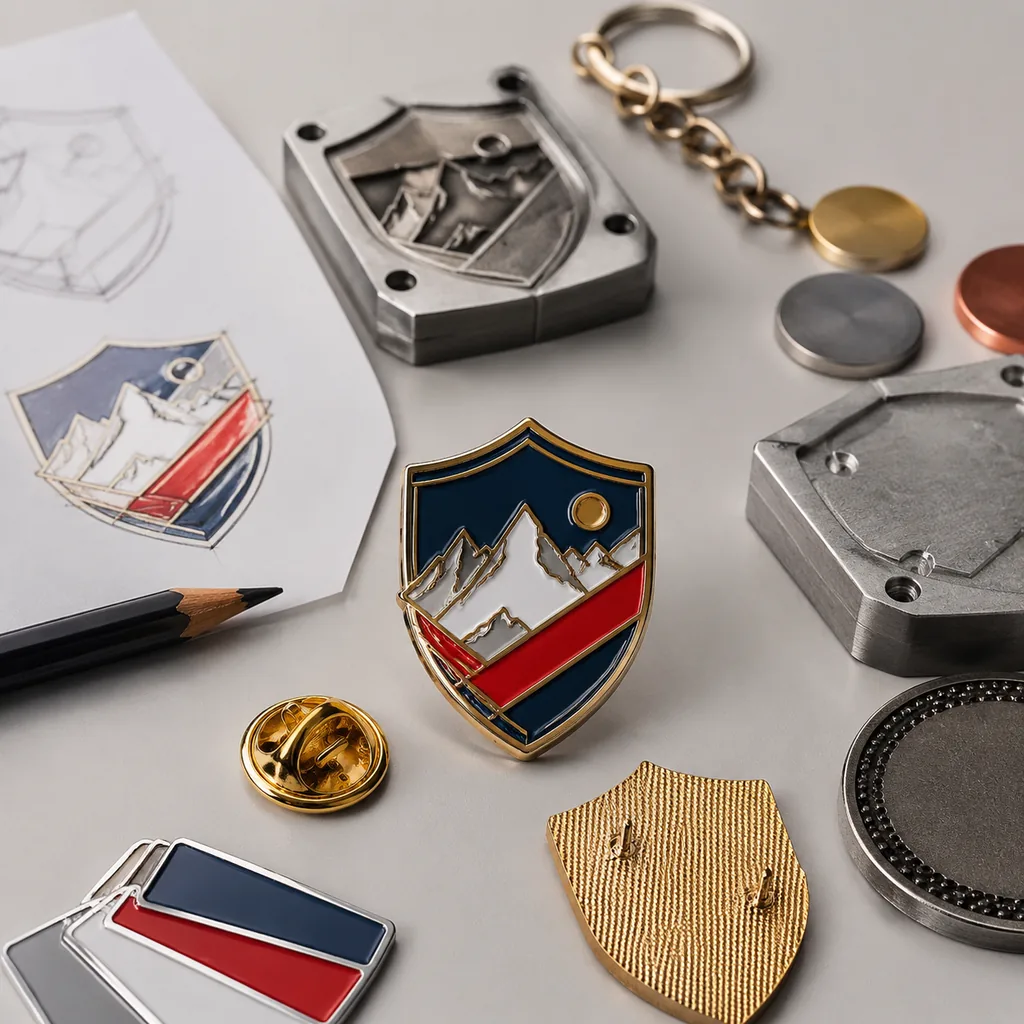
For enamel pins and metal badges, the metal body already accounts for most of the product weight and value, so the cleanest sustainability gains usually sit outside the die-struck shape. Removing the OPP bag, moving to FSC card, reducing PVC accessories, and switching to tissue-separated bulk packing preserve approved artwork and usually avoid new tooling. That is why these are normally the first swaps worth quoting side by side.
A common benchmark is a 30 mm soft enamel iron pin, 1.2-1.5 mm thick, one butterfly clutch, up to four fill colors, and standard nickel or black nickel plating. At 500 pieces, that often lands around USD 0.45-0.85 FOB. At 1,000 pieces, the same build is often USD 0.36-0.68 FOB, depending on cut-outs, backstamp, epoxy cover, and backing-card requirement. A 350 gsm FSC uncoated card with 4C offset print usually adds about USD 0.03-0.08 per unit. Custom die-cut shape, euro hole, slot pair, or two-sided print can raise that to USD 0.05-0.10.
Finish sensitivity matters more than the eco claim. Mirror gold, mirror nickel, imitation hard enamel flat surfaces, and black dye plating with polished highlights are much more prone to rub marks than standard soft enamel with raised metal lines. If the buyer removes individual sleeves, the PO should state the exact carton separation method: acid-free tissue, PE foam sheet, divided blister tray, or layered card separators. Quality language should be explicit as well. AQL 2.5 for major defects and AQL 4.0 for minor defects is common for promo metal items; retail-grade presentation often tightens that to AQL 1.5 major and AQL 2.5 minor.
Plating expectations also need numbers, not adjectives. Decorative nickel, imitation gold, black nickel, or brass plating in the 0.03-0.05 micron range is typical for indoor giveaway use. If the item will sit in humid storage, travel by sea, or remain in stock for more than 12 months, ask for anti-tarnish treatment and confirm whether appearance must hold after repeated handling. A low-plastic pack-out only works economically if cosmetic rejects stay under control.
Lanyards, patches, and keychains: the real trade-offs in tolerance, durability, and FOB
Lanyards are usually the safest place to hit a sustainability target without much engineering risk. rPET yarn in 15 mm or 20 mm sublimated lanyards performs close to standard polyester for conference, staff ID, and office badge use. Typical specifications are 0.8-1.2 mm finished thickness, 900 mm lay-flat length, 10-20 mm width, and webbing width tolerance of about plus or minus 1 mm. At 1,000 pieces, a standard polyester sublimation lanyard often runs USD 0.38-0.75 FOB, while an rPET version is typically USD 0.42-0.85, depending on hook style, buckle, split ring, breakaway count, and print coverage. The practical differences are usually yarn allocation, a slightly different hand feel, and occasional limits on very bright or fluorescent Pantone matches.
Patches are less predictable because construction matters more than the sustainability label alone. A standard woven patch with merrow border and heat-seal backing often costs USD 0.22-0.60 FOB at 1,000 pieces for sizes around 60-75 mm. An embroidered patch of similar size is often USD 0.28-0.75 depending on stitch coverage, backing, and border finish. rPET felt, recycled felt, or cork-blend bases can work well for campaign merch, gift-with-purchase sets, and limited fashion drops, but buyers should expect wider visual variation. Edge tolerance can drift to about plus or minus 1.5 mm on soft felt die-cuts, while shade repeatability across lots is generally weaker than on standard twill or woven grounds. Those builds are best when texture and story matter more than reorder-perfect repeatability.
Keychains show the widest cost spread. A printed acrylic charm with split ring is efficient but combines plastic sheet, print layer, protective film, and metal hardware. A die-cast zinc alloy keychain simplifies material mix and usually lasts longer, yet price climbs quickly once the design exceeds 50 mm, 3 mm thickness, or includes multi-level relief and cut-outs. At 500 pieces, a 50 mm acrylic charm may land around USD 0.35-0.90 FOB. A 50 mm die-cast zinc alloy keychain more often lands around USD 0.85-1.60 FOB, depending on plating, attachment, and thickness. If the main target is plastic reduction rather than maximum durability, the better ROI often comes from packaging reduction and accessory simplification before changing the body material.
Lead-time traps: approvals, allocation, dielines, and sampling
Most schedule slippage happens before bulk production starts, not during the main production run. A sustainable swap almost always creates another approval gate: rPET webbing texture, paper absorbency, fold structure, felt shade, cork grain, or revised pack-out photos. Lead time should therefore be counted from approved pre-production sample, approved material swatch, or approved photo sample, not from deposit date. On event-driven programs, that distinction often determines whether the order ships on time.
A practical planning split is four separate clocks. Artwork proofing usually takes 1-3 working days. Sampling often takes 3-7 working days for standard items and 5-10 working days when alternative substrates or custom paper structures are involved. Mass production commonly runs another 7-15 working days depending on process and quantity. Final inspection and packing add 1-3 working days, especially when custom cards, envelopes, mixed-set collation, or no-polybag protective layering is required.
Material allocation is the most common hidden delay on rPET webbing, specialty felt, cork composite, and custom paper envelopes. A 20 mm rPET lanyard can slip because stock is available only in 25 mm and the approved width must be rewoven or slit. A paper envelope can stall because the stocked sheet is 300 gsm while the approved mockup used 250 gsm, changing fold memory, tab fit, and insertion speed. If the deadline is fixed, the safer move is usually to keep the product construction standard and shift the sustainability target to packaging reduction, carton optimization, or shipment consolidation.
How to compare supplier quotes without being misled by eco line items
Suppliers do not structure eco quotes the same way. One factory may include upgraded paper card, OPP removal, and revised export-carton packing inside one net unit price. Another may add only a recycled-material surcharge while leaving standard packing in the base line, making the sustainable version look artificially expensive. The cleanest comparison is a split quote showing body material, tooling, decoration, attachment hardware, individual packing, inner carton method, export carton, sample charge, and any surcharge for alternate substrates as separate lines.
Quantity breaks matter because many premiums are small-lot effects rather than true long-run cost. For most promo items, request at least 300, 500, 1,000, and 3,000 pieces when those tiers are commercially relevant. If an rPET lanyard surcharge falls from USD 0.10 at 500 pieces to USD 0.04 at 3,000 pieces, that is normal. If it stays flat, the supplier may be buying through a trader, padding risk, or using the eco line as a margin bucket rather than a pass-through material cost.
QC language should be as visible as price. Paper cards need basis weight, print registration tolerance, and die-cut alignment limits. Metal items need plating expectation, enamel-fill tolerance, and scuff-control method if packed without sleeves. Fabric items need shade approval standard, width tolerance, backing type, and pull-strength expectation for hooks or buckles where relevant. A cheap quote with vague inspection criteria often becomes the expensive one during bulk production.
- Request separate costs for product body, decoration, packing, and export-carton changes
- Ask for MOQ by material option and by packaging option, not only by design
- Confirm whether lead time starts from deposit, artwork approval, or sample approval
- Check whether cards, sleeves, or envelopes need a die-cut tool charge or print-plate charge
- State AQL before approving bulk packing without polybags or sleeves
- Approve one physical sample or photo sample of the sustainable variant, not only the standard version
When the sustainable swap is the wrong call
Do not force a lower-impact material when the item must tolerate abrasion, repeated washing, outdoor exposure, moisture contact, or strict brand-color repeatability. PVC and molded rubber still outperform many paper- or felt-based alternatives for wash resistance, dimensional stability, and edge durability. Standard polyester can still be safer than rPET when exact shade repeatability and immediate stock availability matter more than recycled-content claims. Individually bagged mirror-plated pins can still be the correct choice when retail presentation and zero-rub finish are mandatory.
Small quantities are another warning sign. Below 300 pieces, setup, sourcing, and conversion overhead often dominate unit economics, making many substitutions uneconomical. In those cases, the smarter move is usually to keep the core item standard, remove one packing layer, improve master-carton utilization, or consolidate shipments so cartons ship full. Those changes are easier to control, easier to inspect, and less likely to trigger defects or delays.
For the next RFQ, ask each supplier for two controlled versions side by side: a standard specification and a sustainable-swap specification using the same size, print colors, attachment, and pack quantity. Require MOQ, sample days, mass-production days, FOB unit price, tooling cost, packing method, and inspection standard in the same format. If the ship date is tight, prioritize swaps that do not change tooling or geometry. In most real factory programs, that still means rPET lanyards, FSC paper cards, glassine or kraft outer packing, and reduced individual wrapping on durable metal items. Those remain the most reliable 2026 options for cutting waste without creating hidden schedule risk.
Have a project? Send your artwork and target quantity and we’ll reply with a detailed quotation within 12 working hours.
Ready to get this made?
Send your sketch, target quantity and ship-date. Detailed quotation in 12 hours.



