Sustainable Material Swaps for Custom Promo Items in 2026
Start with swaps that reduce impact without changing how the item works
Most eco-merch failures start in the RFQ, not on the production line. The brief says 'recycled,' 'PVC-free,' or 'plastic-free' but does not define operating conditions: carried load, abrasion, wash frequency, UV exposure, target Pantone match, retail presentation, compliance market, and in-warehouse launch date. Those inputs matter more than the claim. A 20 mm rPET lanyard holding a 30 g paper badge for a two-day expo is a low-risk substitution. A daily-use lanyard carrying a 200 g credential wallet, keys, and a badge reel is not. Likewise, a PVC-free patch for a fashion capsule is a different engineering problem from a patch sewn onto industrial workwear and washed 50-plus cycles.
The lowest-risk sustainability gains usually come from high-volume, non-structural components: rPET webbing, FSC-certified or 80-100% recycled backing cards, recycled mailer cartons, right-sized export cartons, and eliminating unnecessary individual polybags. The highest-risk swaps are the ones that change process behavior or appearance: soft PVC to silicone or TPU, virgin embroidery thread to recycled thread, virgin acrylic to recycled PMMA, or polished plating to painted finishes. Those changes can alter gloss, base whiteness, opacity, edge crispness, odor, abrasion resistance, and color consistency lot to lot.
A practical sourcing method is to sort every proposed change into three buckets. First, no-regret swaps: FSC board, recycled corrugate, water-based carton inks, and rPET lanyard webbing on standard event-use builds. Second, controlled-risk swaps: recycled-thread embroidery, woven rPET labels with small text, TPU zipper pulls, recycled PMMA charms, and silicone molded patches. Third, non-verifiable claims: 'eco metal,' 'green plastic,' 'sustainable alloy.' Those are marketing phrases, not production specifications, and they create disputes during inspection because they cannot be measured consistently on the line.
If the goal is a program that ships on time and survives inspection, rank decisions in this order: function, compliance, visual standard, cost ceiling, then sustainability story. That sequence usually delivers better outcomes than chasing the strongest environmental claim first and trying to retrofit the engineering afterward.
Metal promo items: reduce waste in geometry, plating, and packing before changing alloy
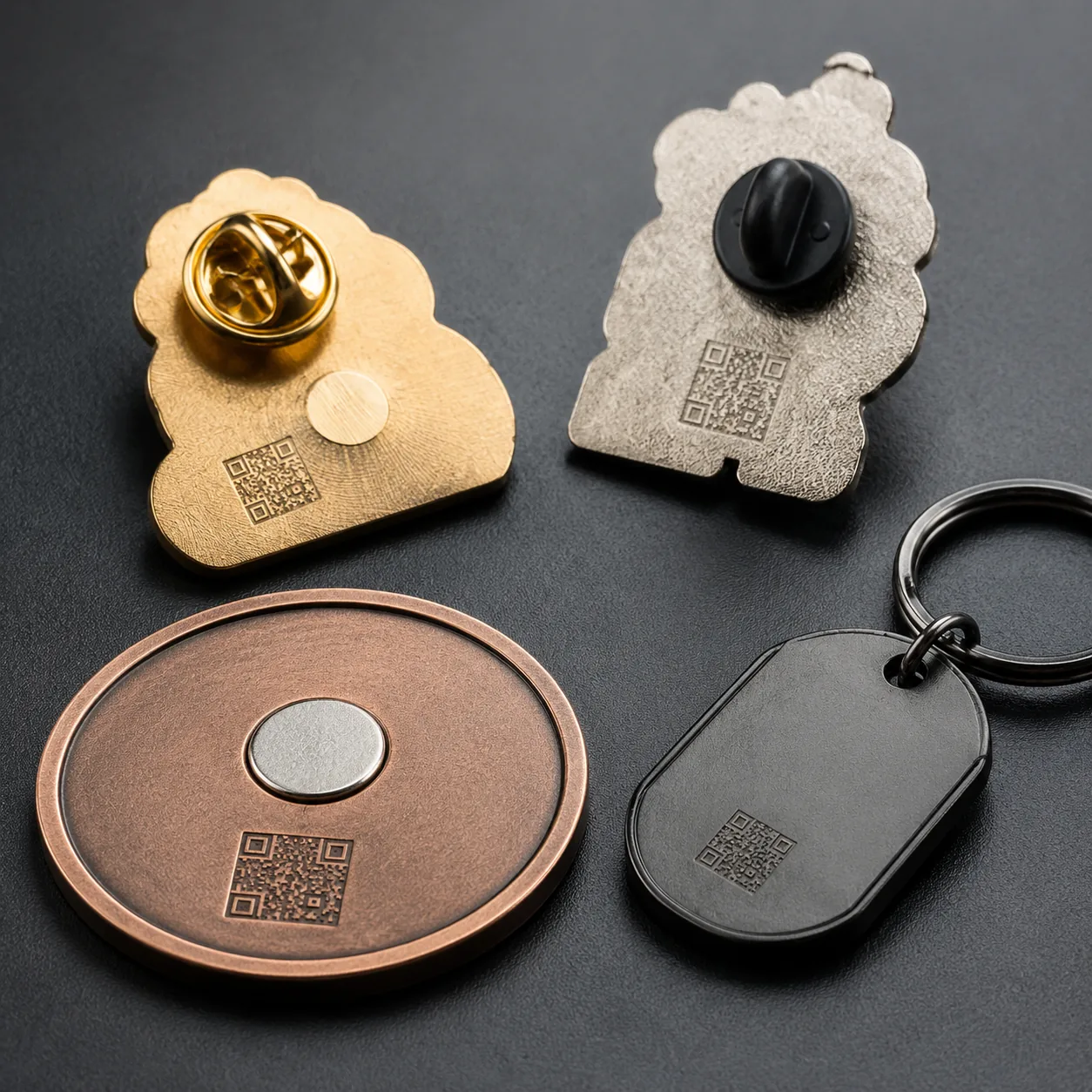
For enamel pins, stamped tags, challenge coins, medallions, and metal keychains, the biggest material wins usually do not come from changing the base metal. They come from eliminating scrap-heavy outlines, unnecessary thickness, duplicate finish variants, and overpack. Zinc alloy remains the correct choice for die-cast 3D shapes, open cutouts, spinner elements, layered relief, and parts with undercuts. Iron is still the cost leader for flat stamped pieces with simple silhouettes. Brass remains the safer option for fine die-struck detail, crisp text, polished edges, and premium antique finishes where cleaner strike definition matters.
In 2026, common production specs are stable. Soft enamel and die-struck pins typically run 1.2-1.5 mm thick, with 1.5 mm preferred for a more premium hand feel. Stamped metal keychains commonly run 1.5-2.5 mm, while challenge coins are usually 3.0-4.0 mm and occasionally 4.5 mm for heavier commemorative programs. Realistic tolerances are ±0.10 mm on stamped parts and ±0.15 mm on cast zinc parts. For dependable production, keep minimum recessed line width above 0.20-0.25 mm on stamped brass or iron and above 0.30-0.35 mm on cast zinc. Text below roughly 4 pt equivalent, or hairlines below those thresholds, will push die correction, raise reject rates, and increase remake risk.
Decorative plating on promo metal goods is thin by design. Flash plating is commonly about 0.03-0.08 microns over an undercoat such as copper or nickel, depending on the finish stack. That is adequate for appearance, but not for harsh continuous wear. For daily-handled pieces, a clear e-coat or lacquer topcoat usually improves tarnish and rub resistance more predictably than forcing a base-metal change. If buyers want a lower-impact adjustment, they will usually save more material by removing double plating, trimming excessive thickness, simplifying highly scrap-prone outlines, and reducing unit polybags than by switching zinc to iron on paper.
As a buying rule, do not force a metal swap when the process need is obvious. If the artwork relies on sub-0.25 mm die-struck detail, brass is still safer. If the keychain includes moving inserts or deep relief, zinc is usually correct. In those cases, the better environmental move is to simplify the pack-out, reduce finish variants, and tighten golden-sample control so there are fewer remakes and fewer air-shipped corrections.
Lanyards are often the highest-volume, lowest-risk material swap
On many promo programs, the biggest practical reduction is not the pin, charm, or patch. It is the lanyard, strap, pouch, sleeve, or card produced at much higher total mass. Recycled PET webbing is now mature enough for most trade show, education, event, and corporate ID uses. A standard 20 x 900 mm folded sublimation lanyard in rPET performs similarly to virgin polyester for light-to-moderate badge loads when the webbing weight, stitch pattern, and hardware are specified correctly.
Common widths remain 10, 15, 20, and 25 mm, with 20 mm still the default for full-color programs. Typical webbing weight is about 110-140 gsm equivalent, depending on yarn denier, weave density, and whether the construction is smooth sublimation, tubular, woven, or jacquard. Standard dimensional tolerances are width ±1 mm and folded length ±10 mm. For stitched ends, specify box stitch or X-box stitch rather than a generic 'sewn finish.' If a breakaway buckle is required, define its release range. For event-use safety buckles, 8-15 N is a practical target. For heavier daily-use builds, confirm full assembly tensile performance against the real carried load instead of assuming any buckle is acceptable.
Typical MOQ is 100-300 pieces for sublimated rPET, 300-500 pieces for woven rPET, and 500 pieces or more for mixed hardware or custom attachments. Lead time after artwork approval is usually 7-12 days for sublimated rPET and 10-16 days for woven or jacquard. FOB pricing for a 20 mm full-color rPET lanyard with a standard swivel hook typically lands around USD 0.45-0.85 at 500 pieces, USD 0.38-0.70 at 1,000 pieces, and USD 0.32-0.60 at 3,000 pieces. Add about USD 0.04-0.09 for a breakaway, USD 0.05-0.12 for a detachable buckle, and USD 0.03-0.08 for an individual bag or carded retail pack.
The trade-offs are real but manageable. Recycled yarn can show more variation in base whiteness, sheen, and hand feel than premium virgin polyester. That matters when artwork uses pale backgrounds, pastel tones, or a close visual match to a hard good such as a plated pin or acrylic charm. On woven or jacquard constructions, recycled yarn can also soften edge definition on text below about 2.0 mm cap height or strokes under roughly 0.30 mm. If the branding depends on micro text, woven logos, or a specific white point, sample that exact construction before release.
| Item type | Standard material | Lower-impact swap | Typical MOQ | Lead time | FOB range | Main trade-off |
|---|---|---|---|---|---|---|
| Lanyard 20 x 900 mm, sublimated | Virgin polyester | rPET webbing | 100-300 pcs | 7-12 days | USD 0.32-0.85 | Slight lot variation in whiteness, sheen, and hand feel |
| Backing card 300-400 gsm | Virgin coated paperboard | FSC-certified or 80-100% recycled board | 500 pcs | 5-8 days | USD 0.03-0.12 | Lower brightness, fiber specking, less smooth surface |
| 2D molded patch/tag 50 mm | Soft PVC | Silicone or TPU | 300-500 pcs | 10-16 days | USD 0.45-1.40 | Different edge feel, hardness, opacity, and tooling behavior |
| Acrylic keychain 3 mm | Virgin PMMA | Recycled PMMA where available | 300-500 pcs | 10-15 days | USD 0.35-1.10 | Transparency and tint consistency may vary by lot |
| Embroidered patch 75 mm | Virgin polyester thread | Recycled polyester thread | 300 pcs | 9-14 days | USD 0.28-1.20 | Slightly different sheen and narrower in-stock shade range |
| Mailer or gift box | Virgin SBS or CCNB | Recycled board or FSC board | 500 pcs | 7-12 days | USD 0.18-0.95 | May need higher gsm or inserts to keep crush strength |
PVC-free is a redesign decision, not a one-click substitution
A 'PVC-free' requirement is now common for molded patches, zipper pulls, bag tags, and flexible keychains, but buyers should not expect a one-to-one material conversion. Silicone, TPU, woven labels, TPU film laminates, and recycled polyester badges do not process like soft PVC. Shore hardness, mold flow, gate marks, edge rounding, dust pickup, color opacity, and attachment methods all change. If the artwork was built around PVC's stepped 2D cartoon layering and low-cost wall definition, converting late in sampling usually produces soft detail and buyer dissatisfaction.
Silicone is usually the safer choice when flexibility, soft-touch feel, and broad temperature stability matter. For promo patches, Shore A 40-60 is a common working range. It stays flexible in both cold and warm conditions and feels premium, but fine recessed lettering can lose crispness and matte surfaces tend to attract lint or dust. TPU generally gives cleaner edges, better abrasion resistance, and lower dust pickup on zipper pulls and bag tags. Typical hardness is Shore A 70-90 depending on formulation. The trade-off is tighter molding control: thin features are more vulnerable to flow marks, gate witness, short fill, and variable gloss if the tool and process window are not tuned carefully.
As a practical design rule, keep minimum raised or recessed line width at about 0.40-0.50 mm for silicone and 0.35-0.45 mm for TPU. Avoid sharp internal corners below roughly R0.30 mm and avoid isolated islands or tiny enclosed counters that depend on PVC-like wall definition. For sewn patches or heat-applied badges, define a total thickness target because many molded flexible parts land in the 1.2-2.5 mm range, which affects hand feel, edge stability, and sewability. If the part attaches to a split ring, cord, or metal fitting, specify pull performance or bond integrity rather than just naming the material.
For a 50 mm molded custom patch or tag, expect MOQ of 300-500 pieces, lead time around 10-16 days after final artwork approval, and FOB roughly USD 0.45-1.40 depending on thickness, color count, backing type, and tooling complexity. Basic 2D tooling often falls around USD 35-120, with more for multi-cavity or multi-part builds. If the destination market restricts PVC, redesign early around the new material limits instead of asking the supplier to duplicate the PVC artwork exactly. That usually saves one full sample round and 7-14 calendar days.
Packaging is one of the strongest levers, but it must still survive transit and handling
Packaging is often the fastest place to remove material, and on giftable sets it can account for 10-30% of landed program cost. It is also one of the easiest places to create expensive failures. A thinner recycled carton is not a win if it crushes in ocean transit, scuffs plated product, warps in humidity, or drives e-commerce returns. The right question is not whether packaging sounds greener. It is whether the revised pack still protects the product through packing, export handling, stacking, humidity swings, and final-mile delivery.
For standard pins, patches, keychains, and small gift sets, the most practical lower-impact options are 300-400 gsm recycled or FSC cards, unlaminated kraft sleeves, molded pulp trays, glassine sleeves where a low-plastic barrier is needed, and right-sized master cartons that reduce void fill. Surface interaction matters. Rough uncoated stock can mark mirror acrylic, polished plating, and high-gloss epoxy domes. If the face finish is delicate, use tissue interleave, glassine, or a localized protective bag only where necessary rather than defaulting to full polybagging on every unit.
For export cartons, ask for objective specs instead of 'strong carton': board grade, flute type, ECT or burst requirement, target packed weight, and pallet pattern. As a baseline, many promo exports perform well with corrugate around 32 ECT or stronger, depending on pack density, with carton weight controlled around 12-15 kg for manual handling. If metal parts can contact each other in transit, use partitions, chipboard separators, or unit cards to prevent face damage and plating rub. Recycled board works well in many cases, but it may need higher gsm, better insert geometry, or tighter moisture control to maintain compression strength.
Inspection standards should separate product quality from packaging quality. AQL 2.5 major and 4.0 minor under ANSI/ASQ Z1.4, General Inspection Level II, remains common for decorated promo goods. Packaging should have its own acceptance points: corner crush, glue smears, print scuff, barcode readability, board warp, fit tolerance, and color shift. For recycled cards and boxes, define gsm tolerance such as ±5%, die-cut tolerance such as ±0.5 mm, and acceptable fiber specking in advance so recycled content does not become a subjective argument at final inspection.
Write claims and QC points that can be verified on the factory floor
The fastest way to lose control of a PO is to specify language nobody can verify during production. 'Eco plastic,' 'green yarn,' and 'sustainable alloy' are not inspection criteria. A stronger PO names the exact component being changed, the declared material, the measurable physical requirements, and the visual standard that still applies.
For an rPET lanyard, that means 20 ±1 mm width, 900 ±10 mm folded length, print method, hook type, stitch pattern, breakaway requirement if used, pack method, and carton quantity. For a recycled board backing card, specify target gsm, finish, print colors, die-cut tolerance, and hole-position tolerance if relevant. For silicone or TPU molded parts, specify Shore hardness range, color standard, thickness range, minimum line width, backing method, odor acceptability, and bond integrity if assembled to metal hardware. For metal items, call out base metal, thickness, finish stack, attachment style, and whether a protective topcoat is required.
Approval works best at three checkpoints: digital construction approval, pre-production material confirmation, and one physical pre-production sample. On larger orders above 5,000 pieces, final random inspection to ANSI/ASQ Z1.4, General Level II, remains a sensible default unless the buyer uses a tighter internal standard. If recycled-content, FSC, or other chain-of-custody claims matter commercially, request the supplier declaration or certificate reference before mass production, not after the goods are packed.
- Name the exact component being changed, not a vague sustainability claim
- Put minimum line width, thickness, hardness, plating, and attachment specs in the PO
- Set dimensional tolerances such as width ±1 mm, length ±10 mm, and die-cut ±0.5 mm where relevant
- Request a material declaration, FSC reference, or traceability document for each swapped component
- Approve one physical pre-production sample whenever the swap changes feel, gloss, edge quality, opacity, or color
- Set separate acceptance criteria for product defects and packaging defects
- Do not stack multiple material changes onto a rush schedule with a fixed launch date
Compare total program cost, not just FOB unit price
Sustainable variants often look expensive only because buyers compare FOB unit price in isolation. The better comparison includes sample rounds, tooling, development delay, compliance exposure, packing efficiency, defect risk, and reorder stability. A swap that adds USD 0.06-0.10 per unit can still be cheaper overall if it removes a retailer compliance issue or avoids a second sampling cycle. A backing-card change that eliminates lamination and a plastic window can even come in cost-neutral or lower while simplifying pack-out.
In 2026, premiums are usually modest for paper and webbing swaps and more visible for molded flexible items. rPET lanyards commonly carry a premium of about 3-10% versus standard polyester at the same construction. FSC or recycled paper cards can be near parity when unnecessary finishes are removed. Silicone or TPU replacements for soft PVC often add around 10-35%, depending on hardness, color count, and tooling complexity. Recycled embroidery thread can approach parity on simple fills, but may cost more on dense multi-color programs if special shades must be sourced in low volume.
Where buyers lose money is fragmented development. Asking multiple suppliers to each solve the same PVC-free redesign can add 2-3 weeks, duplicate tooling charges, and create cross-item color mismatch. A better approach is to shortlist a supplier already producing your mix of lanyards, pins, keychains, and patches, then prototype only the controlled-risk components. That reduces approval loops, packaging conflicts, and inconsistent standards between factories.
A reliable sourcing sequence for 2026 is straightforward: first, swap high-volume no-regret components such as lanyard webbing and paper packaging; second, quote controlled-risk alternatives line by line against the standard build; third, sample only the parts where process behavior changes; and finally, lock the approved construction into a reorder spec sheet with material callouts, dimensions, hardness where relevant, plating finish, pack method, carton count, and inspection standard. Lower-impact promo items are delivered through specific, enforceable swaps, not broad sustainability language.
Have a project? Send your artwork and target quantity and we’ll reply with a detailed quotation within 12 working hours.
Ready to get this made?
Send your sketch, target quantity and ship-date. Detailed quotation in 12 hours.



