Sustainable Material Swaps for Custom Promo Items: Failure Modes to Spec Out
Why sustainable material swaps fail in production, not at quote stage
Most recycled-content or PVC-free requests look manageable during quoting because the visible changes are FOB price, MOQ and lead time. The real risk appears later: the substitute material shifts the process window for stamping, casting, plating, printing, sewing, molding or pack-out. A recycled-brass pin, an rPET lanyard, or a TPU patch can all match the approved artwork and still fail in bulk on fill, edge definition, color density, burr level, stitch integrity or transit protection.
That is why buyers should treat a material swap as an engineering change order, not a marketing upgrade. The correct sourcing question is not only, "Can you make this in recycled material?" but also, "Which process parameters, tolerances, test limits and reject criteria change when we change substrate?" If those revisions are not written onto the purchase order and tied to a sealed pre-production sample, the factory will build to its nearest standard process and your incoming QC team will have no objective basis to accept or reject drift.
The economics often justify the extra discipline. On a 30 mm soft enamel pin at 1,000 units, a lower-impact substrate or paper-packaging swap may change FOB by only USD 0.03 to 0.08 per piece. That saving disappears quickly if the bulk lot needs polishing rework, color sorting, repacking or air-freight remake. Typical MOQ bands still cluster around 100, 300, 500 and 1,000 pieces, but low-volume orders are less forgiving because sampling, color approval and hand packing are spread across fewer units.
Failure mode 1: recycled metal shifts fill, edge definition and plating yield
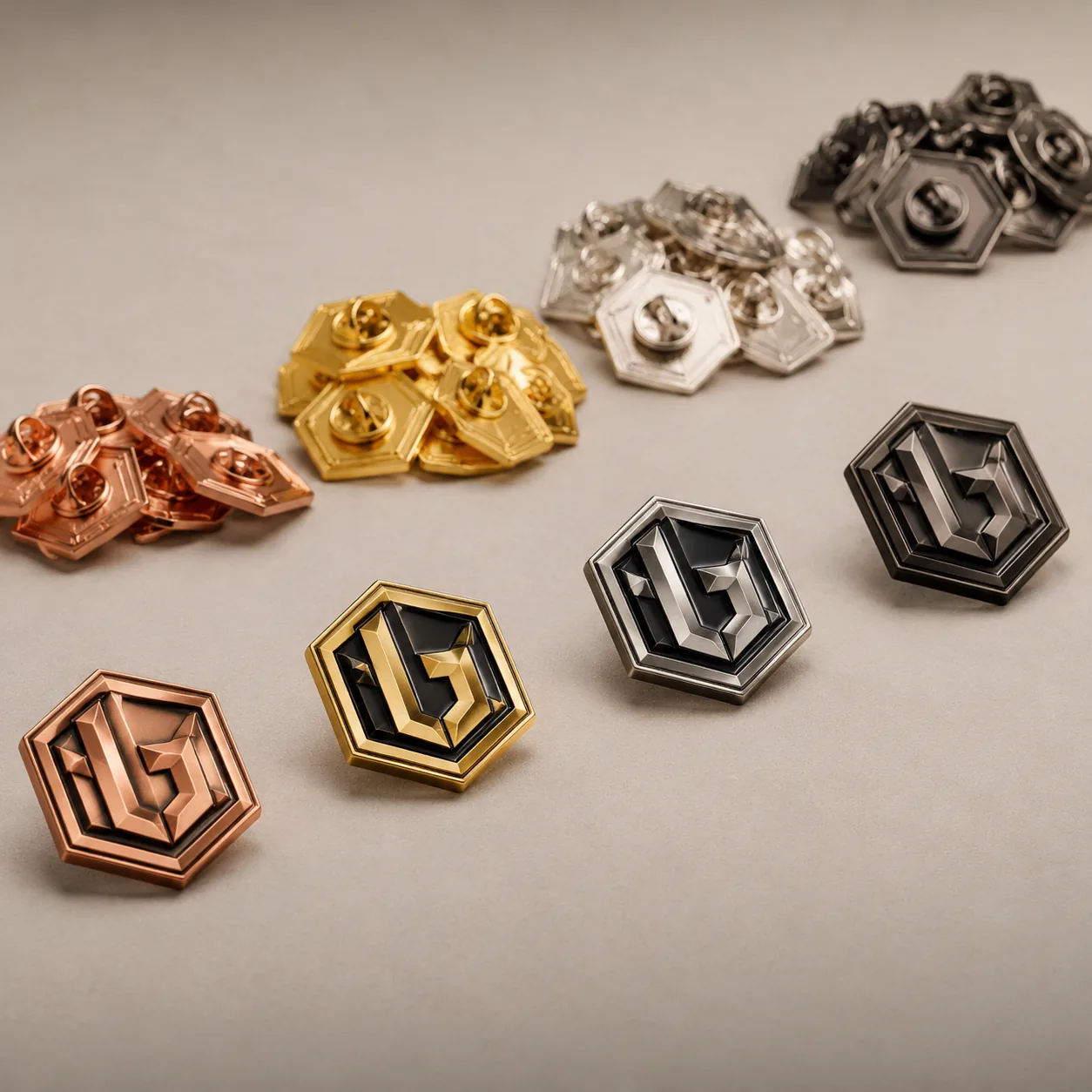
Recycled-content brass, iron and zinc alloy are viable for pins, medals, coins and keychains, but only when the supplier controls alloy grade and melt-lot consistency. In practice, incoming variation shows up as softer die-struck lines, less-uniform enamel-well depth, more polish pinholes and higher fallout before plating. Artwork that already sits at the process limit is where scrap rises first. A badge with 0.25 mm lines, 0.25 mm gaps, large mirror areas and deep 3D relief can be stable in virgin stock yet unstable in recycled-content production.
For stamped badges under 40 mm, a safer specification is minimum metal line width 0.30 to 0.35 mm, minimum recessed wall width 0.35 mm, minimum exposed-edge radius 0.20 mm, and dimensional tolerance of ±0.15 mm instead of ±0.10 mm unless the alloy declaration is tightly defined by grade. Soft-enamel recess depth should typically stay in the 0.18 to 0.25 mm range; shallower wells increase color spread during fill and deeper wells slow polish leveling. For die-cast zinc alloy keychains above 45 mm, add margin on unsupported tips, thin strokes and open cutouts because edge loss after tumbling and buffing becomes visible quickly.
Plating specifications are also routinely underwritten. Decorative nickel, black nickel, imitation gold and imitation silver finishes on promo metal items often use a cosmetic top layer in the 0.03 to 0.08 micron range, with copper or nickel undercoats varying by substrate and finish stack. That thickness is normal for non-jewelry promo use, but the acceptance rule must be explicit: no blistering, bare spots, pits, peel, burn marks or exposed base metal visible at 300 mm under 5000K to 6500K lighting. Burrs and sharp points should be classified as major defects, while plating peel or exposed substrate on customer-facing areas should be treated as major or critical depending on intended use.
At 1,000 pieces, a 30 mm soft enamel iron pin commonly lands around USD 0.32 to 0.65 FOB, while a 45 mm die-cast zinc alloy keychain is more often USD 0.75 to 1.60 FOB depending on thickness, attachment, plating and pack-out. If recycled-content metal adds polishing loss or color fallout, the apparently greener option can produce more remakes and more waste. In many cases, a robust design with slightly wider lines and lower scrap delivers the better environmental and commercial result.
Failure mode 2: alternative plating stacks create tone mismatch across launch sets
Nickel-free or alternative plating requests are common, especially for skin-contact concerns or internal sustainability policies. The technical problem is not whether the finish can be supplied; it is whether the visual tone stays consistent across different substrates and SKUs. The same imitation gold can look warmer on brass than on zinc alloy, darker on recycled stock, or flatter when the underplating stack changes. In a gift set containing pins, keychains and challenge coins, that drift becomes a measurable QC defect rather than a subjective design complaint.
Control it by approving finish against a retained swatch and a sealed production-standard sample, not by finish name alone. The PO should list substrate, undercoat requirement, top finish, nickel-free requirement if applicable, and the comparison method. A workable rule is visual match under D50 or 5000K to 6500K light at arm's length, with no obvious tone break between SKUs packed in the same set. If the supplier will mix output from multiple plating lots, require lot segregation or pre-pack sorting before final assembly and define who absorbs the labor cost if tone drift exceeds the approved sample.
| Material or finish choice | Typical buyer benefit | Common failure mode | Spec to lock before sampling |
|---|---|---|---|
| Recycled brass or iron | Reduced virgin metal content | Softened fine detail after stamping or polish | Minimum line width 0.35 mm; tolerance ±0.15 mm; alloy grade or supplier declaration by melt lot |
| Nickel-free plating stack | Skin-contact or compliance preference | Gold or silver tone mismatch across SKUs | Retained plating swatch; sealed sample; visual check at 5000K-6500K; define lot-sorting responsibility |
| rPET lanyard webbing | Reduced virgin polyester use | Lower print density, edge fray or stitch weakness | Width 15/20/25 mm; thickness 0.90 ±0.10 mm; yarn denier; pull test; PMS tolerance |
| TPU or silicone patch | PVC-free flexible construction | Deboss detail loss and pigment shift | Minimum stroke 0.40 mm; text height 2.5-3.0 mm; Shore A 55-70; sealed molded color chip |
| Paper card or molded pulp insert | Less plastic packaging | Scuffing, pin-post punch-through or crush damage | Board 300-400 GSM; caliper target; fit test with actual hardware; carton compression rule |
Failure mode 3: rPET lanyards pass strip samples but fail in event use
rPET lanyards are now mainstream, but they are not process-identical to virgin polyester. Yarn consistency, denier, weave density and print absorption vary significantly by supplier, especially on rush orders, low MOQs and custom PMS colorways. The most common bulk failures are fuzzy sublimation edges, weaker solid-color saturation, hot-cut fray, webbing curl after packing, and hardware pull-out when the strap structure is too loose for the clip load. A 150 mm sample strip can hide those problems; a full shift carrying an access card, badge reel, radio or key ring exposes them quickly.
Specify the full construction rather than only the artwork. State width as 15 mm, 20 mm or 25 mm; webbing thickness such as 0.90 ±0.10 mm; yarn spec such as 140D or 300D equivalent; breakaway requirement; buckle style; hook material; and print method. For sublimation, require legibility at 300 mm viewing distance and no obvious feathering on strokes above 0.30 mm. For screen print, define maximum registration shift, typically 0.50 mm between colors. On sewn joints, specify back-tack count and a static pull threshold matched to the hardware, such as 7 to 10 kgf for a standard swivel-hook assembly and 10 to 12 kgf for a heavier lobster-claw or double-ended build.
For 1,000 pieces, a 20 mm rPET sublimated lanyard with metal hook and safety breakaway usually runs about USD 0.38 to 0.75 FOB. A heavier-duty construction with buckle release, denser webbing and upgraded stitching commonly moves into the USD 0.70 to 1.05 range. Typical MOQ is 100 to 300 pieces depending on print method, while normal production lead time is around 10 to 15 days after art and sample approval. When buyers force both the lowest webbing cost and the shortest schedule, curling, fluffing and stitch complaints become much more likely.
Failure mode 4: PVC-free patches and charms lose the detail the design depended on
Switching from soft PVC to TPU, silicone, woven labels or metal emblems often improves the sustainability narrative, but the materials do not resolve detail in the same way. Large, separated color zones usually transfer well into TPU or silicone. Micro text, narrow borders, tiny stars and registration marks often do not. What looked sharp in a woven label or metal emblem can close up, round off or sink in a softer molded material. Straight-on sample photos routinely hide that loss; arm's-length readability does not.
Start by separating material intent from design intent. If the product needs flexibility, washability and soft touch for bags, outerwear or uniforms, TPU or silicone can be a good fit, but geometry limits must be realistic. A sound starting spec is minimum raised or recessed width 0.40 mm, minimum text height 2.5 to 3.0 mm, minimum spacing 0.30 to 0.40 mm, and controlled hardness in the Shore A 55 to 70 band. Outside that range, handfeel, edge stability and deboss clarity change noticeably. Colors should be approved against actual molded chips or a sealed production sample, not a printed proof, because pigment appearance shifts by resin and gloss level.
Attachment deserves equal attention. A material swap changes how the patch behaves during sewing, heat pressing or hook-and-loop lamination. For sew-on builds, keep at least 3 mm of flat stitch margin around the perimeter. For heat-applied versions, define the fabric family used for validation and set a bond rule such as no lifting on corners after a 24-hour cure and a practical peel check. At 1,000 pieces, custom TPU or silicone patches typically range from USD 0.45 to 1.10 FOB depending on size, thickness and backing. Common MOQs are 100 or 300 pieces, and standard lead times are about 12 to 18 days after sample approval.
Failure mode 5: paper-first packaging cuts plastic but raises transit damage
Replacing polybags, blister lids or foam trays with paper cards, kraft envelopes or molded pulp inserts can reduce plastic use, but it also changes the friction, compression and retention behavior of the packed item. Polished keychains can scuff against uncoated board, pin posts can emboss through thin cards, and challenge coins can dent edges when inserts do not immobilize the piece. Those defects are often misread as plating or handling failures even though the root cause is package fit or insufficient board strength.
Treat packaging as a protective component, not only a branding surface. For retail pin cards, specify board weight and caliper in addition to size. A 300 to 400 GSM coated card is generally safer for 25 to 40 mm enamel pins than light stock below 250 GSM. For heavier keychains, use reinforced slots, folded cards or glassine wrap where scuff risk is high. If molded pulp or paper inserts are used in gift boxes, require a fit test with actual posts, split rings and chain links installed, because these hardware points create pressure concentrations that simple paper mockups miss.
Outer-carton rules matter as well. State whether units require tissue, glassine or individual bags to prevent metal-to-metal contact; define carton performance such as burst strength or ECT target if your supplier uses those metrics; and set a transit-survival rule such as no functional or visible cosmetic damage after a standard corner-and-face drop sequence on the master carton. Custom paper inserts usually carry MOQs of roughly 500 to 1,000 units, and packaging-development changes often add 3 to 7 days if dielines, fit approval and product sample approval are not closed together.
Failure mode 6: sustainability claims are too vague for incoming QC to verify
The most common sourcing error is approving language that no one in receiving can actually audit. Terms such as eco-friendly, green material or recycled metal are not production specifications. If the purchase order does not define the material claim, evidence requirement and substitution rule, incoming QC can inspect count, appearance and dimensions but cannot verify whether the bulk lot matches the intended build.
Convert every claim into a checkable requirement. State the declared material on the PO, require the same declaration at sample stage and bulk shipment, and link it to the supplier statement or supporting document your program accepts. Then keep product QC objective: dimensions, plating appearance, print clarity, odor, burrs, attachment strength, packaging count and carton marks can be inspected using AQL 2.5 for major cosmetic and functional defects, with AQL 4.0 often acceptable for lower-risk packaging defects and AQL 0 for critical issues such as sharp exposed points or missing safety breakaway where required.
- Lock the exact material name on the PO, not a marketing phrase
- Require matching material declarations at sample approval and bulk shipment
- Approve one sealed appearance sample and one retained reference sample
- Set AQL levels separately for critical, major and minor defects
- Define dimensional, cosmetic and functional reject limits in writing
- Record every approved substitution before mass production starts
How to pilot a lower-impact swap without risking the full range
If you are planning 2026 material changes, start with one SKU that has moderate geometry, average finish requirements and enough volume to reveal process variation. Good pilot candidates are a 30 to 35 mm soft enamel pin, a 20 mm event lanyard, or a simple die-struck keychain with one attachment type. Avoid beginning with your most detailed coin, your shortest deadline or a mixed-material gift set, because too many variables move at once and root-cause analysis becomes expensive.
In the RFQ, ask suppliers to quote three items together: the substitute material, the process changes it requires, and the revised reject criteria. Compare 100, 300, 500 and 1,000-piece tiers on more than FOB alone. Include scrap exposure, sample cycle count, repeatability and production time. For most custom metal and textile promo products, realistic lead time is 10 to 18 days after final approval; rush schedules can work on repeat builds, but they are less forgiving when a new material needs tuning. A pilot succeeds when one material description, one sample standard, one packaging rule and one QC checklist can be repeated across the next order without reopening the spec every time.
Have a project? Send your artwork and target quantity and we’ll reply with a detailed quotation within 12 working hours.
Ready to get this made?
Send your sketch, target quantity and ship-date. Detailed quotation in 12 hours.



