Sustainable Material Swaps for Custom Pins and Keychains
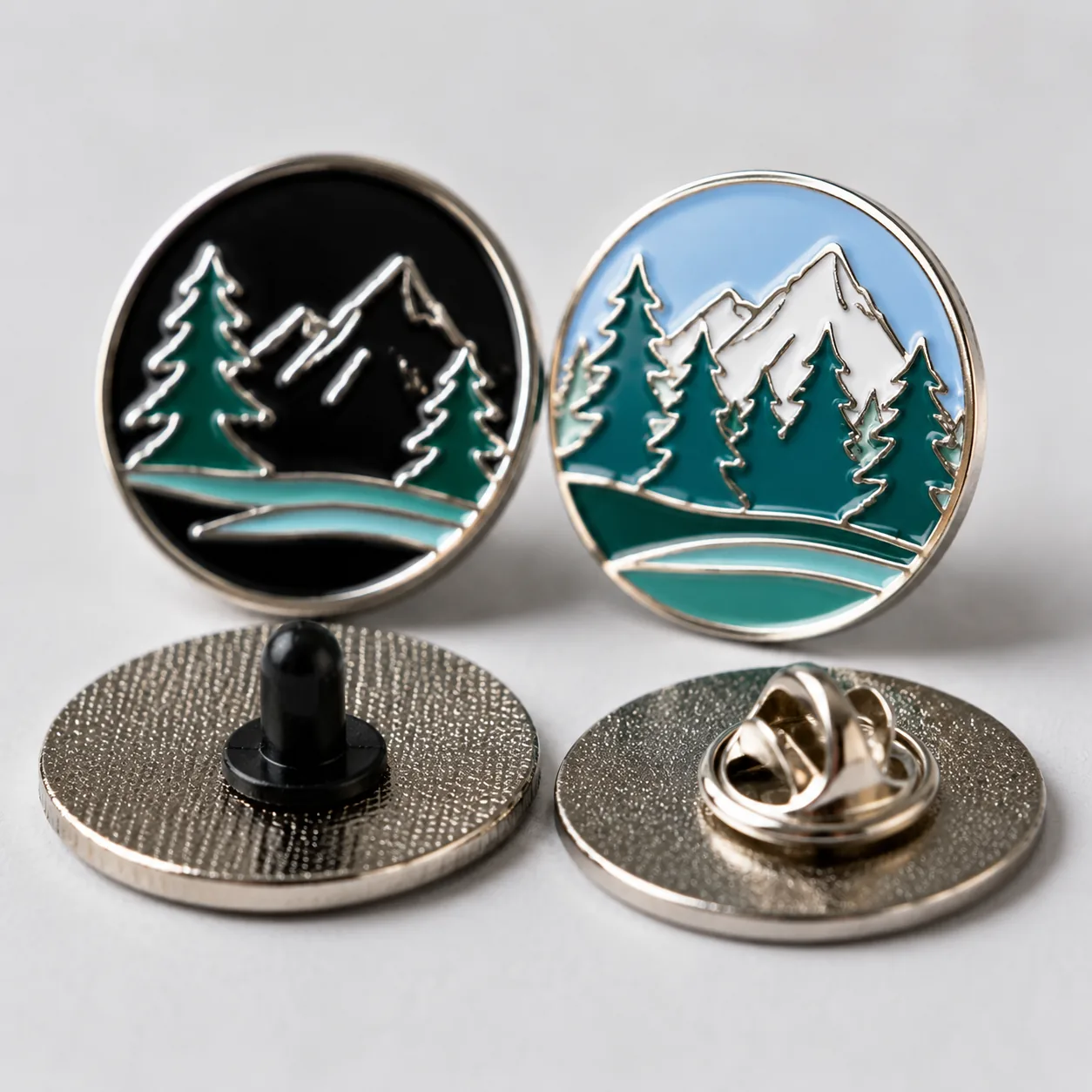
Start with the RFQ, or the sustainability claim stays superficial
Most "green" custom pin and keychain projects fail before sampling because the RFQ is written around virgin inputs and default decorative finishes: stamped brass or die-cast zinc alloy with standard nickel plating, molded PVC patch bodies, virgin polyester webbing, acrylic display parts, and individual OPP bags. Once those lines are locked, most factories can only offer low-impact substitutions such as kraft cards or reduced polybag use. Those changes help, but they do not materially alter the bill of materials, process chemistry, or mixed-material complexity.
The highest-yield substitutions are usually the ones that stay inside the factory's established process window. In practice, that means recycled-content brass for stamped pins and medals, recycled-content zinc alloy for die-cast keychains and bottle openers, RPET webbing for lanyards, FSC-certified SBS or kraft board for backing cards and sleeves, and PVC-free alternatives such as woven or embroidered patches. These swaps preserve normal tooling, stamping pressure, die-casting flow, polishing, rack plating, enamel fill, and final inspection. That is why they scale better at 100 to 5,000 pieces than experimental bio-based plastics or specialty composites.
The sourcing test is straightforward: the alternative material must survive the same commercial QC as the standard build. Saving 4 to 8 g of virgin plastic is not a win if the change increases plating blister, color drift, board warp, weak adhesive bond, or attachment failure. Rework and replacements can erase the environmental gain and raise total landed cost.
For first-round comparison quotes, keep all commercial variables fixed: same artwork, dimensions, thickness, attachment, packaging count, export carton count, inspection level, and Incoterm, usually FOB. Change only one or two material lines at a time. That exposes whether the sustainable version adds 3 to 8 percent, 10 to 15 percent, or almost nothing at all, and whether lead time changes by 2 days or by a full week.
Choose base materials by process fit, not by eco labeling
For enamel pins, badges, medals, challenge coins, and most metal keychains, the safest sustainable move in 2026 is recycled input within a standard alloy family, not replacing metal with a novelty substrate. For die-cast items, request zinc alloy with a declared recycled melt-input range such as 30 to 70 percent. For stamped items, request brass in the same gauge with a declared recycled-input range and specify whether the claim is post-industrial, post-consumer, or mixed. Reject vague labels such as "eco alloy" if the supplier cannot state alloy family, recycled percentage range, and traceability basis.
Geometry still determines the correct process. Stamped brass remains the better option for fine-line soft enamel pins where recessed lines are under 0.25 mm, lettering is smaller than roughly 4 pt equivalent, or sharp corner definition matters after polishing. Typical stamped thickness is 1.2 to 1.5 mm before plating, with finished thickness tolerance commonly held at ±0.10 mm. Zinc alloy is usually the better choice for 3D keychains, hollow-back parts, bottle openers, spinner parts, and openwork shapes larger than about 55 to 60 mm, because die casting reduces distortion and secondary machining on thicker sections. Typical die-cast body thickness is 3.0 to 4.0 mm, with flatness held within 0.25 mm across a 40 mm span for nominally flat faces.
Do not force a sustainable material into an end use that exposes its weakness. Woven and embroidered patches are credible PVC-free options for uniforms, fashion accessories, club merchandise, and indoor promotional use, but molded PVC still outperforms them in repeated mud, oil, salt, and harsh industrial washing. RPET webbing is now standard for many lanyard programs, but exact optic white and fluorescent shades remain less consistent than on virgin polyester. If the brand standard depends on bright white, fluorescent yellow-green, or a very clean cyan, call that out at quotation stage rather than after bulk dyeing.
| Spec line | Standard build | Practical sustainable swap | Reject the swap if |
|---|---|---|---|
| Pin base | Stamped brass, 1.2-1.5 mm | Recycled-content brass, same gauge, 30-70% declared input | Artwork needs ultra-fine lines under 0.20 mm and supplier cannot prove stamping consistency |
| Keychain body | Die-cast zinc alloy, 3.0-4.0 mm | Recycled-content zinc alloy, same mold and polishing route | Supplier cannot state recycled range, alloy family, or adhesion controls |
| Patch body | 2D molded PVC | Woven patch or recycled-yarn embroidery | Application involves oil, salt, mud, or repeated industrial washing |
| Lanyard strap | Virgin polyester, 15 or 20 mm | RPET polyester, same width and hardware | Exact fluorescent shade or high-white match is contract-critical |
| Backing card | Virgin coated card | FSC SBS or FSC kraft board, 300-400 gsm | Retail format depends on PET blister, acrylic cover, or heavy spot-UV build |
Simplify plating and topcoat before you chase recycled claims
Buyers often focus on recycled metal and overlook plating, even though decorative plating causes more compliance questions and cosmetic rejects than the base alloy. A practical sustainability move is to simplify the finish family across the order: fewer plating baths, fewer mixed-finish SKUs, and fewer post-plating handling steps. That reduces rework, sort errors, and partial-lot scrap without changing the product architecture.
For most decorative pins and keychains, the PO should specify finish family, nickel-free requirement where relevant, topcoat type, and the approved appearance after coating. Decorative gold-tone layers are commonly in the 0.03 to 0.08 micron range. Decorative nickel or imitation-rhodium layers are often around 0.10 to 0.20 microns. On parts with regular abrasion or skin contact, especially keychains and zipper pulls, add a clear e-coat or lacquer topcoat and approve gloss level on the pre-production sample because clear coats can reduce mirror brightness and slightly warm the tone.
Nickel-free systems are useful where allergy risk or restricted-substance review matters, but they often look less blue-bright than conventional nickel-based silver finishes. On recycled-content castings, antique silver, antique brass, matte black, brushed gunmetal, and satin nickel-free silver usually perform better than mirror gunmetal or high-gloss gold because they hide minor substrate variation and polishing marks. In volume production, that can cut cosmetic reject rates by 2 to 5 percentage points on the same SKU.
If the supplier cannot quote approximate plating thickness, topcoat type, or adhesion method, expect inconsistent wear performance. At minimum, define how adhesion is checked after polishing and coating: common methods are tape test, cross-hatch, and dry-rub checks. Also define visual inspection distance, typically 30 cm under normal indoor lighting at roughly 600 to 1000 lux, so "acceptable finish" does not become a subjective dispute during final QC.
Use decoration methods that tolerate normal substrate variation
Most sustainable conversions fail in decoration, not in the base material. For custom metal products, soft enamel remains the safest mainstream process because it tolerates modest variation in polish and substrate while keeping brand color reasonably stable. Imitation hard enamel, transparent color fills, offset print over uneven metal, UV doming, and other high-effect finishes can look strong on samples, but they narrow the process window and increase scrap when porosity, polish, or absorbency shifts.
Write color requirements in sourcing language. Instead of demanding identical color across enamel, woven thread, RPET webbing, uncoated FSC card, and acrylic print, separate colors into critical and non-critical groups. A practical specification is one primary logo color matched to a Pantone reference under D50 lighting, while secondary colors are approved visually to the signed sample. On RPET yarn and uncoated kraft or SBS stock, colors often read 5 to 10 percent duller than on virgin polyester or gloss-coated paper.
Numeric decoration tolerances prevent argument later. For soft enamel, underfill should generally not exceed 0.10 to 0.15 mm below the adjacent metal line on the approved sample. For screen or offset print on cards, define registration tolerance at ±0.20 mm for small cards and ±0.30 mm for larger folded inserts. For woven patches, define edge cleanliness, thread density, and acceptable back yarn show-through. If special effects such as glitter, glow pigment, transparent resin, or domed UV are essential, keep those builds in low-volume runs of 100 to 300 pieces and move core volume into simpler SKUs with lower defect exposure.
For lanyards and woven patches, always ask whether recycled yarn is stock dyed or custom dyed. That detail often matters more than the recycled claim itself. Custom dyeing can add 3 to 7 calendar days, raise MOQs from 100 to 300 pieces or from 300 to 500 pieces, and widen lot-to-lot shade tolerance.
Cut mixed plastics in attachments and packaging without creating transit damage
Attachments and packaging often have small unit cost but large leverage over material complexity. On lapel pins, replacing individual OPP bags with bulk carding, glassine sleeves, or paper interleaving can remove substantial disposable plastic without touching the core part. If the goal is lower plastic intensity, one secure metal clutch on an FSC card is usually a better answer than a premium presentation format built around PET blister, EVA foam, and acrylic display parts.
Specify hardware by function, not by appearance alone. For pins wider than 45 mm, call for dual posts or anti-rotation hardware to reduce skewing and returns. For keychains above 50 g finished weight, increase split-ring wire gauge to 1.6 to 1.8 mm and define acceptable ring closure gap after assembly at no more than 0.30 mm. Common ring outside diameters are 25, 28, and 30 mm, but wire thickness matters more than outside diameter for field durability.
For magnets, specify magnet type, thickness, adhesive system, and holding expectation. Lightweight flat items often use 0.5 to 1.0 mm rubber magnet. Heavier parts, smaller bond areas, or high-heat transit routes may need ferrite or stronger constructions with a defined adhesive cure of 24 hours before pack-out. The useful test is not the material name; it is whether the magnet stays bonded and holds on the intended surface after handling and summer transit exposure.
The FOB impact is often favorable. Removing individual OPP bags usually saves about USD 0.01 to 0.03 per piece at 1,000 units. Upgrading to an FSC printed card commonly adds USD 0.02 to 0.06 depending on size, ink coverage, and coating. In many pin programs, simpler packing offsets most of the sustainable-packaging premium.
- Specify dual posts or anti-rotation hardware for pins wider than 45 mm
- For keychains above 50 g, use 1.6-1.8 mm split-ring wire and verify closure gap after packing
- If removing polybags, define paper interleaving or tray count so plated parts do not rub in transit
- Ask for attachment pull and twist checks on 13 pcs per lot as an in-line screen
- For magnets, confirm thickness, adhesive cure time, and hold performance after 24 hours
Know the 2026 MOQ, lead-time, and FOB trade-offs before you sample
When geometry and process remain stable, sustainable versions are rarely 30 percent more expensive. Recycled-content brass or zinc often adds little or no visible FOB premium at medium volumes if the supplier already buys that stock in normal production. The real cost drivers are certified paper packaging, custom-dyed RPET webbing, recycled-content yarn in non-stock shades, and specialty nickel-free finishes. In practice, straightforward sustainable substitutions usually change FOB by about 3 to 12 percent on unchanged designs.
MOQ matters as much as unit price. A recycled-content brass pin can still run at 100 pieces because tooling, stamping, polishing, and enamel fill remain standard. FSC rigid boxes, molded pulp trays, or custom display packs often need 500 to 1,000 pieces to dilute setup cost. RPET sublimation lanyards typically start at 300 to 500 pieces depending on width, hardware, and print coverage. Recycled-yarn woven patches can run at 100 to 300 pieces, but some factories require higher MOQs when stock yarn colors are limited.
Lead time should be quoted as a variable, not assumed as a penalty. A standard pin typically needs 5 to 7 days for a pre-production sample and 10 to 15 days for bulk production after approval. Recycled-content brass or zinc usually fits the same window if alloy stock is already in the supplier's normal flow. Custom-dyed RPET webbing, specialty paper packaging, uncommon nickel-free finishes, or non-stock yarn colors can add 3 to 7 days. The biggest avoidable delay is late comparison shopping after tooling has already been cut.
| Item type | Typical MOQ | Lead time after art approval | Indicative FOB at 500 pcs |
|---|---|---|---|
| 20-30 mm soft enamel pin, recycled-content brass, FSC carded | 100 pcs | Sample 5-7 days; mass 10-15 days | USD 0.55-1.10 |
| 50 mm die-cast zinc alloy keychain, recycled content, split ring | 100 pcs | Sample 6-8 days; mass 12-18 days | USD 0.90-1.80 |
| RPET sublimation lanyard, 20 mm, safety breakaway | 300-500 pcs | 10-15 days | USD 0.45-0.95 |
| Woven patch with recycled-yarn content, merrow border | 100-300 pcs | 12-18 days | USD 0.30-0.75 |
| FSC printed backing card, 90 x 55 mm, 4C both sides | 500 pcs | 7-12 days | USD 0.04-0.12 |
Turn sustainability claims into measurable QC and compliance criteria
The main buyer mistake is accepting sustainable materials by declaration alone. Recycled-content feedstock can change polish response, porosity, color appearance, and surface feel, so the factory still needs a standard inspection plan. Ask for incoming material traceability where available, a physical pre-production sample built with the exact sustainable stack, and in-line checks on plating adhesion, enamel fill, hardware retention, and packaging rub resistance.
Translate each sustainability target into ordinary acceptance language. Good examples are: no visible plating blister at 30 cm under normal viewing; zero detached hardware in a 32-piece functional sample; enamel underfill not exceeding 0.15 mm versus signed sample; no sharp burr after polishing; split-ring closure gap within 0.30 mm; and no functional transit damage after agreed carton-drop handling. If the factory cannot describe the sustainable build in measurable QC terms, the project is not ready for release.
For promotional products, AQL 2.5 major and 4.0 minor remains common. Premium retail presentation sets often move to AQL 1.5 major and 2.5 minor, especially when packaging drives perceived value. If packaging includes recycled-content, FSC, disposal, nickel-free, or country-of-origin messaging, treat text accuracy and claim placement as a critical checkpoint before bulk print. Incorrect environmental claims create more risk than a small cosmetic defect because they can trigger retailer rejection, legal review, or customs issues.
Write dimensional and surface controls directly onto the PO: finished thickness tolerance of ±0.10 mm for thin stamped parts; flatness within 0.25 mm across 40 mm for flat pins or badges; no plating blister or exposed base metal on the face side; registration within ±0.20 mm on printed cards; and visual approval against the signed sample rather than a generic finish name. These are the controls that keep a sustainable substitution from turning into a warranty problem.
Pilot one stable SKU first, then scale what works
Do not convert a full assortment on the first attempt. Start with one stable SKU that has repeat volume, ordinary geometry, no fragile effects, and no compressed deadline. Quote the standard build and one sustainable alternative with identical size, attachment, packaging method, QC level, and FOB terms. That makes the comparison commercial instead of theoretical.
A workable first-trial pin specification looks like this: 25 mm stamped brass body with 30 to 70 percent declared recycled input, 1.2 mm thickness; nickel-free antique silver finish with clear e-coat; soft enamel to approved Pantone references; two posts with metal butterfly clutches; FSC 350 gsm SBS backing card; no individual OPP bag; paper interleaves between packed layers. A practical keychain trial is 50 mm die-cast zinc alloy with declared recycled content, 3.0 to 3.5 mm body thickness, matte nickel-free silver finish, 30 mm split ring using 1.6 mm wire, and anti-scratch interleaving in the export carton. Those lines are specific enough to quote, sample, inspect, and reorder without overengineering the program.
Approve one physical pre-production sample built from the exact sustainable stack, not a visual mock-up made from standard stock. Review weight, color, edge finish, hardware retention, plating wear, and transit abrasion exactly as you would on a conventional order. If the sample passes, lock the approved wording on the PO before deposit, including tolerances, AQL, carton method, and sustainability claim language. Sustainable sourcing works when the swap is routine enough for the factory to repeat, inspect, and ship without improvisation.
- Start with one repeat SKU and ordinary geometry
- Change one or two material lines, not the full specification
- Ask for a declared recycled-content range instead of vague eco wording
- Specify finish family, topcoat, AQL, and hardware checks on the PO
- Compare standard and sustainable quotes on equal FOB and packing terms
- Approve a physical pre-production sample before mass production
Have a project? Send your artwork and target quantity and we’ll reply with a detailed quotation within 12 working hours.
Ready to get this made?
Send your sketch, target quantity and ship-date. Detailed quotation in 12 hours.



