Sustainable Material Swaps for Custom Metal Promo Specs 2026
Start With the Spec Lines That Actually Change Impact
Most sustainability requests break down at RFQ stage because the buyer asks for a greener product but leaves the production spec untouched. A factory can only quote and control what is written into the build sheet: base metal, forming process, finished thickness, plating stack, color method, attachment hardware, magnet grade, packaging structure, artwork method, inspection standard, and documentation requirement. If those lines do not change, the delivered item is usually the same product with a softer claim.
For custom lapel pins, challenge coins, medals, keychains, badges, and magnets, the most practical 2026 swaps are not experimental materials. They are controlled substitutions inside established production routes: die-cast zinc alloy with 30% to 70% declared recycled content instead of virgin zinc; 350 to 400 gsm FSC-certified or 80% to 100% recycled paperboard instead of virgin coated card; glassine or bulk pack-out instead of individual OPP bags; RPET webbing instead of PU tabs; and water-based printing on cards or textile accessories after adhesion and rub resistance are validated. These changes reduce disposable plastics and mixed-material add-ons without forcing a new tooling family or redrawing the artwork around a new process.
Treat sustainability as a line-by-line engineering exercise before sampling. That gives the supplier time to confirm molding route, line-width limits, plating compatibility, pull strength, package protection level, MOQ effect, and revised QC criteria. If you wait until after pre-production sample approval, even a small change such as replacing OPP with card-and-glassine or changing a PU strap to RPET commonly adds 3 to 7 calendar days, triggers a second sample round, and pushes up unit cost through avoidable rework.
Base Metal and Forming: Improve the Material Inside the Right Process
Choose the forming process first, then improve the material inside that route. For irregular outlines, deep recesses, 3D relief, open cutouts, and thicker keychain bodies, die-cast zinc alloy remains the most practical first swap because recycled-content zinc can usually run on the same mold, trimming, polishing, and plating lines as standard alloy. A typical cast part at 2.0 to 3.0 mm thickness and 35 to 70 mm size can often use zinc alloy with a declared minimum 30% recycled content, while stronger suppliers may offer 50% to 70% as a batch-controlled typical range. On 500 to 3,000 piece runs, the FOB effect is often cost-neutral to about +8% if no third-party chain-of-custody audit is required.
Stamped iron or brass is still the better technical choice for flat enamel pins and badges that need crisp rims, micro text, and lower tooling cost. A 1.2 to 1.5 mm stamped iron pin can usually hold raised metal lines near 0.25 to 0.30 mm and enclosed spaces around 0.35 mm. A cast zinc version of the same artwork is safer closer to 0.35 to 0.45 mm line width and larger negative spaces to avoid soft edges, sink marks, or uneven enamel fill. If the design includes badge numbers, legal text, narrow borders, or serif characters below about 5 pt equivalent, switching from stamping to casting only to claim recycled metal often reduces readability and increases reject risk.
Write recycled-content scope precisely. “Recycled zinc” is not enough. The RFQ should state whether the content is post-industrial, post-consumer, or mixed; whether the percentage applies to the full metal body or only selected components; and whether the stated percentage is a guaranteed minimum or a typical range. For most custom metal promos, a practical line is: “zinc alloy body with minimum 30% declared recycled content, batch controlled.” That is more realistic than demanding 80% content on a 500-piece pilot where alloy sourcing may not be stable lot to lot.
| Spec line | Standard option | Lower-impact swap | Typical 2026 effect |
|---|---|---|---|
| Base metal | Virgin die-cast zinc alloy | 30% to 70% declared recycled-content zinc alloy | Usually cost-neutral to +8%; no major tooling change on standard cast parts |
| Flat pin material | Stamped virgin iron or brass | Keep stamped route; cut impact through packaging and hardware | Best when line width must hold near 0.25 mm and detail retention outranks metal swap |
| Backing card | 300 to 350 gsm virgin coated card | 350 to 400 gsm FSC or 80% to 100% recycled card | Usually +2% to +6% on packaging cost; improved stiffness for direct mounting |
| Polybag | Individual OPP bag | Glassine bag or bulk inner-carton pack | Cuts plastic sharply; not suitable for every mirror-polished finish |
| Keychain tab | PU leather tab | RPET webbing or delete tab entirely | Typically +$0.03 to +$0.12 per pc depending on width, color, and stitch detail |
| Tray or insert | PET blister or plastic tray | Molded pulp or folded card locator | Often adds 500 to 1,000 pc MOQ for custom conversion; safer on matte than mirror polish |
Plating and Finish: Reduce Layers Without Sacrificing Appearance
Plating is often overspecified. Buyers usually lock an appearance target rather than the actual finish stack, so factories build decorative items with multiple layers that do not all contribute to field performance: bright nickel, antique wash, hand polish, clear lacquer, and epoxy dome on one part. Every extra step adds chemistry use, labor touches, drying time, and defect opportunities.
For appearance-led metal promos, decorative plating thickness is commonly about 0.03 to 0.08 micron depending on finish and supplier practice. That is enough for look, not for structural wear. For products that sit in retail packaging for 6 to 12 months, move through humid storage, or are handled repeatedly at events, a controlled topcoat usually matters more than simply requesting “heavier plating.” A clear electrophoretic coat or lacquer over bright nickel, black nickel, or imitation gold can improve tarnish resistance and fingerprint control without adding another decorative layer underneath.
Simplify selectively, not blindly. Transparent enamel over polished metal, proof-like challenge coins, and premium gift keychains depend on high reflectivity and consistent polish direction. In those cases, stripping down the finish stack can create haze, color shift, or a flatter look under transparent fills. If the program is judged visually at AQL 2.5 major and the customer expects jewelry-grade appearance, keep the proven plating route and lower impact elsewhere through packaging, BOM simplification, or recycled-content substrate. That trade is usually safer than passing a sustainability checklist but failing the appearance standard.
Write the finish as a stack, not a marketing phrase. Example: “die-cast zinc, polished raised areas, antique nickel decorative plate 0.05 micron nominal, clear lacquer topcoat, no epoxy dome.” That lets the supplier quote and validate exactly what is changing, and it reduces unplanned substitutions that look similar on paper but perform differently in salt-humidity storage, transit rub testing, or shelf display.
Hardware, Magnets, and Attachments: Remove Mixed Materials First
Secondary components are often the hidden source of material complexity. A badge may ship with rubber clutches, EVA foam pads, hot-melt adhesive, acrylic windows, PVC spacers, split rings, swivel clasps, PU tabs, and release liners. Those parts can add more mixed-material content than the core metal body, while also increasing assembly labor and field failure points.
For lapel pins below about 25 mm and under 8 g unit weight, a standard butterfly clutch in iron or brass remains one of the simplest functional choices. If the program needs garment protection, reduced scratching, or child-safe handling, specify a rubber clutch deliberately rather than accepting it as an unstated default. For keychains, every extra joint matters. A body plus jump ring, 4-link chain, and split ring already creates 3 to 5 stress points. Adding a swivel and decorative tab may improve perceived value, but it also raises break risk under 1.0 m drop, repeated twist, and pocket abrasion.
Magnets need the same discipline. Do not request the strongest magnet available without defining the use case. A lightweight fridge magnet or card-mounted promo piece often performs adequately with ferrite. A premium metal badge worn through fabric may need NdFeB, but the holding force should be tied to badge mass and garment thickness. As a practical guide, a 35 mm metal badge around 12 to 18 g may hold acceptably with a paired ferrite setup for display use, while a wearable magnetic back on thicker fabric often requires NdFeB with verified pull force. Over-specifying magnet strength can force thicker backing plates, larger adhesive areas, or secondary fixtures, increasing both material load and cost.
- Request a full BOM, including adhesives, liners, films, foam pads, sleeves, and tapes
- Classify each component as functional, protective, or decorative before approval
- Delete duplicate hardware such as both swivel and chain unless the use case truly requires both
- Set attachment performance targets such as pull strength, twist resistance, and 1.0 m drop survival
- Keep mixed-material add-ons only when they improve safety, garment protection, retention, or real usability
Packaging: Usually the Lowest-Risk Sustainability Win
Packaging is usually the safest place to reduce impact because it rarely changes tooling or the front-face appearance of the metal part. Many promo orders still use inherited pack-out: one item in one OPP bag on one card inside one tray into one export carton, even when the finish and shipping profile do not justify that structure. Removing one unnecessary layer can cut plastic immediately without touching the core product.
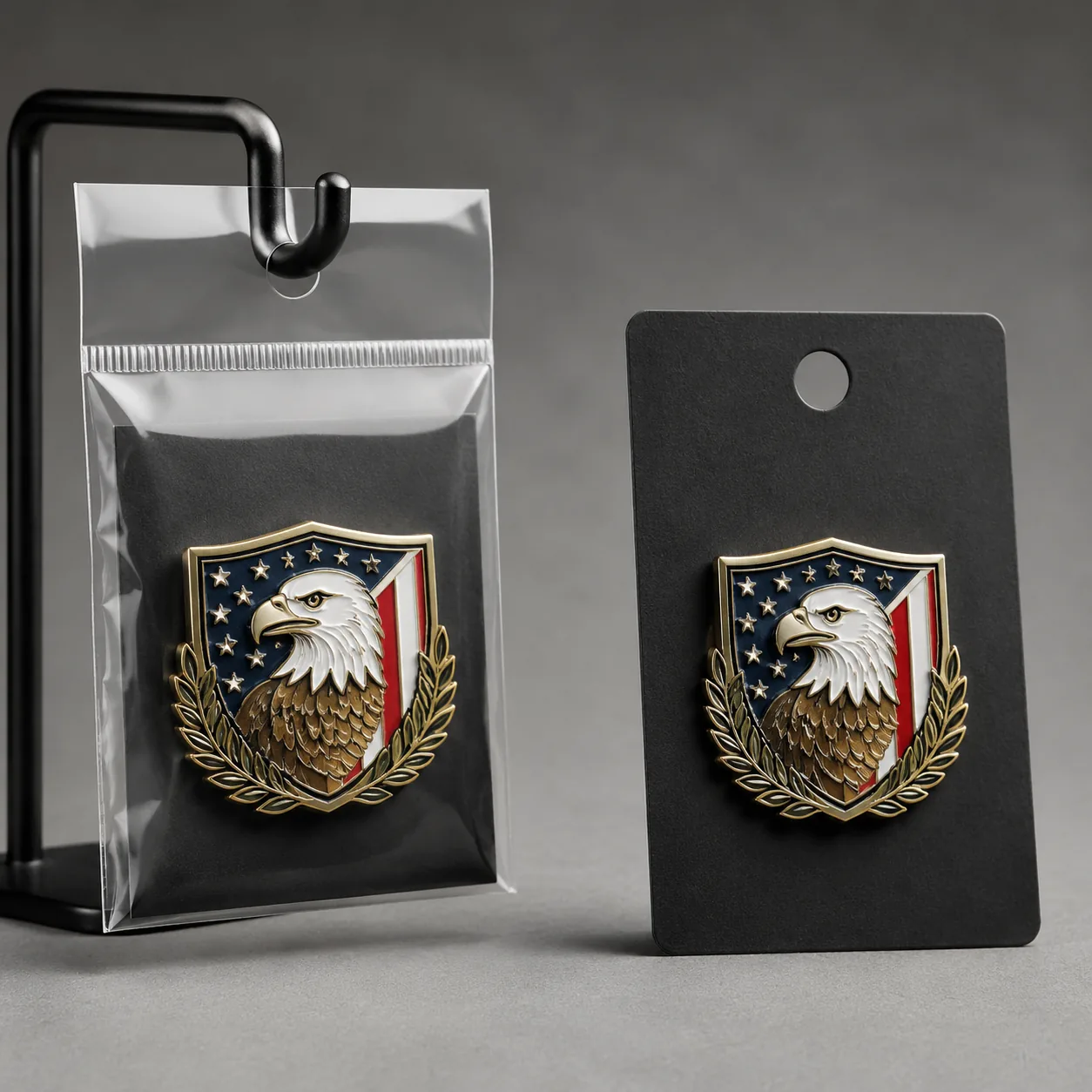
For enamel pins and badges, a practical 2026 structure is direct mounting on 400 gsm recycled or FSC-certified card, then packing 50 pieces per inner bag with tissue interleave every 10 pieces. For antique or matte challenge coins, kraft envelopes, paper sleeves, or molded pulp trays often replace plastic capsules successfully. For bright-polished coins, mirror nickel keychains, or high-gloss epoxy-domed items, packaging reduction must be matched to surface sensitivity because scratch incidence rises quickly once individual barriers disappear.
Write packaging in measurable production language. Example: “each pin mounted on 400 gsm recycled card; 50 pcs per inner; no individual OPP; tissue interleave every 10 pcs; export carton max 12 kg gross; carton passes corner-edge-flat drop sequence from 80 cm.” That tells the factory what performance still matters while leaving room to optimize material use and carton utilization.
Packaging swaps can save or add cost. Removing individual polybags may save roughly $0.01 to $0.03 per piece. Switching to a printed recycled card may add $0.02 to $0.06 per piece. A custom molded pulp insert or printed rigid paperboard box can add $0.05 to $0.20 per piece, sometimes more on runs below 1,000 units because die-cutting and setup are spread over fewer parts. The right question is not whether paper is automatically cheaper. It is whether the chosen pack-out protects the finish at the target defect rate.
Printing, Adhesives, and Color Control: Keep Performance Measurable
The lower-impact option does not always preserve every visual effect at the same level. Water-based printing works well on backing cards, paper inserts, cotton tape, and many RPET webbings, but not every coated substrate or metal surface will pass the same abrasion, solvent rub, or adhesion requirement as a conventional solvent-based route. If the item carries QR codes, legal text, or Pantone-critical brand marks, print performance should outrank the claim.
For adhesive-backed magnets, layered name badges, and mounted gift sets, validate bond performance before mass production if you change liner paper, adhesive chemistry, or foam thickness. A practical test request is: 24-hour room-temperature bond check, then 50 to 60 degrees C heat exposure for 2 hours, followed by peel assessment after cooling; for export programs, add a simple cold check at 0 to 5 degrees C. Promo goods spend time in containers, vans, and storerooms, not just climate-controlled offices.
State color and print tolerances clearly. For cards and textile accessories, require visual approval against Pantone references under D50 or equivalent daylight conditions. For enamel or printed metal, specify that critical marks remain legible at normal viewing distance and that visible mis-registration versus the golden sample is rejectable. For scannable codes, require scan success on at least two common phone camera systems at typical arm’s-length distance. If a sustainable ink or substrate weakens readability, flakes at the edge, or causes QR failure, the substitution is not successful.
Cost, MOQ, Lead Time, and Inspection: Put the Trade-Offs Into the RFQ
Lower-impact swaps are not automatically cheaper. Recycled-content metal may carry a small premium, RPET tabs usually cost more than generic PU, and custom paper structures can cost more than OPP because converting labor rises even when plastic falls. On typical 500 to 3,000 piece custom metal promo orders, most sustainable swaps land between cost-neutral and about 12% above standard spec, with occasional savings when multiple plastic layers are deleted at once.
A realistic 2026 FOB guide at 1,000 pieces is: 25 mm stamped soft-enamel pin, about $0.28 to $0.55 each; 45 mm die-cast zinc keychain, about $0.75 to $1.60 each; 50 mm challenge coin, about $1.10 to $2.40 each; and 60 mm medal with ribbon, about $1.50 to $3.20 each. Recycled zinc, FSC carding, glassine sleeves, or RPET accessories usually shift those numbers at the margin rather than changing the whole cost structure. MOQ can matter more than unit price: a factory may accept 100 to 300 pieces for a standard pin with stock packing, but require 500 to 1,000 pieces for a custom pulp tray, FSC-certified print run, or non-stock dyed RPET strap.
Split lead time into tooling, pre-production sample, and mass production. For many standard projects, artwork and mold setup take 3 to 5 days, pre-production sample 5 to 7 days, and mass production 10 to 18 days after sample approval. Add around 3 to 7 days for custom paper packaging, non-stock strap colors, recycled-content paperwork, or revised package drop validation. The swap itself is often not the schedule problem; accessory sourcing and packaging revision are.
If materials change, inspection language has to change with them. Decorative metal goods commonly run at AQL 2.5 for major defects and 4.0 for minor defects, but the defect definition cannot simply be copied from the legacy build. Recycled paper cards may show visible fiber specking. Molded pulp inserts may have softer trim edges. Matte finishes may hide fingerprints while making edge scuffs more visible. Keep production tolerances explicit: overall size within plus or minus 0.20 mm on small stamped items, metal thickness within plus or minus 0.10 to 0.15 mm depending on process, and hole or slot position within plus or minus 0.15 mm where fit matters. The strongest RFQ format is a dual quote: current spec versus revised lower-impact spec, with separate lines for tooling change, unit FOB price, MOQ, sample days, production days, and quality-risk notes. Once those substitutions are written into the PO and golden-sample record, sustainable material swaps stop being vague claims and become controllable manufacturing decisions.
Have a project? Send your artwork and target quantity and we’ll reply with a detailed quotation within 12 working hours.
Ready to get this made?
Send your sketch, target quantity and ship-date. Detailed quotation in 12 hours.



