Sustainable Material Swaps for Custom Metal Promo Items
Define the exact swap before you request quotes
Most weak sustainability RFQs fail for a simple reason: the requested change is too vague to price, source, or inspect. One factory reads "eco-friendly" as recycled base metal only. Another swaps the lanyard yarn, card stock, and polybag but leaves the metal unchanged. Those offers are not comparable. Treat the request like an engineering change order. State exactly which BOM line changes, which lines stay fixed, and which acceptance standard still governs release.
For pins, die-cast keychains, magnets, badges, challenge coins, and lanyards, line-by-line substitution is usually lower risk than redesign. A 3.0 mm die-cast zinc alloy keychain can often move to recycled-content zinc with little visible change if melt control, polishing, and plating are stable. A fine-detail stamped brass pin with 0.25-0.30 mm raised outlines may not. On lanyards, changing virgin polyester webbing to RPET is routine; eliminating every individual bag from bright-plated keychains is not, because transit abrasion claims rise quickly on nickel, gold, and black nickel finishes.
- Specify `recycled-content zinc alloy, target 30-60% recycled input, subject to sample approval` rather than `eco metal`
- Specify `RPET webbing, 10/15/20/25 mm width, 0.8-1.2 mm thickness, width tolerance +/-0.5 mm` rather than `recycled fabric`
- Specify `FSC-certified card, 350-400 gsm SBS/C1S board, matte or gloss lamination as approved` if paperboard is part of the claim
- Specify `no individual polybag` only after confirming finish sensitivity, carton density, and shipping mode
- Specify `plating unchanged` unless you also approve a different color, gloss, wear profile, or topcoat
- Specify inspection terms such as `AQL 2.5 major / 4.0 minor, General Inspection Level II` in the RFQ
When the change is tightly defined, the price impact is usually modest. On FOB orders of 500-3,000 pieces, sustainable substitutions often add only USD 0.01-0.05 per piece for small pins or magnets, USD 0.03-0.12 for larger die-cast keychains or cast coins, and USD 0.00-0.07 for standard RPET lanyards. Bigger premiums usually mean the supplier is pricing uncertainty, lower yield, more hand polish, or a packaging change into the same line item.
Use recycled-content metal only where geometry and finish allow it
For metal promo items, the practical swap is usually recycled-content zinc alloy for die-cast parts and recycled-content iron or brass for stamped parts when the source is stable. The real question is not whether recycled feedstock exists. It is whether the factory can hold chemistry, die fill, shrinkage, porosity, burr level, polish response, and plating adhesion lot to lot. A recycled-content claim has little value if the same factory cannot hold the same cosmetic window.
Die-cast parts generally tolerate recycled-content metal better than high-detail stamped parts. Good candidates include zinc alloy keychains or badges at 2.5-4.0 mm thickness with minimum bridge widths above 0.8 mm, and cast coins at 3.0-3.5 mm where the design does not rely on mirror fields or microtext below 0.35 mm stroke width. Higher-risk applications include stamped iron or brass pins with outlines below 0.30 mm, unsupported cutouts below 0.60 mm, flush-polished hard-enamel-style surfaces, or raised copy that must stay crisp after grinding and plating.
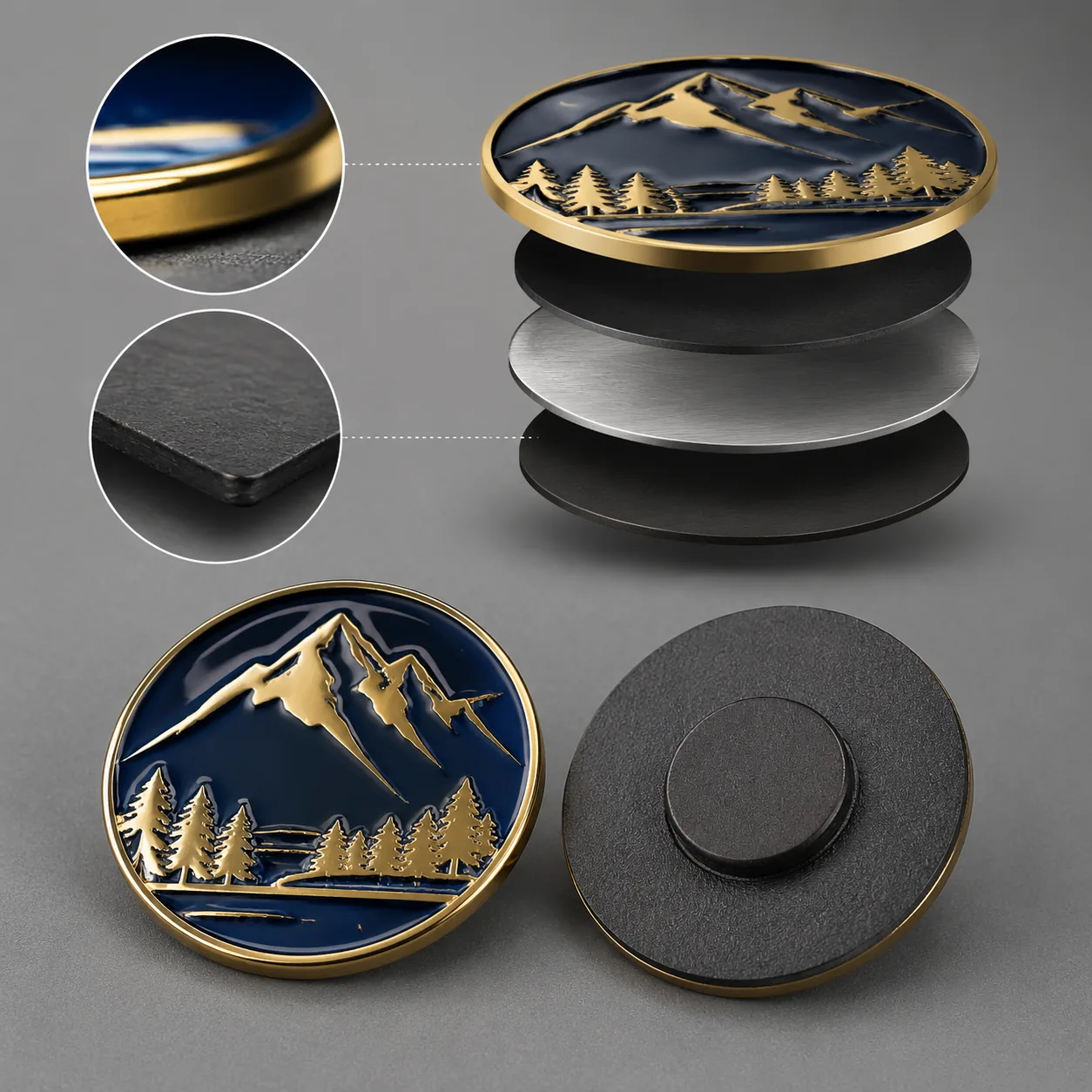
Flatness and edge quality matter on magnets and badges. Thin, asymmetrical parts are more likely to warp if cooling is uneven. A workable buyer tolerance is front-face flatness within 0.15-0.20 mm for small badge formats under 50 mm and within 0.25 mm for larger magnet bodies over 60 mm. Also specify burr height under 0.05 mm on accessible edges, plating adhesion that passes a standard tape test on the sample, and magnet bond strength confirmed by peel and drop checks before mass production.
| Product type | Standard build | Lower-risk sustainable swap | Critical acceptance points | Typical MOQ | Lead time impact |
|---|---|---|---|---|---|
| Soft enamel pin | Stamped iron, 1.2-1.5 mm | Recycled-content iron with standard nickel or black nickel plating | Outline width above 0.30 mm, burrs under 0.05 mm, plating adhesion, rust-free surface before plating | 100-300 pcs | 0-2 days |
| Die-cast keychain | Zinc alloy, 2.5-4.0 mm | Recycled-content zinc alloy | Porosity control on polished edges, bridge width above 0.80 mm, ring-hole strength, plating smoothness | 100-300 pcs | 0-3 days |
| Challenge coin | Cast zinc alloy, 3.0-3.5 mm | Recycled-content zinc alloy on cast version only | Avoid mirror fields, premium struck detail, or text below 0.35 mm stroke width | 100 pcs | 2-4 days |
| Fridge magnet badge | Stamped iron plus ferrite or rubber magnet | Recycled-content iron body | Flatness within 0.15-0.20 mm, magnet bond, front-face scratch control in pack-out | 300 pcs | 0-2 days |
| Cutout badge | Stamped brass or iron | Case-by-case recycled-content metal | Do not approve bridges below 0.60 mm without physical sample approval | 200 pcs | 2-5 days |
FOB reference pricing for mid-volume custom orders usually falls in these bands: 25-35 mm soft enamel pins at USD 0.28-0.68 each for 500-3,000 pieces; 45-60 mm die-cast keychains at USD 0.65-1.45; 38-45 mm cast challenge coins at USD 0.90-2.00 depending on plating, edge treatment, and packaging. If a recycled-content metal quote is much higher, ask whether the true driver is polishing labor, lower casting yield, extra sorting, or upgraded protective packing.
Match lanyard material to print method, load, and event duration
Lanyards are usually the fastest sustainability win, but material choice still has to match artwork, wear time, and hardware load. RPET polyester is the standard option because it is widely available in 10 mm, 15 mm, 20 mm, and 25 mm widths, accepts sublimation well, and gives consistent handfeel when sourced from approved mills. Recycled nylon is smoother, often stronger in abrasion, and better for premium programs, but it commonly costs 10-25% more FOB than RPET at the same width and hardware set. Cotton and cotton-rich blends create a natural matte look, but print edges are softer, shrinkage is less predictable, and repeat color from dye lot to dye lot is harder to control.
For small text under 5 pt, repeating logos, QR-like patterns, or tight registration, RPET sublimation is usually safer than cotton screen print. Practical buying specs include webbing thickness of 0.8-1.2 mm for standard event lanyards, width tolerance of +/-0.5 mm, print-to-edge offset tolerance of +/-1.0 mm on sublimated runs, and visible fray limited to no more than 1 loose fiber longer than 2 mm per 100 mm edge segment at inspection. On woven or jacquard constructions, confirm minimum readable character height before ordering; many factories struggle below 3.0-3.5 mm on narrow widths.
Hardware still determines field performance. A sustainable strap does not compensate for a weak swivel hook, thin split ring, or inconsistent breakaway. For badge programs, ask for hook wire diameter, spring action, and breakaway release target. A practical release range is 1.5-3.0 kgf depending on venue safety policy. Below that range, nuisance opening becomes common. Well above it, the safety function is reduced. If users will hang heavier items such as acrylic holders, USB drives, or small tools, avoid economy webbing below 0.8 mm and confirm the supplier's recommended assembly load.
Typical FOB pricing for custom RPET lanyards is about USD 0.22-0.52 each at 1,000-5,000 pieces for standard widths, one-side sublimation, and basic hook hardware. Recycled nylon often lands around USD 0.30-0.68 in the same volumes. Standard RPET widths usually add little or no lead time versus virgin polyester, while dual clips, safety breakaways, woven labels, retail cards, or individual sleeves often add 3-7 calendar days after sample approval.
Cut packaging waste without increasing damage claims
Packaging is often the easiest place to reduce waste, but it is also where cosmetic failures begin. Removing an individual OPP bag from plated pins or keychains immediately cuts plastic use, yet direct metal-to-metal contact inside a carton raises abrasion risk, especially on bright nickel, imitation gold, black nickel, and epoxy-domed fronts. The correct substitution depends on finish sensitivity, pack density, humidity exposure, and whether the product includes chains, jump rings, sharp points, or moving parts.
For carded pins, grouping 25 or 50 units in one master polybag is often acceptable when the cards are face-aligned and packed tightly enough to limit movement. For mirror-polished keychains, domed badges, or coins, individual protection is still usually safer. A workable compromise is downgauged OPP, or bulk packing with tissue or glassine interleaves every 10-20 units. If paper sleeves are proposed, confirm that they do not shed fibers onto epoxy surfaces, wick moisture, or scuff polished edges during vibration transit.
Use measurable packaging specs instead of broad eco claims. Call out a 5-layer export carton, state a target carton limit such as 12-15 kg gross weight, and require dry packing with sealed tape lines. For humid routes or ocean freight, add desiccant by carton where appropriate and require goods to be fully cooled and dry before sealing to avoid trapped condensation. A packed-unit shake or rub test plus a simple master-carton drop simulation will reveal more real-world risk than marketing language about sustainable packaging.
The cost deltas are small enough that damage prevention should lead the decision. Individual OPP bagging typically costs about USD 0.01-0.03 per piece. Printed backing cards in 350-400 gsm board usually add USD 0.03-0.08 depending on size, print coverage, and finish. Those savings can offset much of the premium from RPET or recycled-content metal, but only if the new pack-out does not raise complaints, replacements, or rework.
Keep plating, coating, and color control measurable
Buyers often focus on recycled base material and overlook finishing chemistry, which is where cosmetic failures show up first. If you keep plating and topcoat unchanged during the first sustainability revision, you isolate one variable and make failure analysis far easier. If the factory changes alloy, plating stack, clear coat, and packaging all at once, it becomes difficult to tell whether tarnish, scratch visibility, or color shift came from the metal, chemistry, or transit conditions.
Write finishing requirements in measurable terms wherever possible. Decorative nickel on promo items is commonly thin, often around 0.03-0.08 microns depending on the finish stack, with flash gold, black nickel, imitation gold, or dyed top finishes above it. That is normal for display-oriented products but not equivalent to engineered corrosion-resistant hardware. For higher-contact keychains, ask whether a clear protective topcoat is included and request the factory's normal decorative salt-spray expectation for that exact build, such as 12-24 hours appearance retention, rather than imposing an industrial hardware standard that the item was never designed to meet.
For enamel fills and graphics, define defect classes in advance. A practical baseline is AQL 2.5 for major defects and AQL 4.0 for minor defects under General Inspection Level II. Major defects include wrong logo color, wrong material, plating peel, missing clutch or split ring, detached magnet, broken clasp, or front-face scratch visible at about 30 cm under neutral light. Minor defects include slight backside plating haze, small color variation within approved tolerance, or light edge roughness outside the main viewing face. If brand color matters, approve against a physical chip or controlled-light sample under D50 or equivalent neutral lighting, not an uncalibrated phone image.
Approve pre-production samples with a substitution-specific checklist
A sustainable substitution should not move straight from quote to mass production. The pre-production sample is where the buyer verifies whether the new material changes weight, edge feel, flex, print sharpness, odor, magnet pull, or pack-out behavior. Skipping that step may save 3-5 days early in the schedule, but it can easily cost 14-28 days if the order ships wrong and requires remake, credit negotiation, or selective replacement.
The checklist should follow the material that changed. On recycled-content metal parts, inspect pits, sand holes, plating smoothness, edge burrs, rivet or solder security, thickness, and flatness. On RPET lanyards, inspect color saturation, webbing thickness, edge fray, breakaway consistency, and print clarity on both the first and last article from the same sample run. On packaging changes, inspect rub resistance after packing, carton compression, and whether grouped units leave ring marks or chain impressions on each other after vibration.
- Approve one physical pre-production sample from a production-equivalent process, not artwork only
- Record thickness tolerance; +/-0.10 mm is common for many pins, badges, and keychains
- Record size tolerance; +/-0.5 mm is typical for stamped or die-cast items under 60 mm
- Record weight tolerance if density changes affect perceived quality or mailing cost
- Set flatness tolerance for magnets and badges, usually 0.15-0.20 mm on small formats
- Define acceptable color variance for enamel, print, or lanyard webbing before production
- Run a packed-unit shake or rub test for bright plating, epoxy domes, or mirror-polished faces
- Confirm outer carton spec, gross carton weight, and drop readiness before mass packing
- Retain one sealed golden sample for reorder comparison and dispute resolution
Compare quotes line by line to expose greenwashing
Sustainable sourcing becomes expensive when buyers compare claims instead of constructions. If one supplier quotes a recycled-zinc keychain with no polybag, plain carton, and standard plating while another quotes standard alloy with FSC card and individual bagging, both may market the item as sustainable, but they are not quoting the same build. Force every supplier to price from the same BOM and show which line carries any premium.
A disciplined quote sheet separates tooling, unit price, base material, recycled-content claim, plating finish, attachment hardware, backing card, individual packaging, master carton, sample charge, and production lead time in calendar days. For many standard custom metal orders, realistic production is about 10-18 calendar days after final sample approval. Add 3-7 days for retail packing, custom cards, assortments, or nonstandard attachments. Lanyards commonly run 8-15 calendar days after approval on standard widths with common hardware. Any note such as `equivalent material subject to factory arrangement` should be treated as a risk flag, not routine boilerplate.
Also ask what should remain unchanged. If the current product already has stable plating, low complaint rates, and low scrap, the highest-value sustainability move may be reduced packaging, consolidated shipping, or RPET accessories rather than a full base-metal substitution. Good sourcing is not about changing the highest number of components. It is about making the highest-impact, lowest-risk change first and proving that the result still meets the original quality standard.
Use a short sustainability addendum instead of rewriting the RFQ
The fastest practical tool is usually a one-page sustainability addendum attached to the current product specification. Keep one substitution per line, one acceptance criterion per line, and one section listing the BOM items that do not change. That gives suppliers a controlled quote framework, shortens review cycles, and reduces the chance of unapproved substitutions during production.
A workable example for a keychain program is: base material changed to recycled-content zinc alloy with target 30-50% recycled input, subject to approved pre-production sample; thickness remains 3.0 mm +/-0.10 mm; plating remains bright nickel with existing clear topcoat; attachment remains 30 mm split ring plus short chain; front face remains epoxy-free; individual polybag replaced by bulk pack of 25 with tissue interleave; backing card remains 400 gsm FSC-certified board; outer carton remains 5-layer export grade; inspection remains AQL 2.5 major / 4.0 minor; production lead time target remains 14 calendar days after sample approval. That is specific enough to compare cost, capability, and schedule without forcing a redesign.
If you manage a mixed program across pins, keychains, magnets, coins, and lanyards, start with the item that combines the highest volume and lowest cosmetic risk. In many cases that is an RPET lanyard, a simple die-cast keychain with standard plating, or a carded pin where packaging can be reduced without exposing the face finish. Those changes usually deliver the cleanest sustainability gain first, with the smallest effect on unit cost, complaint rate, and lead time.
Have a project? Send your artwork and target quantity and we’ll reply with a detailed quotation within 12 working hours.
Ready to get this made?
Send your sketch, target quantity and ship-date. Detailed quotation in 12 hours.



