Sustainable Material Swaps for Custom Giveaways in 2026
Make the lowest-risk swap first
Most sustainable promo projects fail because the material question is raised after the commercial brief is already fixed. By that point, artwork is approved, the FOB ceiling is tight, unit count is locked, and the ship date leaves no room for a new process trial. The result is usually a symbolic substitution that adds cost, extends production, and still does not meet the product's real job. In 2026, the practical pattern is still the same: lower-impact builds typically add 0% to 15% to FOB, and they usually add 2 to 5 calendar days when specified before sampling or 5 to 8 days when introduced after a standard sample has already been approved.
A more dependable approach is to identify which layer can change without degrading function, finish, or repeat-order consistency. For most custom giveaways, that means keeping the product architecture familiar and replacing the highest-impact or least necessary component first. Common examples are RPET webbing for lanyards, FSC-certified 300 to 400 gsm paper cards instead of PET blisters, recycled zinc alloy for die-cast metal items with medium detail, and removal of epoxy domes, PVC windows, or rigid plastic insert trays where they are not doing real protective work.
This use-case filter matters. A two-day event lanyard, a museum retail pin, and a service award coin should not be optimized the same way. The lanyard is a short-life textile item where recycled webbing and bulk packing usually have low downside. The retail pin is a keepsake, so edge sharpness, plating consistency, and low cosmetic defect visibility matter more than making the strongest recycled-content claim. The award coin depends on weight, relief depth, and premium hand feel, so a conservative material swap inside the metal family is usually more credible than changing to a lighter but weaker substrate.
Screen each SKU before you ask for eco options
Before sending any RFQ, force each SKU through four operational questions. First, what mechanical job must the item do: attachment load, pull strength, bend resistance, wash resistance, or wear on corners and edges. Second, what visual job must it do: Pantone accuracy, gloss level, line sharpness, plating brightness, or texture. Third, how long must it last in actual use: one event day, six months, or several years. Fourth, what proof is really required: recycled-content declaration, FSC support, REACH screening, nickel release testing, or no formal sustainability claim at all.
- Define function first: attachment load, expected wear cycles, outdoor or wash exposure, and target service life in months or years.
- Define appearance second: acceptable color variance, typically Delta E less than 2.5 for close logo work, plus gloss, seam visibility, edge quality, and scratch tolerance.
- Define proof third: separate mandatory documents from preferred documents before paying a paperwork premium.
- Define commercial limits upfront: MOQ tier, FOB target in USD, AQL level, approval date, and latest ship date.
This screen prevents vague discussions about eco claims that never translate into a stable factory spec. Recycled inputs do not always behave exactly like virgin inputs. RPET yarn can show slight sheen or dye-lot variation. Recycled zinc alloy can cast well for medium-detail shapes but is less forgiving on ultra-fine raised lines than stamped brass. Paper pack-outs can scuff plated faces if plastic is removed without replacing it with tissue, glassine, a cavity tray, or another controlled separator. If a supplier cannot describe these trade-offs in measurable terms, the quote is still at the marketing-claim stage rather than the production stage.
Use the right material family for the product
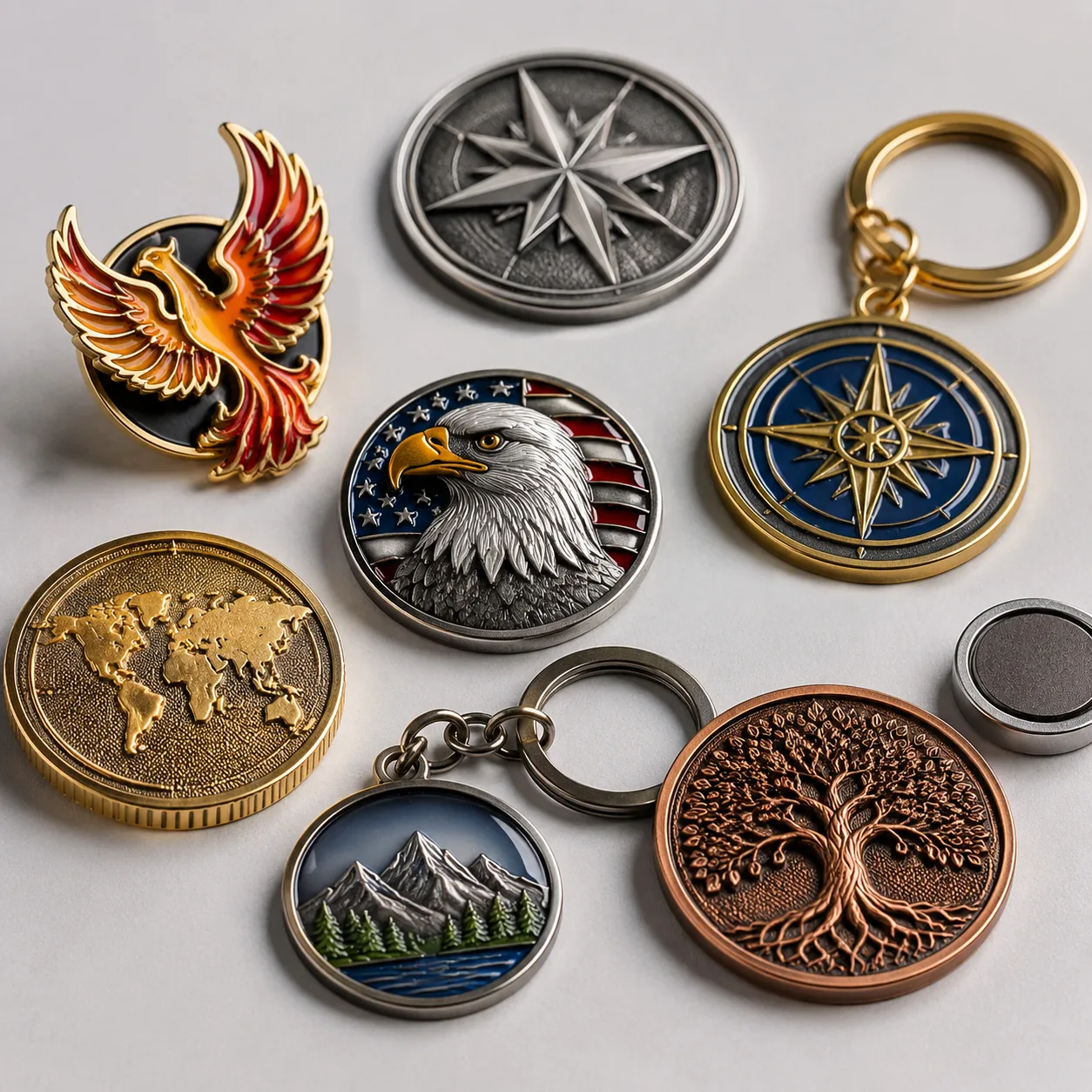
For pins, badges, keychains, medals, and challenge coins, the most credible lower-impact move is usually within the metal family. Recycled zinc alloy remains the standard choice for die-cast items that need irregular outlines, interior cutouts, or 3D relief. Typical finished thickness is 2.0 to 4.0 mm, common sizes run from 25 to 60 mm, and MOQ is often 100 pieces for simple repeatable formats or 300 pieces when a new custom mold is required. After sample approval, normal production is about 12 to 18 days for pins and keychains and 14 to 21 days for thicker coins or medals.
Recycled brass is usually the better choice for stamped pins and badges that need sharper borders, thinner sections, and cleaner raised detail. Standard stamped thickness is 1.0 to 1.5 mm before plating, soft-enamel recess depth is commonly 0.20 to 0.35 mm, and minimum raised line width should usually be held at 0.30 mm or above to keep detail stable through polishing and plating. Because recycled brass supply is tighter and the process requires more forming and edge finishing labor, price is higher than basic zinc alloy. At 500 pieces, a 30 mm stamped recycled brass pin typically lands around USD 0.78 to 1.85 FOB, depending on color count, plating, backing card, and whether one or two clutches are used.
For lanyards and patches, the decision shifts to textiles. RPET satin or recycled polyester webbing is now mainstream in 15 mm, 20 mm, and 25 mm widths, with MOQ commonly starting at 100 pieces. Production after artwork approval is usually 8 to 12 days for sublimation or screen print plus assembly, and 10 to 15 days when the build adds woven construction, custom breakaway color, detachable buckle, or multiple attachments. For embroidered patches, recycled polyester thread is available, but thread shade libraries are narrower than standard rayon or virgin polyester ranges, and the finish is often slightly flatter. That matters on logos that depend on vivid contrast, metallic-look thread, or very bright fluorescent shades.
The common sourcing error is forcing a product-family change purely to support a claim. A keychain expected to live on keys for 12 months will usually perform better in metal than in MDF, cork composite, bamboo laminate, or low-grade acrylic. The lower-impact answer is more often recycled zinc alloy, single-sided design, no epoxy dome, and paper-sleeve packaging, not a switch to a fragile substrate that creates breakage, replacements, and lower perceived value.
| Product | Recommended 2026 lower-impact construction | Typical MOQ | Lead time after approval | Indicative FOB at 500 pcs | FOB effect vs standard |
|---|---|---|---|---|---|
| Soft enamel pin, 30 mm | Stamped recycled brass or die-cast recycled zinc alloy, no epoxy, 350 gsm FSC backing card | 100-300 pcs | 12-18 days | USD 0.68-1.45 | 0% to +12% |
| Metal keychain, 45 mm | Recycled zinc alloy, 25 mm chain plus split ring, paper sleeve or card mount | 100-300 pcs | 12-20 days | USD 0.85-1.90 | 0% to +10% |
| Challenge coin, 45-50 mm | Recycled zinc alloy or brass, antique finish, paper box or paper sleeve | 100-200 pcs | 14-21 days | USD 1.35-3.20 | 0% to +15% |
| Patch, 70-90 mm | RPET twill base or recycled polyester thread embroidery, merrow or laser edge | 200-500 pcs | 10-16 days | USD 0.45-1.10 | +5% to +18% |
| Lanyard, 20 mm x 900 mm | RPET sublimation or screen print on recycled webbing with standard hook | 100-500 pcs | 8-15 days | USD 0.36-0.92 | 0% to +8% |
| Backing card or folding box | FSC paperboard, 300-400 gsm, water-based or soy-based ink where available | 500-1000 pcs | 7-15 days | USD 0.04-0.28 | -5% to +10% |
Control the failure points in production
Failure point one is assuming recycled means identical. It does not. Recycled zinc alloy is stable for die-cast products with medium detail, but features below about 0.25 mm line width, very tight internal corners, or deep undercuts can soften during casting and polishing. For stamped products that need crisp borders, buyers should specify minimum raised line width of 0.30 mm, recessed enamel depth of 0.20 to 0.35 mm, and finished edge tolerance of plus or minus 0.15 mm. Without those numbers, quality becomes subjective, approvals drag, and reject rates rise.
Failure point two is overpromising on plating finish. Decorative plating on promotional metal items is thin compared with jewelry. A common commercial range for bright nickel, imitation gold, or black nickel is roughly 0.03 to 0.08 microns, sometimes sealed with clear e-coat or lacquer to slow tarnish and improve abrasion resistance. Antique, matte, and brushed finishes usually suit recycled-content metal better because they disguise minor surface variation and light handling marks. If the design depends on mirror-bright gold or chrome, expect stricter polishing control, higher cosmetic reject risk, and a higher FOB.
Failure point three is plastic reduction without transit engineering. A plated pin or keychain shipped loose in a paper envelope will scratch during courier or ocean transit. The fix is small but must be written into the spec: glassine sleeve, tissue interleaf, cavity tray, or a minimal OPP bag used only as face protection. The added cost is often just USD 0.01 to 0.04 per unit. Omitting that protection to support a plastic-free claim often creates more waste through returns and remakes than the avoided packaging ever saved.
Failure point four is hardware mismatch. A recycled-webbing lanyard still fails if the breakaway releases too easily, the hook corrodes in storage, or the stitch pattern tears under load. For event lanyards, define webbing thickness, commonly 0.8 to 1.2 mm, and breakaway opening force, usually 2.5 to 4.5 kgf depending on market and safety expectations. For pins wider than 28 to 30 mm, two rubber clutches generally control rotation better than one butterfly clutch. The recycled-material claim has little value if the assembled product fails on first use.
Price the swap with MOQ, timing, and simplification in mind
Not every lower-impact option is expensive. Buyers need to separate raw-material premium from process premium and documentation premium. RPET webbing and FSC paper are now inside normal market bands at many export factories. Costs rise faster when recycled content must be segregated by lot, color matched tightly across repeat runs, or backed by batch-specific declarations and third-party reports. That extra cost is mostly traceability and control, not the material itself.
For standard metal promo goods in the 30 to 50 mm range, realistic 2026 FOB at 500 pieces is about USD 0.60 to 1.60 for pins, USD 0.85 to 1.90 for keychains, and USD 1.35 to 3.20 for coins, depending on process, thickness, colors, plating, and packaging. At lower MOQs, unit prices step up sharply because mold cost and setup are spread over fewer pieces. A 100-piece custom die-cast keychain that lands at USD 1.70 to 2.90 FOB may drop to roughly USD 0.85 to 1.90 at 500 pieces and below USD 1.40 at 1,000 pieces for the same core spec.
Sustainable swaps usually add 0% to 15%, but that premium often shrinks or disappears when the build is simplified at the same time. Removing epoxy, reducing the number of plating combinations, changing from a rigid plastic case to a paper sleeve, or eliminating unnecessary insert trays can offset the recycled-material upcharge. RPET lanyards are the cleanest example because the supply chain is mature and the lead-time impact is modest. At 500 pieces, a 20 mm RPET sublimation lanyard with black safety breakaway and metal swivel hook commonly runs USD 0.36 to 0.92 FOB depending on print coverage, hook type, and packing method.
Lead-time risk stays manageable only when the lower-impact build is fixed before sampling. In many cases, the delta versus a standard construction is only 2 to 5 calendar days. Delays become material when a buyer approves a standard sample and then requests recycled content for mass production. That often reopens dye matching, plating review, attachment pull testing, package fit, and even carton count if unit weight changes. A 5 to 8 day slip is common in that scenario, and on urgent event programs it is often the difference between sea freight and air freight.
Write claim and inspection terms that factories can execute
A PO that says eco-friendly is not actionable. Buyers should state the exact claim they intend to make and the proof they actually need. In most programs, the useful documents are limited to recycled-content declarations for RPET or recycled paper, FSC claim support for paper packaging where relevant, and nickel, lead, cadmium, or REACH-related testing if the destination market or customer policy requires it. Asking for every available certificate increases cost and slows approvals without improving the item itself.
Inspection terms also need to be explicit because lower-impact versions of standard SKUs are easy to mix with conventional stock. At minimum, define the required material wording on labels, inner packs, and packing lists, then set the visual and functional inspection baseline. A common commercial standard is AQL 2.5 for major defects and 4.0 for minor defects, with critical defects at 0.0. For metal goods, major defects should include wrong plating, missing attachment, severe color-fill voids, sharp burrs, wrong backing card, and obvious face scratches. For lanyards, major defects should include wrong webbing width, major misprint, failed breakaway, wrong hook, and stitch failure at the attachment point.
- State exact claim language on the PO: RPET polyester, recycled zinc alloy, FSC-certified paperboard, or no sustainability claim.
- Confirm whether proof is supplier-level, lot-level, or batch-level before approving any premium.
- Set inspection terms in writing, such as AQL 2.5 major and 4.0 minor, with critical defects at 0.0.
- Require a golden sample if the lower-impact version differs in sheen, texture, thread shade, or packaging method.
- Lock carton markings, SKU codes, and inner-pack wording so lower-impact and standard versions cannot be mixed in stock.
This discipline matters even more for kits and mixed-product promotions. A set containing a pin, lanyard, and backing card may include three different substitutions, each with different documentation, inspection points, and carton markings. If those are not treated as controlled specifications, purchasing and QC teams often handle the eco and standard builds as the same SKU. That is where avoidable claim disputes, relabeling costs, and emergency reorders start.
Choose by use case, then build the RFQ around that choice
For event giveaways, the strongest move is usually RPET lanyards plus simplified pack-out. End users care about comfort, print clarity, and quick distribution, not whether the hook body contains recycled metal. A practical event spec is 20 mm RPET webbing, full-color sublimation on both sides, black plastic safety breakaway, zinc alloy swivel hook, total folded length 900 mm, webbing thickness around 0.9 mm, and bulk pack of 50 pieces per bag or paper-banded bundle. That keeps unit cost efficient while removing unnecessary packaging layers.
For retail, museum, and membership merchandise, product life and giftability matter more. Metal pins and keychains still make sense, but the construction should be rationalized. A durable retail pin spec could be a 30 mm stamped recycled brass pin, 1.2 to 1.5 mm thick, soft enamel, antique nickel finish, two rubber clutches, mounted on a 350 gsm FSC card with a glassine sleeve for face protection. That preserves perceived value, avoids brittle novelty substrates, and reduces plastic without turning the item into a lower-grade souvenir.
For awards and recognition items, avoid forcing a rugged product into a weak material story. Challenge coins, service pins, and safety awards rely on weight, tactile quality, and a low visible defect rate. The better decision is usually recycled-content metal where feasible, conservative plating choices, compact paper packaging, and freight-efficient master cartons. Lower replacement rates and fewer cosmetic rejects often produce more operational benefit than trying to remove every conventional input from the bill of materials.
In the next RFQ, start with one SKU rather than the full assortment. Choose either the highest-volume item or the easiest substitution, then request two like-for-like quotations: standard construction and one lower-impact construction with identical artwork, quantity, pack-out, and Incoterm. Specify dimensions, target weight, thickness, attachment, finish, packaging, MOQ tier, destination market, and latest ship date. Then add only the sustainability requirement you genuinely intend to buy, such as RPET webbing, recycled zinc alloy, FSC backing card, or plastic-reduced inner pack with defined transit protection. Approve a pre-production sample of that actual lower-impact version, not a standard sample described as equivalent. When a supplier can hold the trade-offs through sampling, production, inspection, and repeat orders, the result is a sourcing program that works commercially rather than a claim that collapses under factory conditions.
Have a project? Send your artwork and target quantity and we’ll reply with a detailed quotation within 12 working hours.
Ready to get this made?
Send your sketch, target quantity and ship-date. Detailed quotation in 12 hours.



