Surface Texture Specs for Custom Metal Badges and Coins
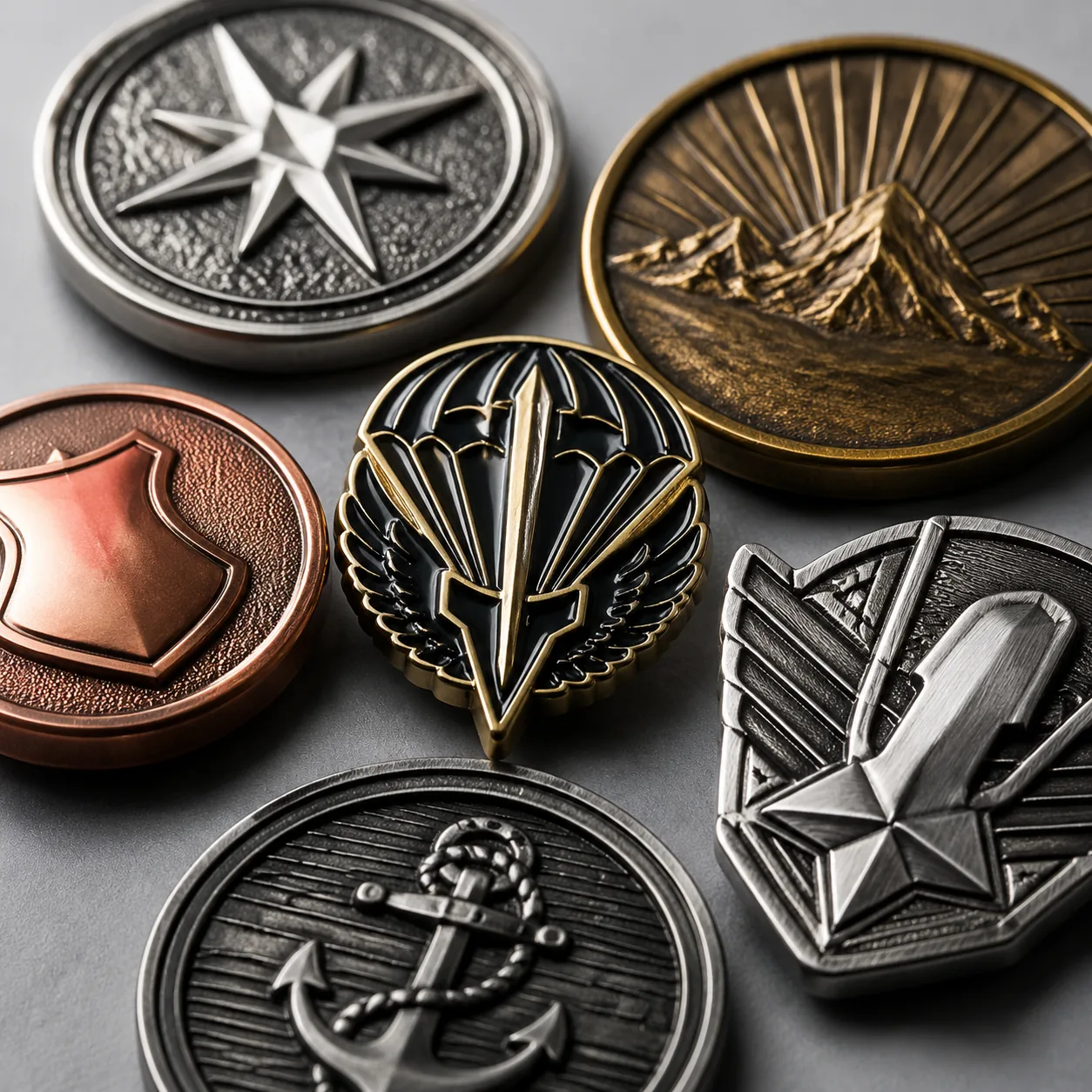
Why Approved Artwork Still Produces the Wrong Feel
A custom badge, lapel pin, keychain, or challenge coin can match the approved vector artwork and still look inexpensive if the surface texture is not defined. The common failure is a vague note such as “gold plating with matte recessed background.” That does not tell the factory how matte the background should be, where the matte area stops, whether raised metal should be mirror polished or satin polished, or how the result will be inspected. The factory then applies its default sandblast, light polish, or antique wipe, and the finished piece may look cloudy, patchy, or too reflective under retail or trade-show lighting.
Texture affects more than appearance. It changes color contrast, fingerprint resistance, enamel visibility, plating yield, and the perceived weight of the item. On zinc alloy castings, texture can hide light flow marks and small pores, but it can also soften fine relief. On brass or iron stamped items, texture improves contrast but makes polishing and plating coverage harder to control at narrow edges. A clear texture instruction usually adds no cost to the drawing stage and only 0 to 3 days to sampling. A wrong finish discovered after mass production can add 12 to 25 days for remake, re-plating, or sorting.
This guide is for custom metal pins, brooches, medals, keychains, fridge magnet badges, and challenge coins made from zinc alloy, brass, iron, or stainless steel. It gives procurement teams usable RFQ language, practical tolerances, MOQ and lead-time expectations, and QC criteria that can be checked against a plated pre-production sample.
Choose the Texture by Function, Not Name
The main finishes used on promotional metal goods are mirror polish, satin polish, mechanical brush, sandblast matte, bead blast matte, antique wash, and chemical etch grain. Each has a practical use. Mirror polish works best on raised logos, rims, and small premium areas where shine is part of the design. Sandblast matte works best in recessed coin fields where the buyer wants strong contrast against polished raised metal. Brushed metal works well on flat nameplates and keychains, but it is difficult to keep consistent on curved 3D relief.
For most orders, one dominant texture plus one contrast finish is safer than mixing three or four finishes. A 50 mm coin with a mirror-polished raised logo and sandblasted recessed field is a stable specification. A 25 mm pin with polished border, matte recess, brushed letters, enamel fills, and antique wash is risky because the operator has too little room to control each effect. If a raised metal stroke is below 0.35 mm wide, do not request a separate brush direction or mirror-polished line; it will not be repeatable across a 500-piece or 1,000-piece batch.
Always confirm the texture on the same plating finish planned for mass production. Raw zinc alloy or brass does not show the final contrast. Nickel, imitation gold, real gold flash, black nickel, gunmetal, antique silver, and antique brass all change how deep or soft a texture appears.
| Texture type | Best use | Avoid when | Typical FOB add-on |
|---|---|---|---|
| Mirror polish | Raised logos, rims, premium pins, smooth keychains | Large flat areas above 25 x 25 mm because scratches and waves show | +0.00 to 0.03 USD per piece |
| Satin polish | Corporate badges, subtle backgrounds, soft metal contrast | Buyer expects jewelry-like reflection | +0.02 to 0.05 USD per piece |
| Sandblast matte | Recessed fields on coins, medals, and bold 2D badges | Fine text below 0.8 mm high or relief below 0.25 mm | +0.02 to 0.06 USD per piece |
| Bead blast matte | Even matte on stainless steel, brass, or premium keychains | Ultra-low-cost iron pins or parts with many enamel pockets | +0.04 to 0.10 USD per piece |
| Mechanical brush | Nameplates, keychains, flat badges, minimalist designs | Curved 3D relief, small irregular shapes, narrow raised strokes | +0.05 to 0.12 USD per piece |
| Antique wash | Challenge coins, vintage badges, deep recessed relief | Bright brand colors, medical themes, food campaigns, clean corporate palettes | +0.03 to 0.08 USD per piece |
| Chemical etch grain | Thin badges, plaques, nameplates, detailed flat graphics | Thick cast coins or soft sculpted 3D designs | +0.03 to 0.09 USD per piece |
Material and Process Limits That Change Texture
Zinc alloy casting is common for 3D badges, keychains, and coins because it supports deep relief, cutouts, and moderate tooling cost. It accepts sandblast and antique finishes well, especially at 2.5 to 4.0 mm thickness. The limitation is mirror polish on broad flat fields: small pores can appear after plating, especially on areas larger than about 20 x 20 mm. For a zinc alloy coin with a premium face, keep mirror shine on raised logos, borders, and small icons rather than the full background.
Brass stamping gives sharper 2D edges and better polishing control than zinc alloy. It is the preferred material for premium lapel pins, medals, and coins when the design is flat or semi-relief. Typical brass pin thickness is 1.2 to 2.0 mm; coin thickness is usually 2.5 to 4.0 mm. Brass also handles brushed surfaces better because the base metal is dense and takes nickel, gold, and antique finishes evenly.
Iron is selected mainly for budget pins and simple badges. It can produce a clean result, but it needs reliable plating coverage because exposed iron can rust. For iron badges, specify 3 to 5 microns of nickel underplating before decorative gold, silver, black nickel, or gunmetal. Avoid deep sandblast pockets with sharp trapped corners on iron because plating can thin at edges and become a corrosion risk.
304 stainless steel is a strong choice for brushed keychains, name badges, bottle openers, and minimalist plaques at 1.5 to 2.5 mm thickness. It is less suitable for bright soft enamel pins because plated color options and enamel adhesion are more limited than with brass or zinc alloy. If the design needs strong brush texture and colored enamel in the same piece, brass with nickel plating is usually easier to control.
- Use zinc alloy for 3D relief, antique coins, cutouts, and complex shapes above 35 mm.
- Use brass for premium 2D pins, sharp raised edges, controlled brushing, and cleaner mirror polish.
- Use iron only when budget is tight and nickel underplating is included in the RFQ.
- Use 304 stainless steel for brushed keychains, nameplates, bottle openers, and minimalist badges.
- Avoid combining stainless steel, heavy enamel fill, and bright gold plating unless sampling time allows testing.
- Choose one main texture and one contrast finish for first-time orders or tight launch schedules.
Write Texture Zones Into the Drawing
A useful texture note identifies the surface, the zone, and the inspection expectation. “Matte background” is not enough. Better wording is: “Recessed background only: uniform sandblast matte; raised logo and outer rim: mirror polish; enamel pockets: no sandblast; texture must match approved plated sample at 30 cm viewing distance.” This gives the mold maker, polishing operator, plating line, and QC inspector the same target.
Relief height matters because polishing tools cannot avoid shallow recesses. For pins and badges under 30 mm, allow at least 0.25 mm height difference between polished raised metal and matte recessed fields. For 40 to 70 mm challenge coins, 0.35 to 0.60 mm relief difference gives stronger separation and better antique wash retention. If the recess is only 0.10 mm deep, the polishing wheel can touch the matte background and create shiny wipe marks.
Texture borders need clearance from enamel and plated color boundaries. Keep sandblast or antique wash at least 0.20 mm away from enamel edges on small pins and 0.30 mm away on coins or keychains. For brushed metal, specify the grain direction as horizontal, vertical, radial, or parallel to the long axis. Without that instruction, one batch may have horizontal grain and the reorder may have vertical grain, even if both pass a general visual inspection.
| Spec item | Recommended value | Reason |
|---|---|---|
| Raised/recessed height gap for pins | Minimum 0.25 mm | Reduces accidental polishing of matte recesses |
| Raised/recessed height gap for coins | 0.35 to 0.60 mm | Improves contrast and holds antique wash |
| Texture clearance from enamel edge | 0.20 to 0.30 mm | Prevents rough borders and color contamination |
| Minimum raised text height on matte field | 0.8 mm | Sandblast and plating soften small lettering |
| Minimum polished metal line width | 0.35 mm | Narrower lines cannot be polished evenly |
| Typical pin thickness tolerance | +/-0.20 mm | Practical tolerance for stamped or cast badges |
| Typical coin thickness tolerance | +/-0.30 mm | Allows plating build and relief variation on heavier items |
| Visual texture tolerance | No obvious mismatch at 30 cm under neutral white light | Matches normal buyer inspection conditions |
Plating Thickness Controls Final Contrast
Texture is formed before or during finishing, but plating thickness determines how it looks after production. Too little plating exposes roughness, pores, or dark base metal. Too much plating fills shallow grain and reduces contrast. For most custom pins, badges, and keychains, a typical build is 3 to 5 microns of nickel plus a decorative top layer. Gold flash is often 0.03 to 0.10 micron for promotional use; imitation gold or brass-color finishes may run 0.10 to 0.30 micron depending on the supplier’s process. Silver, black nickel, gunmetal, and nickel finishes commonly sit within a 3 to 6 micron total plating build.
Challenge coins and keychains need a more durable base because they rub against pockets, keys, and packaging. For zinc alloy or brass coins, a common premium stack is 2 to 4 microns copper strike, 3 to 5 microns nickel, then the decorative finish. Copper helps level the surface; nickel improves corrosion resistance and brightness. Antique finishes require a dark wash in the recesses followed by controlled wiping on raised areas. If the raised surface is too rough or heavily sandblasted, the antique wash can stain the top and look dirty instead of aged.
Mirror black nickel should be used carefully. It photographs well but shows fingerprints, hairline scratches, and dust more than satin nickel or antique silver. For giveaways handled by thousands of people, satin nickel, antique brass, antique silver, or sandblast gold normally hides wear better. For retail items, specify individual polybagging or tissue wrapping because bulk packing can scratch polished surfaces before inspection.
MOQ, FOB Price, and Lead-Time Impact
Texture rarely changes the formal MOQ by itself, but it changes labor time, sorting rate, and yield. Practical MOQ tiers for custom metal goods are 100, 300, 500, and 1,000 pieces. The strongest unit-price improvement is usually between 300 and 1,000 pieces because tooling cost, setup time, and plating line preparation are spread over more units. Below 100 pieces, sampling and setup dominate the price; above 1,000 pieces, material and labor become the main drivers.
As a working range, a 30 mm zinc alloy badge with one plating finish and a standard butterfly clutch may cost 0.55 to 1.20 USD FOB at 500 pieces. Controlled sandblast, satin polish, or a defined texture boundary usually adds 0.02 to 0.06 USD per piece. A 50 mm challenge coin, 3.0 mm thick, with two-sided relief and antique finish often runs 1.60 to 3.40 USD FOB at 300 to 500 pieces. Dual texture, sequential polishing, bead blasting, or tight retail inspection can add 0.08 to 0.25 USD per coin.
Lead time depends on tooling, sample approval, and whether the finish must be corrected. Normal sampling is 5 to 8 days for simple 2D pins, 7 to 10 days for zinc alloy 3D badges, and 8 to 12 days for two-sided challenge coins. Mass production is typically 10 to 18 days after approval for 300 to 500 simple pins, 12 to 22 days for textured 3D badges, and 15 to 28 days for coins or keychains. If the mold is correct but the surface is too shiny, too dull, or uneven, a finish-only correction sample usually takes 3 to 6 days.
| Order example | MOQ tier | Sample lead time | Mass production lead time | Typical FOB range |
|---|---|---|---|---|
| 30 mm 2D brass pin, satin nickel, butterfly clutch | 100 to 1,000 pcs | 5 to 8 days | 10 to 18 days | 0.65 to 1.45 USD |
| 35 mm zinc alloy 3D badge, polished logo, sandblast recess | 100 to 1,000 pcs | 7 to 10 days | 12 to 22 days | 0.80 to 1.80 USD |
| 50 mm brass or zinc alloy coin, antique silver, two-sided relief | 100 to 1,000 pcs | 8 to 12 days | 15 to 25 days | 1.60 to 3.40 USD |
| 60 mm keychain, brushed front face, split ring | 300 to 2,000 pcs | 7 to 11 days | 16 to 28 days | 1.20 to 2.80 USD |
| 304 stainless steel name badge, horizontal brush, pin back | 300 to 3,000 pcs | 6 to 10 days | 14 to 24 days | 0.90 to 2.10 USD |
QC Checks for Texture Before Mass Production
Texture inspection should combine visual standards and measurable checks. For promotional metal goods, inspect appearance at 30 cm under neutral white light around 5000K to 6500K, then tilt the piece to reveal patchiness, polishing wipe marks, and inconsistent brush direction. Measure diameter, thickness, relief height, and critical line width with calipers. AQL 2.5 for major defects and AQL 4.0 for minor cosmetic defects is a practical starting point. Retail jewelry, licensed merchandise, or high-value boxed coins may require AQL 1.5 major and AQL 2.5 minor.
Major defects include wrong texture zone, exposed base metal, peeling plating, rust, heavy stain, sharp burrs, missing antique wash in large recesses, reversed brush direction on the main face, and polishing that removes part of a logo or crosses into enamel. Minor defects include tiny hairlines, slight shade variation, or matte specks not visible at normal viewing distance. The signed plated sample should define the boundary between acceptable and unacceptable because “premium finish” is not a measurable QC term.
For mass production, compare pieces against the golden sample from at least three angles. A sandblast finish can look even straight on but become blotchy when tilted. Brushed parts should keep the specified direction on at least 95% of inspected pieces, with any reversed grain on the main face treated as a major defect. Coins should be checked on both sides because back faces often receive less polishing time than fronts.
- Approve a plated texture sample, not only a raw casting, strike sample, or digital rendering.
- Mark texture zones directly on the artwork with arrows, finish names, and brush direction.
- Use AQL 2.5 major and AQL 4.0 minor unless retail or licensed standards require tighter limits.
- Inspect at 30 cm under neutral white light, then tilt each piece to reveal uneven matte or polish marks.
- Measure thickness tolerance at +/-0.20 mm for most pins and +/-0.30 mm for coins and heavy keychains.
- Reject exposed base metal, plating peel, sharp burrs, wrong texture zones, and visible polish wipe marks.
- Keep one signed golden sample and the supplier’s finish notes under the same item code for reorders.
RFQ Language That Prevents Texture Disputes
Before requesting quotes, decide whether texture is a required design feature or only a nice-to-have effect. If it is required, include marked artwork, material preference, thickness, plating color, texture zones, target MOQ, packaging method, and inspection standard. Without those details, suppliers quote the easiest finish and adjust later, which makes price comparisons unreliable.
A clear specification can be short: “50 mm diameter zinc alloy challenge coin, 3.0 mm thickness, two-sided relief, antique silver plating, raised logo and rim mirror polished, recessed background uniform sandblast matte, no sandblast in enamel pockets, relief gap 0.40 mm minimum, texture must match approved plated sample, AQL 2.5 major/4.0 minor.” This gives tooling, polishing, plating, and QC teams a shared production target.
Do not use special texture where it adds risk without visible value. On badges below 20 mm with several enamel colors, buyers usually notice line quality and Pantone accuracy more than metal grain. Avoid antique finishes when the brand requires bright white, yellow, or light blue enamel because the dark wash can make colors appear dull. Avoid mirror finishes on keychains and bag charms unless the buyer accepts normal abrasion from keys. For functional carry items, satin, brushed, bead-blasted, or antique surfaces usually produce fewer complaints.
A practical RFQ should end with acceptance criteria: texture must match the approved plated sample; no exposed base metal; no visible patchiness at 30 cm; no reversed brush direction on the main face; no polishing marks across enamel boundaries; and no burrs sharp enough to catch skin, fabric, or packaging. Those terms are specific enough for inspection and still realistic for custom promotional metal production.
Have a project? Send your artwork and target quantity and we’ll reply with a detailed quotation within 12 working hours.
Ready to get this made?
Send your sketch, target quantity and ship-date. Detailed quotation in 12 hours.



