Stock Molds vs Custom Tooling for Small MOQ Orders
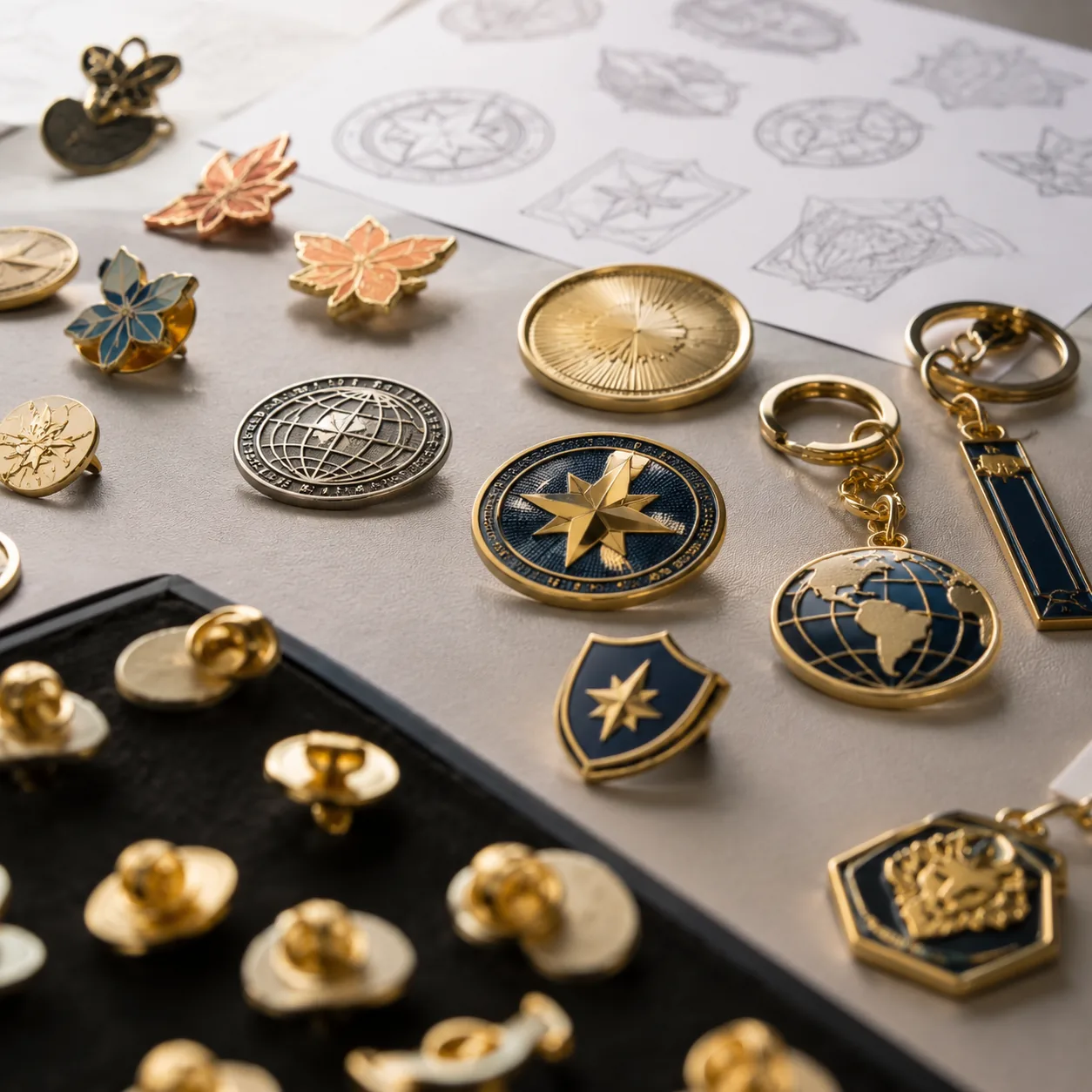
For 50 to 300 pieces, fixed setup cost usually dominates the quote
On low-volume promotional metal orders, the largest cost driver is usually the setup path, not the grams of metal. For soft-enamel pins, die-struck badges, keychains, magnets and simple commemorative coins, a stock mold can cut first-order spend by roughly 25 to 60 percent versus a new die. The savings are most pronounced below 200 pieces because die cutting, engineering review, plating setup, sample preparation and line changeover are fixed costs spread across very few usable units.
That is where buyers often misread quote sheets. A custom item may look only USD 0.20 to 0.55 higher per piece than a stock-shape version, but the non-recurring engineering charge changes the real economics. Typical 2026 FOB die charges are about USD 70 to 160 for 25 to 35 mm pins and badges, USD 110 to 240 for keychains with custom outlines, and USD 140 to 320 for 38 to 45 mm coins with custom edges or dual-sided relief. On a 100-piece run, the die charge alone can equal or exceed the value of the goods.
The practical decision is not whether custom tooling is better in theory. It is whether the design actually requires a custom silhouette, custom piercings, multi-level relief, edge pattern, hardware placement control or dimensional repeatability that a stock blank cannot deliver. If the design message sits mainly in the front artwork, a stock mold usually gives the stronger first-PO result: less cash exposure, fewer approval rounds, lower scrap risk and a shorter production calendar.
Stock blank versus custom die: what really changes in production
A stock-mold route uses a prequalified geometry already running on the supplier’s line: round, square, rectangle, oval, shield, dog tag, heart, star or standard key-fob bodies with fixed hole and ring positions. Decoration is then added inside that outline by soft enamel, hard enamel imitation, screen print, offset print, UV print, laser marking or epoxy dome. The outer shape and most dimensions stay fixed; only the face artwork, finish and hardware options change.
Custom tooling means the factory cuts a new die for the exact perimeter and, where applicable, the internal raised and recessed metal structure. That enables branded silhouettes, internal cutouts, asymmetrical borders, bottle-opener backs, stepped levels, rope or spur edges, backside text, and fit-specific dimensions. It also adds die-line review, feasibility checks, first-article approval and a higher chance of at least one revision cycle if the art pushes minimum line, gap or cutout limits.
This is not a quality hierarchy. A stock 25 mm round pin with 0.35 mm raised metal lines, clean soft-enamel fill and polished nickel plating can look more premium than a rushed custom silhouette with thin webs, unstable cavities and poorly placed posts. The commercial question is whether the outline itself carries value and whether the buyer is likely to amortize tooling over repeat runs within 6 to 12 months.
| Factor | Stock mold route | Custom tooling route |
|---|---|---|
| Typical MOQ | 50 to 100 pcs; some printed magnets or acrylic-backed items from 25 pcs | 100 to 300 pcs typical; 200 pcs common for efficient setup; 300 pcs improves die amortization |
| Tooling / NRE | USD 0 to 30; occasionally USD 35 to 75 for screen, fixture, backing card die-cut or sample prep | USD 70 to 160 for pins/badges; USD 110 to 240 for keychains; USD 140 to 320 for coins or complex outlines |
| FOB unit price at 100 pcs | USD 0.58 to 1.30 for 25 to 30 mm pins; USD 0.90 to 1.95 for keychains; USD 0.45 to 1.15 for flat magnets | USD 0.98 to 2.20 for pins/badges; USD 1.30 to 2.90 for keychains; USD 1.85 to 4.40 for 38 to 45 mm coins |
| FOB unit price at 300 pcs | USD 0.38 to 0.95 for pins; USD 0.68 to 1.50 for keychains | USD 0.60 to 1.60 for pins; USD 0.98 to 2.20 for keychains; USD 1.30 to 3.00 for coins |
| Lead time after art approval | 3 to 5 days for print-only items; 7 to 10 days for plated blanks with color or epoxy | 12 to 18 days typical; 15 to 22 days if a plated pre-production sample is required |
| Sample timeline | Digital proof in 1 to 2 days; decorated stock sample in 3 to 5 days | Tooling drawing in 1 to 3 days; first metal sample in 5 to 7 days; plated/color sample in 7 to 10 days |
| Dimensional tolerance | Usually ±0.20 mm to ±0.30 mm on perimeter, hole location and blank thickness | Usually ±0.10 mm to ±0.15 mm on approved die-struck perimeter; attachment placement often tighter |
| Relief capability | Flat print, epoxy dome, or light 2D border within standard geometry | Full 2D raised lines, deeper recessed color areas, custom edge patterns and limited 3D contours |
| Best fit | Pilot launches, urgent events, internal recognition, price-sensitive campaigns | Retail SKUs, official commemoratives, collector pieces, fit-critical packaging, planned repeat programs |
Where stock molds save money, and where they damage perceived value
Stock molds work when the commercial message sits in the artwork rather than in the perimeter. Typical fits include a 25 mm round conference pin, a 30 x 20 mm employee-service badge, a 50 mm square tourist magnet, or a standard tag-style keychain with UV print and epoxy. In those cases, eliminating new tooling often saves USD 80 to 150 and removes around 4 to 7 calendar days otherwise spent on die cutting, die correction and sample confirmation.
They also lower startup risk. A proven blank already has known stamping behavior, known plating response, known ejectability and known packing dimensions. On a 100-piece run, this matters because early scrap is expensive. If a new custom die produces 6 to 10 percent rejects in the first pass because of shallow cavities, overthin bridges or attachment misalignment, the loss is immediately visible in usable-unit cost. A mature stock blank is more likely to hold a first-pass yield above 97 percent.
The tradeoff is clear. If the silhouette is the product, forcing it into a generic round or rectangle strips out selling value. A stadium outline, state map, mascot head, bottle profile, product-shaped charm or crest with internal voids loses recognition when flattened into a stock shape. The same applies when the design needs internal piercings below about 1.2 mm, edge features such as rope borders, or exact fit into a shaped insert window. In those cases, the stock route does not simply limit aesthetics; it reduces brand recognition and can hurt sell-through.
Compare total usable cost, not just quoted unit price
The clean comparison is total manufacturing cost per usable piece. Example: a 30 mm stock-shape soft-enamel badge at 100 pieces is quoted at USD 0.78 FOB with no die charge, total USD 78. A custom-outline version is quoted at USD 1.05 FOB plus a USD 90 die charge, total USD 195. If the stock run yields 99 percent usable pieces and the custom run yields 97 percent after setup losses, the effective cost is about USD 0.79 per good stock unit versus roughly USD 2.01 per good custom unit. For order one, the custom route costs about 2.5 times more per usable part.
At 300 pieces, the gap narrows but remains material. If the stock route drops to USD 0.56, total cost is USD 168. If the custom route drops to USD 0.74 plus the same USD 90 die, total cost is USD 312. The custom route becomes easier to justify only when the tool is reused. A second 300-piece custom run at USD 0.74 with no new die is USD 222, bringing the two-run average to USD 1.00 per unit before any scrap adjustment. That is still higher than stock, but much closer if the shape carries retail value.
A useful procurement rule is straightforward. If the die charge is more than 25 to 35 percent of the first-order total and the outline is not commercially critical, request a stock-mold option first. If the item is a retail SKU, challenge coin, museum piece or official commemorative with planned repeat demand, treat the die as a production asset rather than a surcharge. Also confirm die storage terms in writing. Many suppliers keep active tools 12 to 24 months, but inactive dies may require USD 20 to 60 refurbishment or full recutting if corrosion, burr wear or edge damage appears.
The production specs that matter more than the rendering
Mockups hide most manufacturing limits. Before approving any low-MOQ metal item, request a written spec covering base metal, finished size, body thickness, plating finish, decorative plating thickness, line-width limits, cutout minimums, attachment hardware, packaging method and inspection level. Typical workable body thickness is 1.2 to 1.5 mm for pins, 1.5 to 2.5 mm for badges and keychains, and 2.0 to 3.0 mm for challenge coins. Common decorative plating in nickel, black nickel, imitation gold or imitation brass is usually about 0.03 to 0.08 microns for appearance, not long-term abrasion resistance.
Geometry limits are where many small custom jobs fail. Raised metal lines under 0.25 mm tend to plate unevenly and lose edge definition. Recessed color cavities under 0.30 mm can trap enamel inconsistently, especially on low-volume hand-filled runs. A safer engineering floor for 25 to 35 mm items is 0.30 mm minimum line width, 0.30 mm minimum gap, 0.60 mm minimum edge web, and internal corner radii above 0.40 mm. For piercings or cutouts, anything narrower than 1.2 mm should trigger explicit feasibility review and may require slower punching or laser assistance.
Quality language should be equally concrete. AQL 2.5 for major defects and AQL 4.0 for minor defects is common for promotional metal products, but those numbers are only useful if the defect definitions are written. Clarify whether plating pits, exposed base metal, color voids over 0.2 mm, epoxy bubbles over 0.5 mm, front-face scratches visible at 30 cm, bent posts, off-center split rings or edge dents count as major or minor. On a 100-piece order, each rejected unit has an outsized effect on effective cost, so vague QC wording is expensive.
- Lock finished size and thickness in mm, for example 30.0 mm ±0.15 mm and 1.5 mm ±0.10 mm
- Confirm minimum line width, minimum gap, minimum web and minimum cutout width before artwork approval
- Specify plating finish and approximate decorative plating thickness in microns
- Define hardware exactly: post quantity, post diameter, butterfly clutch or rubber clutch, split-ring size, or magnet grade such as ferrite or N35
- Require AQL level plus written defect definitions for scratches, color fill, plating voids, dents and attachment alignment
- Confirm die storage term, die reuse policy and any refurbishment fee after inactivity
Lead time risk usually sits in approvals, not in the press cycle
Low quantity does not guarantee short lead time. On custom orders, most delay occurs before mass production starts: die-line review, cutout confirmation, post and hole placement, plating exposure comments, color-callout clarification and first-sample approval. If the art is near process limits, one revision cycle commonly adds 2 to 4 days. If a plated pre-production sample is required, add another 5 to 8 days. That pushes many small custom orders to 15 to 22 production days before freight pickup.
Stock molds compress that front-end loop because the geometry is already proven. The practical gain is often 3 to 6 days, and sometimes more if the buyer can approve from a digital layout instead of waiting for a physical sample. That matters because logistics recovery is costly. Missing an event date and upgrading a small carton from standard air consolidation to express courier can easily add USD 60 to 180, which can wipe out the savings gained from negotiating a few cents off the unit price.
Another recurring problem is feature overload. Buyers request a custom silhouette, glitter fill, dual posts, backside logo, sequential numbering and individual backing cards on a 100-piece run, then expect stock-item timing. A disciplined factory will usually suggest one of three fixes: simplify the feature set, raise the order to 300 to 500 pieces so setup cost is better absorbed, or split the project into a standard first batch and a premium second run after market demand is proven.
When custom tooling is still the better choice below 300 pieces
Custom tooling is usually justified for membership emblems, challenge coins, museum retail pieces, official commemoratives and collector drops. In these categories, buyers are paying for silhouette recognition, edge definition, relief consistency and the feel of a purpose-built object. Saving USD 100 on tooling is poor economics if the result looks generic, fails to match an existing series or loses retail credibility at the shelf.
It also makes sense when the small run is only the launch batch of a longer program. If clubs, distributors, campuses or branch offices will reorder the same item across 6 to 12 months, the approved die becomes reusable infrastructure. Follow-on runs are usually smoother because the die, approved plating standard, QC master sample and hardware position are already established. In practice, second-run custom lead times are often 2 to 4 days faster than first-run custom orders when no art changes are required.
Tolerance can force the decision as well. If a badge must fit a 32.0 mm foam cavity with only 0.5 mm total clearance, align to a shaped card window, or match an existing collectible program within ±0.15 mm, stock shapes are rarely dependable enough. In that case, custom tooling is not a premium upgrade. It is simply the only route likely to meet the dimensional requirement consistently.
A practical 2026 buying method for orders under 300 pieces
Use a dual-quote method. Ask for one quotation on the nearest stock shape and one on full custom tooling, holding finished size, thickness, plating, hardware, packaging and FOB term constant. That makes the real delta visible and prevents a low unit price from hiding a die fee, sample charge, carding cost or packaging upcharge elsewhere in the quote.
Then test the project against three questions. First, does the item lose commercial meaning if the outer shape becomes standard. Second, can the deadline absorb one tooling revision plus a sample loop. Third, is reorder volume likely to amortize the die within 6 to 12 months. If two answers favor speed and standardization, a stock mold is usually the safer first PO. If two favor identity, fit or repeatability, approve the custom die and manage it as a reusable asset.
Before issuing the PO, lock every critical variable in writing: finished size, thickness, process type, plating finish, hardware, backing, packaging and inspection standard. For custom jobs, add die charge, die storage duration, die ownership language if relevant and die reuse policy. For stock molds, confirm exactly which blank dimensions are fixed, whether art will be resized to fit the live area, and whether the sample is digital only or physical. On small orders, that discipline usually decides whether the job runs like a controlled manufacturing program or an improvised one.
Have a project? Send your artwork and target quantity and we’ll reply with a detailed quotation within 12 working hours.
Ready to get this made?
Send your sketch, target quantity and ship-date. Detailed quotation in 12 hours.



