Stock Molds vs Custom Tooling for Small-MOQ Metal Pins
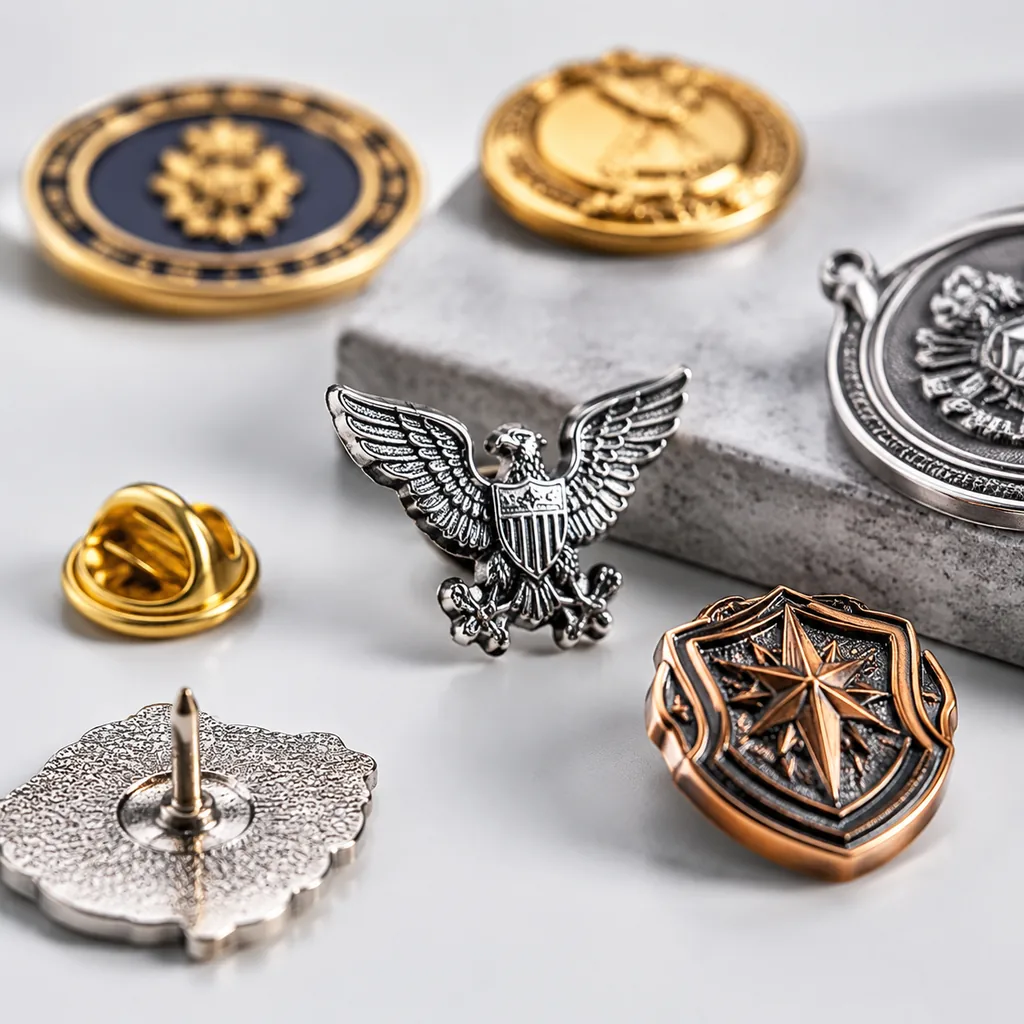
On 100 to 500 pieces, tooling usually matters more than enamel type
For low-volume metal pins, the first commercial decision is rarely soft enamel versus imitation hard enamel. It is whether the design can use an existing blank or requires a dedicated die. On a 100-piece order, a new stamped die charge of about USD 70 to 150 or a zinc alloy die-cast mold charge of USD 130 to 280 often adds more to first-run cost than the enamel fill, epoxy dome, or plating upgrade.
That is why the build route should be settled before discussing decoration details. A stock-mold route uses an existing round, square, rectangle, oval, shield, or dog-tag blank. The factory then adds offset print plus epoxy, screen print, laser marking, or limited recessed-and-filled decoration if the blank already supports that structure. Custom tooling creates a die for the exact outer profile and relief layout, so perimeter shape, internal cutouts, edge geometry, post placement, and backstamp area are built around the artwork instead of forced into inventory dimensions.
At 100 to 500 pieces, there is not enough quantity to dilute a bad tooling choice. Buyers usually lose money in one of two ways. Either they pay a die charge for artwork that would have worked cleanly on a standard 25 mm, 30 mm, or 38 mm blank, or they force a silhouette-led design into a generic shape and remove the feature that carries the brand. In both cases, the commercial error shows up immediately in unit economics or product quality.
A useful comparison keeps five inputs fixed across all quotes: finished size in mm, process, quantity, attachment hardware, and packaging. When those are locked, stock blank versus custom die becomes a clear economics decision instead of a moving target created by mixed assumptions.
Head-to-head comparison: MOQ, FOB, lead time, tolerance, and process control
| Spec | Stock mold build | Custom tooling build |
|---|---|---|
| Typical MOQ | 50 to 100 pcs for printed badges or simple stock-shape enamel items | 100 to 300 pcs typical for new stamped dies; some factories accept 50 pcs but unit cost rises sharply |
| Best-fit size range | 20 to 45 mm lapel pins; 35 to 50 mm key tags or medallions | 20 to 60 mm stamped pins; 35 to 70 mm die-cast badges, key tags, and medallions |
| Common body thickness | 1.2 to 1.8 mm for stock pin blanks; 2.0 to 2.5 mm for stock tags | 1.2 to 2.0 mm stamped iron or brass; 2.0 to 4.0 mm zinc alloy die-cast |
| Tooling charge | USD 0 to 40 if an existing blank is used; print screen, film, or fixture setup may still apply | USD 70 to 150 for stamped iron or brass die; USD 130 to 280 for zinc alloy mold |
| FOB unit price at 100 pcs | USD 0.65 to 1.05 for printed or simple stock-shape enamel pins | USD 1.10 to 2.20 depending on size, metal, colors, cutouts, and plating |
| FOB unit price at 300 pcs | USD 0.45 to 0.85 | USD 0.72 to 1.45 plus any first-run die charge |
| FOB unit price at 500 pcs | USD 0.39 to 0.72 | USD 0.62 to 1.10 with stored die reused |
| Lead time after artwork approval | 7 to 12 days typical; 5 to 7 days on repeat jobs using the same blank and artwork | 10 to 18 production days; add 2 to 4 days if a pre-production sample is required |
| Outer shape freedom | Limited to blank inventory, fixed radii, and fixed hole or post positions | Full custom perimeter, internal cutouts, controlled border width, and custom hardware map |
| Minimum practical line/gap | About 0.30 to 0.35 mm, depending on print method or shallow stamped detail | About 0.25 to 0.30 mm on 25 to 35 mm stamped pins; below that, reject rate usually rises |
| Relief depth control | Shallow only; often cosmetic recess rather than true sculpted relief | Typical relief difference 0.20 to 0.40 mm with tolerance around plus or minus 0.10 mm |
| Decorative plating thickness | Common decorative range 0.03 to 0.08 micron nickel, gold, or black nickel | Common decorative range 0.05 to 0.15 micron; premium retail specs may ask for the upper end |
| Outer size tolerance | Typically plus or minus 0.15 to 0.20 mm depending on blank source | Typically plus or minus 0.10 to 0.15 mm on stamped parts |
| Backside options | Plain back, sandblast, laser code, or fixed stock post positions | Custom backstamp, texture field, serial area, dual posts, and defined post spacing |
| Inspection target | AQL 2.5 major / 4.0 minor is common | AQL 2.5 major / 4.0 minor; retained golden sample recommended for repeat orders |
| Reorder consistency | Acceptable only if the same blank remains in active inventory | Better when die number, CAD, plating spec, and approved sample are archived |
| Main compromise | Lower setup cost and faster launch, but weaker shape control and more dependence on current stock | Higher first-run cost and longer setup, but better repeatability and brand control |
This is why stock molds are common for event handouts, campus badges, artist test drops, and sample packs. They remove most or all die cost and usually save 3 to 6 production days. The tradeoff is physical: thickness, edge radius, post position, and sometimes hole location belong to the blank, not to the design.
Custom tooling reverses that logic. The buyer spends more upfront, but gets control over silhouette, border width, relief depth, backside branding, and anti-rotation hardware placement. For retail pins, formal insignia, museum programs, and any SKU expected to reorder, that control is often worth more than the one-time die charge.
Where stock molds actually save money
A stock blank is the right answer only when the artwork fits standard geometry without looking compromised. Common examples are a 25 mm round anniversary pin, a 30 mm square club badge, a 40 mm rectangular key tag, or a 44 mm coin-style medallion. In those cases, using an existing blank can eliminate USD 70 to 150 in die cost and reduce ex-factory lead time by roughly 3 to 6 days compared with a new custom die.
The cheapest stock-shape executions are usually offset print with epoxy dome, screen print on plated metal, or simple soft enamel on a standard round or rectangle. A realistic market example is a 30 mm round printed pin with one butterfly clutch and individual polybag at 100 pieces: roughly USD 0.68 to 0.88 FOB. A custom-outline stamped soft enamel pin at the same size and quantity is more likely to land around USD 1.25 to 1.60 FOB, plus tooling.
But stock blanks only save money when the stock geometry already suits the product. Many inventory blanks are fixed at 1.5 mm or 1.8 mm thickness, use standard corner radii, and come with one default post position. If the design needs a narrow top section, an offset hanging hole, dual posts to reduce rotation, or recessed lines tighter than 0.30 mm, the factory may add drilling, extra hand polishing, or process substitutions. The savings narrow quickly, while the item still reads as generic.
There is also a continuity problem that buyers often miss. Some suppliers call a shape stock because it is on the shelf today, not because it is a stable catalog blank. A repeat order six months later may come from a different lot with slightly different thickness, edge break, or hole spacing. For repeat programs, request exact blank data: width, height, corner radius, thickness, hole diameter, hole location, and tolerances. A reasonable control target is plus or minus 0.10 mm on thickness and plus or minus 0.15 to 0.20 mm on finished size.
When custom tooling pays back faster than expected
Many buyers assume custom tooling only makes sense above 500 pieces. That is too simplistic. A new die often makes sense even at 100 to 300 pieces when the outline itself carries the design value. Character heads, building silhouettes, machine profiles, shields, crests, bottle shapes, and logos with asymmetric borders lose too much identity when compressed into a round or rectangle.
Custom tooling also becomes rational as soon as a second run is plausible. A USD 90 stamping die spread across 100 pieces adds USD 0.90 per piece on the first order. Spread across an initial 300 pieces plus one reorder of 500, the tooling burden falls to roughly USD 0.11 per piece. For museum stores, membership programs, branded merchandise, distributor awards, and uniform insignia, that is usually an efficient trade for better shape fidelity and repeat consistency.
Process selection matters inside the custom route. For flat or low-relief pins under 40 mm, stamped iron is typically the lowest-cost base metal. Stamped brass costs more, but usually produces cleaner edges on small lettering, narrow borders, and enclosed areas. Zinc alloy is useful when the design needs a thicker body, raised 3D surfaces, deep recesses, or open cutouts that are difficult to stamp cleanly. For a flat 30 mm pin with four enamel colors and no difficult cutouts, zinc die-casting usually adds cost without adding value.
A serious RFQ for custom tooling should specify minimum line width, minimum gap, relief depth, and attachment layout. On a 30 mm soft enamel pin, many competent factories can hold 0.25 to 0.30 mm lines and gaps, plus or minus 0.15 mm on outer size, and 0.20 to 0.35 mm relief difference between raised and recessed areas. If those numbers are missing, the quote still does not define the actual manufacturing standard.
Break-even math for small-run programs
The clean way to compare routes is to calculate first-run total and two-run total separately under the same FOB term. Keep the artwork, clutch type, packaging, and inspection standard identical so the only real variable is the build path.
Example one: a 30 mm soft enamel pin, four colors, iron base, one butterfly clutch, and individual polybag at AQL 2.5/4.0. At 100 pieces, a stock-shape version may quote USD 0.78 FOB with no die charge, for a total of USD 78. A custom-outline stamped version may quote USD 1.38 FOB plus USD 80 tooling, for a total of USD 218. The first-run gap is USD 140 total, or USD 1.40 per piece.
Example two: the same design at 300 pieces. A stock-shape option may quote USD 0.56 FOB for a total of USD 168. A custom-outline option may quote USD 0.90 FOB plus the same USD 80 die, for a total of USD 350. The total gap is USD 182, but the effective difference is now only about USD 0.61 per piece across the order.
Add a 500-piece reorder and the economics shift again. The stock-shape reorder may land around USD 0.43 to 0.50 FOB if the same blank is still available. The custom version, using stored tooling, may fall to roughly USD 0.74 to 0.82 FOB depending on plating, color count, and packaging. If silhouette recognition matters or the custom pin sells at retail, the incremental cost becomes easier to justify because the die charge has already been absorbed.
Schedule still matters. If a stock blank can ship in 8 to 9 ex-factory days and a custom die needs 14 to 16 days, those extra 5 to 7 days may outweigh outline accuracy for a hard event date. But for gift shop stock, quarterly recognition programs, or recurring branded merchandise, long-term consistency usually matters more than one faster first run.
Specifications to lock before approving either route
- Confirm finished size in mm and tolerance, for example 30.0 mm plus or minus 0.15 mm.
- State the exact process: offset print with epoxy, screen print, stamped soft enamel, imitation hard enamel, or die-cast zinc alloy.
- Specify base metal: iron for economy, brass for finer stamping, zinc alloy for thicker or more sculpted geometry.
- Request plating color and decorative thickness range. For most custom pins, 0.05 to 0.15 micron is realistic.
- Set minimum line width and minimum gap. On small stamped pins, 0.25 to 0.30 mm is a practical control band.
- For stock blanks, ask for a blank drawing or approved sample showing exact width, height, corner radius, hole size, and thickness.
- For custom tooling, confirm die charge, die number, storage period, and whether the die is reserved for your reorder program.
- Lock attachment type and location, including post count and edge distance. Pins above about 30 mm tall often need two posts to limit rotation.
- Approve backside details even on low-cost jobs: plain back, sandblast, logo backstamp, serial zone, or defined texture field.
- Set inspection terms such as AQL 2.5 major and 4.0 minor, and require a retained golden sample for repeat production.
- Define packaging because backing cards, barcode labels, OPP bags, velvet pouches, and gift boxes all change FOB and carton density.
- State the required ship window in calendar days, not just rush, so the supplier can quote the correct production path.
These checkpoints matter because two suppliers can quote the same art through completely different assumptions. One may price a printed stock badge with epoxy. Another may price a stamped soft enamel pin. A third may default to zinc alloy for a design that stamped iron could handle at lower cost. Without a locked specification, quote comparison is mostly noise.
When the cheaper quote is the wrong commercial choice
Do not use a stock mold when silhouette recognition is part of the value. If the design is a mascot head, architectural profile, industrial machine outline, bottle shape, shield, or any logo where the perimeter carries identity, a generic round or square blank removes the most visible branding element. The pin may still function, but it will read like a giveaway rather than a deliberate branded product.
The same caution applies to retail, museum, and uniform programs. On a resale card, premium garment, or formal badge application, buyers notice edge quality, border consistency, enamel cleanup, and post stability more than they do on event handouts. In those cases, saving USD 80 to 120 on tooling can be a false economy if the result looks generic, rotates during wear, or cannot be matched cleanly on reorder.
The reverse is also true. Custom tooling is usually unnecessary for a one-time campaign under 150 pieces when the design fits comfortably inside a standard geometry and has no reorder value. In that case, the die charge is pure setup cost. A well-executed stock blank with print or limited enamel usually delivers the required function at lower cost and in fewer days.
Buyers should also avoid overbuilding the specification. A target FOB below about USD 1.20 at 100 pieces rarely supports custom tooling, imitation hard enamel, dual plating, and gift-box packing at the same time. A more realistic path is to keep the custom outline if the shape matters, then simplify the rest: soft enamel, standard nickel or black nickel plating, and polybag or backing-card packaging.
A practical RFQ structure for faster, cleaner pricing
Start by classifying the order correctly: one-time event item or repeatable branded asset. For one-time use under 300 pieces, ask for two matched quotes against the same artwork and packaging: one stock-mold option and one custom-tooling option. For repeatable assets, ask for first-run and reorder pricing separately so the tooling effect is visible instead of buried in the unit price.
Then send a short RFQ with fixed numbers: quantity, finished size, thickness target, process, base metal, plating, color count, attachment, packaging, AQL level, and required ship date. Ask the supplier to comment on suitability, not only price. A competent factory should tell you whether the design is better served by stock blank adaptation, stamped custom tooling, or die-cast construction, and should identify the likely line-width, relief, and tolerance limits before sampling begins.
A dependable benchmark is to compare three scenarios side by side: stock blank with print, stock blank with limited enamel, and full custom stamped die. In one quoting cycle, that usually reveals the real answer. The right choice is rarely the cheapest unit in isolation. It is the route that fits the job: speed for a fixed event date, silhouette control for a branded product, or stored-tool consistency for a program that will reorder.
Have a project? Send your artwork and target quantity and we’ll reply with a detailed quotation within 12 working hours.
Ready to get this made?
Send your sketch, target quantity and ship-date. Detailed quotation in 12 hours.



