Stock Molds vs Custom Tooling for Low-MOQ Metal Promos
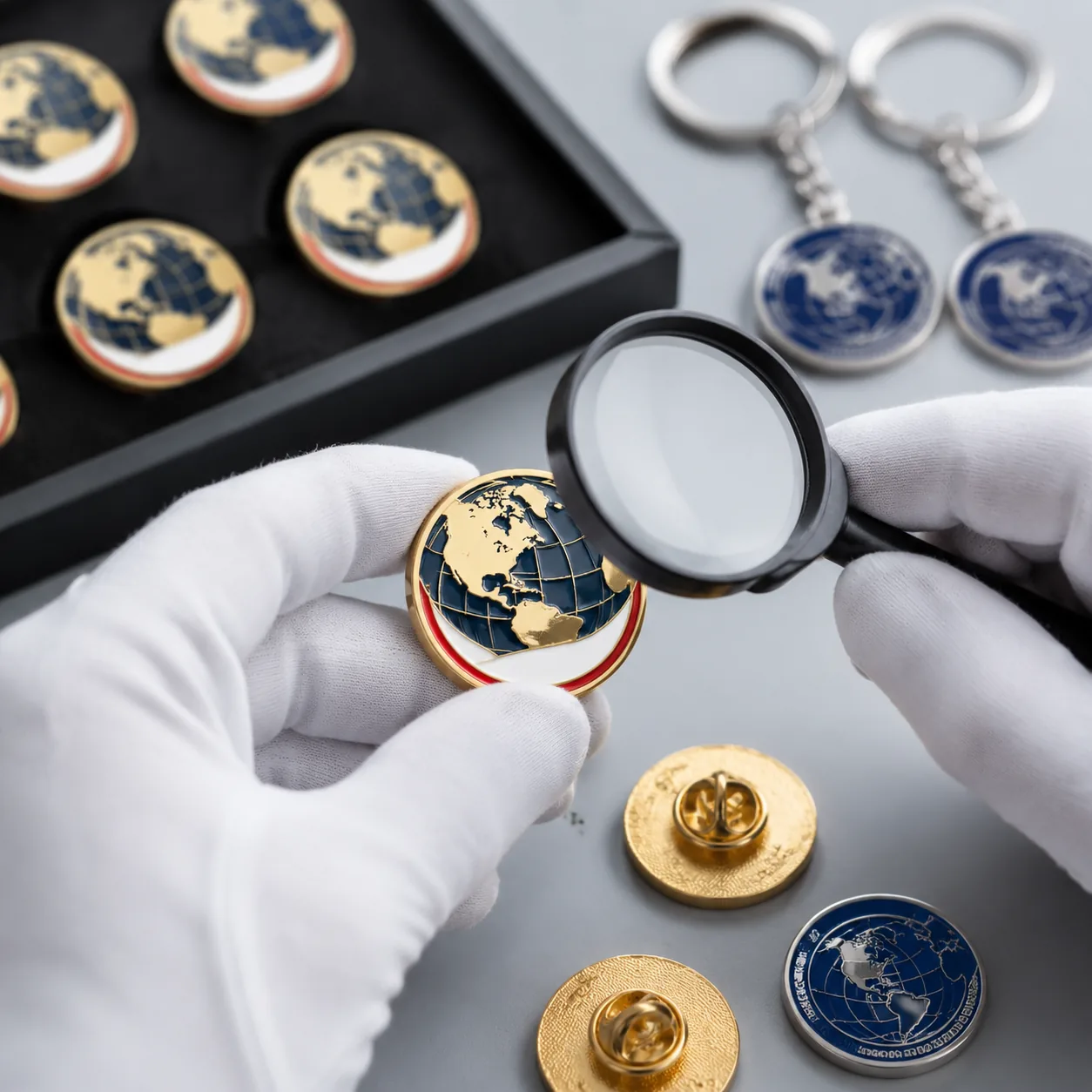
Low-MOQ economics: fixed tooling cost vs brand-specific geometry
In low-volume metal promos, the commercial issue is not whether custom tooling is 'better' in the abstract. It is whether the shape-specific value of the product is worth paying for at 100 to 500 pieces. A new stamped die for a 2D iron pin typically costs about USD 80 to 180 FOB. A new zinc alloy mold for a custom keychain, medal, or multi-level coin usually falls around USD 180 to 450 FOB, while more complex 3D, double-sided, or openwork tooling often reaches USD 450 to 800. On a 100-piece order, that adds roughly USD 0.80 to 8.00 per unit before plating, assembly, freight, or retail packaging are counted.
That is why stock molds remain commercially useful in 2026, especially for event giveaways, internal recognition pins, test-market merchandise, and pilot distributor runs. In practice, a stock mold means the factory already has the outer profile and basic blank geometry in production: common round, square, shield, dog tag, oval, bar, bottle-opener, or medallion forms. Your logo, enamel colors, laser numbering, printed insert, or rear text can change, but the silhouette, edge profile, and often the hardware layout are already fixed.
The real decision is whether the buyer's message is carried mainly by artwork and color, or by the outline itself. If recognition depends on a mascot contour, a vehicle shape, a bottle silhouette, or a brand icon with negative space, stock geometry often weakens the product. If the item is mainly informational or commemorative and the outer shape is secondary, eliminating tooling can materially improve first-order economics without damaging the end use.
What changes between stock molds and custom tooling
Stock molds reduce setup friction because the factory has already validated blank size, edge trim, polishing sequence, plating rack arrangement, and often attachment placement. That usually means fewer engineering variables, faster sampling, and lower risk of die correction at low quantities. A standard 30 mm round pin or 50 mm tag blank can often move from approved art to pre-production sample in 3 to 5 calendar days. A new custom stamped outline normally needs 5 to 8 days for engineering review, die making, strike testing, and revised proofing. A zinc alloy mold with cutouts, variable wall thickness, or heavy polishing requirement more often needs 7 to 12 days.
Custom tooling, however, is what buys control. It allows the buyer to specify silhouette, cutouts, border width, relief hierarchy, edge style, hole placement, post spacing, and front-to-back balance. That matters on products where perceived value depends on form: retail pins, collector coins, museum merchandise, shaped keychains, and brand-signature membership pieces. It also improves repeatability if the tool number, approved artwork revision, and hardware spec are properly retained for reorders.
| Spec area | Stock mold or standard blank | Custom tooling |
|---|---|---|
| Typical MOQ | 50 to 200 pcs for pins, magnets, tags; 100 to 300 pcs for common keychains | 100 to 300 pcs for most stamped or cast promos; 300+ pcs for complex cast or multi-part items |
| Tooling charge FOB | USD 0 to 50 if fully existing; USD 30 to 80 if a standard blank needs minor adaptation | USD 80 to 180 simple stamped die; USD 180 to 450 cast mold; USD 450 to 800 complex 3D or openwork |
| Sample lead time | 3 to 5 days for common pins, tags, and opener blanks | 5 to 8 days stamped items; 7 to 12 days cast, multi-level, or openwork items |
| Mass production lead time | 7 to 12 days after sample approval for simple finishes | 10 to 18 days after approval, depending on polishing, plating queue, and assembly |
| Outline freedom | Restricted to existing round, square, shield, bar, tag, oval, or opener profiles | Fully custom contour, asymmetry, cutouts, stepped edges, and custom back geometry |
| Finished size tolerance | Typically ±0.15 to ±0.25 mm on small stamped parts | Typically ±0.15 to ±0.25 mm stamped; ±0.20 to ±0.35 mm cast |
| Typical relief depth | Usually standardized at about 0.3 to 0.6 mm | About 0.6 to 1.2 mm on 2D items; deeper on cast pieces if draft and polish allow |
| Reorder continuity | Good only while the same stock blank remains active | Good if tooling ID, artwork revision, plating code, and hardware spec are retained |
| Best commercial fit | One-time events, rush campaigns, internal use, market tests | Retail SKUs, collector items, shaped logos, long-run repeat programs |
Where stock molds work well—and where they usually fail
Stock molds perform best when the product's job is communication, not shape recognition. Common examples are 25 mm to 32 mm soft enamel pins, 45 mm to 55 mm rectangular key tags, 50 mm round fridge magnets with printed inserts, standard bottle-opener keychains, and simple medallions for internal awards. In these cases, buyers are usually optimizing for lower setup cost, faster ship dates, and acceptable cosmetic quality rather than proprietary geometry.
They also work when the artwork already fits normal process limits. For soft enamel pins, a practical minimum metal line is usually 0.8 to 1.0 mm, with minimum recessed enamel cells around 0.7 to 0.8 mm. Text smaller than roughly 4.5 pt equivalent at final size often becomes marginal, especially on plated borders or curved layouts. If the design already fits cleanly inside a standard 25 mm, 30 mm, or 32 mm shape, paying for a new die just to reproduce a conventional outline usually adds cost without improving function.
Where stock molds fail is when the silhouette is part of the brand language. A badge shaped like a product package, a tourism keychain shaped like a landmark, or a membership pin built around a distinctive crest usually loses recognition when forced into a stock circle or shield. The part may pass dimensional inspection and still feel generic. Layout pressure is another hidden issue: art that reads well at 38 mm custom may become crowded at 25 mm stock, forcing thicker borders, reduced text, or filled-in negative space after enamel.
Factories also change stock programs over time. A blank that is available today may be dropped 6 to 12 months later, or supplied by a different subcontractor with small changes in hole position, edge radius, or hardware spacing. For disposable event promos, that risk is manageable. For repeat merchandise, it can break continuity.
Quality control details matter more than the shape decision
Buyers often over-focus on stock versus custom and under-specify the controls that actually determine quality. A stock blank can still arrive with weak plating, loose jump rings, off-center posts, or inconsistent enamel fill if the quote never locked the production standard. Conversely, a low-volume custom item can perform well if the specification is disciplined.
Start with material and nominal thickness. Stamped iron pins commonly run 1.0 to 1.5 mm base thickness before plating. Brass is sometimes used for finer die-struck detail but usually at a higher FOB cost. Zinc alloy keychains, medallions, and shaped openwork items typically finish around 2.0 to 4.0 mm, with thicker sections for high-relief cast designs. For decorative plating, many promo items use thin appearance layers in roughly the 0.03 to 0.08 micron range for nickel, imitation gold, or black nickel finishes; some buyers request a clear anti-tarnish lacquer, especially for gold-tone or black finishes that are handled frequently.
Then define dimensional and assembly controls. Finished external size tolerance on small stamped items is commonly ±0.15 to ±0.25 mm. Cast parts are often ±0.20 to ±0.35 mm after shrink, trim, and polish. One post is usually adequate up to about 25 mm on pins; above 35 to 45 mm, two posts reduce rotation and improve wear stability. For keychains, specify split-ring wire diameter, commonly 1.4 to 1.8 mm, and confirm that jump-ring closure will not leave an excessive gap. For inspection, AQL 2.5 major and AQL 4.0 minor is still a common baseline for metal promos, but it only helps if major and minor defect definitions are written clearly.
- Confirm MOQ by exact combination of item, plating, attachment, and packaging
- Ask whether the shape is a fully existing blank, a modified stock blank, or new tooling
- Specify material, nominal thickness, finished size, and allowable tolerance
- Define minimum line width, minimum recessed enamel area, and minimum readable text size
- Lock plating finish, target appearance, and whether anti-tarnish lacquer is required
- Set inspection standard, commonly AQL 2.5 major and AQL 4.0 minor
- Confirm sample lead time, production lead time, and whether sample fees credit back on order
- Record hardware type, attachment positions, and reorder retention policy for tooling or stock blanks
Cost math at 100, 300, and 500 pieces
At low MOQs, comparing only the quoted unit rate gives a distorted picture. Stock-mold jobs sometimes show a slightly higher piece price because the supplier is running a standard blank and may not optimize nesting the way it would on a dedicated die. Even so, the total FOB can still be lower if tooling is waived. Custom tooling usually becomes easier to justify when either the quantity increases, the product will reorder, or the custom silhouette materially improves sell-through or perceived value.
Take a 30 mm soft enamel iron pin, 1.2 mm thick, butterfly clutch, individual polybag. At 100 pieces, a stock-shape FOB piece price is often around USD 0.72 to 1.05, with tooling waived or a nominal USD 20 to 40 setup. A custom outline version may quote around USD 0.78 to 1.15 plus USD 90 to 160 tooling. Spread over 100 pieces, the die charge adds about USD 0.90 to 1.60 per unit, which is usually the real source of the price gap, not a dramatically higher manufacturing cost per piece.
The same logic is even clearer on zinc alloy keychains because mold cost and labor content are higher. A 50 mm die-cast keychain with a standard tag outline may be economical at 100 pieces if stock tooling exists. A custom-shaped, openwork, or double-sided version can make sense only if the shape supports the sales story or if a repeat order is likely within the next 6 to 12 months.
| Order scenario | Standard shape effective cost FOB | Custom tooling effective cost FOB |
|---|---|---|
| 100 pcs, 30 mm soft enamel pin | USD 0.75 to 1.20 each all-in | USD 1.70 to 2.70 each all-in |
| 300 pcs, 30 mm soft enamel pin | USD 0.62 to 0.95 each all-in | USD 0.95 to 1.55 each all-in |
| 500 pcs, 30 mm soft enamel pin | USD 0.55 to 0.85 each all-in | USD 0.78 to 1.20 each all-in |
| 100 pcs, 50 mm zinc alloy keychain | USD 1.20 to 1.90 each all-in | USD 2.40 to 4.20 each all-in |
| 300 pcs, 50 mm zinc alloy keychain | USD 0.95 to 1.55 each all-in | USD 1.35 to 2.30 each all-in |
| 500 pcs, 50 mm zinc alloy keychain | USD 0.88 to 1.35 each all-in | USD 1.10 to 1.80 each all-in |
A practical decision rule by product type
Pins are the easiest category for stock shapes because many low-MOQ programs do not depend on outline recognition. For schools, clubs, charities, employee awards, and conference giveaways, a 25 mm to 32 mm round, square, or shield pin often gives the best cost-to-risk ratio. Move to custom tooling when the silhouette is part of the identity, when the design needs cutouts or irregular borders, or when the item is sold at retail rather than handed out.
Keychains sit in the middle. A standard rectangle, medallion, or bottle-opener form works well for service businesses, tourism promotions, and fast-turn event merchandise. But if the concept is a vehicle outline, beverage bottle, building profile, product replica, or logo with open negative space, custom tooling usually pays back because the outline drives recognition and perceived value. On keychains, shape matters more than on pins because the product is larger and handled more often.
Coins, medallions, brooches, and commemorative pieces lean further toward custom tooling even at 100 to 300 pieces. These products rely on relief separation, edge quality, front-to-back balance, and collector appeal. A stock round blank can work for a simple award coin, but collector-style pieces with rope edges, stepped rims, dual plating, or custom cutouts usually justify dedicated tooling.
How to quote a low-MOQ RFQ correctly
The cleanest RFQ method is to ask for two parallel offers from the start. First, request the nearest stock shape with exact specifications: finished size, thickness, material, plating, attachment, packaging, and inspection standard. Second, request the fully custom version with tooling listed separately. That creates a true apples-to-apples comparison instead of forcing the supplier to defend one incomplete unit price.
When comparing offers, put four numbers side by side: unit FOB, tooling charge, effective unit FOB after allocating tooling across the order quantity, and lead time to ship after sample approval. Also compare what is included in the quote: sample fee, Pantone matching if relevant, epoxy dome, laser numbering, backstamp, or retail carding. On many low-volume programs, the correct answer becomes obvious once those items are normalized.
Before approving production, require a pre-production proof that lists final dimensions, nominal thickness, plating finish, Pantone references where applicable, hardware type, attachment positions, packaging method, and AQL standard. At low MOQs, the expensive mistake is usually not the tooling charge itself. It is approving a shape, text size, or hardware layout that was never engineered for the actual use case.
Have a project? Send your artwork and target quantity and we’ll reply with a detailed quotation within 12 working hours.
Ready to get this made?
Send your sketch, target quantity and ship-date. Detailed quotation in 12 hours.



