Stock Molds vs Custom Tooling for Low-MOQ Metal Promo Items
For 50 to 300 pieces, tooling choice changes more than unit price
On low-MOQ metal promo items, the common buying error is treating tooling as a minor setup detail. For runs of 50 to 300 pieces, the real decision is whether to fit the artwork into an existing stock mold or cut dedicated tooling. That choice typically shifts total FOB spend by 20% to 60%, sample timing by 3 to 8 calendar days, and the amount of design compromise built into the finished part.
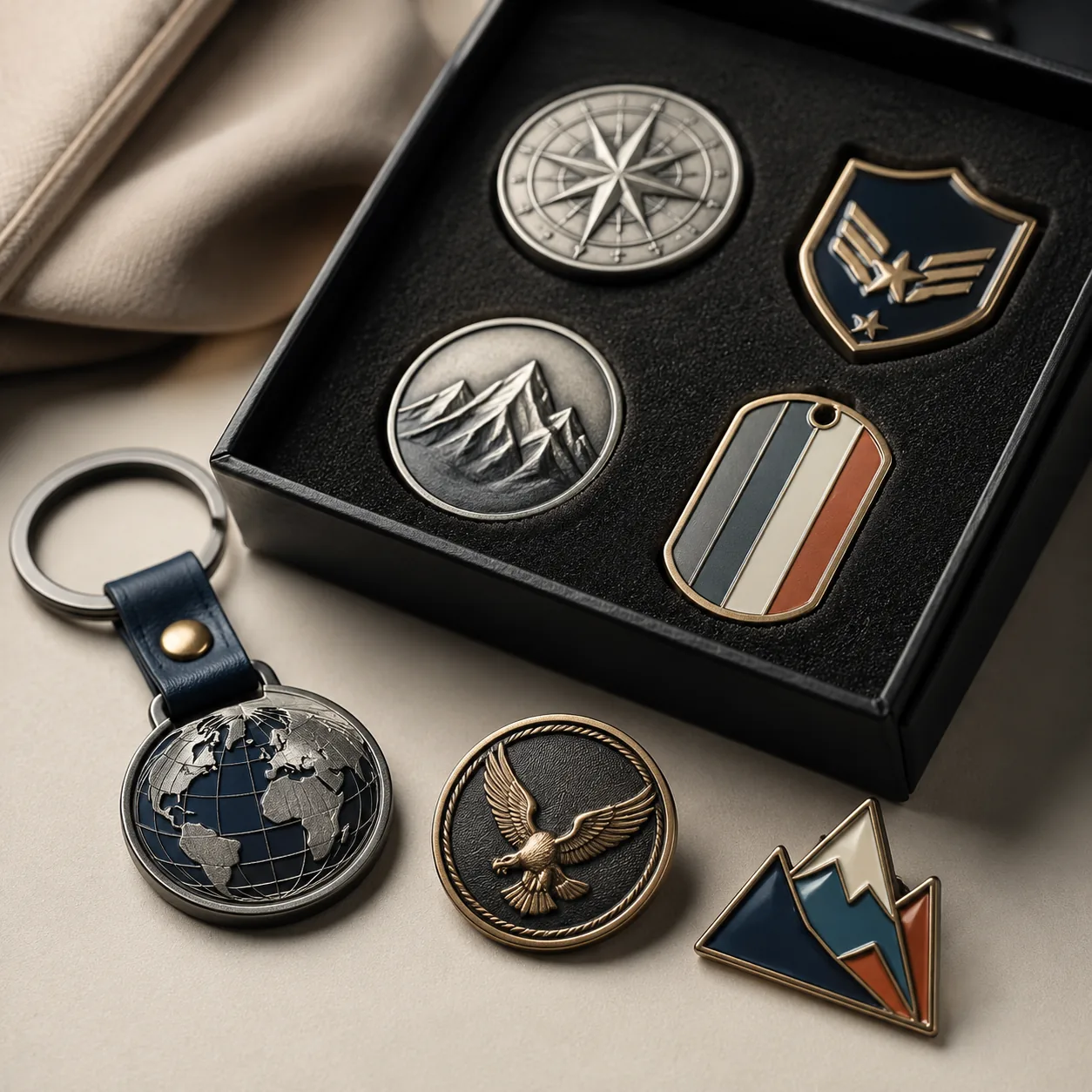
The issue comes up most often on soft enamel pins, die-struck badges, zinc-alloy keychains, fridge magnets, bottle-opener coins, and commemorative medallions for events, campus programs, retail pilots, tourism, staff recognition, and dealer sampling. A stock mold is faster because the outer cavity, blank diameter, standard hole location, or frame profile already exists. Custom tooling adds a fixed charge, but it gives control over contour, border width, relief depth, attachment placement, backside branding, and weight distribution.
For buyers sourcing in Southern China, the two routes are not interchangeable versions of the same product. A stock mold is a speed and cost shortcut when standard geometry is commercially acceptable. Custom tooling is the better route when the item itself carries brand value through exact silhouette, engineered hardware layout, tighter detail, or more resale-ready finish quality. On small orders, the wrong tooling choice usually shows up later as dead margin around the logo, unreadable fine text, rotation on a pin post, poor hanging balance on a keychain, or a product that looks generic even though the vector art was correct.
Side-by-side economics: MOQ, lead time, tolerances, and FOB ranges
| Factor | Stock mold route | Custom tooling route |
|---|---|---|
| Typical MOQ | 50-100 pcs for standard pins, dog tags, coin blanks, simple magnets | 100-300 pcs typical; some factories accept 50 pcs if full tooling cost is charged |
| Tooling charge | USD 0-30 if existing cavity works without modification | USD 60-180 for simple iron/brass stamp dies; USD 120-320 for zinc-alloy cast molds; USD 180-380 for 3D coin tooling |
| FOB unit price at 100 pcs | Pin/badge 25-35 mm: USD 0.55-1.15; keychain 40-50 mm: USD 0.85-1.75; magnet 50-70 mm: USD 0.70-1.45; coin 38-50 mm: USD 1.05-2.10 | Pin/badge 25-35 mm: USD 0.95-2.20; keychain 40-50 mm: USD 1.20-2.90; magnet 50-70 mm: USD 0.95-2.20; coin 38-50 mm: USD 1.40-3.20 |
| FOB unit price at 300 pcs | Usually 8%-18% below 100-pc pricing | Usually 15%-30% below 100-pc pricing as tooling is spread across more units |
| FOB unit price at 500 pcs | Usually another 5%-10% below 300-pc pricing | Usually another 8%-15% below 300-pc pricing |
| Sample lead time | 2-5 days for artwork fitting, proof, or pre-production sample | 5-8 days for die making and first sample; 7-10 days if die correction is needed |
| Mass production lead time | 7-12 days after sample approval for standard plating and polybag packing | 10-18 days after approval; 12-20 days with epoxy dome, dual plating, laser numbering, or gift box |
| Shape freedom | Limited to existing round, square, shield, bottle-opener, dog-tag, or standard frame outlines | Full custom contour, inner cutouts, asymmetry, custom hole placement, stepped relief, edge texturing |
| Outline tolerance | Commonly +/-0.30 mm | Commonly +/-0.15 mm to +/-0.25 mm |
| Thickness tolerance | Usually +/-0.10 mm to +/-0.15 mm | Usually +/-0.08 mm to +/-0.12 mm when called out on PO |
| Common metal thickness | Typically fixed at 1.2 mm, 1.5 mm, 2.0 mm, or standard coin gauges | Stamped parts 1.0-2.0 mm; cast items 2.0-4.0 mm; coins 2.0-3.5 mm |
| Minimum separator line | About 0.25-0.30 mm for soft enamel layouts | About 0.20-0.25 mm when process and size are engineered for it |
| Minimum readable text height | About 1.2-1.5 mm for raised text on promo-grade parts | About 0.8-1.2 mm depending on finish, depth, and layout |
| Back details | Generic texture, standard recess, or limited logo stamp area | Custom backstamp, serial panel, anti-slip texture, recessed logo field, QR or laser zone |
| Plating options | Bright gold, bright nickel, black nickel, antique brass, antique copper | Adds matte nickel, satin gold, selective antique, dual plating, sandblast contrast, epoxy topcoat |
| Decorative plating thickness | Often about 0.03-0.05 microns on promo-grade runs | Often about 0.05-0.10 microns when premium plating is specified |
| Inspection standard | Commonly AQL 2.5 major / 4.0 minor | Can be set to AQL 1.5 major / 2.5 minor if written into quote and PO |
| Best fit | Rush programs, standard recognition items, low-risk event giveaways | Retail launches, exact-shape branding, premium gifting, repeat programs with fixed specs |
These are realistic 2026 buying ranges, not blanket promises. Final numbers still move with size, base metal, enamel count, attachment style, plating, packaging, and whether the part is stamped iron, die-struck brass, or zinc-alloy cast. A 25 mm bright-nickel pin with one soft-enamel fill and butterfly clutch should not be costed like a 55 mm cast keychain with epoxy dome, lobster clasp, and individual window box.
The low-volume math is simple. A USD 120 die charge adds USD 2.40 per piece at 50 pcs, USD 1.20 at 100 pcs, USD 0.40 at 300 pcs, and USD 0.24 at 500 pcs. That is why stock molds often win the first quote but lose their advantage once the item is likely to reorder, sell at retail, or depend on a silhouette that a standard cavity cannot reproduce cleanly.
When stock molds are the better commercial option
Stock molds work best when the buyer accepts standard geometry and needs speed. Typical examples are 25 mm or 32 mm round award pins, shield-style staff badges, 50 mm rectangular key fobs, 44 mm bottle-opener coin blanks, and standard circular or rectangular magnet frames. Because the cavity already exists, the factory can skip die machining and move directly to art fitting, color separation, plating setup, and assembly.
In practice, that usually removes 3 to 5 days from the front of the schedule and eliminates one setup variable. Existing molds also have known production behavior: fill is predictable, edge trimming is already tuned, and post or hole locations have been proven in previous runs. On a 100-piece order with one or two enamel colors, bright nickel plating, and standard butterfly clutch or split ring hardware, that is often the most efficient path.
The savings are real only when the artwork fits the cavity without distortion. Buyers should ask for the usable art area, not just the outside dimensions. A nominal 35 mm shield may offer only 28 to 30 mm of visually balanced branding space after border width, corner radii, and hardware keep-out zones are deducted. If the logo includes long text, fine outlines, script lettering, or a recognizable silhouette, forcing it into a stock frame usually thickens separators, closes negative space, and makes text below about 1.2 mm high hard to read after plating and enamel fill.
Stock molds also make the most sense on low-risk promotional projects where giveaway grade is acceptable. If the item is used for a one-day event, conference welcome kit, campus orientation, or distributor sample rather than repeat retail sale, the commercial penalty of a generic outline is lower. In that case, shorter lead time, lower setup cost, and simpler approval often matter more than exact shape control or premium backside detail.
When custom tooling wins, even at 100 pieces
Custom tooling is the better choice when the shape itself carries brand value. That is common in retail pins, sponsor gifts, museum merchandise, campaign items, tourism products, commemorative medallions, and premium event badges. In these categories, silhouette is not a decorative extra. It is part of recognition. A dedicated die lets the engineer set the actual contour, corner radii, relief steps, border width, and cutout geometry instead of compressing the design into a generic frame.
The advantage is also mechanical. Dedicated tooling allows dual pin posts spaced to reduce rotation, keychain holes moved to the center of mass, a protective rim of roughly 0.8 to 1.2 mm around exposed enamel fields, and reinforcement of thin projections on cast parts. On large brooches or asymmetrical badges, those decisions determine whether the piece hangs flat or twists. On cast keychains, controlling local wall thickness to around 2.0 to 2.5 mm on narrow sections can reduce bending after plating, assembly, and parcel transit.
Custom tooling improves spec control. A buyer can call out 1.5 mm stamped iron for a pin, 1.8 mm brass for a die-struck badge, 2.5 mm zinc alloy for a cast keychain body, or a 3.0 mm coin blank with raised rim and recessed center. Backstamp size, serial number field, anti-counterfeit microtext, magnet pocket depth, edge milling, and packaging orientation are all easier to standardize when the tool is built around the approved drawing rather than adapted to a stock cavity.
For repeat programs, custom tooling often becomes cheaper on the second order. Once the die is labeled, stored, and linked to an approved sample, the buyer reduces interpretation drift and avoids having artwork re-fitted to whatever stock cavity happens to be available. If the item is likely to reorder within 6 to 12 months, the first-run tooling premium is usually easier to justify than accepting the same brand compromise on every batch.
The hidden variables: plating build, hardware layout, and inspection risk
The first overlooked variable is plating build. Low-MOQ stock-mold programs usually default to common bright finishes with promotional decorative thickness, often around 0.03 to 0.05 microns on the visible top layer over copper and nickel underplating. That can be acceptable for short-term event use. It is less suitable for items sold at retail, handled daily, or expected to maintain a cleaner surface over time. Buyers should specify the finish precisely: bright nickel, matte nickel, bright gold, satin gold, antique brass, and black nickel are different visual and wear outcomes, not interchangeable labels.
The second hidden variable is hardware geometry. Stock shapes often come with fixed post positions, fixed keychain hole locations, or standard magnet pad areas. Those defaults can create rotation on a wide pin, an awkward hanging angle on a tall keychain, or corner lift on a magnet with uneven mass. For example, a 60 mm wide badge usually performs better with two posts spaced roughly 18 to 24 mm apart, while a 65 mm contour magnet may need two ferrite pads or a larger rubber magnet sheet to prevent tilt. Custom tooling lets the attachment follow the balance of the part rather than the convenience of the existing mold.
The third variable is inspection. Budget low-MOQ runs often ship under looser cosmetic acceptance because aggressive pricing leaves less room for hand sorting and rework. AQL 2.5 major / 4.0 minor is common on promotional orders. Higher-spec custom runs can often be set to AQL 1.5 major / 2.5 minor if that requirement is written into the quotation and purchase order before production starts. For direct-to-consumer programs, that difference can matter more than saving USD 0.20 to 0.40 per piece.
Process limits should be reviewed before artwork approval. On soft enamel items, practical separator width is commonly 0.25 to 0.30 mm, while readable raised text usually starts around 1.2 mm height unless the factory confirms finer capability. Die-struck lines below about 0.20 mm can fill in after plating. Antique finishes mute very small detail, while bright nickel or bright gold will show scratches more clearly on large smooth fields. These are production constraints, not sales preferences, and they should be resolved while the drawing is still editable.
Best route by product type: pins, keychains, magnets, and coins
Enamel pins are the category where custom tooling most often wins, even at 100 pieces. Pins depend heavily on silhouette, border rhythm, recess depth, and post placement. A stock round or shield mold works well for club emblems, years-of-service awards, simple numerals, and straightforward institutional badges. It is usually the wrong route for mascot outlines, building silhouettes, script typography, or logos recognized mainly by negative space.
Keychains are more mixed. If the project uses a standard round tag, dog-tag rectangle, hotel-style blank, or bottle-opener body, a stock mold can be efficient and durable. Typical hardware specs are split rings with 25 to 30 mm outside diameter, chain links in about 3.5 to 4.0 mm wire, and connector jump rings around 0.8 to 1.2 mm wire diameter. But when the keychain body itself is the brand shape, or when an offset hole and internal cutout are part of the design, custom tooling is worth the added cost because body balance and hole placement strongly affect perceived quality in hand.
Fridge magnets sit between the two routes. A simple rectangular or circular magnet can use a stock mold with acceptable performance, especially if a flexible magnet sheet covers most of the back. But for contour magnets, anti-rotation layouts, or heavier cast pieces, custom tooling helps place the magnet area correctly and reduces the risk of corner lift after assembly. On heavier 60 to 70 mm cast designs, two magnet pads or a bonded magnet zone of at least 35 to 45 mm width is often necessary to keep the piece flat on a refrigerator door or steel fixture.
Challenge-coin-style items use standard diameters such as 38 mm, 44 mm, and 50 mm very effectively for recognition tokens and tourism programs. However, once the project requires bottle-opener integration, edge text, irregular contour, backside relief, rope edge detail, or a two-level 3D layout, custom tooling becomes the safer route. In coins, rim height, edge definition, and relief depth have a strong influence on perceived value, so forcing a premium concept into a generic blank usually shows immediately.
How to quote both routes without wasting a week
- Send one vector artwork file and request two quote paths in the same RFQ: stock mold and custom tooling.
- Ask for FOB pricing at 100, 300, and 500 pcs so tooling allocation is visible in the math.
- Specify finished size in mm, thickness in mm, base metal, plating finish, color count, hardware, and packaging.
- Request the actual usable art area on the stock mold, not only the outside dimensions.
- Confirm minimum line width, minimum text height, outline tolerance, and thickness tolerance on the final part.
- State the inspection target in the PO: AQL 2.5/4.0 for promo grade or AQL 1.5/2.5 for resale grade.
- For keychains and brooches, confirm ring size, chain wire diameter, clutch or hinge type, and any pull-test expectation.
- Ask how custom dies are labeled, stored, and matched to approved samples for reorders.
The fastest comparison process is one RFQ built on a complete specification ladder. Ask for size, thickness, process, plating, color count, attachment, packaging, sample lead time, production lead time, tooling charge, and FOB at three quantities. Without that structure, the buyer cannot see where custom tooling overtakes the stock option on total cost.
A credible supplier should also identify every compromise required by the stock route. That includes reduced text, enlarged separators, moved holes, thicker borders, flatter relief, smaller magnet area, or dead margins created by the existing cavity. If a factory simply says the artwork is possible without showing the adaptation, the quote is incomplete. Stock-mold fit is a physical limitation, not a wording issue.
A practical decision rule for orders under 300 pieces
Start with two questions. First, does the item need a brand-specific shape to look correct? Second, is there a realistic chance of reorder within 12 months? If both answers are no, a stock mold is usually the right route to price first. In that case, the buyer should negotiate around lead time, packaging, and defect sorting rather than paying to perfect a silhouette that has limited commercial value.
If either answer is yes, custom tooling should be quoted immediately. The first-run premium is often smaller than the downstream cost of compromise, especially when the item is sold at retail, used for visible brand exposure, or expected to repeat. A practical comparison is to ask the factory for three outputs at the same time: a stock-mold mockup showing usable art area, a custom-tooled mockup at target size, and a cost table at 100, 300, and 500 pieces.
Then judge the options on fitness for purpose: lead time, shape accuracy, hardware performance, plating build, inspection level, and reorder stability. The best low-MOQ order is rarely the one with the cheapest first-sheet unit price. It is the one whose tooling route matches the product’s actual job, the artwork’s physical limits, and the buyer’s likelihood of repeating the program.
Have a project? Send your artwork and target quantity and we’ll reply with a detailed quotation within 12 working hours.
Ready to get this made?
Send your sketch, target quantity and ship-date. Detailed quotation in 12 hours.



