Stamped, Cast, or Etched? Choosing the Right Build for Metal Giveaways
Start With the Job, Not the Finish
Most buyers start with appearance, but the correct first question is what the item must do in use. A flat conference badge, a 3D mascot keychain, and a thin serial plate may all carry the same logo, yet they need very different metal structures. If you choose the build method after the artwork is final, you often pay for tooling detail you do not need or lose detail the design depends on.
Think about the part in the hand, in the mail, and on the body. A lapel pin needs crisp edges, a secure pin post, and enough rigidity to survive repeated wear. A keychain needs more mass, stronger attachment points, and edge protection. A serial tag needs legible text and thin stock more than visual depth. For most RFQs, the lowest unit price is not the lowest landed cost once rework, rejects, freight, and packaging are included.
Match the Geometry to the Build
Stamped brass is usually the cleanest choice for flat logos, badges, coins, and medallion faces. H62 or H65 brass at 0.8 to 1.5 mm gives a good balance of stiffness and edge definition. For commercial production, a minimum line width of 0.25 mm is realistic, with relief or recessed detail around 0.3 to 0.5 mm deep. That keeps letters readable without overcomplicating the die or making cleanup expensive.
| Build method | Best fit | Practical limits | MOQ | Tooling | FOB at 300 pcs | FOB at 1,000 pcs | Typical lead time |
|---|---|---|---|---|---|---|---|
| Stamped brass / iron | Flat logos, lapel pins, coins, medallion faces | 0.8-1.5 mm stock; 0.25 mm min line; 0.8 mm bridge minimum; 0.3-0.5 mm relief | 100-300 pcs | $80-$180 | $0.48-$1.10 | $0.32-$0.78 | 10-18 days after sample approval |
| Zinc alloy die cast | 3D mascots, thick edges, openwork forms | 1.2-2.5 mm average thickness; 0.9-1.2 mm wall; 0.4 mm min raised detail; avoid hairline text | 200-500 pcs | $120-$260 | $0.78-$1.65 | $0.52-$1.20 | 15-25 days after sample approval |
| Photo-etched brass / stainless | Fine text, slim tags, lightweight plates | 0.4-0.8 mm sheet; 0.15-0.20 mm line; 0.6 mm bridge minimum; best for shallow relief | 100-200 pcs | $20-$60 | $0.28-$0.82 | $0.18-$0.48 | 7-15 days after approval |
| Hybrid build | Flat face plus raised center or layered logo | Stamped base with cast insert or stacked parts; 0.8-1.8 mm total thickness | 300 pcs+ | $150-$320 | $0.95-$2.10 | $0.68-$1.55 | 18-28 days after approval |
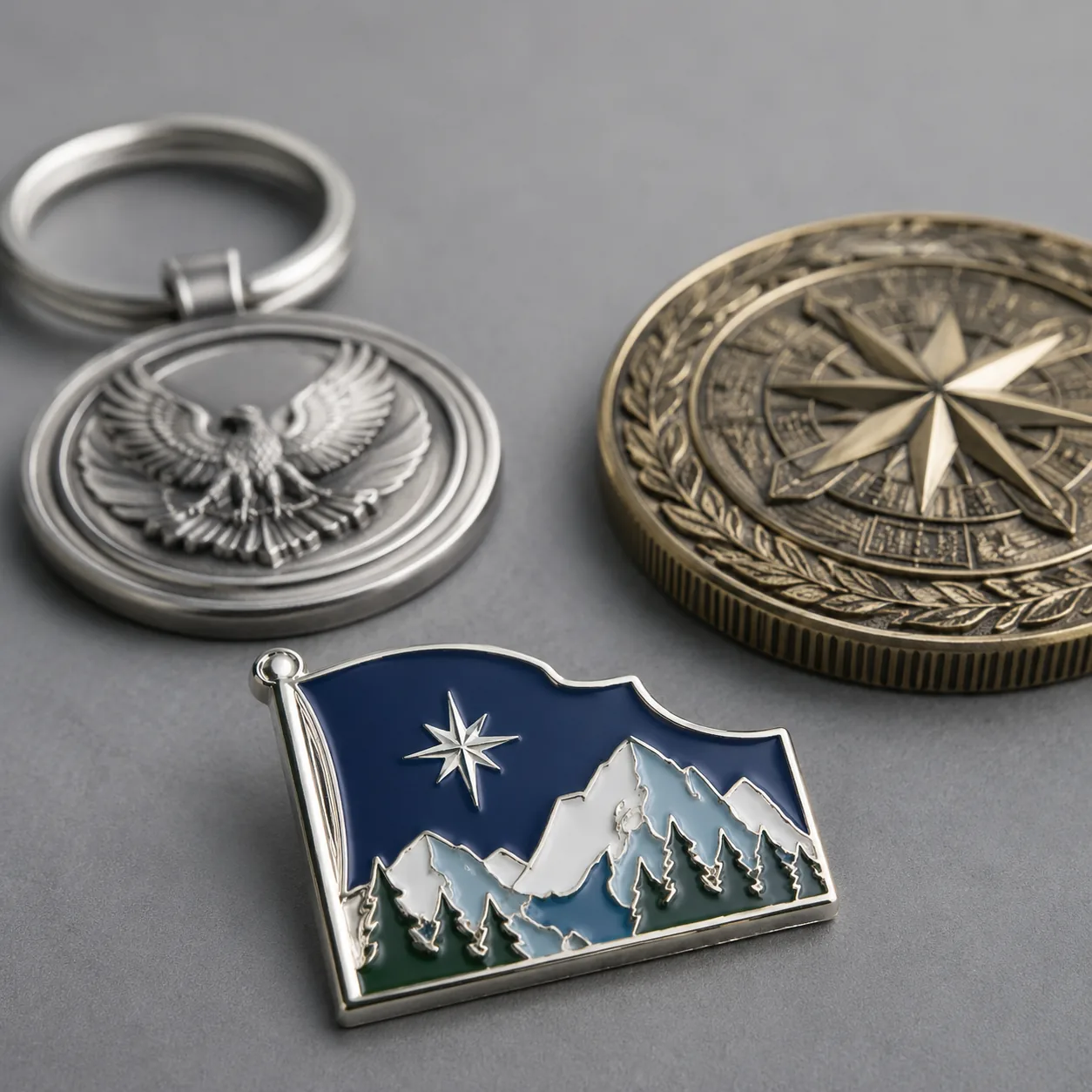
Zinc alloy die cast is the better answer when the design needs depth, domed surfaces, undercuts, or a sculpted mascot feel that stamping cannot hold. Use it for a 45 mm character keychain with a raised face, a thick rim, and recessed eyes, or for a badge with a strong 3D center that should feel substantial in the hand. Do not use die casting for ultra-thin skeletons or tiny serif text; shrinkage and polishing will soften those details. Photo-etch is the opposite: it is excellent for slim tags, fine lettering, and low-weight pieces, but it is not the method for heavy relief or bold edge volume.
Read the Limits in Size, Weight, and Detail
Size changes the answer faster than most buyers expect. Under 25 mm, photo-etch or flat stamped brass usually gives the cleanest result because the artwork stays readable and the part does not feel crowded. Between 25 and 50 mm, stamped brass is often the best balance for lapel pins, badge faces, and small medallions. Above 50 mm, or whenever the design carries deep relief, zinc alloy becomes safer because it can support thicker sections without the visual flattening that can happen in a stamped part.
Openwork needs its own rules. For brass and iron, keep bridges at least 0.8 mm wide and avoid holes smaller than 1.2 mm if you want clean plating and manageable deburring. For zinc alloy, aim for at least 1.0 mm bridges and expect tool compensation for shrinkage and polish loss. A realistic dimensional move on cast faces is 0.2 to 0.4 mm across the contour, so tiny cutouts and tight internal corners need more room than they would in a flat stamped design. Weight also matters: 6 to 12 g is comfortable for lapel-sized pieces, while 12 to 25 g feels premium on a keychain but can twist thin clips or raise postage in mailing programs.
Concrete examples help. A 58 mm conference badge with a name line and one-color logo is usually best as stamped brass with nickel plating and soft enamel fills. A 50 mm mascot keychain with a raised face and thick border is a better fit for zinc alloy die cast. A 90 x 20 mm equipment tag with serial text and a QR code is often best as photo-etched stainless, then filled or printed after etching if needed.
Lock the RFQ Before You Quote
A quote is only useful when the supplier is pricing the same part you intend to buy. The RFQ should state the visible face, the back side, the material grade, the thickness, the finish, the target quantity, and the inspection level. If any of those are missing, different factories will fill the gap with different assumptions, and the result is an apples-to-oranges comparison. For metal giveaways, the best quote is the one that already includes the boring details you do not want to argue about later.
- Final size in mm, with tolerance of ±0.2 mm under 50 mm and ±0.3 mm above 50 mm
- Base metal and grade, such as H62 brass, H65 brass, Zamak 3, Zamak 5, 304 stainless, or low-carbon iron
- Minimum line width, bridge width, hole diameter, and any openwork limits
- Plating stack and thickness, such as nickel underplate at 3-5 μm, gold flash at 0.03-0.08 μm, or black nickel at 0.1-0.3 μm
- Quantity tiers and reorder expectation, for example 100, 300, 500, and 1,000 pcs
- Attachment and packaging, such as butterfly clutch, key ring, O-ring, polybag, or gift box
- Acceptance standard, with critical defects at zero acceptance, major defects at AQL 2.5, and minor defects at AQL 4.0
Those details speed sample approval and reduce drift in the first production run. If you want decorative plating only, be precise: 0.1 to 0.3 μm is a light flash and should not be treated as a wear layer. For products that will be handled often, ask for a 3 to 5 μm nickel underplate and then the decorative finish on top. If the supplier cannot quote the stack, the price is not truly comparable.
Compare MOQ, Tooling, and Lead Time
The raw metal is rarely the main cost driver. Tooling, finishing, hand work, and reject risk matter more than the few grams of brass or zinc in the part. A simple photo-etch setup may cost only $20 to $60 in film or tooling charges, while stamped brass tooling often lands around $80 to $180 and zinc die-cast tooling is more often $120 to $260, depending on cavities, relief, and undercuts. Hybrid builds add more setup because they combine processes.
MOQ follows the same logic. Photo-etch is usually workable at 100 to 200 pcs, stamped brass at 100 to 300 pcs, and zinc alloy die cast at 200 to 500 pcs because the setup cost needs more units to amortize. If the order is below 300 pcs and the art is simple, stamped brass or photo-etch is usually the safer route. If the art demands depth and the order is closer to 1,000 pcs, die casting can become the better value even when the unit price is slightly higher on paper.
Lead time also tracks process complexity. Simple stamped or etched pieces usually sample in 5 to 8 days and ship in 7 to 15 days after approval if plating is standard. Die cast with polishing and hand filling commonly needs 15 to 25 days after sample approval. Add 3 to 5 days for double plating, epoxy domes, laser marking, or special packaging. That is not delay; it is the time required to control the parts you are asking the factory to make.
Set QC and Tolerances Before Production
Different processes fail in different ways, so inspection points should be different too. Stamped brass usually fails with burrs, weak edge fill, or plating pooling on sharp rims. Die cast often shows shrink marks, pinholes, or softened fine detail after polishing. Photo-etch can fail with over-etched lines, warped sheets, or bridges that are too thin to survive trimming. A good QC plan catches those failures where they appear, not after the shipment arrives.
For visible promotional items, ask for 100 percent visual sorting on scratches, stains, bubbles, and color mismatch, then use lot sampling for dimensions. A practical tolerance set is ±0.2 mm on outer size under 50 mm, ±0.3 mm above 50 mm, ±0.15 mm on hole position, and ±0.1 mm on relief height for stamped parts. For cast pieces, allow a little more overall movement but do not allow visible sink, warp, or flash on the show face. If the item has cutouts, ask the supplier to mark bridge widths and gate positions on the tool proof before production starts.
Plating should also be specified in measurable terms. Decorative nickel is commonly 3 to 5 μm, gold flash is often 0.03 to 0.08 μm, and black nickel is typically 0.1 to 0.3 μm. Antique finishes usually need a protective clear coat if the item will be handled often. If the product is a wearable or a key item, ask where wear will happen and thicken the stack there rather than assuming one finish solves every problem.
Choose the Build That Survives the Quote and the Line
The quickest way to a useful quote is to send one artwork file, one intended use, one target quantity, and two budget ceilings: tooling and unit FOB. Then ask the supplier to price the same design in two builds, such as stamped brass and zinc die cast, so you can see whether the extra depth actually earns its cost. If the design is still fluid, request a DFM note on minimum line width, bridge width, plating stack, and expected shrinkage before sample approval.
That simple workflow usually saves more money than arguing over the first sample after the tool is already made. For flat branding, choose stamped brass or photo-etch. For sculpted pieces, choose zinc alloy die cast. For mixed geometry, use a hybrid only when the extra complexity clearly improves the part. If you are sourcing through ZheCraft, that is the same structure we use for badges, keychains, coins, plates, and other metal giveaways: define the use case first, then match the build to the geometry, the MOQ, and the landed cost.
Have a project? Send your artwork and target quantity and we’ll reply with a detailed quotation within 12 working hours.
Ready to get this made?
Send your sketch, target quantity and ship-date. Detailed quotation in 12 hours.



