Split-Shipping Custom Pins Without Batch Mix-Ups
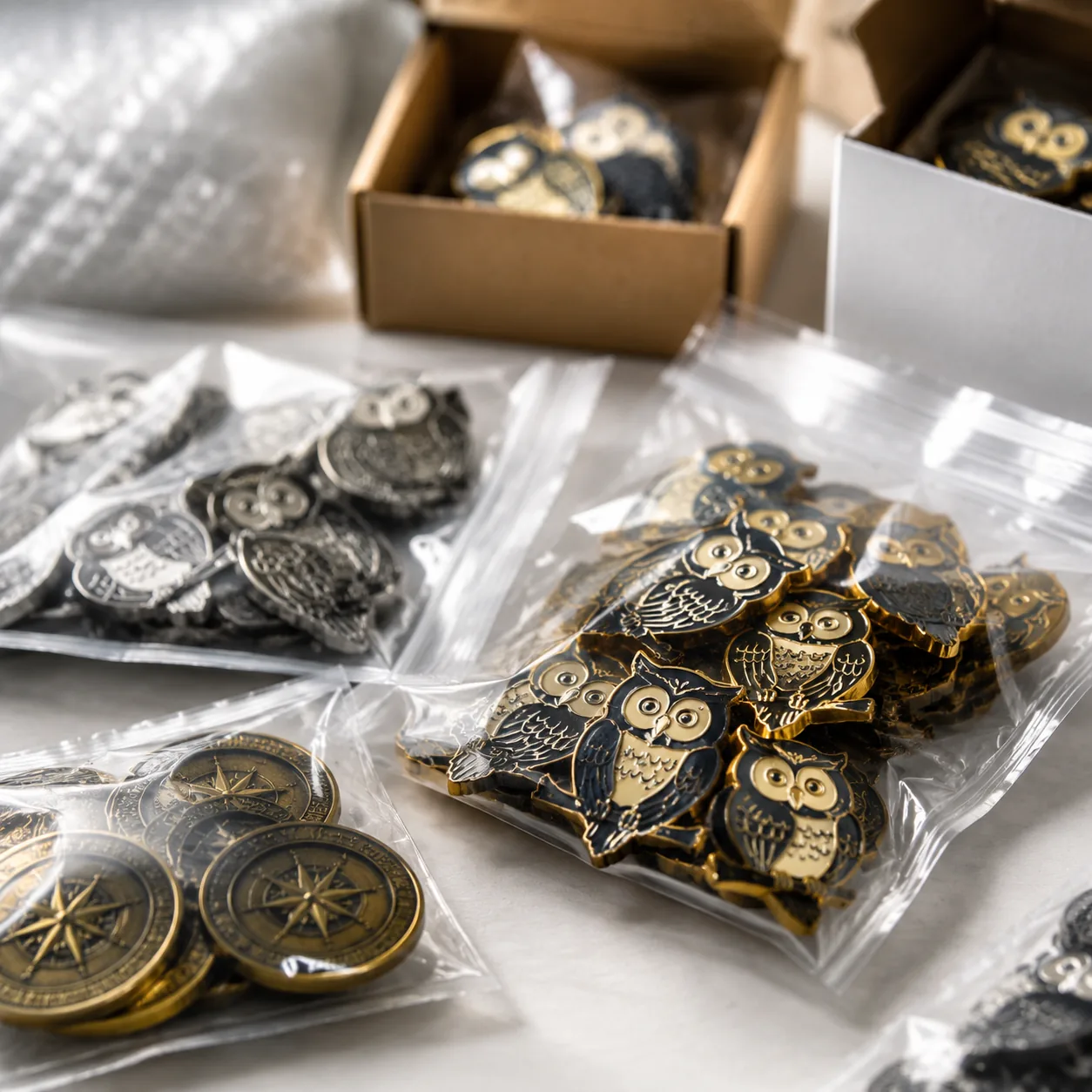
The Real Problem: 2,000 Pins Must Move, 8,000 Should Not
A distributor receives final artwork approval from a beverage brand on Friday afternoon. The first tasting event is 18 calendar days away. The client needs 2,000 enamel pins on site for guests, staff, press kits, and a small reserve. The full purchase order is 10,000 pieces, but the remaining 8,000 are for retail counter displays that can arrive 40 to 50 days later. If the buyer treats the order as one shipment, either the event misses its pins or the entire 10,000-piece order moves by expensive air freight.
Split shipping solves the freight problem only when it is controlled from quotation through carton labeling. A rushed partial release can create two different nickel tones, mismatched enamel colors, missing backing cards, incomplete inspection records, or cartons that a forwarder cannot identify. The safer method is one production order, one master specification, and two controlled delivery lots: Lot A Air and Lot B Bulk.
For this scenario, assume a 28 mm soft enamel pin, 1.6 mm iron base, nickel plating, six enamel colors, one 8 mm post, black rubber clutch, individual OPP bag, and printed backing card. At 10,000 pieces, a realistic FOB China factory range is USD 0.48 to 0.82 per pin, excluding mold, premium packaging, third-party inspection, duty, and international freight. A 250 gsm backing card usually adds USD 0.025 to 0.06 per piece; epoxy dome coating can add USD 0.06 to 0.14 depending on size and rejection rate.
A split shipment is normally practical from 1,000 pieces per SKU, but the economics improve at 3,000 to 5,000 pieces because setup, QC, packing, and freight documentation are spread over more units. The buyer should not ask, "Can you ship some first?" The better RFQ language is, "Quote one 10,000-piece production run with 2,000 pieces released by air after full QC and 8,000 pieces released by deferred air or sea after batch comparison."
RFQ Triage: Decide What Actually Needs Air Freight
The first decision is quantity discipline. Many urgent orders become expensive because the buyer asks the factory to air ship the entire PO when only the launch quantity is time-critical. In this case, the event plan is 1,500 pins for guests, 300 for staff and media kits, and 200 reserve pieces. That makes 2,000 pieces a rational air lot, not an arbitrary split.
The supplier should quote one tooling set, one approved color standard, and two delivery lots. Tooling for a 28 mm stamped iron pin normally falls between USD 45 and 90. Complex cutouts, deep relief, backstamps, or multiple cavities can push tooling higher. Standard mold opening and pre-production sample photos usually take 5 to 7 days after vector artwork approval. Mass production for 10,000 simple soft enamel pins normally takes 12 to 18 days after sample approval; very tight color fills, glitter enamel, transparent enamel, or epoxy can add 2 to 5 days.
For an 18-day launch, the schedule has little tolerance for a couriered physical sample unless artwork is simple and the buyer can approve immediately. A practical schedule is: artwork freeze on day 0, mold and sample photos by day 5 or 6, Lot A production and packing by day 13 or 14, factory QC on day 14 or 15, and express pickup no later than day 15. That leaves only 3 to 7 transit days, so customs paperwork and delivery address accuracy matter as much as production speed.
| RFQ Decision | Lot A Air | Lot B Bulk |
|---|---|---|
| Quantity | 2,000 pcs, including event reserve | 8,000 pcs for retail and replenishment |
| Production basis | Same mold, enamel, plating, backstamp, and card | Same master specification; compare against Lot A retained samples |
| Inspection | AQL 0 critical, 1.5 major, 4.0 minor before release | Same AQL, plus color and plating comparison |
| Transit target | Express or air, typically 3 to 7 days after pickup | Deferred air 8 to 15 days, sea/consolidation 25 to 45 days |
| Commercial note | Higher freight per kg, lower total urgency cost | Lower freight per piece, more receiving buffer |
Master Spec: Freeze One Pin, Not Two Similar Versions
Split orders fail when the urgent lot is produced from a rushed file and the bulk lot is corrected later. The brand then receives two visible versions under one SKU. Before production starts, the buyer should freeze one master specification covering dieline, color references, plating, attachment, backing card, packing, tolerances, and inspection standard.
For the 28 mm beverage pin, specify finished size tolerance at ±0.20 mm and base metal thickness at 1.6 mm ±0.15 mm. Standard decorative nickel flash plating on promotional pins is often specified around 0.08 to 0.12 microns; if the buyer needs higher corrosion resistance, that must be stated separately because cost and process time change. Soft enamel fill should sit cleanly below the raised metal ridges, with no exposed pits over 0.20 mm in visible color areas and no overflow onto metal lines under a normal 30 cm visual check.
Pantone references should be coated references, viewed under D65 daylight or a 5500K to 6500K light booth. For enamel pins, a practical visual tolerance is often closer to a controlled visual match than a strict Delta E target, because enamel thickness, metal walls, and bake conditions affect perceived color. If the buyer uses a corporate color standard, send a physical reference or approved previous sample, not only a screen image.
Attachment also needs to be fixed. A single 8 mm post with black rubber clutch is common for balanced pins under 30 mm. For a long logo, irregular mascot, or pin wider than about 35 mm, two posts spaced 12 to 18 mm apart may reduce rotation and returns. Two posts usually add USD 0.03 to 0.07 per piece and increase assembly checks. Do not let Lot A use one post and Lot B use two posts unless the SKU, carton label, and packing list intentionally separate them.
- Freeze one vector artwork file with final dieline, Pantone colors, backstamp, plating, thickness, attachment, and packaging.
- Name the lots in the PO as Lot A Air 2,000 pcs and Lot B Bulk 8,000 pcs.
- Approve one golden sample or one production photo set for both lots; do not approve each lot from memory.
- State overrun rules clearly: 0 to 3 percent overrun is typical, but no underrun for the urgent lot without written approval.
- Require retained samples from Lot A so Lot B can be compared before final shipment.
Production Control: Run the Lots Consecutively
The safest factory plan is to keep both lots close together in production. A typical stamped soft enamel process is mold opening, stamping, trimming or piercing, polishing, plating, enamel filling, baking, surface cleaning, attachment, packing, and final inspection. If Lot A and Lot B are separated by weeks, plating bath condition, enamel viscosity, operator technique, and polishing pressure can shift enough to be visible.
For a 10,000-piece order, a controlled approach is to stamp the full metal quantity together, then prioritize plating, enamel filling, assembly, and packing for the first 2,000 pieces. The remaining 8,000 continue through production while Lot A is inspected and released. This keeps tooling impression, base metal, and most process settings consistent while still meeting the urgent delivery window.
The buyer should ask how the factory will prevent variation. Useful answers include same enamel batch where possible, same plating color family, recorded bake time and temperature, separated WIP trays, and a retained-sample comparison before Lot B packing. Vague answers such as "same as sample" are not enough for a split shipment with a brand launch attached.
Some designs are poor candidates for aggressive splitting. Eight or more enamel colors, large transparent enamel areas, glitter fills, glow pigment, or epoxy dome coating all increase process sensitivity. Transparent enamel over textured metal is especially risky because the plating tone changes the final color. In those cases, it may be better to fly 1,000 to 1,500 event pieces and give the factory 2 or 3 more days to stabilize the rest of the run.
| Stage | Control Target | Split-Order Risk |
|---|---|---|
| Stamping | Burr height under 0.10 mm after trimming | Tool wear or mixed blanks if lots are not segregated |
| Polishing | No sharp edges; reject visible scratches at 30 cm | Over-polishing Lot A can soften relief details |
| Plating | Nickel tone matched to approved sample | Different rack position or bath condition can shift brightness |
| Enamel filling | No color overflow; no visible pits over 0.20 mm | Different enamel batch can create shade drift |
| Assembly | Post pull check 5 kg for 10 seconds | Weak posts may pass visually but fail in use |
| Packing | Carton under 15 kg gross where possible | Mixed cartons can defeat the entire split plan |
QC Gate: Treat the Air Lot as the Whole Order
The urgent lot should not receive a lighter inspection because the event is close. It needs the strongest release control because there is no recovery time if bent posts, wrong cards, weak clutches, or mixed cartons arrive at the venue. Use ANSI/ASQ Z1.4 single normal sampling unless the buyer has a stricter internal standard.
For promotional pins, a practical buyer specification is AQL 0 for critical defects, 1.5 for major defects, and 4.0 for minor defects. Critical defects include sharp exposed metal, detached posts, wrong logo, incorrect safety warning where required, and mixed SKU cartons. Major defects include wrong plating finish, visible color mismatch, missing backing cards, weak clutches, bent posts, or incorrect carton quantity. Minor defects include small cosmetic marks that are not visible under the agreed viewing distance.
For a 2,000-piece Lot A, many inspections will sample roughly 80 to 125 pieces depending on inspection level and buyer risk tolerance. Pull-test at least 8 to 13 assembled posts per lot at 5 kg for 10 seconds, or follow the buyer’s stricter protocol. Compare at least five random Lot A pieces against the approved sample for color, plating, relief, backstamp, and attachment location.
The inspection report should separate Lot A and Lot B. For Lot A, record sampled quantity, defect counts by category, carton count, gross weight, net weight, and photo evidence of open cartons, sealed cartons, inner bags, backing cards, and master carton labels. Hold at least 20 retained Lot A samples until Lot B is inspected and shipped. Those samples are the cheapest insurance against a visible second-batch mismatch.
Cartons and Labels: Prevent the Warehouse Error
When a split order goes wrong, the root cause is often not the pin. It is a carton label that says only "custom pins" or a packing list that does not identify which cartons are air freight. Once cartons reach a forwarder warehouse, vague labeling can cause missed pickups, accidental consolidation, partial delivery, or expensive relabeling.
For this order, each inner bag can hold 50 individually packed pins, with 10 inner bags per export carton. That creates 500 pins per master carton. A 28 mm pin with backing card typically weighs about 8 to 12 g per packed unit, so a 500-piece carton often lands around 5 to 7 kg gross weight depending on card stock, clutch type, and carton material. A practical carton size might be 35 x 28 x 20 cm in five-layer corrugated board, but the final dimensions should be confirmed after actual packing.
Lot A therefore uses four cartons for 2,000 pieces, marked Carton 1 of 4 through Carton 4 of 4, Lot A Air. Lot B uses 16 cartons for 8,000 pieces, marked Carton 1 of 16 through Carton 16 of 16, Lot B Bulk. If event cartons ship directly to a venue, add a large side label with event name, receiving contact, phone number, delivery window, and a do-not-open note if the cartons are pre-counted for staff packs or guest packs.
| Label Field | Recommended Format | Why It Matters |
|---|---|---|
| PO number | PO 45821 | Links buyer, factory, invoice, and forwarder records |
| SKU | BRV-PIN-28-NI | Prevents mixing similar pin designs |
| Lot | Lot A Air or Lot B Bulk | Separates urgent and deferred cartons |
| Carton sequence | 1 of 4, 2 of 4 | Shows missing cartons immediately |
| Quantity | 500 pcs per carton | Supports receiving count and claim evidence |
| Gross weight | Actual kg after packing | Reduces freight billing disputes |
| QC status | QC passed, date, inspector code | Confirms release before dispatch |
Freight Math: Air the Need, Not the Purchase Order
The buyer should request separate logistics estimates before approving the split. For small metal items, air freight is billed by the higher of actual weight and volumetric weight. A 35 x 28 x 20 cm carton has volumetric weight of about 3.3 kg using a 6000 divisor, so the actual 5 to 7 kg gross weight usually applies. Four cartons at 6 kg each create about 24 kg of chargeable weight for Lot A.
Express freight from China to North America or Europe for this weight often falls in a planning range of USD 6 to 12 per kg before remote-area fees, duty, tax, fuel surcharges, or special handling. That puts Lot A freight around USD 144 to 288 in many normal cases. Flying the entire 10,000-piece order would move roughly 20 cartons and about 120 kg chargeable weight, pushing freight to approximately USD 720 to 1,440 under the same assumptions.
Bulk shipping depends on launch calendar and cash flow. Deferred air may take 8 to 15 days and is useful when retail delivery is important but not event-critical. Sea freight or consolidation can take 25 to 45 days port-to-door, sometimes longer during peak season or customs delays, but it lowers freight cost per piece. The correct lane is not always the cheapest lane; it is the one that arrives before the retail launch with enough buffer for customs clearance, receiving, and distribution.
- Use express only for event-critical cartons when the transit buffer is under 10 days.
- Use deferred air when the buyer has 15 to 25 days after factory completion and needs predictable delivery.
- Use sea or consolidated freight when the retail launch has at least 35 to 55 days of buffer after factory completion.
- Do not combine event cartons with unrelated goods if the forwarder may hold the whole shipment for consolidation.
- Confirm Incoterms in writing, such as EXW Yiwu, FOB Ningbo, FOB Shanghai, or DAP destination.
PO Addendum: The One-Page Control Document
A split shipment is a production-control instruction, not a casual freight request. Before asking for final pricing, decide the urgent quantity, latest acceptable event delivery date, bulk delivery window, visual matching requirement, carton limit, inspection level, and Incoterms. If both lots must be indistinguishable at retail, state that directly and require Lot B to be compared against the same approved standard and retained Lot A samples.
The PO addendum should list artwork version, finished size, base metal, thickness, plating, enamel type, attachment, packaging, carton quantity, carton dimensions target, AQL levels, pull-test requirement, retained-sample requirement, and lot names. It should also request the mold cost, unit price by quantity, sample timing, production timing, Lot A freight estimate, Lot B freight estimate, and the latest date for artwork freeze. If the supplier provides one total price and says shipping can be decided later, push for a dated split schedule before issuing the PO.
On receiving day, the buyer should open one Lot A carton fully and spot-check the others by label, seal condition, quantity marking, and gross weight. If a carton differs from the packing list by more than about 0.5 kg without explanation, investigate before releasing stock to the event team. Check 32 to 50 pieces for wrong cards, loose posts, weak clutches, missing enamel, scratched plating, or color mismatch against the retained sample. Report any issue the same day with photos showing the carton label, full carton contents, defect close-up, and good pieces for comparison.
For a factory such as ZheCraft, the most useful buyer instruction is clear lot control from day one: one master spec, consecutive production, full QC before the air release, retained samples from Lot A, and batch comparison before Lot B ships. That gives the buyer speed without turning one order into two uncontrolled productions.
Have a project? Send your artwork and target quantity and we’ll reply with a detailed quotation within 12 working hours.
Ready to get this made?
Send your sketch, target quantity and ship-date. Detailed quotation in 12 hours.



