Split-Shipping Custom Giveaways for Events Without Missed Deadlines
Start With the Shipment Matrix, Not the Artwork
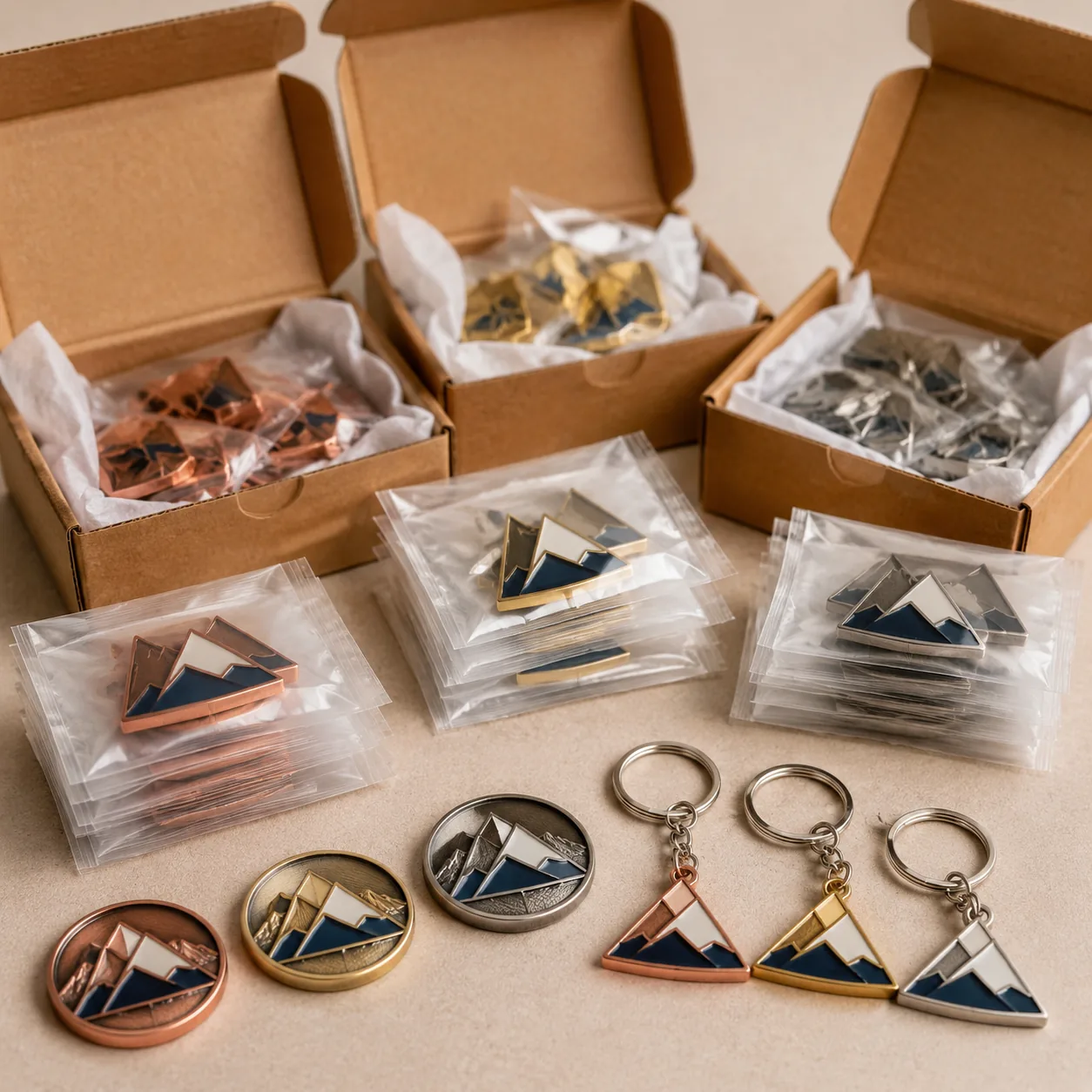
For event merchandise, the costly failure is usually logistics rather than decoration. A mold can be corrected; a carton shipped to the wrong convention center may not be recoverable before booth setup. A typical campaign may require 3,000 enamel pins for a Chicago trade show, 1,000 challenge coins for VIP speakers in Hamburg, 2,000 lanyards for staff check-in in Singapore, and 500 keychains for a distributor dinner in Dubai. If that is treated as one factory order with one ship date, the buyer increases the risk of mixed cartons, incomplete customs documents, and local teams opening inventory meant for another market.
The RFQ should begin with destination lots. Each lot needs a quantity, delivery address, required receiving date, freight method, carton mark, packing format, consignee details, importer information, and document requirement. At ZheCraft, we normally code lots by market and event, such as US-CHI-MAY12, DE-HAM-MAY17, and SG-SIN-MAY20. Those codes then appear on artwork approvals, QC reports, packing lists, carton labels, and freight bookings. This prevents the common late-stage scramble of reopening sealed cartons to separate inventory by country.
Product specifications should also be aligned across the kit. A practical event set might use 35 mm soft enamel pins in 1.2 mm zinc alloy, 50 mm die-struck coins in 3.0 mm zinc alloy or brass, 20 mm polyester lanyards, and 70 mm PVC patches. State tolerances before sample approval: ±0.2 mm for stamped metal outlines, ±0.3 mm for cast zinc alloy, ±0.5 mm for coin thickness, ±2 mm for sewn textile length, and ±1 Pantone shade as a commercial target rather than a guarantee across different materials. Without these limits, products may pass individually but look inconsistent when displayed together.
Quote by Destination Lot and MOQ Tier
Instead of requesting only “6,000 pins,” write the RFQ as: 3,000 pins to a Chicago hotel dock by 12 May, 1,000 pins to a Hamburg warehouse by 17 May, and 2,000 pins to a Singapore office by 20 May. This tells the factory that each destination needs separate carton counts, labels, invoices, packing lists, and handover photos. It also exposes whether the split is commercially sensible.
MOQ does not always divide cleanly. Custom enamel pins are normally workable from 100 pieces per design, but stable pricing usually starts at 300 to 500 pieces. Challenge coins often price best from 300 pieces because mold setup, polishing, and plating labor are heavier. Screen-printed polyester lanyards commonly start at 300 pieces per design; woven or jacquard lanyards are usually 500 pieces. If a buyer requests eight destinations with 60 pieces each, production may be possible, but split-packing labor and document control can cost more than the unit-price saving.
| Order structure | Factory impact | Typical added cost |
|---|---|---|
| One item, one destination | Standard carton mark, invoice, and packing list | No added split cost |
| One item, three destinations | Separate counts, carton labels, invoices, and pickup handover | USD 15-40 per added lot |
| Four items, three destinations | Lot-level kitting, SKU checks, and label control | USD 40-120 per added lot |
| VIP and general stock separated | Colored inner cartons, warning labels, and extra count check | USD 20-80 per lot |
| Mixed products, mixed freight methods | Different ready dates, chargeable weights, and customs documents | Quoted case by case |
Ask suppliers to separate unit price, mold charge, packaging, split-packing labor, inspection cost, and estimated freight. A pin quoted at USD 0.72 FOB can land higher than a USD 0.78 pin if the cheaper quote excludes relabeling, inner cartons, barcode labels, document revisions, and carton photo control.
Build the Schedule Backward From Receiving
Event freight should be scheduled from the date the booth team must physically hold usable goods, not from the factory completion date. For international events, target delivery 7 to 10 calendar days before booth setup. For hotel delivery, add 1 to 2 days if the property uses a third-party receiving dock or charges package handling fees. For distributor warehouses, allow time for ASN creation, barcode scanning, appointment booking, and internal release before the event team can collect stock.
Typical production after final artwork approval is 12 to 18 days for soft enamel pins, 15 to 22 days for hard enamel pins, 14 to 20 days for enamel metal keychains, and 18 to 25 days for challenge coins with antique plating or 3D relief. Screen-printed lanyards are often 10 to 15 days; woven or jacquard lanyards need 15 to 22 days. A physical pre-production sample adds 5 to 8 days including courier time. Photo approval is faster, usually 1 to 2 days, but gives less certainty on plating shade, edge feel, and attachment strength.
Transit time should be assigned per lot. Air express is typically 3 to 7 days after pickup. Economy air freight with destination handling is 6 to 12 days. Rail to Europe is commonly 22 to 35 days. Sea freight is often 25 to 45 days depending on port pair, peak season, customs, and final-mile trucking. If Chicago needs goods in 18 days but Hamburg has six weeks, split freight is usually cheaper than rushing every carton by express.
- Set the factory ex-works date at least 10 days before the first international receiving deadline.
- Reserve 2 to 3 days after production for inspection, carton weighing, document correction, and pickup booking.
- Confirm hotel receiving hours, contact name, booth number, package fees, and maximum carton weight before pickup.
- Ask warehouses whether they require ASN labels, pallet labels, PO numbers, carton barcodes, or delivery appointments.
- Avoid Friday pickup for urgent international lots when airline handover or customs entry may slide into the next week.
- Keep a 3 to 5 percent overrun buffer for handout items if the venue can store extra stock.
Lock Event-Safe Product Specifications
Products that survive hand-carry delivery may fail after three courier hubs and two warehouse touches. For event pins, specify 1.2 to 1.5 mm zinc alloy or iron, polished edges, and pin posts soldered for badge use. Decorative flash plating for gold, nickel, black nickel, or antique finishes is commonly quoted around 0.03 to 0.08 microns. For outdoor events, retail resale, or heavy abrasion, ask for thicker plating and salt-spray or rub-test expectations rather than assuming standard promotional plating is sufficient.
Attachments should match the risk level. Butterfly clutches are economical at about USD 0.03 to 0.06 per piece, but they can loosen when pins are bulk packed or handled repeatedly. Rubber clutches cost about USD 0.04 to 0.08 and are gentler on fabric. Deluxe locking clutches may run USD 0.15 to 0.35 but reduce loss for staff uniforms, VIP badges, and multi-day conferences. For magnets, define magnet diameter and thickness, then test against the intended jacket or shirt fabric because thick material sharply reduces holding force.
Keychains and lanyards need the same precision. A 25 mm steel split ring for general promotional use should use about 1.8 to 2.0 mm wire; 1.2 mm rings deform easily in bulk cartons. A standard event lanyard should specify 20 mm polyester, 0.8 to 1.0 mm finished thickness, metal lobster hook or J-hook, and a breakaway buckle where public safety rules require it. A USD 0.35 FOB lanyard may be acceptable for a one-day giveaway, but not for staff wearing badge holders for a five-day expo.
| Item | Event-safe baseline spec | Typical FOB range at 1,000 pcs |
|---|---|---|
| Soft enamel pin | 35 mm, 1.2 mm zinc alloy, 4 colors, rubber clutch, OPP bag | USD 0.55-0.95 |
| Hard enamel pin | 30 mm, 1.5 mm brass or zinc alloy, polished surface, butterfly clutch | USD 0.85-1.45 |
| Challenge coin | 50 mm, 3.0 mm zinc alloy, antique plating, 2D relief, PVC pouch | USD 1.80-3.20 |
| Metal keychain | 45 mm charm, 2.0 mm zinc alloy, enamel fill, 25 mm split ring | USD 0.80-1.60 |
| Screen-printed lanyard | 20 mm polyester, one-color print, lobster hook, OPP bag | USD 0.32-0.65 |
Control Cartons Before Packing Starts
Carton control is where many split shipments fail. If destinations change after production, the factory must reopen cartons, recount inner bags, relabel boxes, and sometimes rewrite invoices. That adds labor, increases handling damage, and can delay pickup by 1 to 3 days. Carton rules should be approved with artwork, not after the final QC report.
For small metal items, keep courier cartons around 10 to 15 kg gross weight. Above that range, cartons are more likely to be dropped, crushed, or split during express handling. A 35 mm enamel pin in an OPP bag usually weighs 8 to 15 g depending on thickness and backing card. A 50 mm challenge coin may weigh 45 to 70 g, so 200 to 300 coins per carton is safer than loading 1,000 pieces into one heavy box.
Carton marks should include buyer PO, item code, design revision, destination lot, carton number, quantity, gross weight, net weight, carton dimensions, and country of origin if required. Common export cartons are around 40 x 30 x 25 cm for pins and coins, while lanyards may use 50 x 40 x 30 cm cartons. Final dimensions must be confirmed before freight booking because courier billing often uses volumetric weight, commonly length x width x height divided by 5,000 when dimensions are in centimeters.
- Use unique lot codes such as US-CHI-001, DE-HAM-001, and SG-SIN-001 on every carton and packing list.
- Do not mix destinations inside one master carton unless the receiving warehouse has approved cross-docking.
- Pack VIP items in separate inner cartons or with colored labels so booth staff do not give them away as general stock.
- Request photos of the open carton layout, sealed carton mark, scale weight, and full carton lineup before shipment.
- State whether mixed kits are pre-assembled per attendee or shipped as separate bulk cartons for local assembly.
Inspect by Lot, Not by Total Order
AQL inspection must follow the split. For promotional metal and textile giveaways, a common standard is AQL 2.5 for major defects and AQL 4.0 for minor defects under ISO 2859-1 sampling logic. Critical defects should be zero tolerance: sharp edges, broken pin posts, wrong logo, unsafe magnet detachment, missing breakaway hardware, incorrect destination label, or carton shortage.
Lot-level inspection means checking every destination quantity and carton mark, not only sampling from the combined production pile. If 6,000 pins are correct in total but the US lot is short 300 pieces and the Germany lot has the wrong backing card, the order still fails the event requirement. Split-lot QC records should include quantity count, random visual inspection, attachment pull checks, plating color comparison, enamel fill review, packaging confirmation, and carton mark verification.
Functional checks should use measurable standards. Pin posts should withstand a 2 to 3 kg pull test for several seconds without detaching on standard event pins. Split rings should not remain permanently open after manual twist testing. Lanyard hook gates should close fully, and breakaway buckles should release under firm pull but not open during ordinary walking. For color-critical campaigns, approve Pantone targets under D65 light while accepting that enamel, polyester print, and PVC will not reflect color identically.
Model Landed Cost by Freight Path
FOB unit price is only one part of split-shipment budgeting. Mold charges are normally one-time per design and should not multiply by destination unless the artwork, size, or relief changes. Custom pin molds often range from USD 40 to 90 for ordinary 25 to 45 mm designs. Challenge coin molds usually run USD 80 to 180 depending on diameter, 2D or 3D relief, edge detail, and engraving. Packaging also moves the quote: OPP bags may add USD 0.01 to 0.03 each, backing cards USD 0.04 to 0.18, and individual barcodes or numbering more.
Freight should be evaluated by chargeable weight. Coins are dense and can hit actual weight limits quickly; lanyards are light but bulky and may bill by volume. Mixing dense metal items with textile cartons can create awkward packing and damage risk. A practical supplier quote should show estimated gross weight, carton dimensions, chargeable weight, incoterm, pickup date assumption, and whether duties or destination fees are excluded.
| Cost item | Reasonable planning range | When it increases |
|---|---|---|
| Split packing labor | USD 15-120 per destination lot | Many SKUs, small lots, or late carton changes |
| Custom backing card | USD 0.04-0.18 per piece | Thicker card, foil, barcode, or individual numbering |
| OPP individual bag | USD 0.01-0.03 per piece | Larger items or warning labels |
| Pin mold charge | USD 40-90 per design | Large size, cutouts, or complex relief |
| Challenge coin mold | USD 80-180 per design | 3D relief, dual plating, or detailed edge |
| Air express freight | Often USD 5-12 per kg chargeable weight | Remote postcode, peak season, or oversized cartons |
Confirm the PO With Shipment Controls
Before confirming a split-shipment event order, make a one-page shipment matrix part of the purchase order. The matrix should list item code, design revision, approved sample reference, quantity, destination address, receiving deadline, freight method, carton mark, packaging format, inspection standard, and document requirement. This prevents the common dispute over whether the factory was instructed to ship by total order quantity or by destination lot.
Send final vector artwork, Pantone references, dimensions, attachment choices, and packaging instructions at the same time. Approve one golden sample or production photo standard per item, then apply that standard across all lots. If any destination requires a different backing card language, importer address, barcode, warning label, or country-of-origin statement, identify it before mass production starts.
The practical next step is to request two quotes: one consolidated shipment and one split by event destination. Compare unit FOB price, mold charges, sample timing, production days, inspection plan, carton mark control, document handling, and freight assumptions. For ZheCraft quoting, send the shipment matrix with artwork and deadline dates; our team can flag risky lots, recommend safer carton weights, and separate urgent air lots from slower economy freight before production begins.
Have a project? Send your artwork and target quantity and we’ll reply with a detailed quotation within 12 working hours.
Ready to get this made?
Send your sketch, target quantity and ship-date. Detailed quotation in 12 hours.



