Split Shipments for Custom Promo Products: Specs That Prevent Mix-Ups
Why Split Shipments Fail After Good Production
In custom promotional manufacturing, the highest-cost failure is often not the mold, Pantone match or plating finish. It is the final 48 hours, when 40,000 approved pieces must be divided across offices, event venues, distributors or retail launch kits. If the factory receives one artwork file, one PO and a spreadsheet of addresses after mass production is packed, workers must reopen cartons, relabel under time pressure and sort similar-looking SKUs by eye. Correct goods can land in the wrong market, and the buyer then pays for emergency courier moves that exceed the original packing budget.
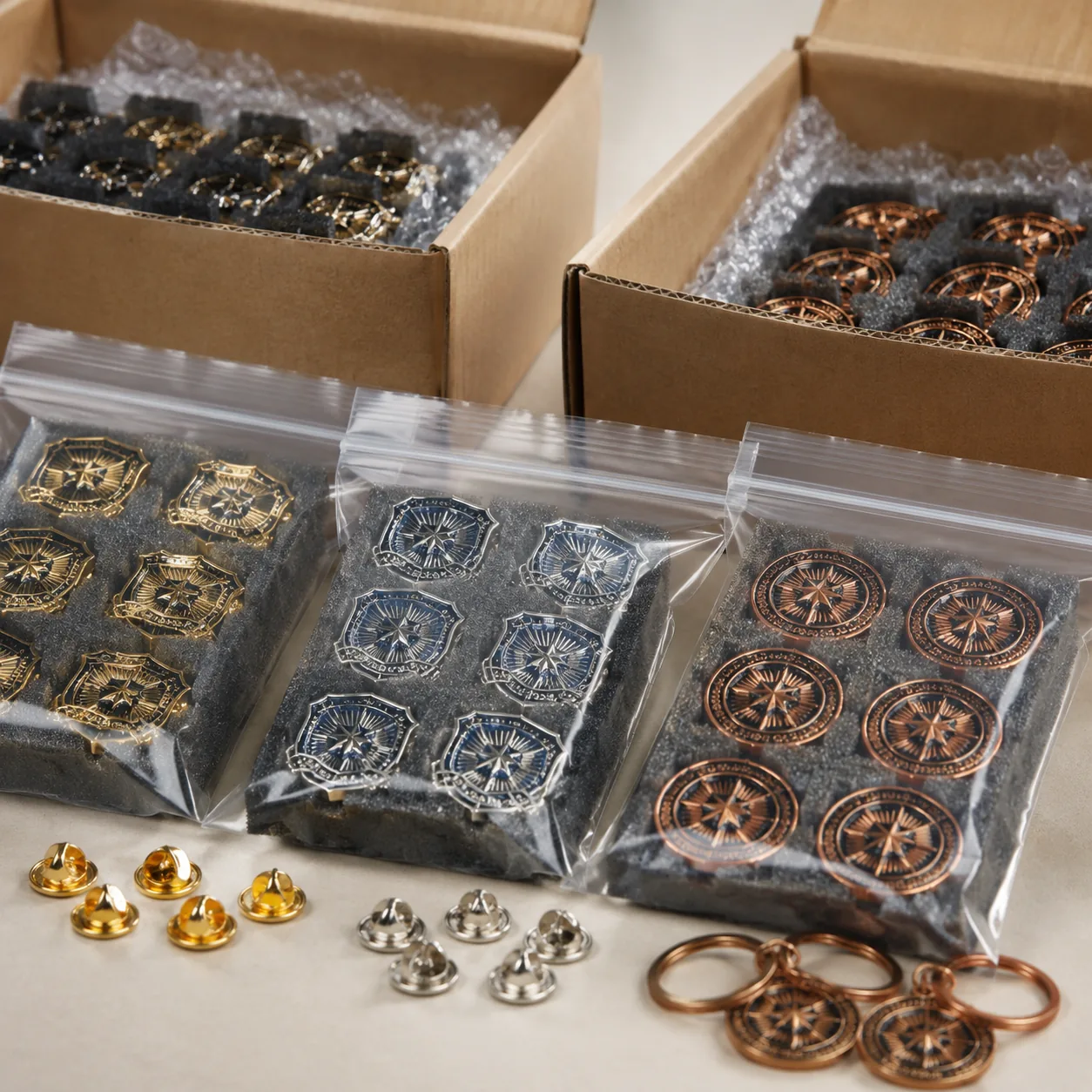
Split shipment control should be specified before sampling. For enamel pins, challenge coins, keychains, patches, fridge magnets and lanyards, ZheCraft treats each destination as a packing sub-order with its own SKU code, allocation quantity, inner-pack rule, carton mark and inspection line. This adds administration, usually USD 25 to 80 per destination depending on complexity, but it prevents a more expensive defect: approved products delivered to the wrong place.
The practical goal is to remove judgment from the packing bench. A worker should not need to decide whether a nickel-plated 30 mm pin with an English card belongs in New York or Toronto. The SKU, bag label, carton mark and packing list should all answer that question the same way.
Separate True SKUs From Packing Destinations
The first control point is deciding whether the order is one item split by destination or multiple SKUs split across destinations. One 30 mm hard enamel pin going to six offices is operationally simple. Six designs, three clutch types, two backing-card languages and eight destinations is a pick-pack project, even if the total order quantity is identical.
Factories normally price metal products by mold, artwork, plating bath, enamel filling, attachment and packing method. One mold covers one shape and size. Typical tooling tolerance is about ±0.10 mm for stamped iron or brass and ±0.20 mm for zinc alloy die casting. A change from 30 mm to 32 mm, a new cutout, or a different relief profile is a new tool, not a packing variation. Thickness should also be locked: common pin thickness is 1.2 to 1.8 mm for stamped iron, 1.5 to 2.0 mm for zinc alloy, and 3.0 to 4.0 mm for challenge coins.
Give every sellable or distributable version a unique SKU before sample approval. Avoid file names such as final_blue_revised.ai. A workable code is PIN-30HE-NI-BFLY-US, meaning 30 mm hard enamel, nickel plating, butterfly clutch and United States backing card. The same code should appear on the proof, sample tag, inner bag, carton label and packing list. If barcode labels are needed, confirm Code 128, EAN-13, UPC-A or retailer-specific format before printing.
| Scenario | Factory handling | Typical added cost | Risk if unspecified |
|---|---|---|---|
| Same SKU, 2 to 5 destinations | One production batch with separate final packing | USD 15 to 40 per destination FOB | Cartons split by rough count only |
| Same SKU, 6 to 20 destinations | Destination sub-orders with carton marks | USD 25 to 70 per destination FOB | Short packs or mixed destination cartons |
| Multiple SKUs, one destination | SKU bins before master packing | USD 0.01 to 0.04 per piece for SKU labels | Manual sorting errors at buyer warehouse |
| Multiple SKUs, multiple destinations | Pick-pack matrix with line-level QC | USD 0.03 to 0.08 per piece or USD 80 to 250 project fee | Wrong SKU delivered to event, retailer or country |
Lock the Destination Matrix Before Mass Packing
A destination matrix is the operating document for split shipments. It should show SKU code, product description, finished size, attachment, packaging type, destination code, ship-to address, consignee contact, delivery window, carton mark wording and document requirements. For export orders, it should also state whether the buyer needs one commercial invoice, separate invoices by destination, or separate packing lists under one master invoice.
Quantity tolerance must be written into the matrix. For custom pins and coins, production overrun or underrun is commonly controlled within ±3% below 5,000 pieces and ±2% for larger repeat orders. Lanyards, woven patches and embroidered patches often carry ±2% to ±5% because printing, weaving, cutting and heat-seal loss vary by process. Exact quantity is possible, but the factory needs a higher production buffer, tighter final counting and a clear rule for rejects.
If every destination requires exact counts, state it plainly: no destination may ship short; factory to hold overruns as spare stock; or all extra pieces to ship to one named destination. Without this rule, packing teams may distribute extras randomly. That is harmless for internal giveaways but unacceptable for retail planograms, event kits or tax-declared import quantities.
- Create one SKU per artwork, size, finish, attachment, card language and packing method.
- Freeze the destination matrix before mass packing; changes after sealing cartons normally add 1 to 3 working days.
- State whether destination quantities are exact or allow ±2% to ±3% tolerance.
- Assign spare clutches, magnets, cards or repair parts to one destination or divide them by percentage.
- Use destination codes such as US-NY, CA-TOR, DE-BER or UK-LON on carton marks and packing lists.
- Require written approval for any address, consignee or allocation change after final inspection.
Specify Unit Packing That Identifies the SKU
Small promo products are easy to confuse when shape, color or plating is similar. A 28 mm soft enamel pin with black nickel plating may look like a 30 mm version inside a clear bag. A woven patch with hook-and-loop backing may be mistaken for sew-on backing unless the bag label says otherwise. Sorting by eye is not a reliable control method during peak season.
Unit packing should match the business risk. For an internal giveaway, one pin plus one butterfly clutch in a 60 x 80 mm OPP bag may be enough. For retail, distributor resale or regional launch kits, use SKU-coded bags, barcode stickers or printed backing cards. Common OPP bag thickness is 30 to 50 microns; heavier PE bags are usually 60 to 80 microns. Backing cards are typically 300 to 400 gsm C1S paper, often 55 x 85 mm or 60 x 90 mm, with trim tolerance of ±1.0 mm. Hang-hole position should be controlled within ±1.5 mm if the product goes on retail pegs.
Packing cost rises quickly with identification requirements. A plain OPP bag usually adds USD 0.02 to 0.04 per piece FOB. A printed backing card plus bag adds USD 0.08 to 0.18 per piece. Variable barcode or destination labeling adds USD 0.015 to 0.05 per piece depending on label size, data source and scan testing. For orders above 20,000 pieces, destination-specific labels normally add 2 to 4 working days because labels must be printed, checked and reconciled against the matrix.
Set Carton Rules for Weight, Marks and Handling
Carton specifications must be more precise than “export carton.” Pins, coins and keychains are dense; cartons can exceed safe manual handling limits before they look full. A practical gross weight limit is 12 to 15 kg for enamel pins and coins, 10 to 13 kg for mixed keychains, and 8 to 12 kg for bulky patches or lanyards. Above 18 kg, crushed cartons, courier surcharges and warehouse handling complaints become more likely.
For small metal items, a common structure is 100 pieces per inner bag or inner box and 500 to 1,000 pieces per master carton, using 5-ply export cartons for international shipping. Coin capsules, retail cards, magnetic backs and epoxy domes reduce the count per carton because they add volume and need more protection. Carton dimension tolerance is typically ±5 mm, but the final packing list should show actual gross weight, net weight and carton size after packing, not the estimate used in the quotation.
Carton marks should include buyer PO, SKU, destination code, carton number, total cartons for that destination, quantity, gross weight, net weight and country of origin if the importer requires it. Number cartons by destination, not only by the whole order. “DE-BER 1/6” is safer than “Carton 17/42” because a forwarder can separate the Berlin cartons without reading the full allocation sheet.
| Product type | Recommended carton limit | Common inner pack | Use stronger cartons when |
|---|---|---|---|
| Enamel pins, 20 to 35 mm | 12 to 15 kg gross weight | 100 pcs per OPP group or inner box | Pins are carded, magnetic-backed or courier-shipped long distance |
| Challenge coins, 40 to 50 mm | 10 to 14 kg gross weight | 50 to 100 pcs per tray, capsule or bubble group | Finish is mirror-polished, antique-plated or individually pouched |
| Metal keychains | 10 to 13 kg gross weight | 50 to 100 pcs per inner bag | Split rings are heavy or product has acrylic, epoxy or moving parts |
| Woven or embroidered patches | 8 to 12 kg gross weight | 100 pcs per bundle | Hook-and-loop backing or individual retail bags increase bulk |
| Polyester lanyards | 9 to 12 kg gross weight | 50 pcs per bundle | Safety buckles, badge reels or individual bags increase carton volume |
Inspect by SKU and Destination, Not Only Total Quantity
A final inspection that samples only from the total order can miss destination-level failures. If 30,000 pins are acceptable overall but the Canadian cartons contain too few French backing cards, the shipment still fails. Split shipments need product inspection and packing inspection.
For appearance and function, a common standard is ANSI/ASQ Z1.4, General Inspection Level II, with AQL 2.5 for major defects and AQL 4.0 for minor defects. Critical defects should be zero tolerance. Major defects include wrong plating, wrong attachment, exposed sharp burrs, missing enamel, broken hardware, unreadable required logo text or wrong backing card. Minor defects include small polishing marks, enamel specks within the agreed visual limit, slight color variation against the approved range, or bag scuffs that do not affect retail use.
Packing inspection should verify carton marks, SKU labels, destination counts, inner-pack counts and mixed-carton restrictions. For complex orders, every SKU-destination combination should have its own counted line. A practical approach is 100% carton-label verification, 100% destination count reconciliation and random opening of at least 20% of cartons per destination. First-time orders, retailer programs and launch events justify opening 30% to 50% of cartons, especially when SKUs differ only by language, clutch or barcode.
- Approve one golden sample per SKU, including attachment, plating, enamel fill, backing card and bag label.
- Require carton photos for every destination group before pickup, not only one product beauty photo.
- Use AQL 2.5 major and 4.0 minor unless your internal standard is stricter.
- Define critical defects as zero tolerance, including sharp points, failed child-safety items and wrong country labels.
- Ask for a packing reconciliation sheet showing ordered quantity, packed quantity, carton count, shortage and spare quantity.
Build Lead Time Around the Slowest Requirement
Split-shipment lead time is more than production time. A normal custom metal pin order may take 18 to 25 days after sample approval for 1,000 to 5,000 pieces. Orders from 10,000 to 50,000 pieces often take 25 to 40 days depending on mold count, plating capacity, enamel filling, polishing and packing. Destination sorting, carton labeling, packing photos and document preparation typically add 2 to 6 working days when there are more than five destinations.
The slowest destination often controls dispatch. One country may require importer tax ID wording, retailer barcode verification, exact carton dimensions before booking, battery or magnet statements, or a wood-free pallet declaration. Courier pickup is flexible but costly. Air freight, rail and sea consolidation need earlier booking and more accurate carton data. If some destinations are urgent, define priority air cartons and economy bulk cartons before production, not after the goods are sealed.
Rush production is risky for split orders because packing time is compressed at the end. A rush fee that saves four production days does not help if the allocation matrix is still changing. The reliable sequence is: freeze artwork, approve product and packing samples, freeze SKU and destination matrix, then book courier, air, rail or vessel service.
| Order stage | Normal timing | Split-shipment risk | Buyer control point |
|---|---|---|---|
| Artwork and mold setup | 2 to 5 days | SKU codes missing before tooling | Approve SKU naming before proof sign-off |
| Pre-production sample | 5 to 10 days | Sample approved without final packing | Approve product, card, bag and label together |
| Mass production | 15 to 35 days | Overruns not allocated by destination | Confirm exact-count or tolerance rule |
| Sorting and packing | 2 to 6 days | Late address changes and label errors | Freeze matrix before final QC |
| Export documents and pickup | 1 to 4 days | Invoice or carton data mismatch | Check consignee, HS code, carton count and weights before booking |
Know When Factory Split Packing Is Not Worth It
Split shipment is not always the best use of budget. If the order is below 500 pieces total, or each destination receives fewer than 50 pieces, factory-level split packing may cost more than local redistribution. In those cases, one master shipment to the buyer’s warehouse can be cleaner, especially if local staff must insert tax labels, language leaflets or event-specific tickets.
Split packing is also weak when destinations are unstable. If allocations change weekly, do not ask the factory to reopen sealed cartons repeatedly. Repacking after inspection can add USD 30 to 80 per change event, plus 1 to 2 working days, and it increases scuffed-card and missing-accessory risk. Keep final allocation near the end market when demand is uncertain.
For regulated or child-oriented products, do not mix compliant and non-compliant versions in the same destination group. Nickel-free plating, child-safe attachments, magnet warnings, age labels and country-of-origin marks should be isolated by SKU. If the buyer needs EN71, CPSIA, Prop 65, REACH or nickel-release documentation, state the requirement before quotation. A test report should match the actual material, finish, attachment and packaging, not a similar item made for another customer.
Before placing the PO, send a one-page split-shipment brief with total quantity, SKU list, matrix, unit packing, carton mark format, quantity tolerance, inspection standard, delivery windows and document needs. Include concrete specs: 30 mm pin width, 1.5 mm stamped iron thickness, 0.8 to 1.2 micron nickel plating, rubber clutch, 300 gsm 55 x 85 mm backing card and 40 micron OPP bag. For coins, state 45 mm diameter, 3.0 mm thickness, zinc alloy or brass, antique plating and capsule or pouch packing. For lanyards, state 20 mm polyester, 900 mm loop length, safety breakaway, metal lobster hook and print method.
Have a project? Send your artwork and target quantity and we’ll reply with a detailed quotation within 12 working hours.
Ready to get this made?
Send your sketch, target quantity and ship-date. Detailed quotation in 12 hours.



