Split Shipments for Custom Promo Orders Without Event Shortages
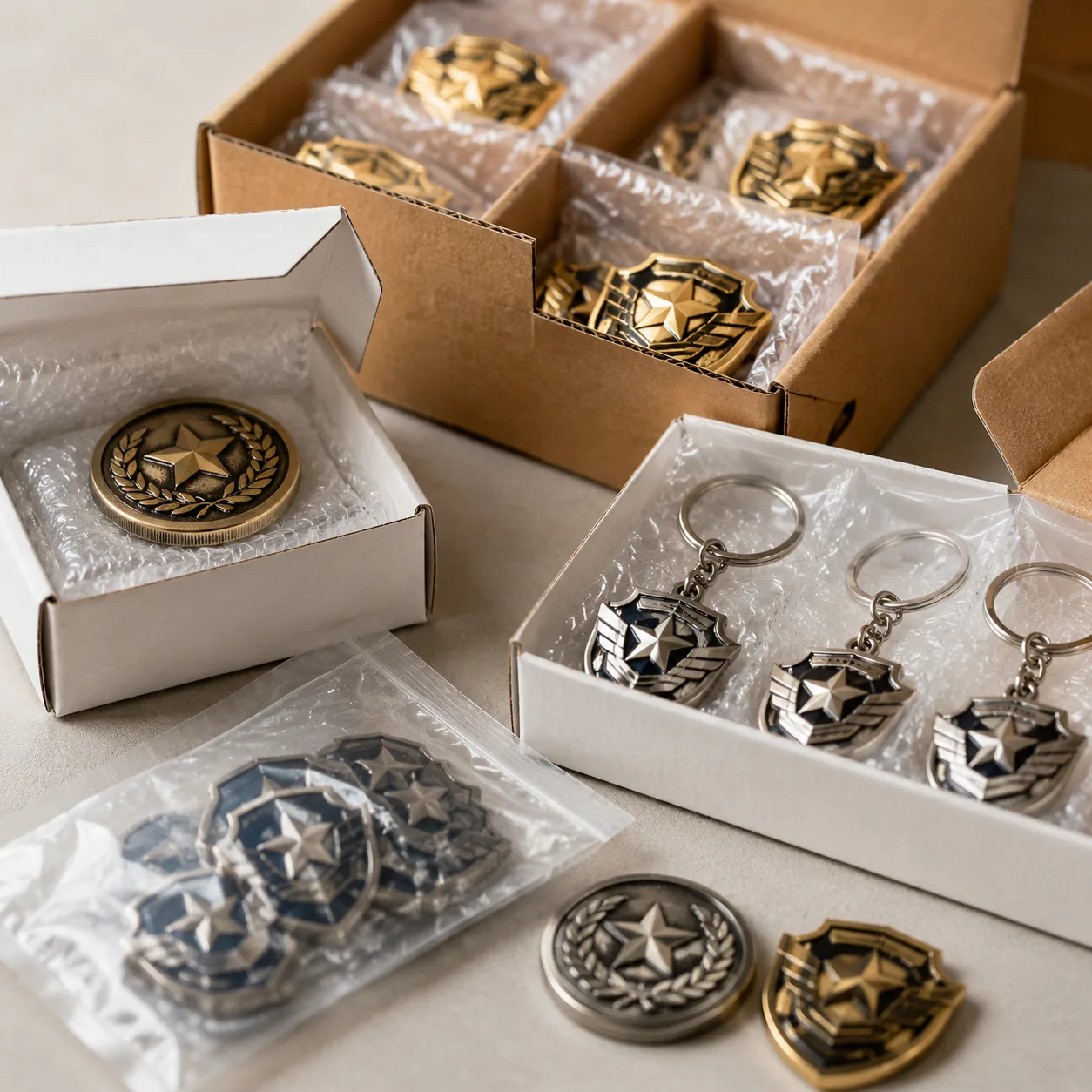
Start with the real risk: one PO, several delivery clocks
A typical promotion order is not one operational deadline. It may be 8,000 enamel pins, 2,000 challenge coins, 5,000 woven patches and 10,000 lanyards under one purchase order, but the goods move in different ways. The sales conference needs 3,000 complete sets in Chicago by 12 May. A distributor warehouse needs the replenishment balance by 25 May. Another 500 VIP kits need individual polybagging, name labels and hotel delivery before registration opens.
If the RFQ says only "ship ASAP," the factory will normally optimize for production efficiency: finish tooling, run the longest process first, pack cartons by SKU, and release once the whole PO is complete. That is logical for manufacturing, but it does not protect the event. A split shipment has to be engineered before mass production, because it affects packing order, carton labels, inspection sampling, buffer stock, export documents, and sometimes the unit price.
For metal promotional items, even a small mistake can consume the remaining schedule. Replacing 300 wrong backing cards, sorting mixed plating colors, or re-counting hotel cartons can add 2 to 4 working days after final inspection. Coins and pins also need re-weighing after repack, because freight invoices are based on gross or chargeable weight. At ZheCraft in Yiwu, we treat split shipments as a production-control requirement, not a last-minute logistics favor.
Define shipment lots before artwork approval
The first working document should be a shipment matrix, not the decoration file. Each lot needs a destination, factory handover date, item mix, packing format, inspection rule, document requirement and substitution policy. Without this matrix, a factory may complete all pins first, all lanyards second and all coins last, creating cartons of finished components that cannot become complete event kits.
For planning, custom hard enamel pins normally require 12 to 20 production days after sample approval for 500 to 5,000 pieces, plus 2 to 5 days for carding, inner boxes and export cartons. Soft enamel pins can be similar, but epoxy coating adds curing and handling time. Zinc alloy or brass challenge coins are usually 18 to 28 days depending on diameter, thickness, edge style and plating. Woven patches often take 10 to 18 days, while printed polyester lanyards can be 7 to 14 days if webbing, clips and safety breakaways are all available.
The first event lot should be released when at least 105 percent of its required quantity has passed inspection and is physically packed against that lot. The extra 5 percent is not a production bonus; it covers courier carton damage, hotel receiving loss, badge-desk counting errors and last-minute attendee additions. For high-control VIP kits, use 3 percent if every kit is serialized and scanned, or 8 percent if the event team will distribute manually from open cartons.
| Shipment lot field | Recommended buyer spec | Reason to lock it early |
|---|---|---|
| Lot ID | A, B, C or event name plus destination city | Prevents warehouse staff mixing similar SKUs or campaigns |
| Factory handover date | Specific date goods leave the factory, not event date | Allows booking time for courier, air cargo or forwarder pickup |
| Arrival deadline | Latest acceptable date at hotel, warehouse or advance receiving dock | Separates freight transit from on-site receiving risk |
| Quantity rule | Exact quantity plus 3 to 8 percent buffer | Protects against handling loss and attendee overrun |
| Packing format | Bulk, carded, 1-piece polybag, retail box or VIP kit | Changes labor time, carton size and inspection sampling |
| Release rule | Ship only after lot-level AQL pass and packing photos | Stops unchecked partial goods from reaching the event |
| Document need | Invoice, packing list, COO, HS code and consignee data | Avoids customs delay caused by document mismatches |
Sequence production by event value, not carton convenience
The first shipment should contain the goods that control the event experience. For a conference badge set with a hard enamel pin, zinc alloy keychain, woven patch and polyester lanyard, the metal items usually carry the schedule risk because they require tooling, polishing, plating and enamel or color fill. Lanyards are faster to make, but they are bulky; shipping all lanyards by air can cost more than shipping the metal items first and moving the balance by slower service.
Useful planning ranges for FOB Yiwu are: 30 mm soft or hard enamel pins at USD 0.55 to 1.20 per piece at 1,000 pieces; 45 mm zinc alloy keychains at USD 0.80 to 1.80 at 1,000 pieces; 50 mm challenge coins, 3 mm thick, at USD 1.80 to 3.80 at 500 pieces; woven patches at USD 0.25 to 0.75 at 1,000 pieces depending on size and backing; and 20 mm polyester lanyards at USD 0.35 to 0.95 at 1,000 pieces depending on print method, hook and safety breakaway. These are planning ranges, not quotes, because mold complexity, plating area, stitch density, color count and packing can move the cost materially.
MOQ also affects split planning. Many factories will accept 300 to 500 pieces for repeat enamel pin orders when an existing mold is used, but first production often starts at 500 or 1,000 pieces because tooling, plating setup and color mixing are fixed costs. Challenge coins commonly start at 100 to 300 pieces for simple designs, but the best price breaks often begin at 500 and 1,000 pieces. Lanyards and patches may be technically possible at 100 pieces, but freight and setup charges make the landed cost poor below 500 pieces.
When budget is tight, do not automatically air-ship the complete first lot. A stronger split may be 500 VIP kits by express, 2,500 attendee metal pieces by air cargo, and bulky lanyards or retail boxes by economy express or sea-air. The trade-off is control: every split increases the chance of mismatched quantities unless the factory maintains lot-level packing lists and carton photos.
Specify carton labels, weights and inner packing
Carton labels must work for warehouse staff who have never seen the purchase order. Use a minimum label size of 100 x 150 mm on two adjacent carton sides. The lot ID and destination city should be at least 8 mm high in black text. Each carton should show PO number, SKU, lot ID, carton sequence, inner quantity, total carton quantity, gross weight, net weight and carton dimensions in centimeters.
For pins, badges and coins, export cartons should usually stay between 12 and 18 kg gross weight when courier handling is expected. A common carton for carded enamel pins is 38 x 28 x 24 cm or 40 x 30 x 30 cm, depending on backing card size. Challenge coins need smaller cartons, often 32 x 24 x 18 cm, because 500 coins at 50 mm diameter and 3 mm thickness can exceed 18 kg once capsules, polybags and inner boxes are included. Lanyards are the opposite problem: they are light but bulky, so volumetric weight can exceed actual weight.
Inner packing should match distribution. Bulk pins may be packed 50 or 100 pieces per OPP bag for warehouse counting, but event teams usually need 1 pin per backing card and 50 cards per inner box. Coins, magnets and keychains with plated surfaces should be individually polybagged or separated with tissue; vibration can create rub marks even when plating thickness meets spec. For VIP kits, confirm whether each kit needs barcode labels, attendee names, sequential numbering or a master carton by hotel room block.
- Use one lot ID per export carton; do not mix destinations unless the buyer approves the exception in writing.
- Place a printed packing list inside carton 1 of each lot and send a matching PDF with the shipping documents.
- Keep pin and coin cartons under 18 kg gross weight for courier networks; use smaller cartons for dense metal items.
- Number cartons by lot, such as Lot A 1/12, Lot A 2/12, instead of using only a PO-level carton count.
- Photograph open carton contents, sealed carton faces and labels before warehouse release.
- State whether buffers ship with the event lot, the warehouse balance or a separately labeled spare-parts carton.
Inspect each partial shipment as its own batch
Partial shipment should not mean partial quality control. For most custom metal promotional products, use ANSI/ASQ Z1.4 general inspection level II with AQL 2.5 for major defects and AQL 4.0 for minor defects. For premium retail launches, executive gifts or VIP kits, tighten to AQL 1.5 major and 2.5 minor, but expect more inspection time and possible sorting cost. The inspection report should identify the lot number, not only the total PO.
Sampling must be by shippable lot. If Lot A contains 3,000 pins and Lot B contains 7,000 pins, inspect Lot A as its own batch before it leaves. Otherwise, a defect concentrated in the first packed cartons can disappear statistically inside the full 10,000-piece order. This matters when the first lot is packed before the full run is complete, or when different plating tanks, enamel workers or card-printing batches are used.
Define measurable tolerances before inspection. For stamped iron enamel pins, outline size tolerance of ±0.20 mm is realistic for many designs; very fine cutouts may need looser agreement. Enamel overflow should not exceed 0.15 mm beyond the raised metal line on visible areas. Decorative nickel, gold or black nickel plating is commonly in the 0.05 to 0.12 micron range unless a heavier plating spec is purchased. Pin post position tolerance of ±1.0 mm is normally acceptable, but anti-rotation designs may need tighter control. Colors should be checked against Pantone Coated references or the approved physical sample under consistent lighting.
| Defect area | Major defect example | Minor defect example |
|---|---|---|
| Function | Broken clutch, weak magnet, loose keyring, missing safety breakaway | Slightly stiff clasp that still operates |
| Appearance | Wrong plating color, exposed base metal, missing enamel in visible logo area | Tiny dust dot under epoxy within agreed size limit |
| Dimensions | Pin or coin outside approved tolerance, wrong thickness, wrong patch size | Minor edge variation that does not affect assembly or branding |
| Quantity | Carton shortage, mixed lot, wrong SKU in destination carton | Inner bag count mismatch corrected before sealing |
| Branding | Wrong logo, wrong backing card, unreadable QR code | Backstamp shallow but still legible |
| Packing | Carton too weak for weight, no destination label, wrong consignee | Label placed on one side only instead of two |
Build buffers for quantity, transit and receiving
Exact event quantities are risky. For event lots, specify a production overrun allowance of 3 to 5 percent for normal distribution and up to 8 percent when products will be handled by hotels, volunteers or multiple field teams. State where the extra pieces go. If the factory simply adds overruns to the final warehouse lot, the first event still has no protection.
Top-up orders are slower than buyers expect. For enamel pins, adding 300 pieces after mass production can still require 7 to 12 working days because stamping, polishing, plating, enamel fill, curing and packing cannot be skipped. Challenge coin top-ups may take 12 to 18 working days if the plating line or edge process is already rescheduled. Lanyard repeats can be faster, often 5 to 10 working days, but exact color matching may vary if yarn or webbing lots change.
Timing buffers should be separate from quantity buffers. After factory handover, air express to North America or Western Europe is often 3 to 6 working days, but add 2 to 4 days for customs clearance, remote-area delivery, trade-show advance warehouse receiving or hotel dock scheduling. Air cargo may be cheaper for 100 kg and above, but it usually needs more paperwork and consignee coordination. Sea freight is rarely suitable for urgent event lots unless the event is more than 45 to 60 days away and the buyer has a warehouse that can receive pallets.
Receiving rules are often missed. Trade-show advance warehouses may require carton labels with booth number, show name and target move-in date. Hotels may refuse large freight without a guest name, event manager contact or delivery window. Distributor warehouses may require ASN data, pallet labels or carton barcodes. These requirements should be in the split shipment brief before cartons are sealed.
Price the split before approving the proforma
Split shipment adds cost in three places: packing labor, document handling and freight. A simple two-lot split with the same bulk packing may add only USD 20 to 80 in factory handling. A complex split with VIP kitting, barcode labels, separate carton marks and multiple packing lists can add USD 0.05 to 0.35 per set. If each kit includes a pin, coin, patch, lanyard and printed insert, manual assembly and 100 percent count verification may add more than the product buyer expects.
Freight is usually the larger cost. Ten 10 kg courier shipments normally cost more than one 100 kg shipment because minimum charges, pickup fees and destination charges repeat. Volumetric weight also matters. Lanyards, foam inserts and gift boxes can invoice at chargeable weight above actual weight, while coins are dense and may hit courier handling limits before carton volume is full. For planning, ask the factory for carton dimensions and gross weights by lot before approving the freight method.
Do not use split shipment when there is no date-sensitive need, when one warehouse can receive everything in time, or when destination quantities are too small for efficient courier movement. For low-value giveaways such as simple silicone keychains or basic lanyards, extra handling can exceed the benefit of earlier partial delivery. In those cases, one consolidated shipment plus clear internal allocation may be safer.
| Split option | Best use case | Typical trade-off |
|---|---|---|
| Air first lot, sea balance | Event needs 500 to 2,000 urgent pieces and balance is stock | Lowest event risk, but two freight processes |
| Air metal items, later lanyards | Pins or coins drive perceived gift value | On-site kitting needed if components arrive separately |
| All lots by courier | Multiple small destinations under tight timing | Higher freight cost, simpler tracking |
| Air cargo for first pallet | Urgent lot exceeds courier efficiency, often 100 kg plus | More consignee coordination and document control |
| Factory kitting by destination | Distributor wants cartons ready for drop ship | Higher labor cost, fewer warehouse picking errors |
| Consolidated shipment | No event deadline or one receiving warehouse | Lowest handling risk, slower first availability |
Control documents, Incoterms and release responsibility
Shipment instructions should state whether the price is FOB, EXW, FCA or DDP. FOB Ningbo or Shanghai is common for sea freight, but courier shipments from Yiwu often operate closer to EXW or FCA handover. If the buyer's forwarder collects the goods, specify pickup address, contact person, pickup window, carton readiness time and whether export declaration is handled by the factory, trading company or forwarder.
Commercial invoices must match the actual lot shipped. If Lot A contains 3,000 pins and 500 coins, the invoice should not show the full PO quantity of 8,000 pins and 2,000 coins. Customs officers compare invoice, packing list and airway bill; quantity or description mismatches can delay delivery even when the products are correct. Each lot should have its own packing list with carton count, SKU quantity, gross weight, net weight and dimensions.
Use specific product descriptions instead of vague wording such as "promotional gifts." Better descriptions include "iron enamel lapel pins with rubber clutches," "zinc alloy challenge coins, non-currency," "polyester printed lanyards with metal hooks" or "woven polyester patches with heat-seal backing." Do not understate value to reduce duty. It creates customs, insurance and claim risk for the buyer, especially if only one urgent lot is lost or delayed.
Before requesting a quote, build a one-page split shipment brief with item list, artwork revision, destination addresses, arrival deadlines, Incoterms, lot quantities, packing format, inspection standard and buffer allocation. Ask the factory to confirm three dates for each lot: mass production completion, inspection date and carrier handover date. Also ask for carton label proofs before labels are printed or cartons are sealed. Split shipments succeed when assumptions are removed before tooling, card printing and packing begin.
Have a project? Send your artwork and target quantity and we’ll reply with a detailed quotation within 12 working hours.
Ready to get this made?
Send your sketch, target quantity and ship-date. Detailed quotation in 12 hours.



