Split Shipments for Custom Promo Orders: Specs That Avoid Chaos
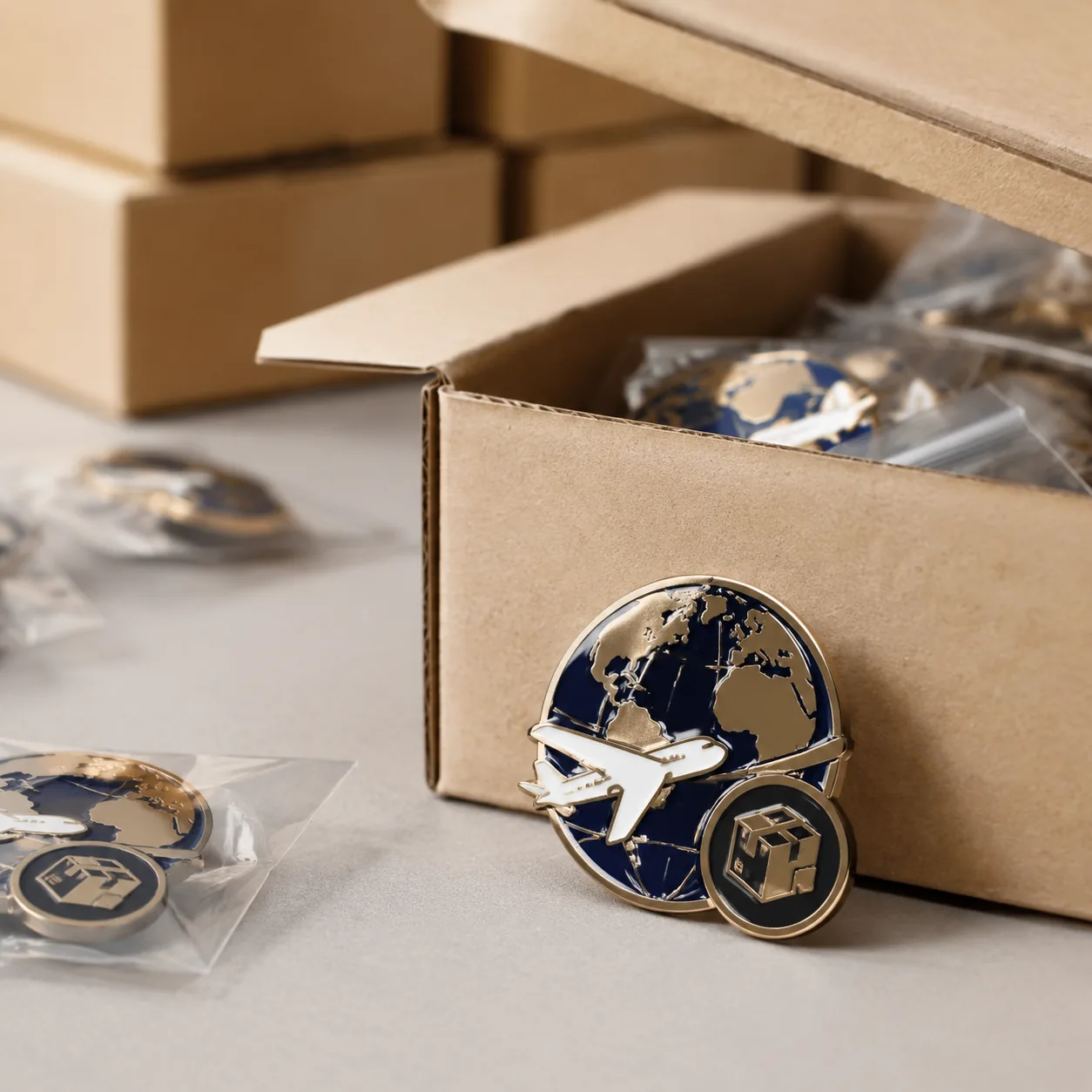
Why Split Shipments Fail: Packing, Not Production
A 5,000-piece order is simple when every carton moves to one warehouse. It becomes operationally risky when 1,200 enamel pins go to a U.S. event venue, 800 keychains go to a German distributor, 500 lanyards go to a Singapore office, and the remaining stock goes to a 3PL. At that point, the factory is not only producing merchandise; it is also performing destination-level allocation, carton control, labeling, and document matching.
The most common failures are not poor enamel fill, weak plating, or incorrect mold dimensions. They are mixed SKUs in the wrong carton, missing backing cards, uneven quantity allocation, carton labels that do not match the packing list, and receiving teams that cannot reconcile cartons quickly. If a venue needs 600 lanyards on Monday and the carton contains 480, the product quality no longer matters.
For custom enamel pins, brooches, challenge coins, keychains, fridge magnets, patches, and lanyards, split shipment instructions should be treated as a controlled production specification. The factory needs the split plan before mass packing starts. Repacking sealed cartons usually adds 1 to 3 working days, requires replacement export cartons, and increases the chance of scuffed polybags, bent backing cards, scratched plating, and miscounts.
When Factory Split Packing Is Worth It
Split shipments are useful when receiving locations are fixed, event dates differ, customs entry is easier through regional hubs, or a campaign requires market-specific packaging. A 35 mm hard enamel pin may use the same metal mold for all markets, but need English backing cards for the U.S., French-English cards for Canada, and EU warning text for Germany. In that case, separating inventory at the factory is usually cleaner than repacking after import.
They are usually inefficient for very small orders. If an order is under 300 pieces and has more than three destinations, the factory handling cost and courier minimum charges often exceed the benefit. A 100-piece pin order split into five cartons may require five labels, five carton lines on the packing list, five destination checks, and five courier minimums. Sending one master carton to a local distributor is often cheaper and safer.
A practical threshold is 500 pieces per SKU or about 2,000 pieces across a mixed promotional set. Below that, use one bulk shipment unless an event deadline, customs rule, or retail routing requirement justifies the extra labor. For China FOB planning, basic split packing often adds USD 0.02 to 0.08 per piece, while unit-level barcode labels, kit assembly, or photo reporting can push the added cost to USD 0.10 to 0.30 per piece or set.
| Order situation | Recommended approach | Commercial reason |
|---|---|---|
| 300 pins to 2 offices | Ship bulk to one office and redistribute locally | Factory handling and courier minimums usually outweigh savings |
| 2,000 keychains to 4 sales regions | Use factory split packing | Carton-level separation reduces 3PL receiving and repacking labor |
| 10,000 lanyards to 12 venues | Use a destination matrix and pallet map | Event receiving teams need clear carton counts and delivery sequencing |
| Mixed set: pin, coin, patch, lanyard | Split only after all components pass QC | One late component can block the complete destination carton |
| Different language backing cards | Split at factory by card version | Avoids market-specific relabeling after import |
Build the Destination Matrix Before Packing
The destination matrix is the control document for split shipments. It should list destination code, full receiving address, contact name, phone number, email, SKU code, item description, packaging version, inner pack quantity, master carton quantity, required delivery date, courier account if applicable, and shipping mark. “Send 500 to London” is not enough. The factory needs to know whether those 500 pieces are loose packed, individually polybagged, pinned to backing cards, bundled into 50-piece inner boxes, or packed as complete kits.
Use stable SKU codes that do not change between artwork, sample approval, invoice, carton labels, and the packing list. A useful code is short but specific, such as PIN-35HE-BLK-GOLD for a 35 mm hard enamel pin with black fill and gold plating, or LNY-20MM-PMS186-SAFETY for a 20 mm red polyester lanyard with a safety breakaway. Avoid file-style names such as “event pin final final,” because they break traceability when artwork, labels, and documents use different wording.
Quantity tolerance must also be stated. Custom metal promotional items are commonly produced with 0 to 3 percent overrun or underrun depending on MOQ, mold yield, and inspection results. That tolerance is acceptable for bulk warehouse stock, but not for event cartons. If a destination must receive exactly 1,000 pieces, the matrix should state “exact count required, plus 0 / minus 0 for this destination.” Otherwise, the factory may place the overrun in the easiest carton and leave another destination short.
- Freeze the final destination matrix before mass packing starts.
- Use one SKU code per product, colorway, attachment, and packaging version.
- State exact destination quantities and whether 0 to 3 percent overrun is allowed.
- Include receiving contacts in English and local language where possible.
- Separate event-critical destinations from normal replenishment stock.
- Approve backing card language, barcodes, warnings, and retail labels before printing.
Carton, Inner Pack, and Weight Specifications
Carton rules should be specific enough for the factory to pack consistently and for the warehouse to receive without opening every carton. For pins, coins, badges, and keychains, use inner polybags or inner boxes before master cartons. A typical enamel pin master carton is 32 x 22 x 18 cm to 38 x 28 x 25 cm, with gross weight kept below 12 to 15 kg for courier handling. Challenge coins and zinc alloy keychains are heavier, so 8 to 12 kg gross weight is safer to prevent bottom seam failure and corner crushing.
For lanyards, a common structure is 50 or 100 pieces per inner polybag, then 500 to 1,000 pieces per carton depending on hook, badge holder, and individual packaging. For patches, 100 pieces per inner bag is common, but merrowed edges can deform if compressed too tightly. For PVC or metal fridge magnets, avoid heavy stacking because magnet sheets can shift, edge surfaces can rub, and printed faces can stick under pressure.
Standardize carton quantities where possible. Six cartons of 200 pieces are easier to receive than five cartons of 200 pieces and one unclear partial carton. If a partial carton is unavoidable, mark it clearly as “PARTIAL CTN” and show the exact unit count on the carton label and packing list. Many warehouses receive by carton count first and verify units later, so carton count and unit count must both be visible.
| Product type | Typical inner pack | Suggested master carton limit | Packing caution |
|---|---|---|---|
| Enamel pins on backing cards | 50 or 100 pieces per inner box | 8 to 12 kg gross weight | Protect card corners and pin posts from bending |
| Metal keychains | 50 pieces per inner bag or box | 10 to 15 kg gross weight | Separate split rings from plated surfaces if they scratch |
| Challenge coins in capsules | 25 or 50 pieces per inner box | 8 to 12 kg gross weight | Avoid bottom-layer pressure marks and cracked capsules |
| PVC fridge magnets | 100 pieces per inner bag | 10 to 14 kg gross weight | Prevent surface sticking and edge deformation |
| Woven or embroidered patches | 100 pieces per inner bag | 8 to 12 kg gross weight | Do not compress merrowed edges |
| 20 mm polyester lanyards | 50 or 100 pieces per inner bag | 12 to 18 kg gross weight | Keep hooks aligned to reduce tangling |
Carton Labels That Receiving Teams Can Use
Every split carton should be identifiable from at least two adjacent sides without opening it. A reliable carton mark includes buyer name or PO number, destination code, SKU code, product description, quantity in carton, carton number, total cartons for that destination, net weight, gross weight, carton dimensions, and country of origin if required. “DEST-03 / PIN-35HE-BLK-GOLD / 200 PCS / CTN 2 OF 6” is far safer than a carton marked only with a PO number.
If cartons move through a 3PL, add barcode or QR labels when required, but do not rely only on machine-readable codes. Human-readable text is still necessary when labels are scratched, scanners fail, or cartons are cross-docked quickly. For Amazon-style routing, retail warehouse routing, or big-box compliance labels, buyers should provide the template. Factories should not guess SSCC, FBA, UCC-128, routing, or retailer-specific label formats.
Label durability matters. For export cartons, use 100 x 150 mm thermal labels or coated paper labels with strong adhesive. A 100 x 100 mm label is the minimum for readable split shipment marks. If cartons may face humidity during sea freight, tape the label edge or place the label inside a clear pouch, but avoid glossy tape over barcodes because scanner glare can cause failed reads.
- Use one destination code on carton labels, packing lists, invoices, and email approvals.
- Number cartons by destination, such as Germany CTN 1 of 4, not PO CTN 1 of 32.
- Add product thumbnails on mixed-SKU carton labels when warehouse staff may not know the items.
- Use labels at least 100 x 100 mm, with 100 x 150 mm preferred for courier cartons.
- Place labels on two adjacent sides, not only the top panel.
- Do not mix two destinations in one carton unless the buyer approves it in writing.
QC Standards for Split Packing
Split shipment QC has two layers: product inspection and packing inspection. Product inspection checks dimensions, color, plating, enamel fill, printing registration, attachment strength, magnet adhesion, lanyard stitching, and visible defects. Packing inspection checks SKU, count, inner pack, destination allocation, carton mark, document match, and label readability.
For general promotional metal products, many buyers use ANSI/ASQ Z1.4 or ISO 2859-1 sampling with AQL 2.5 for major defects and AQL 4.0 for minor defects. Critical defects should be 0 accepted. For safety-related issues, such as exposed sharp pin posts, loose magnets, broken clasps, choking-hazard components, or missing small-parts warnings, the shipment should not be released until corrected.
Packing accuracy needs tighter control than appearance inspection. A minor enamel speck may be acceptable under AQL 4.0, but a wrong destination label can misroute an entire carton. Destination labels, carton counts, and packing list matches should be checked 100 percent. For event cartons, quantity should be plus 0 / minus 0 unless the buyer authorizes buffer stock in that destination. Inner packs can be random checked for large runs, but small destination runs should be counted fully before sealing.
Dimensional tolerances should be written where they affect fit. For a 35 mm die-struck or enamel pin, a practical tolerance is often ±0.3 mm on overall size after polishing and plating. For printed lanyards, width tolerance is commonly ±1 mm and length tolerance ±20 mm unless the buyer requires tighter control. Backing card print color should be controlled against approved artwork or Pantone references, not described only as “close enough.”
| QC point | Suggested standard | Buyer note |
|---|---|---|
| Product appearance | AQL 2.5 major, AQL 4.0 minor | Use stricter limits for retail, licensing, or executive gifting |
| Critical safety defects | 0 accepted | Sharp posts, loose magnets, unsafe small parts, and missing warnings require correction |
| Key dimensions | Pins ±0.3 mm; lanyard width ±1 mm | Confirm tighter tolerances before sampling if parts must fit holders or cards |
| Carton destination label | 100 percent check | One wrong label can misroute the whole carton |
| Destination quantity | Plus 0 / minus 0 for event cartons | State whether warehouse stock can receive overruns |
| Packing list match | 100 percent document check | Invoice, carton list, and labels must use identical SKU names |
Lead Time, MOQ, and FOB Cost Planning
Split shipment rarely changes the main production process. Metal stamping, die casting, enamel filling, polishing, plating, printing, embroidery, weaving, and lanyard sewing follow the same schedule. The added time comes at the end: allocation, counting, labeling, carton photography, document revision, and courier handoff. For 2 to 5 destinations, add 1 to 3 working days. For 6 to 15 destinations, add 3 to 6 working days. For 15 or more destinations, treat the project as light fulfillment and confirm a packing calendar before issuing the PO.
MOQ also affects the decision. Many factories can produce custom pins or keychains from 100 to 300 pieces per design, but clean split packing is more practical at 500 pieces per SKU. Lanyards usually become cost-efficient at 500 to 1,000 pieces per design. Patches and PVC magnets vary by process, but destination-level packing below 100 pieces per location often creates high handling cost per unit.
As a China FOB reference, simple split separation with destination carton labels may add USD 0.02 to 0.06 per piece. More detailed work, such as barcode application, retail stickers, carton photo reporting, or mixed-SKU destination packing, usually adds USD 0.05 to 0.20 per piece. Complete kit assembly can add USD 0.10 to 0.30 per set, depending on the number of components and whether each kit needs a bag, card, barcode, or insert. Extra export cartons typically cost USD 0.60 to 1.50 each, but courier minimums and remote-area surcharges can dominate the landed cost.
| Split requirement | Typical added factory time | Typical added FOB cost |
|---|---|---|
| 2 to 3 destinations, same SKU, same packing | 1 to 2 working days | USD 0.02 to 0.04 per piece |
| 4 to 8 destinations with carton labels | 2 to 4 working days | USD 0.03 to 0.08 per piece |
| Mixed SKUs packed by destination | 3 to 5 working days | USD 0.06 to 0.15 per piece |
| Barcode or retail label per unit | 2 to 5 working days | USD 0.05 to 0.12 per piece |
| Complete kit assembly before split | 4 to 7 working days | USD 0.10 to 0.30 per set |
| Repacking after cartons are sealed | 1 to 3 working days delay | Higher due to labor, relabeling, and carton replacement |
Documents to Approve Before Release
Before release, approve the destination matrix, commercial invoice, packing list, carton label artwork, and courier or forwarder instructions as one document set. They must match exactly on SKU code, quantity, carton count, destination wording, and shipping marks. A mismatch between invoice and packing list can delay customs clearance even when the cartons are packed correctly.
Separate shipment lots when Incoterms, customs values, courier accounts, or delivery responsibilities differ. One portion may be FOB Ningbo for a buyer-nominated forwarder, while another portion ships DAP to an event venue by express courier. Mixing these terms on one instruction sheet creates disputes when duties, remote-area fees, failed delivery charges, or storage costs appear.
Regulated-market details should be closed before packing. If nickel-free claims, CPSIA tracking, EU small-parts warnings, country-of-origin marks, or recycling symbols are required, they must be included on the approved card, label, or polybag before production packing starts. Adding compliance text after cartons are sealed increases cost and creates a high risk of mixed old and new packaging.
- Approve the destination matrix, carton labels, invoice, and packing list as one matched set.
- Use separate shipment lots when Incoterms, courier accounts, or customs values differ.
- Confirm HS codes and product descriptions with your broker before export documents are issued.
- Provide warehouse routing labels before final packing, not after carton sealing.
- Request carton photos by destination for event-critical orders.
- Hold 1 to 2 percent buffer stock at one central location for replacements or late additions.
The best split shipment plan is built before artwork approval, backing card printing, and mass packing. Ask the factory to quote the base unit price separately from split packing, labels, extra cartons, kit assembly, and courier handling. That keeps the cost discussion factual and prevents hidden labor charges after production is complete.
Have a project? Send your artwork and target quantity and we’ll reply with a detailed quotation within 12 working hours.
Ready to get this made?
Send your sketch, target quantity and ship-date. Detailed quotation in 12 hours.



