Split Shipments for Custom Promo Orders: Specs, Costs and Risks
Why Split Shipments Fail Late
A common failure pattern is predictable: the buyer approves one good sample, releases one purchase order, then asks the factory to divide finished goods across 8 event cities, 3 sales offices and 1 e-commerce warehouse after production has started. The product may be correct, but the packing plan is not. Carton counts, destination labels, inner pack quantities, customs documents and forwarder pickup instructions all change at the worst point in the schedule.
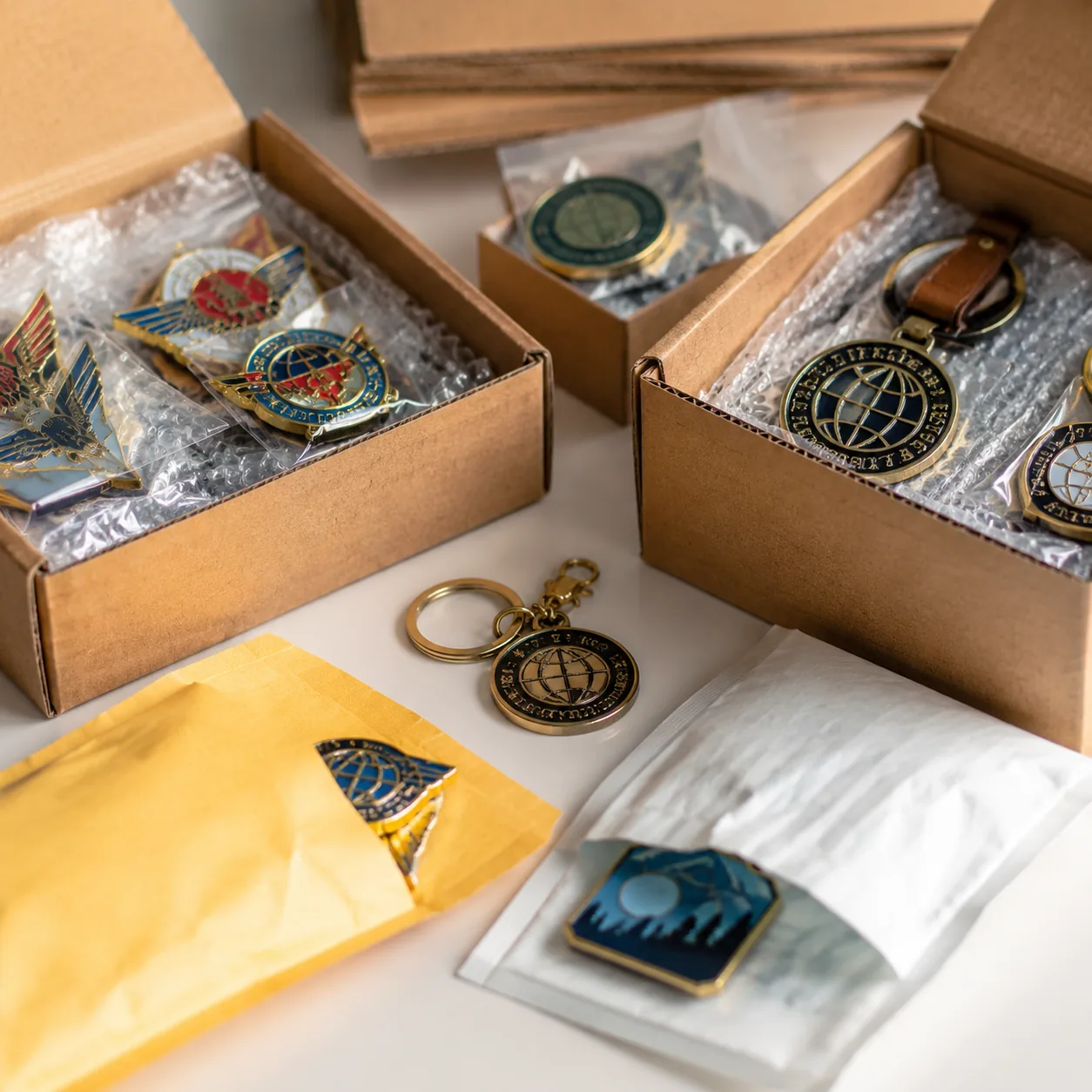
For custom enamel pins, challenge coins, keychains, patches and lanyards, split shipment is not a shipping note. It is a production and packing requirement. It affects MOQ efficiency, master carton size, inner bag quantity, barcode placement, AQL sampling, overrun allocation, carton weight and sometimes the FOB unit price. A 5,000 piece pin order can be physically ready on Friday and still miss a Monday pickup if the factory must reopen cartons, reprint marks and reissue packing lists.
The safest approach is to define the split before final quotation and freeze it before mass packing. This article explains when factory-level splitting is efficient, when a warehouse should handle redistribution, and what technical details belong in the RFQ and purchase order.
When Factory Splitting Makes Sense
Factory split shipment works best when the product is compact, uniform and packed in fixed inner quantities. For example, 10,000 soft enamel pins packed 100 pieces per PE bag and 1,000 pieces per export carton can be divided into ten clean cartons without disturbing retail packs. Lanyards packed 50 pieces per bundle and 500 pieces per carton, or challenge coins packed 50 to 100 pieces per inner box, are also manageable if carton counts are planned before the packing line starts.
It also makes sense when each destination needs controlled labeling at source. A North America batch may require inch-based warning text and distributor SKUs, while an EU batch may require nickel-safe wording, CE-related traceability language or localized carton marks. If these files are approved early, the factory can separate batches with work instructions instead of improvising after final inspection.
| Order Type | Good Factory Split | Better Warehouse Split | Typical Extra Lead Time |
|---|---|---|---|
| 3,000 to 10,000 pins, same design, city-level carton split | Yes, if destination quantities and carton labels are frozen before packing | Only if destinations change weekly | 1 to 2 working days |
| 5,000 to 20,000 lanyards, same print, office allocations | Yes, if inner bundles stay at 50 or 100 pieces | Warehouse is better for many small courier drops | 1 to 2 working days |
| Mixed promo kit with pin, coin, lanyard and patch | Yes, if every kit has the same components and same insert | Warehouse is better if recipient kits vary | 2 to 4 working days |
| Retail-ready goods with barcodes, FNSKU or SKU labels | Yes, if label files are final and scan-tested | Warehouse is better for marketplace rule changes | 2 to 5 working days |
| Rush event order under 12 production days | Only for simple carton splits with no special inserts | Avoid split handling if schedule is fixed | 2 to 3 working days |
When To Avoid Factory Splitting
Do not split at the factory when destination quantities are still moving. If the sales team may change an allocation from 800 to 1,200 pieces after packing, a warehouse is safer because it can reopen cartons without disrupting factory QC records or export documents. A factory packing line is designed for repeatable output, not daily redistribution.
Very small drops are usually inefficient. Sending 50 pins to each of 20 offices creates more carton labels, courier bookings and packing-list lines than the product value justifies. For 25 to 35 mm soft enamel pins at about USD 0.45 to 1.20 FOB each, the handling cost of a micro-shipment can exceed the item cost if every drop requires a separate carton and pickup reference.
Avoid late factory splitting for fragile or presentation-heavy goods. Zinc alloy coins in velvet boxes, glass-front badge frames and large acrylic keychains may need 5-ply cartons, foam separation or corner protection. Repacking increases scratch risk, especially on mirror gold, high-polish silver, black nickel and dyed black finishes where a 0.02 to 0.05 mm surface scuff can be visible under retail lighting.
Product Specs That Drive Feasibility
The easiest items to split are protected at piece level and counted in repeatable units. Soft enamel pins from 20 to 45 mm, 1.2 to 1.5 mm thick, with 8 to 12 micron nickel, gold or black nickel plating can usually be packed 100 to 200 pieces per inner bag when they are not retail-carded. Hard enamel and imitation cloisonné pins need more protection because polished faces can mark during vibration if packed face-to-face.
Challenge coins are dense, so carton weight matters more than carton volume. A 45 mm zinc alloy coin at 3 mm thickness may weigh 35 to 45 g before capsule or pouch. Once packed in acrylic capsules or velvet pouches, a safe carton is often 100 to 300 pieces with a gross weight target of 12 to 16 kg. Overpacking coins into large cartons saves cardboard but increases dropped-carton damage and crushed presentation boxes.
Keychains require individual protection because hardware moves. For a 50 mm zinc alloy keychain with a 25 mm split ring and 3-link chain, individual 0.04 to 0.06 mm OPP bags are recommended for any split shipment. Without bagging, the chain can rub plating during truck or ocean vibration, especially on rose gold, antique brass and electrophoretic black finishes.
Lanyards are usually efficient to split if the carton plan follows standard pack counts. Polyester lanyards at 15 to 25 mm width and 900 mm finished length are commonly packed 50 pieces per bundle and 500 pieces per carton. Sublimated lanyards with detachable buckles should be packed flat rather than compressed tightly because clips can imprint the fabric during a 25 to 35 day sea shipment.
- Confirm finished size before carton planning: pins 20 to 45 mm, coins 38 to 50 mm, keychains 40 to 70 mm and lanyards 15 to 25 mm are the most manageable ranges.
- Use individual OPP bags for polished metal, epoxy keychains, retail pins and any item with moving hardware.
- Avoid loose bulk packing for black nickel, mirror gold, rose gold and high-polish silver finishes.
- Keep inner pack counts consistent: 50, 100, 250 or 500 pieces are easiest to audit.
- Set gross weight limits before packing: 10 to 15 kg for pins and keychains, 15 to 18 kg for lanyards and 12 to 16 kg for boxed coins.
Carton, Label and Document Controls
A reliable split starts with a packing matrix. The matrix should show destination code, SKU, product description, quantity, inner pack count, carton count, gross weight, carton dimensions, label file name and document requirement. For example, cartons DAL-A01 to DAL-A05 may hold 1,000 pins each for Dallas, while TOR-B01 to TOR-B03 holds 800 pins each for Toronto with bilingual labels.
Carton dimensions should match product density. Dense pins and coins often work in 30 x 25 x 20 cm cartons. Retail-carded pins may need 38 x 28 x 25 cm cartons because backing cards add volume. Lanyards often use 50 x 35 x 30 cm cartons, but gross weight should stay below 18 kg to reduce crushed corners and warehouse handling complaints.
Carton marks should be printed once there are more than three destinations. Use a minimum 100 x 150 mm label for courier and warehouse scanning. Destination code should be at least 18 pt text, carton sequence should read clearly as “1 of 5,” and barcodes should have at least a 3 mm quiet zone. One printed label should be scan-tested before mass labeling.
| Packing Item | Recommended Spec | Why It Matters |
|---|---|---|
| Inner polybag | 0.04 to 0.06 mm OPP or PE, sealed or taped | Prevents mixed counts and plating rub |
| Master carton | 5-ply corrugated, 170 to 200 lb burst strength equivalent | Handles dense metal goods better than light export cartons |
| Carton count tolerance | 0 piece variance for fixed destination allocations | Split shipments require exact receiving counts |
| Carton label | 100 x 150 mm, destination code, SKU, PO, carton number and gross weight | Reduces receiving errors across multiple warehouses |
| Pallet label | A4 sheet on two adjacent sides when palletized | Helps forwarders separate destinations without opening cartons |
| Packing lists | One master list plus one list per destination | Prevents customs, forwarder and receiver mismatches |
MOQ, FOB Cost and Lead Time Effects
Split shipment is not free, but the cost should be transparent. For simple enamel pins with normal individual bagging, adding 2 to 5 destination splits usually adds about USD 0.01 to 0.03 per piece for label handling, carton separation and document work. If each destination needs different backing cards, barcode labels, warning inserts or retail boxes, the add-on can rise to USD 0.04 to 0.12 per piece depending on labor time and printed material waste.
FOB pricing normally follows the total production quantity, not each destination quantity, if the design and materials are the same. A 5,000 piece 30 mm soft enamel pin order may remain around USD 0.45 to 0.95 FOB Yiwu or FOB Ningbo depending on base metal, color count, plating and attachment, even when split into five destinations. A 10,000 piece polyester lanyard order may sit around USD 0.28 to 0.65 FOB depending on width, sublimation coverage, buckle type and safety breakaway.
MOQ still matters for destination-specific materials. The factory may accept a total MOQ of 300 to 500 pieces for a simple pin design, but custom backing cards often have an economic MOQ of 1,000 to 2,000 pieces per version. Printed inserts, UPC stickers and small retail boxes may carry minimum print charges even if only 300 units go to one office. These costs should be quoted as separate line items instead of buried in the unit price.
Lead time depends on what changes by destination. A simple carton-label split adds 1 to 2 working days after final QC. Different backing cards, language inserts or SKU labels add 2 to 5 working days because printed materials need proofing and count control. If allocation changes after goods are packed, repacking usually adds 1 to 3 working days and may require a new packing audit.
QC Rules for Split Shipments
The biggest QC mistake is inspecting only the total order and ignoring destination accuracy. AQL should still apply to the full production lot for workmanship, but quantity, label and carton checks must be performed by destination. For standard B2B promotional goods, a common inspection setting is AQL 2.5 for major defects, AQL 4.0 for minor defects and 0 acceptance for critical defects.
For split shipments, add a packing audit after product inspection. The inspector should check carton numbers, destination codes, SKU labels, inner pack counts, gross weight and carton dimensions against the packing matrix. Weight is a useful cross-check: a carton of 1,000 metal pins should often fall within plus or minus 3 percent of the approved gross weight if the count and packing method are unchanged.
Plating, color and attachment checks remain important. Specify plating thickness before quotation: 5 to 8 microns may be acceptable for short-term indoor giveaways, while 8 to 12 microns is better for better wear resistance and multi-leg transport. Pin post placement should typically stay within plus or minus 1.0 mm of the approved sample, and lanyard finished length should usually stay within plus or minus 10 mm unless the brand has tighter requirements.
- Approve one golden sample or production sample and use it as the standard for every destination batch.
- Require carton photos showing open carton, inner packs, label close-up and sealed carton mark before release.
- Check quantities by destination carton number, not by total packed quantity alone.
- Use AQL 2.5 major and 4.0 minor unless your brand or retailer requires stricter limits.
- Set critical defects at 0 for wrong logo, wrong destination label, exposed sharp pin, missing safety warning or mixed SKU.
- Hold 1 to 2 percent spare goods at one nominated destination if event teams may need emergency replacements.
PO Wording and RFQ Checklist
The purchase order should state split shipment requirements as binding production instructions. Include the final destination matrix, packing method, label file names, carton mark format, document requirements, overrun rule and inspection requirement. If the buyer accepts plus or minus 3 percent production tolerance on the total order but needs exact destination counts, the PO must say so clearly.
For example: 6,000 hard enamel pins, 30 mm, 1.5 mm iron base, 10 micron gold plating, butterfly clutch, individual OPP bag, split 2,000 pieces each to three offices. The PO should state that destination quantities must be exact, overruns must be packed as spare stock to destination A, and cartons must be numbered A01 onward, B01 onward and C01 onward. This prevents the factory from spreading overruns randomly or leaving them unassigned.
Freeze the split matrix before mass packing begins, ideally when pre-production samples are approved. Late changes should be treated as controlled repacking with cost, timing and QC consequences. For a clean RFQ, provide product type, finished dimensions, material, plating thickness, attachment, packing method, total quantity, destination quantities, label requirements and Incoterms such as EXW, FOB Yiwu, FOB Ningbo or courier-ready cartons.
- Decide whether the factory or a warehouse should control the split before requesting final pricing.
- Freeze destination quantities before mass packing, not after production ends.
- Use fixed inner pack counts such as 50, 100, 250 or 500 pieces.
- Require a packing matrix, destination packing lists and carton photos before release.
- Keep destination labels large, simple and scan-tested.
- Hold spare stock in one location instead of spreading small overruns across all destinations.
Have a project? Send your artwork and target quantity and we’ll reply with a detailed quotation within 12 working hours.
Ready to get this made?
Send your sketch, target quantity and ship-date. Detailed quotation in 12 hours.



