Split Shipments for Custom Promo Orders: Buyer Specs
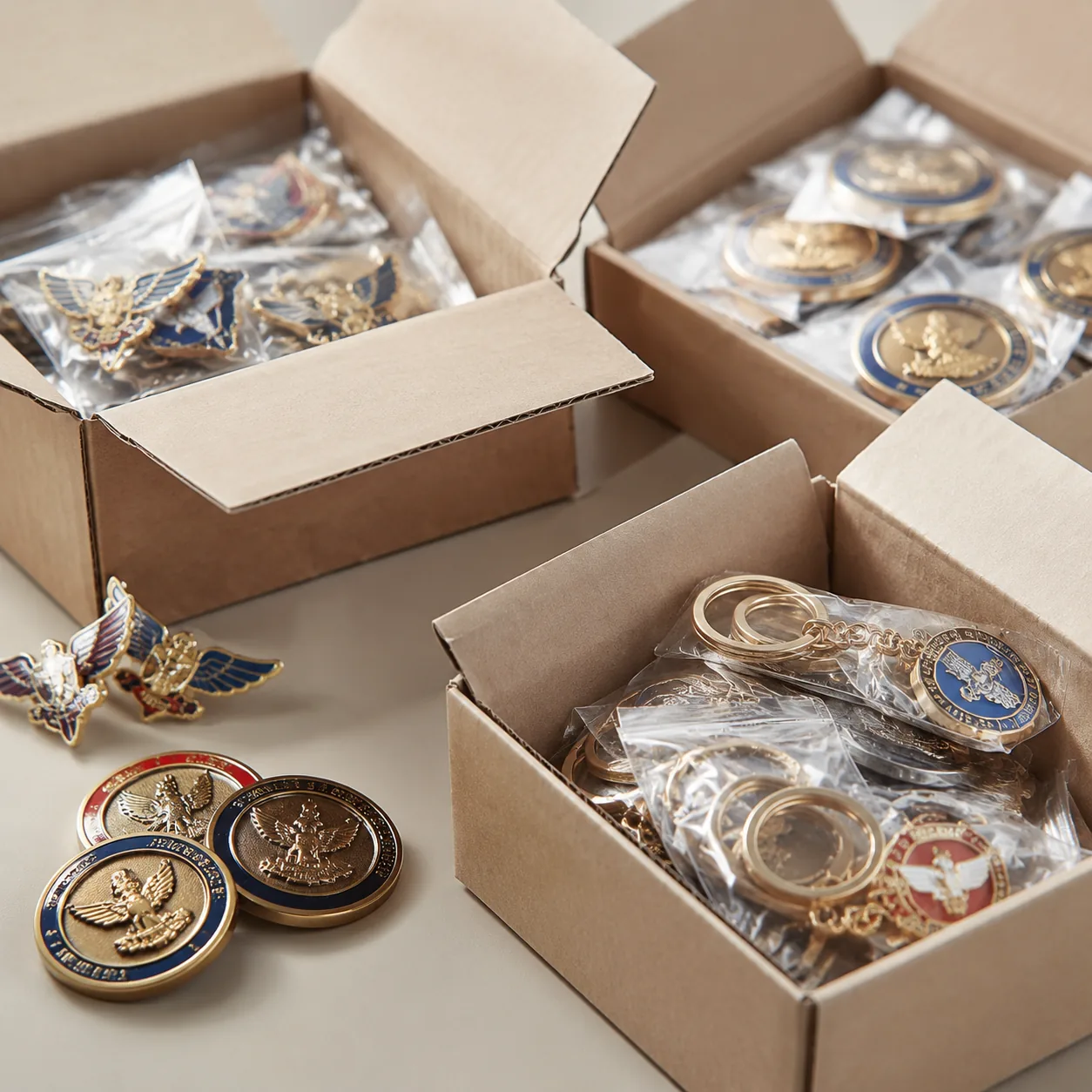
Why split shipments fail: production is not the same as delivery
The product can pass inspection and still fail the project. A 10,000 piece promotional order may need 3,000 lanyards at a Las Vegas hotel by Friday, 2,000 enamel pins at a New Jersey 3PL the following week, 1,000 patches sent to a Canadian distributor, and the balance held for a reorder campaign. If that split is not specified before mass packing, the factory will normally pack by production efficiency, not by event calendar, customs destination or receiving workflow.
For custom enamel pins, challenge coins, woven patches, PVC keychains, fridge magnets and lanyards, split shipments affect carton marks, inner packing, inspection sampling, commercial invoices, export declarations and freight pricing. A late split request after cartons are sealed can add 2 to 5 working days for reopening, counting, relabeling and rebuilding the packing list. For metal items, it can also increase damage risk because cartons are heavier and inner boxes may no longer fit the revised quantities.
Use split shipments when the order has different recipients, deadlines, importers of record or receiving rules. Do not split only to test demand unless the buyer accepts higher per-unit freight, extra handling cost and more chances for document mismatch. For small orders under 500 pieces or under about 30 kg gross weight, one clean shipment is usually safer and cheaper unless an event deadline makes a split unavoidable.
Write the split plan before the proforma invoice
The cleanest split shipment is built into the proforma invoice, production sheet and packing instruction before deposit payment. Each split needs a destination, recipient contact, quantity by SKU, arrival deadline, latest dispatch date, freight method and packing rule. A request such as “ship some to our office and some to the event” is not enough for costing because the factory cannot price cartons, labels, courier chargeable weight or document work accurately.
A usable split line is specific: 4,000 pieces total, SKU PIN-BLUE-32MM, artwork V3, 1,500 pieces to New York by DHL Express with arrival by 12 June, 2,000 pieces to Rotterdam by sea under FOB Ningbo, and 500 pieces held at factory for 30 calendar days for later courier release. For patches and lanyards, add colorway, attachment and packaging because cartons often look identical from outside. For mixed promo sets, state whether the split is by finished kit or loose component.
| Split field | Buyer specification | Factory impact |
|---|---|---|
| Destination | Full company name, street address, postal code, contact phone, email and tax ID where required | Reduces courier holds, invoice corrections and failed delivery attempts |
| Quantity | Exact pieces per SKU and split, with overrun or underrun rule such as ±2% on non-event stock | Prevents proportional shortages from affecting event-critical quantities |
| Deadline | Required arrival date plus latest acceptable dispatch date | Allows realistic selection of express, air, rail, sea or hold-and-release |
| Packing | Pieces per OPP bag, inner box, master carton, carton label and pallet rule if used | Prevents 3PL receiving errors and carton rework |
| Inspection | Combined lot or separate AQL sampling per destination code | Controls whether one clean split can mask defects in another split |
| Documents | Incoterm, invoice description, HS code guidance, declared value and importer details | Keeps paperwork aligned with the physical goods in each shipment |
Choose the right split model
There are four practical split models for custom promo orders. Production split means the goods are divided by destination immediately after QC and before master cartons are sealed. Warehouse split means finished bulk cartons are opened and reallocated after production. Kit split means several products are assembled into recipient-ready packs before shipping. Hold-and-release means approved goods remain at the factory or forwarder and are dispatched later.
Production split is best for one product going to multiple addresses, such as 10,000 soft enamel pins on the same backing card. It is fast and usually adds only USD 0.01 to 0.04 per piece for labels, counting and destination segregation. Warehouse split is more flexible but less efficient: expect USD 15 to 50 per address, plus 1 to 3 working days, because workers must open cartons, recount pieces and rebuild the packing list.
Kit split is useful for event packs but requires stricter controls. A kit containing one 32 mm pin, one 50 mm woven patch and one printed lanyard must be checked as a finished pack, not only as three separate SKUs. Typical kit assembly cost is USD 0.08 to 0.35 per kit for simple polybag kits, or USD 0.40 to 1.20 per kit when a printed box, insert card or barcode label is required. Do not choose kit split if one component is still unapproved; the full kit cannot ship until the slowest component passes QC.
| Split model | Best use case | Extra lead time | Typical added cost |
|---|---|---|---|
| Production split | Single SKU or simple multi-SKU order with known destinations | 0 to 1 working day | USD 0.01 to 0.04 per piece |
| Warehouse split | Finished goods already packed before the destination plan changes | 1 to 3 working days | USD 15 to 50 per split address |
| Kit split | Pins, coins, patches and lanyards packed into event-ready sets | 2 to 5 working days | USD 0.08 to 0.35 per simple kit |
| Hold-and-release | Campaign stock dispatched after the first delivery window | No delay to first shipment; later dispatch time applies | Often free for 15 to 30 days, then USD 0.50 to 2.00 per carton per week |
Set carton, label and packing specs by destination
Packing rules should change by freight mode. Courier cartons should normally stay below 12 to 15 kg gross weight because heavy cartons are more likely to be dropped, crushed or surcharged. Air cargo can often accept 15 to 18 kg cartons if the carton strength is adequate. Sea freight cartons for dense metal items may run 18 to 22 kg gross weight, but only if inner boxes prevent pins, coins or keychains from rubbing during long transit.
For enamel pins on backing cards, common packing is 1 piece per OPP bag, 50 pieces per inner box and 500 to 1,000 pieces per master carton depending on pin size, backing card thickness and clutch type. For 50 mm zinc alloy challenge coins at 3 mm thickness, plan 35 to 45 g per coin before packaging and usually 100 to 250 pieces per carton. For polyester lanyards, 500 to 1,000 pieces per carton is practical, but woven or jacquard lanyards should not be over-compressed because creasing can be visible at receiving.
Carton labels must identify the split without relying on warehouse staff to interpret a packing list. “Carton 3 of 18” is not enough when the same SKU goes to three warehouses. A better label is “PO 2468, SKU PIN-BLUE-32MM, artwork V3, split NYC, carton 3 of 18, 500 pcs.” For Amazon, retail DCs or 3PLs, add FNSKU, barcode, ASN reference or routing guide label if required by the receiver.
- Approve pieces per inner box and master carton before mass packing starts.
- Use short destination codes such as NYC, AMS, YYZ or EVENT on every carton label.
- Set maximum gross carton weight: 12 to 15 kg for courier, 15 to 18 kg for air, 18 to 22 kg for sea.
- Require carton dimensions in centimeters and gross weight in kilograms on the final packing list.
- Ask for label photos and one sealed-carton photo for each split before pickup.
- For palletized sea freight, specify pallet size, carton pattern, stretch wrap and whether cartons may be double-stacked.
Control QC sampling across split lots
A split shipment can hide defects if the inspection plan samples only the easiest cartons. If 5,000 keychains are split into 3,000 courier pieces and 2,000 sea freight pieces, both destination codes should be accessible during final inspection. Otherwise, one destination may receive early-production cartons and another may receive late-production cartons with different plating tone, enamel fill, print registration or attachment strength.
For normal promotional products, many buyers use ANSI/ASQ Z1.4 general inspection level II with AQL 2.5 for major defects and AQL 4.0 for minor defects. Critical defects should be AQL 0. This includes sharp burrs, loose pin posts, broken split rings, weak magnets, exposed staples, detachable small parts on child-facing items and any defect that creates a safety or legal risk. For event kits, add a separate packing accuracy check because product quality and kit completeness are different risks.
Dimensional tolerances should be written by product type. For small die-struck or enamel metal items, ±0.3 mm is practical for length and width when the mold is stable. For larger PVC, acrylic or embroidered items, ±0.5 mm to ±1.0 mm may be more realistic depending on material and cutting method. Color tolerances should reference Pantone coated or uncoated numbers for printed and enamel colors; for plating, approve a physical sample or limit acceptance to a named finish such as shiny nickel, antique brass or matte black nickel.
| QC point | Suggested spec | Reject condition |
|---|---|---|
| Visual defects | AQL 2.5 major, AQL 4.0 minor | Wrong plating, wrong enamel color, deep scratches, missing print or obvious glue marks |
| Critical defects | AQL 0 | Sharp burrs, loose posts, broken rings, weak magnets or unsafe detachable parts |
| Dimensional check | ±0.3 mm for small metal items; ±0.5 to ±1.0 mm for larger PVC, acrylic or textile items | Fit, backing card alignment or attachment function is affected |
| Packing accuracy | 80 to 125 units or kits checked per split on mid-size orders | Wrong SKU, missing component, mixed colorway or wrong destination label |
| Carton verification | 100% carton labels checked against packing list | Carton count, gross weight or destination code mismatch |
Plan freight, customs and price trade-offs
Split shipments almost always raise total landed cost. Express courier is fast, typically 3 to 7 calendar days after pickup to the US or Europe, but dense metal items do not benefit much from volumetric weight. Air freight is often 7 to 12 days door to door when space is available. Sea freight is cheaper per kilogram above roughly 100 to 150 kg, but total door-to-door time is commonly 25 to 45 days depending on port, customs clearance and final trucking.
For planning, FOB China price ranges should be separated from freight. A 30 mm soft enamel pin at 1,000 to 5,000 pieces commonly falls around FOB USD 0.35 to 0.85 per piece depending on mold size, plating, enamel count, backing card and clutch. A 50 mm zinc alloy challenge coin at 3 to 4 mm thickness may run FOB USD 1.80 to 4.50 depending on edge, plating, enamel and 3D relief. Polyester lanyards often start around FOB USD 0.35 to 0.90 at 1,000 to 5,000 pieces, while woven patches may range from FOB USD 0.25 to 1.20 depending on size, thread coverage, backing and border.
MOQ also matters. Many factories can produce enamel pins from 100 pieces per design, but pricing becomes more stable at 500 or 1,000 pieces because mold, setup and QC labor are spread over more units. Lanyards are often quoted from 300 to 500 pieces per design, with better pricing at 1,000 pieces. Challenge coins may be accepted from 100 pieces, but 300 to 500 pieces is a more realistic tier for competitive unit cost.
Customs paperwork must match the physical split. If one shipment contains pins and lanyards, the commercial invoice should not describe only “metal badges.” Use product name, material, quantity, unit value, country of origin and broker-approved HS code guidance consistently. Confirm whether the shipment moves under EXW, FOB, CIF, DAP or DDP because the party responsible for export clearance, import duty, tax and delivery risk changes with the Incoterm.
- Use express only for event-critical quantities, then move replenishment stock by air or sea when time allows.
- Do not courier low-value excess stock if origin storage for 15 to 30 days is available.
- Confirm whether quotes are EXW, FOB, CIF, DAP or DDP before comparing freight prices.
- Keep commercial invoice values consistent with the sales contract and payment records.
- Collect EORI, VAT, tax ID or importer-of-record details before dispatch, not after pickup.
Define overrun, shortage and leftover rules
Custom production rarely lands exactly on the ordered quantity after QC rejects. For pins, keychains, patches and lanyards, a production tolerance of ±2% is common at higher volumes, although factories often try to ship exact accepted counts. The risk is that exact-count split shipments leave no buffer when final accepted quantity is short by 20, 50 or 100 pieces.
Write the allocation rule before production starts. For example: “EVENT split must ship exact 2,000 pieces first; any shortage is deducted from WAREHOUSE split.” Without that rule, the factory may divide accepted goods proportionally, creating two slightly short deliveries and one failed event. For retail or client-specific orders, it may be better to hold all goods until final count is confirmed, then approve the split based on actual accepted stock.
Also decide what happens to surplus pieces, rejected-but-usable pieces, pre-production samples and leftover components. For strict brand control, require rejected branded goods to be destroyed with photos or video confirmation. For normal promotional use, holding 1% to 2% surplus at the factory for 30 days can help cover courier loss, event shortages or reorder samples without restarting production.
RFQ checklist before approval
Before sending a split-shipment RFQ, build a one-page split schedule instead of burying the plan in an email thread. List each SKU, artwork version, quantity, destination, deadline, freight mode, packing method, carton label text, inspection rule and document requirement. Attach it with the artwork files so the factory quotes the real job, not a simplified one-address shipment.
Ask the factory which item controls the lead time. As a planning range, custom metal pins and keychains often need 12 to 20 production days after artwork and sample approval. Challenge coins may need 15 to 25 days depending on mold complexity and plating. Woven patches and printed lanyards may run 10 to 18 days, while kit assembly adds 2 to 5 working days after all components pass QC. Label approval should be completed at least 2 working days before pickup.
A practical buying step is to request three scenarios: one shipment to one address, production split by destination, and event-first express with the balance by slower freight. The cheapest quote is not always the safest, but the comparison shows the real cost of speed, handling and risk control. Approve the order only when the proforma invoice, production sheet, packing list format, carton label and commercial invoice fields all follow the same split plan.
Have a project? Send your artwork and target quantity and we’ll reply with a detailed quotation within 12 working hours.
Ready to get this made?
Send your sketch, target quantity and ship-date. Detailed quotation in 12 hours.



