Split Shipments for Custom Promo Orders: Buyer Specs
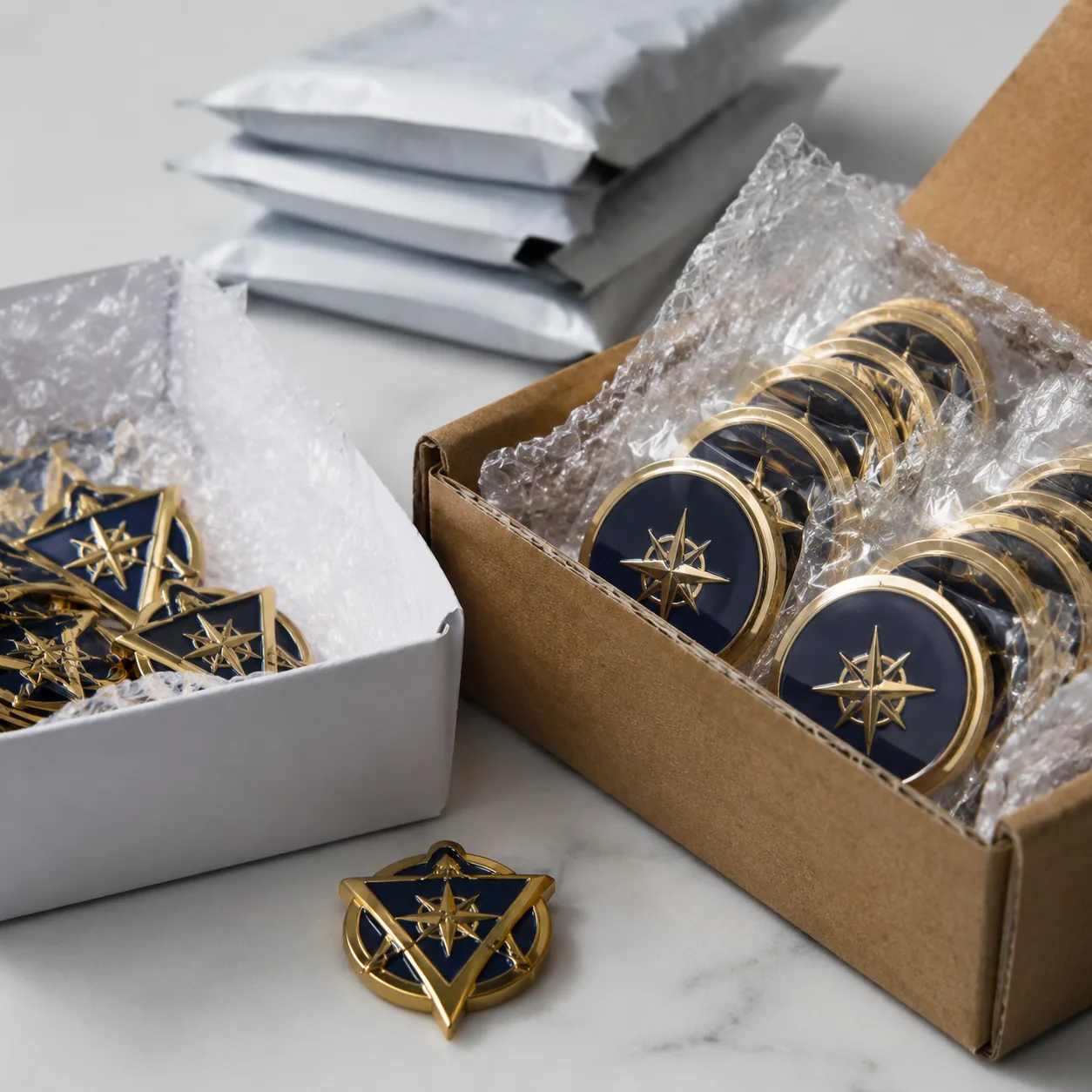
One PO, Multiple Deadlines: Define the Logistics Before Packing
Split-shipment problems rarely start with poor product quality. They usually start with an underspecified purchase order. A buyer orders 20,000 custom promo items: 5,000 enamel pins for a trade show in Germany, 8,000 keychains for a U.S. warehouse, and 7,000 mixed items to hold for regional sales kits. If the RFQ says only “ship when ready,” the factory will normally pack by production batch, carton efficiency, or the easiest export sequence—not by event date or downstream allocation.
For custom pins, challenge coins, patches, lanyards, medals and keychains, the split plan affects more than freight booking. It changes carton marks, inner-bag counts, packing list structure, inspection sampling, export documents, pallet sorting and sometimes the order of final assembly. If the split is changed after cartons are sealed, expect 1–3 working days for recounting and relabeling. Handling charges are commonly USD 0.02–0.08 per unit for simple repacking and USD 0.08–0.20 per unit for mixed-SKU or retail-kit rework.
The factory does not need to become the buyer’s logistics department. It does need exact packing and release rules before mass packing starts. A good split-shipment instruction tells the packing team what goes into each carton, which cartons leave first, what documents accompany each shipment, and who pays when allocations change after approval.
When Split Shipment Is Worth the Extra Handling
Split shipment is justified when delivery timing, customs entry, or destination-level packing is more important than the lowest handling cost. Strong use cases include fixed-date events, multi-country distributor orders, franchise launches, employee onboarding kits, regional sales campaigns and urgent partial releases. It is usually unnecessary for a 500-piece reorder going to one office unless the item is high value or serialized.
A practical threshold for metal promo items is 1,000–2,000 pieces per destination, or any quantity tied to a hard event date. Below 500 pieces per destination, courier shipment from one local warehouse is often cleaner than factory-level split packing. Lanyards and patches can be split economically at smaller quantities because the unit weight is low, but carton discipline still matters if colors, clips, backings or language versions differ.
Do not use factory split shipment only because internal departments have separate budgets. If all goods can clear customs once and be redistributed locally, one bulk shipment is usually cheaper and easier to control. Factory split shipment is strongest when cartons, paperwork, HS descriptions, delivery terms or shipment timing must differ before the goods leave China.
| Use Case | Recommended Split Rule | Minimum Practical Quantity | Added Factory Time | Do Not Use When |
|---|---|---|---|---|
| Trade show plus warehouse stock | Pack event quantity first; release by air or courier; ship balance by sea | 1,000 pcs or 20% of PO | 1–2 days | Local stock can cover the event |
| Multi-country distributor order | Separate carton marks, packing lists and invoice lines by destination | 2,000 pcs per destination | 2–4 days | One importer will redistribute after customs |
| Retail or franchise rollout | Pack by store kit, region or pallet group with fixed carton numbering | 100 kits or 3,000 loose pcs | 3–6 days | Store allocations are still changing |
| Mixed promo set campaign | Pack complete sets by destination with approved overage rule | 500 sets per destination | 3–5 days | Components have different approval dates |
| Urgent partial release | Inspect and release finished approved portion first | Normally 20% or more of PO | 1–3 days | QC risks remain unresolved on the balance |
RFQ Data the Factory Needs Before Production
Write the split by SKU and destination, not only by total pieces. “DE-EVENT: 3,000 30 mm hard enamel pins, gold plating, butterfly clutch, German backing card, individual OPP bag” is actionable. “Send 3,000 sets to Germany” is not. Include product version, packaging, accessory, backing card language, barcodes if used, and whether mixed cartons are allowed.
Define quantity tolerance at destination level. For counted metal products such as enamel pins, badges, medals and keychains, ±0.5% per destination is realistic after final counting. For lanyards packed in bundles of 50 or 100, use bundle logic and allow ±1 inner bundle if exact counts would require opening sealed bundles. For serialized challenge coins, numbered badges or QR-coded items, use exact quantity and require the serial range on the packing list.
State priority when production finishes close to the deadline. A clear rule is: “DE-EVENT split has first packing priority after AQL inspection approval; remaining destinations may ship after balance packing.” Without that instruction, many factories will wait until all goods are ready so they can pack once, reduce labor, and avoid document revisions.
- List every ship-to destination with contact name, phone, postal code, importer name and tax ID where available.
- Break quantities by SKU, colorway, plating, attachment, backing card, barcode and accessory.
- State the Incoterm for each split: EXW Yiwu, FCA forwarder warehouse, FOB Ningbo, FOB Shanghai, CIF port or DAP venue.
- Set quantity tolerance: normally ±0.5% for counted metal items, ±1 inner bundle for lanyards, and exact count for serialized goods.
- Confirm whether each split needs a separate commercial invoice, packing list, certificate of origin, HS description or buyer PO reference.
- Name the priority split and the latest acceptable handover date in calendar days, not vague terms such as “ASAP”.
Packing Specs That Prevent Warehouse Rework
Carton-level discipline determines whether a split shipment works. Each master carton should show PO number, destination code, SKU, carton number, gross weight, net weight, piece count and country of origin where required. For mixed cartons, the carton side mark and packing list must show the item breakdown. A receiving warehouse should not need to open cartons to identify the destination or product mix.
For enamel pins and metal keychains, common inner packs are 50 or 100 pieces per bag, then 300–1,000 pieces per export carton depending on size and packaging. A 25–35 mm enamel pin on backing card may pack 500–800 pieces per carton. A 45–60 mm zinc alloy keychain may pack 300–500 pieces because hardware weight increases quickly. Keep courier cartons below 15 kg gross weight where possible; for air or sea freight, 12–18 kg is a practical target unless the receiving warehouse approves heavier cartons.
For lanyards, bundles of 50 pieces are easier to verify than loose bulk packing. For embroidered patches, use 100 pieces per poly bag and line cartons with poly if transit includes humid storage. For challenge coins with mirror gold, black nickel, epoxy or color-filled details, use capsules, foam trays or individual OPP bags because polished finishes show abrasion faster than antique plating.
| Product Type | Recommended Inner Pack | Typical Carton Quantity | Carton Weight Target | Split-Shipment Control |
|---|---|---|---|---|
| 25–35 mm enamel pins | 50 or 100 pcs per inner bag; backing cards boxed flat | 500–1,000 pcs | 10–15 kg | Separate by clutch type and backing card version |
| 40–60 mm metal keychains | 50 pcs per bag or tray for polished finishes | 300–600 pcs | 12–16 kg | Pack spare rings with the same destination split |
| 50 mm challenge coins | Individual OPP bag, capsule or foam tray | 100–300 pcs | 12–18 kg | Mark carton and packing list by serial range if numbered |
| Embroidered patches | 100 pcs per poly bag; flat-packed | 1,000–3,000 pcs | 8–14 kg | Avoid over-compression on hook-and-loop backing |
| 20 mm polyester lanyards | 50 pcs per bundle; 10–20 bundles per carton | 500–1,000 pcs | 10–17 kg | Bundle by print version, clip type and destination code |
Inspection, AQL and Tolerance Rules by Split
Split shipment does not lower the quality standard. The safest default is to inspect the finished lot before splitting, using ANSI/ASQ Z1.4 general inspection level II, AQL 2.5 for major defects, AQL 4.0 for minor defects and zero tolerance for critical defects. Critical defects include sharp exposed metal, broken keychain hardware, wrong trademark, missing required warning, loose magnets, incorrect child-safety labeling, or a product that cannot be used as intended.
If one destination ships before the full order is complete, inspect that partial release as its own lot. For example, if 5,000 pins ship by courier from a 30,000-piece order, inspect those 5,000 pieces before release and inspect the remaining 25,000 pieces before sea shipment. Do not assume the first plated or enamel-filled units represent later production if the balance will be finished on another day.
Add measurable cosmetic tolerances. For enamel pins and badges, common checks include logo position within ±0.3 mm, overall size within ±0.5 mm for small pins, plating coverage with no exposed base metal, and enamel surface free from obvious bubbles, dust or overflow at normal viewing distance of 30–40 cm. For printed lanyards, specify print position tolerance of ±2 mm, length tolerance of ±10 mm, and color matching to approved Pantone references under D65 light or a consistent 5500K–6500K inspection lamp.
Cost, MOQ and Lead-Time Trade-Offs
Split shipment has two cost layers: factory handling and freight. Factory handling covers carton labels, recounting, destination packing lists, extra inner bags, pallet grouping and allocation checks. For simple loose-packed pins or patches, budget USD 15–50 per extra destination. For retail kits, mixed-SKU allocations or barcode-level sorting, budget USD 0.03–0.15 per unit, because the cost driver is labor and verification rather than product value.
Freight math changes sharply by product weight. A 30 mm enamel pin with backing card commonly weighs 12–18 g packed. A 50 mm challenge coin weighs about 45–80 g before premium packaging. A polyester lanyard with hook weighs about 25–40 g. Air courier may be justified for event stock, but sending the entire order by courier to avoid planning usually creates the highest landed cost.
Lead time should be written in two parts: production lead time and shipment-release lead time. As planning ranges, 1,000–5,000 custom enamel pins often require 12–18 days after artwork approval; 5,001–20,000 pieces require 18–28 days; larger or complex multi-color orders may require 28–40 days. Challenge coins with 3D mold detail, antique plating or epoxy usually need 18–30 days. Woven or embroidered patches are often 10–20 days depending on backing and border. Split packing adds 1–6 days depending on destinations and carton complexity. Courier transit is commonly 3–7 days, air freight 5–10 days after booking, and sea freight to major ports 25–45 days plus local clearance.
| Cost or Schedule Item | Simple Split Range | Complex Split Range | Buyer Control Point |
|---|---|---|---|
| Extra destination packing | USD 15–50 per destination | USD 80–300 per destination | Freeze allocation before final packing |
| Relabeling sealed cartons | USD 0.02–0.08 per unit | USD 0.08–0.20 per unit | Approve carton marks before mass packing |
| MOQ by destination | 500–1,000 pcs for pins or patches | 2,000+ pcs for mixed SKU splits | Avoid tiny splits unless event-critical |
| Mixed-kit sorting labor | Low or not applicable | USD 0.03–0.15 per unit | Provide a SKU-by-destination matrix |
| Partial-release inspection | May be included in order QC | Separate inspection fee may apply | Define whether each split is a separate inspection lot |
Documents, Incoterms and Risk Ownership
Each split needs its own Incoterm and document owner. FOB Ningbo or FOB Shanghai is common for sea freight. EXW Yiwu or FCA forwarder warehouse is common when the buyer’s consolidator collects goods from several suppliers. DAP event venue can work for urgent campaigns, but it is risky if the buyer has not provided importer details, EORI/VAT number, tax ID, broker contact or local delivery restrictions.
Use product-specific customs descriptions. “Promotional gifts” is too vague. Better descriptions include “zinc alloy soft enamel lapel pins,” “polyester lanyards with metal hook,” “embroidered fabric patches with heat-seal backing,” or “zinc alloy challenge coins, non-legal tender.” HS codes and import rules vary by destination, so the importer or broker should confirm the final classification. The factory can provide material, unit price, quantity, gross weight, net weight, carton count and country-of-origin details; it should not be asked to guess the importer’s compliance position.
Storage and ownership risk should also be written into the PO. If goods pass final inspection under FOB terms but the buyer asks the factory to hold one split for 60 days, define who carries storage risk, humidity damage risk, insurance and any warehouse fee. For short holds of 7–14 days, many factories can accommodate staged releases. Longer holds should specify carton storage conditions, reinspection responsibility and the fee if cartons must be replaced.
Split-Shipment Specification Template
A good split-shipment instruction should fit on one page and match the PO, proforma invoice and artwork approval. The most reliable format is a table with destination code, SKU, quantity, packing method, carton mark, document requirement, release date and freight handover point. Use short destination codes such as DE-EVENT, US-WH1 and SG-DIST on every carton mark, inner label and packing list.
Spare quantity rules prevent disputes. For event shipments, ship 2–5% spare units when budget allows, because samples, staff handouts and venue losses are common. For retail or distributor shipments, exact quantity may matter more, so send all overrun stock to the warehouse split or hold it at the factory with written buyer instruction. If underruns occur within tolerance, state which destination absorbs the shortage.
- Destination code: the same short code used on every carton, inner label, packing list and invoice line.
- SKU and version: item number, size, plating, print, backing, packaging, barcode and language version.
- Quantity rule: exact quantity, allowed tolerance, and where overruns or underruns are assigned.
- Packing rule: pieces per bag, bags per carton, maximum gross weight and whether mixed cartons are allowed.
- Carton mark: PO number, destination code, carton number, SKU, quantity, gross weight, net weight and origin marking.
- Release rule: ship date, priority level, carrier handover point, Incoterm and document owner.
- Inspection rule: full-lot inspection before split or separate AQL inspection for each partial release.
Buyer Action Plan Before PO Approval
Before requesting a quote, decide whether the issue is truly a factory packing problem or a local distribution problem. If all destinations are in one country and timing is flexible, one bulk shipment to a warehouse is normally cheaper. If destinations cross borders, have fixed event dates, need different carton marks, or require separate customs documents, specify the split at RFQ stage.
Send the supplier a destination matrix with quantities by SKU instead of hiding instructions in an email paragraph. Ask the supplier to confirm extra handling cost, added packing days, carton weight target, inspection-lot rule, document plan and latest allocation-change date before you approve the proforma invoice. A supplier that cannot confirm these details clearly will usually struggle when the order reaches final packing.
For a ZheCraft order, attach the split-shipment table with artwork files and the PO draft. We can check whether the requested split fits the mold plan, enamel fill, plating batch, backing card print, accessory packing and carton method, then flag cost or timing risks before sampling. That review is much cheaper than opening sealed cartons three days before an event shipment.
Have a project? Send your artwork and target quantity and we’ll reply with a detailed quotation within 12 working hours.
Ready to get this made?
Send your sketch, target quantity and ship-date. Detailed quotation in 12 hours.



