Split Shipments for Custom Promo Orders: Buyer QA Checklist
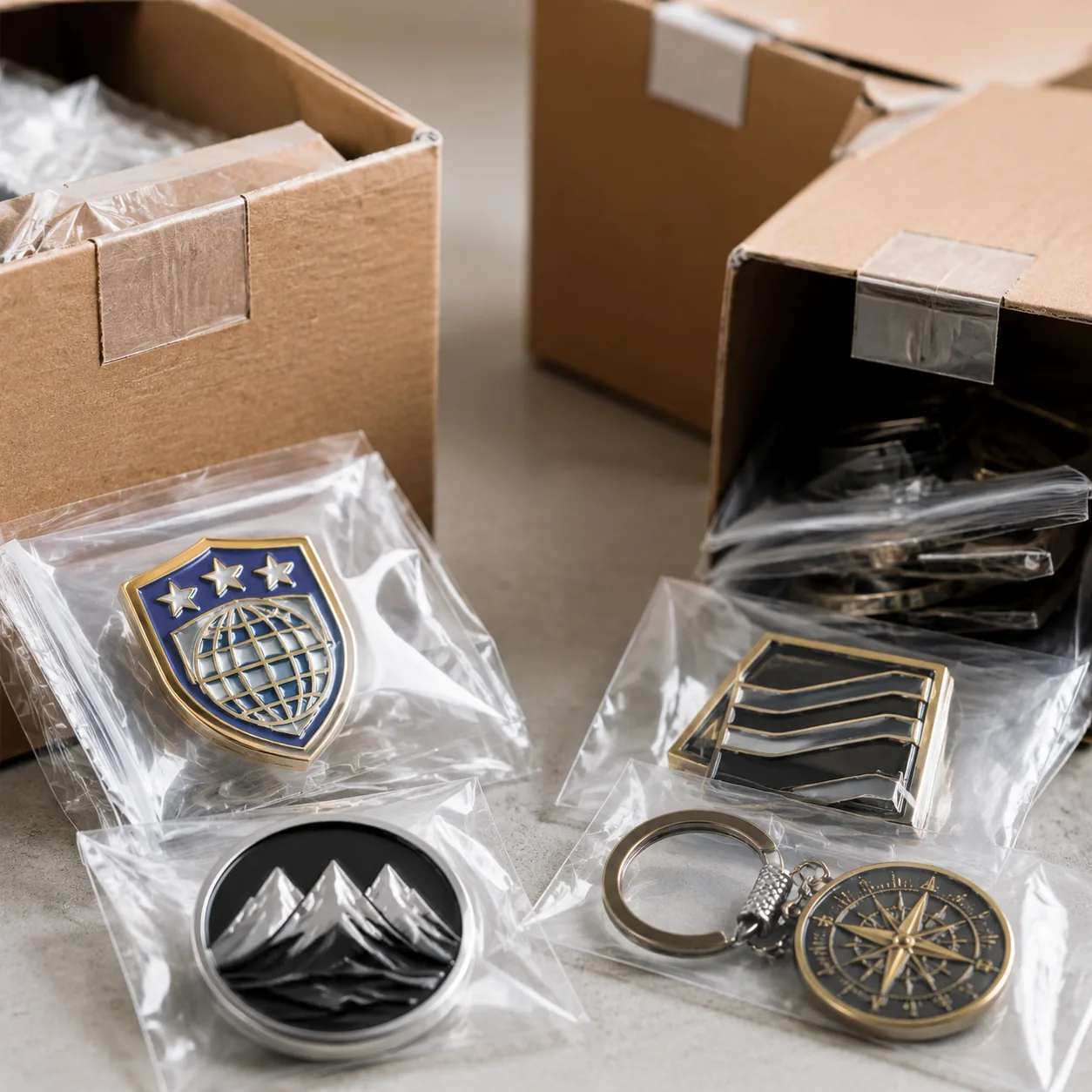
Q: When does a split shipment justify the extra work?
A split shipment is worth using when one purchase order has a genuine timing, destination or inventory-control conflict. For example, a buyer may need 2,000 printed lanyards delivered to a Las Vegas event in 18 days while 8,000 enamel pins can move by ocean freight to a New Jersey 3PL in 35 to 45 days. Another common case is one production run feeding multiple locations: 1,500 pcs to a US distributor, 1,000 pcs to an EU office and the remaining stock held at the China factory for a later replenishment call-off.
The split should remain one controlled production order. Plating color, enamel fill, patch thread shade, lanyard webbing width, backstamp position, retail card artwork and barcode placement should all reference the same approved artwork file, bill of materials and golden sample. If the factory treats each release as a separate job, lot-to-lot variation becomes more likely, especially with imitation gold plating, translucent enamel, woven patch detail, sublimated brand colors and antique coin finishes.
Do not split only to chase a small freight saving. Each release adds carton labeling, packing-list work, booking time, inspection scheduling and another opportunity for SKU, address or quantity errors. For orders below 500 pcs per SKU, or low-value items under about USD 0.60 FOB, one consolidated shipment is usually cleaner unless the deadline is contractual, event-driven or tied to a retail launch.
Q: What split quantities are practical by product type?
The smallest workable release depends on tooling status, SKU count, cartonization and inspection practicality. A 500 pc early release from a 5,000 pc pin order can be reasonable after mold approval. A 300 pc split from a 300 pc order usually creates handling cost without improving control. For patches and lanyards, splitting below one full master carton per SKU and destination often increases repacking and counting risk more than it improves timing.
As a working MOQ tier, plan at least 500 pcs per release for enamel pins, metal badges and keychains; 300 to 500 pcs for heavy challenge coins; and 1,000 pcs for patches, PVC items and printed lanyards. Production MOQs may be lower, but inspection, inner packing and freight efficiency improve once each release contains enough pieces to inspect and carton consistently.
| Product | Practical release quantity | Typical master carton load | Risk if split too small |
|---|---|---|---|
| Soft or hard enamel pins | 500 to 1,000 pcs per release | 1,000 to 2,000 pcs depending on backing card | Mixed clutches, inconsistent plating shade, missing card inserts |
| Challenge coins | 300 to 500 pcs per release | 200 to 500 pcs due to weight | Cartons over 18 kg, edge dents, uneven antique finish |
| Metal keychains | 500 to 1,000 pcs per release | 500 to 1,500 pcs depending on hardware | Wrong ring size, mixed chain style, swivel substitution |
| Embroidered or woven patches | 1,000 pcs per release | 2,000 to 5,000 pcs flat packed | Thread lot difference, border tension variation, edge curl |
| Printed lanyards | 1,000 to 2,000 pcs per release | 500 to 1,000 pcs with hooks attached | Hook substitution, width drift, inner-bag count errors |
| PVC patches or magnets | 500 to 1,000 pcs per release | 500 to 2,000 pcs depending on size | Curing marks, magnet polarity mix, bent printed faces |
Q: How should the RFQ define releases?
Split terms belong in the RFQ, not in late-stage email instructions after production starts. The quote should show total order quantity, release quantity by SKU, destination, required ship date, freight method, carton-label format and whether each release needs its own inspection report. A vague note such as “ship some early” leaves too much room for unpriced handling, wrong carton marks and rework.
A clear RFQ line reads: 5,000 pcs soft enamel pins, 30 mm zinc alloy, black nickel plating at 3 to 5 microns, rubber clutch, individual polybag and printed backing card. Release 1: 1,000 pcs by express or air to Los Angeles, required delivery May 10. Release 2: 4,000 pcs by sea to New Jersey, required delivery June 5. Carton labels must show PO, SKU, release number, carton number, quantity, gross weight and carton dimensions. This gives the supplier enough information to price labor, labels, paperwork and booking effort.
Factory-side split handling is commonly USD 25 to 80 per added release for simple relabeling, packing lists and courier bookings. If each release needs retail barcodes, Amazon-style FNSKU labels, destination-specific inserts, separate commercial invoices or different export documents, expect USD 0.02 to 0.08 per unit plus one to two extra working days for packing setup.
- State total quantity and release quantity by SKU, not only aggregate pieces.
- Confirm whether release 1 can ship after its own finished-goods inspection or only after full production is complete.
- List consignee name, delivery address, tax ID or EORI/VAT number where required, and forwarder account details.
- Specify carton label fields, barcode type, carton number sequence and pallet rules.
- Ask whether the FOB unit price changes when the order is split into two or more releases.
- Lock the approved sample, artwork revision, Pantone list, material spec and hardware BOM for all releases.
Q: How does splitting affect lead time?
A split shipment does not shorten artwork approval, mold cutting, color matching or sampling. Metal molds for pins, badges, keychains and coins usually take 3 to 7 working days after vector artwork approval. Pre-production samples commonly need 7 to 12 days for enamel pins, 8 to 15 days for coins with enamel or dual plating, and 5 to 10 days for patches or lanyards, depending on yarn, webbing and hook availability.
The first release accelerates only if the process supports partial finishing. Soft enamel pins may be packed by tray lot once plating, enamel fill and epoxy are complete. Hard enamel pins are less flexible because baking and polishing are more efficient in larger batches. Coins with 3D relief, edge numbering, dual plating or antique finish are harder to split because each operation queues with the full batch.
A realistic first release from Yiwu, Dongguan or Zhongshan suppliers is usually 12 to 22 days after sample approval for standard pins, patches or lanyards. The balance often takes 20 to 35 days, or 30 to 45 days for complex coins and PVC items. Rush splits can work, but compressing enamel drying, PVC curing, polishing or final packing time raises defect risk.
| Scenario | First release after approval | Balance after approval | Technical note |
|---|---|---|---|
| Standard soft enamel pins, 2,000 plus 8,000 pcs | 12 to 18 days | 22 to 30 days | Best with common plating and fewer than 6 enamel colors |
| Hard enamel pins, 1,000 plus 4,000 pcs | 15 to 22 days | 25 to 35 days | Polishing batch size limits early release speed |
| Challenge coins, 500 plus 2,500 pcs | 18 to 28 days | 30 to 45 days | Dual plating, antique finish and edge text add queue time |
| Sublimated lanyards, 2,000 plus 8,000 pcs | 10 to 16 days | 18 to 28 days | Easier to split than woven jacquard lanyards |
| PVC patches or keychains, 1,000 plus 5,000 pcs | 14 to 22 days | 25 to 35 days | Molding, curing and trimming limit rush options |
Q: What QC plan prevents lot-to-lot variation?
Treat every release as shippable goods. If release 1 passes and the balance ships later with only factory photos, the buyer may still receive color drift, weak clutch fit, mixed attachments, carton-count errors or substituted hardware. The QC file should name one master production standard and then apply release-level inspection before each shipment leaves the factory.
For most promotional products, buyers use ANSI/ASQ Z1.4 single sampling, General Inspection Level II, with AQL 2.5 for major defects and AQL 4.0 for minor defects. Critical defects should be AQL 0, including sharp edges, broken pin posts, exposed wire, loose magnets, lead-risk paint, choking hazards in children’s items, missing warnings or wrong compliance markings. Retail programs and premium brand campaigns may tighten to AQL 1.5 major and 2.5 minor, but that can add sorting cost and one to three days.
Write dimensional and finish tolerances into the PO. For pins and badges, use plus or minus 0.2 mm on outer dimensions under 40 mm and plus or minus 0.3 mm above 40 mm. Lanyard webbing can usually hold plus or minus 1 mm on 15, 20 or 25 mm widths. Patch outer size is typically plus or minus 1 mm, with embroidered border width at plus or minus 0.5 mm. Decorative plating is commonly 3 to 5 microns; specify 5 to 8 microns for heavier handling, premium coins or outdoor exposure.
- Keep one signed golden sample or approved pre-production sample for all releases.
- Inspect each release against the same artwork revision, Pantone references, plating finish and hardware BOM.
- Record release number, production date, inspector name, inspected quantity and carton numbers in the report.
- Check sensitive colors under D65 daylight or a controlled light booth, not mixed warehouse lighting.
- Measure at least 10 pcs per SKU for size, thickness, hardware position and attachment strength.
- Retain one approved sample from each release for reorder comparison and claim investigation.
Q: What packing rules prevent warehouse errors?
Split shipments often fail at the label and carton level, not at the production line. Duplicate carton numbers, mixed SKUs without inner labels or missing release IDs can make a 3PL treat cartons as lost, duplicated or unreceivable. The packing plan should be as specific as the product specification.
A reliable carton mark includes PO number, SKU, product description, release number, carton number, quantity, net weight, gross weight and carton dimensions. Example: PO 45821, SKU PIN-BLUE-30, release 1 of 2, carton 003 of 012, 500 pcs, 42 x 28 x 24 cm, GW 11.5 kg. For coins and dense metal keychains, keep cartons under 15 to 18 kg to reduce crushing, courier surcharges and manual-handling complaints.
Define inner packs before mass packing starts. Pins on backing cards should have card-position tolerance of plus or minus 2 mm, with the post not piercing QR codes, barcodes or legal text. Lanyards should be bundled in 50 or 100 pcs per inner bag. Patches should be flat packed in stacks of 100 pcs to reduce edge curl and make partial picking easier.
| Packing item | Recommended spec | Why it matters |
|---|---|---|
| Carton sequence | Unique sequence per release and destination | Prevents duplicate carton IDs across shipments |
| Inner pack count | 50 or 100 pcs per inner bag | Speeds receiving and reduces miscounts |
| Carton weight | 15 to 18 kg max for dense metal goods | Reduces rupture and handling injury complaints |
| Master carton size | 42 x 28 x 24 cm or 45 x 35 x 30 cm where possible | Improves pallet planning and courier dimensional estimates |
| Label placement | Two adjacent carton sides, not only top face | Keeps labels visible on pallets and racks |
| Mixed SKU cartons | Avoid unless necessary; add inner SKU labels if used | Prevents sorting errors before events or retail launches |
Q: What does a split shipment really cost?
FOB unit price may stay unchanged, but landed cost almost always changes. The early release often moves by express or air, while the balance moves by sea, rail or consolidated air. The buyer should compare the business cost of missing the event against extra freight, inspection, packing and document fees.
Indicative FOB ranges for standard custom items vary by size, finish and quantity. A 30 mm soft enamel pin may be USD 0.45 to 0.95 at 1,000 pcs and USD 0.28 to 0.55 at 10,000 pcs. A 45 mm metal keychain is often USD 0.80 to 1.80 at 1,000 pcs. A 50 mm challenge coin can run USD 1.80 to 4.50 depending on 3D relief, thickness, plating and enamel. Polyester lanyards are commonly USD 0.28 to 0.75 at 5,000 pcs depending on width, hook and print method.
Freight behavior differs by product. Lanyards and boxed pins may bill by dimensional weight, especially by courier. Coins bill by actual weight and need stronger cartons, so reducing carton weight can increase carton count. Third-party inspection typically costs USD 120 to 300 per visit in major China production areas; a two-release order may double inspection visits unless both releases are inspected on the same day.
| Cost item | Typical range | When it applies |
|---|---|---|
| Extra factory handling | USD 25 to 80 per added release | Separate packing list, label set, booking or warehouse move |
| Retail or destination labeling | USD 0.02 to 0.08 per unit | Barcode, FNSKU, store label or release-specific insert |
| Third-party inspection | USD 120 to 300 per visit | Independent QC required before each shipment |
| Courier early release freight | USD 5 to 12 per kg | Urgent event quantity or small release |
| Air freight bulk release | USD 3 to 8 per kg | Urgent shipment too large for courier economy |
| Sea freight consolidation | Usually lowest per kg; 25 to 45 days port-to-door by lane | Balance shipment with flexible deadline |
Q: What must be locked before PO approval?
Before approving the PO, confirm that the split protects a defined business goal. If release 1 supports a trade show, product launch or retail go-live date, write the destination and latest delivery date into the PO. If the split exists because internal teams have not finalized SKU counts or addresses, it may be safer to hold production until the allocation is stable.
The PO should include one release schedule, one packing plan and one QC standard. Ask the supplier to confirm that all releases use the same tooling, material batch where practical, plating process, approved artwork and hardware BOM. For programs combining pins, coins, patches and lanyards, one controlled project file reduces mismatched revisions and duplicate approvals.
Move split details out of email history and into purchase documents. Add a release table, carton-mark template and inspection attachment. That documentation is cheaper than re-sorting cartons in a warehouse three days before an event.
- Approve one golden sample or pre-production sample before any release ships.
- Freeze artwork revision, Pantone colors, plating finish, size, thickness and attachment hardware.
- Define release quantities by SKU and destination, including overrun or underrun allowance, commonly plus or minus 3 percent.
- Set inspection level, AQL, critical defect rules and measurement tolerances before packing begins.
- Require carton photos, packing list, carton list and tracking details for each release.
- Confirm who pays added handling, inspection, document and freight charges before the supplier books shipment.
Have a project? Send your artwork and target quantity and we’ll reply with a detailed quotation within 12 working hours.
Ready to get this made?
Send your sketch, target quantity and ship-date. Detailed quotation in 12 hours.



