Split Shipments for Custom Promo Orders: Buyer Q&A
Q: When does a split shipment actually reduce risk?
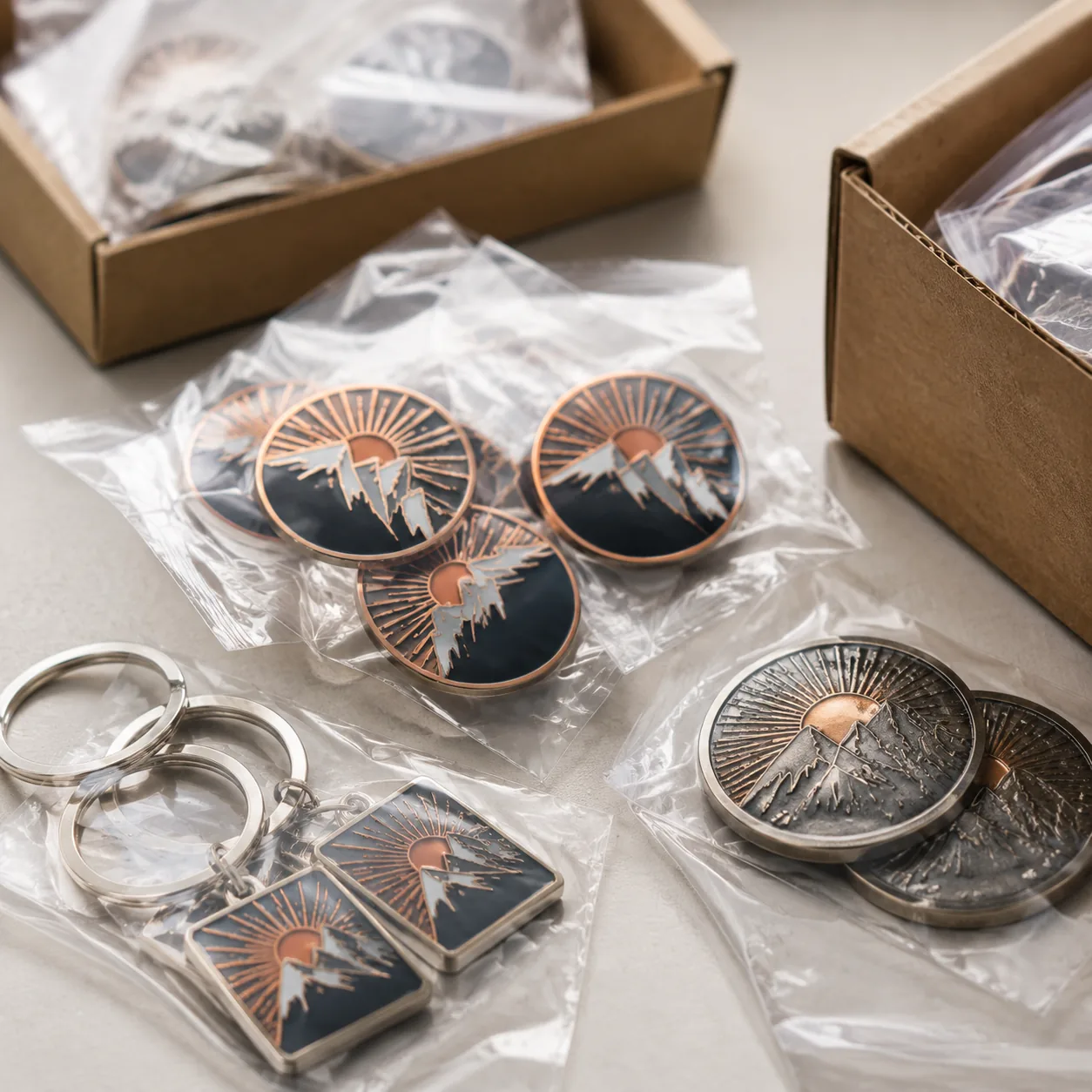
A split shipment helps when one delivery deadline is fixed but the full order does not need to arrive at the same time. Example: a buyer orders 5,000 soft enamel pins for a conference. The event team needs 1,200 pieces at a hotel dock five calendar days before registration opens, while the remaining 3,800 pieces can go to a distributor warehouse for later fulfillment. Sending all 5,000 pieces by courier may protect the event, but the express freight can exceed the FOB value of the pins. Splitting 1,200 pieces by express and 3,800 by deferred air or sea usually gives a better cost-risk balance.
For custom metal promotional goods, the critical path is not only shipping. It includes artwork approval, mold cutting, die striking or casting, polishing, plating, enamel filling, curing, inspection and packing. Once tooling and the approved sample are locked, ZheCraft can plan a controlled partial release. The split must be stated in the RFQ and PO, not added after cartons are sealed. Late splitting usually requires recounting, relabeling, carton rework and a second packing list, adding 1 to 3 working days and increasing the chance of SKU or destination errors.
Split shipment is most useful from about 1,000 pieces upward, or when the urgent lot is at least one complete inner-pack batch. For pins, that is commonly 100 to 500 pieces. For boxed coins, it is often 50 to 200 pieces because cartons become heavy quickly. For lanyards, a practical lot is usually 250 to 500 pieces, depending on bundle size and hook type. For very small orders under 300 to 500 pieces, freight minimums and extra documents often make one shipment cleaner.
Q: What must be fixed before quoting?
The quote should identify each shipment lot, destination, packing method and incoterm. A 2,000-piece challenge coin order may split into 300 coins in velvet boxes by courier for an awards dinner and 1,700 coins in OPP bags by sea for inventory. That is not just a freight split. It changes the bill of materials, carton count, gross weight, packing labor, invoice wording and inspection checklist.
The urgent lot should normally use the same approved product specification as the balance. If it needs a different backstamp, barcode, insert card, plating finish, clutch, split ring, safety breakaway, retail label or polybag warning, treat it as a separate PO sub-line. Use SKU suffixes such as PIN-2026-AIR and PIN-2026-SEA so production, inspection and warehouse teams can sort without interpretation.
- Confirm ship-to address, contact name, phone, postal code, receiving hours and dock restrictions for each lot
- Define quantity per lot and allowed variance; metal goods are commonly 0 to +2% unless exact count is required
- Assign separate SKU, carton mark, packing method, packing list and invoice line to each shipment
- State whether Lot 1 may ship before Lot 2 has passed final inspection
- Confirm incoterm by lot, such as EXW, FOB Ningbo, FOB Shanghai, CIF, DDP or courier door-to-door
- Define freight basis: actual weight, volumetric weight, chargeable weight or named forwarder quotation
Q: What MOQ tiers, FOB prices and lead times are realistic?
Unit pricing usually follows the total order quantity if the design, tooling, base material and finish are unchanged. The split adds handling cost, not a new product MOQ. Factories still prefer each release to be large enough to pack and inspect efficiently. A shipment smaller than one finished carton group may cost more to stage than it saves in freight.
Indicative FOB China pricing varies by size, metal, finish, color count, attachment and retail packing. A 30 mm iron soft enamel pin with rubber clutch is often USD 0.45 to 0.95 per piece at 1,000 pieces and USD 0.32 to 0.70 at 5,000 pieces. A 40 to 50 mm zinc alloy keychain usually falls between USD 0.80 and 2.20 at 1,000 pieces. A 45 mm iron or zinc alloy challenge coin is commonly USD 1.80 to 4.80, with 3D relief, antique plating, sequential numbering, edge text or epoxy raising the price. A 20 mm polyester sublimation lanyard with metal hook is often USD 0.35 to 0.85 at 1,000 pieces before upgraded clips, safety breaks, card holders or individual bags.
| Item type | Practical split MOQ | Production after approval | Indicative FOB China range |
|---|---|---|---|
| Soft enamel pins, 25-35 mm | 1,000 total; 100-500 per lot | 12-18 working days after artwork and mold approval | USD 0.32-1.20/pc depending on size, plating and carding |
| Imitation hard enamel pins | 1,000 total; 100-500 per lot | 15-22 working days after sample approval | USD 0.55-1.60/pc depending on polishing and color count |
| Challenge coins, 40-50 mm | 500 total; 50-200 per lot | 18-28 working days after sample approval | USD 1.80-4.80/pc for common 2D/3D designs |
| Zinc alloy keychains | 1,000 total; 200-500 per lot | 15-25 working days after sample approval | USD 0.80-2.20/pc depending on mold and attachment |
| Sublimated lanyards, 15-25 mm | 1,000 total; 250-500 per lot | 10-16 working days after proof approval | USD 0.35-0.85/pc before accessories |
| PVC patches or magnets | 1,000 total; 250-500 per lot | 12-22 working days after sample approval | USD 0.45-1.80/pc depending on thickness and colors |
Q: Which specifications need tighter lot control?
The drawing should not change between lots, but the control points must be written into the PO. For enamel pins and badges, common base thickness is 1.2 to 1.5 mm with ±0.10 mm tolerance. Diameter or longest-side tolerance is usually ±0.20 mm after polishing. Flash plating is commonly 0.03 to 0.08 microns; heavier plating for corrosion resistance should be quoted separately with a target thickness and test method. Soft enamel should sit slightly below the metal line, while imitation hard enamel should be polished flush, with no exposed base metal in visible color areas.
Challenge coins usually run 3.0 to 4.0 mm thick with ±0.15 mm tolerance, and diameter tolerance is typically ±0.20 mm. Edge text, sequential numbering, antique finish, epoxy coating and custom cutouts should be separate inspection points because they often cause rework. For keychains, specify ring diameter, chain length, ring wire thickness, attachment position and pull-strength requirement, not only logo size.
For lanyards, PVC goods, woven patches and magnets, color consistency is often the main split-shipment risk. Sublimated lanyards can shift if printed on a second fabric roll days later. Woven patches can vary when thread lots change. Soft PVC can drift when pigment is remixed. If two waves will ship, ask the supplier to reserve fabric, thread, PVC compound, magnet sheet or enamel pigments for the full PO before releasing Lot 1 where practical.
Q: What inspection plan prevents the urgent lot becoming the weak lot?
A split shipment should not mean a split quality standard. Use the same approved sample, defect list and AQL plan for every lot. For most custom promotional metal items, ANSI/ASQ Z1.4 general inspection level II with AQL 2.5 for major defects and AQL 4.0 for minor defects is practical. For licensed merchandise, retail programs or safety-sensitive accessories, buyers may tighten major defects to AQL 1.5 or require 100% screening for defined issues such as loose pin posts, wrong barcode, sharp burrs or missing warning labels.
The urgent lot needs its own inspection report because it has its own delivery risk. Check plating scratches, enamel underfill or overflow, pitting, color match, attachment strength, barcode accuracy, carton count and packing method. For pin posts or brooch bars, use a sample pull test of 3 to 5 kgf depending on construction. For keychains and split rings, 5 to 8 kgf is a more meaningful sample test than visual inspection alone. For magnets, confirm polarity, adhesive bond and usable holding force if the product will be used on refrigerators, lockers or retail displays.
| Control point | Urgent lot requirement | Balance lot requirement |
|---|---|---|
| Approved standard | Same golden sample or signed deviation sheet | Same golden sample; no silent material change |
| AQL plan | Level II, AQL 2.5 major and 4.0 minor unless tightened | Same plan or tighter if retail buyer requires it |
| Dimensional check | Measure logo size, thickness and attachment position | Repeat by batch if molds or fixtures change |
| Attachment test | Sample pull test from each production batch | Repeat if hardware supplier changes |
| Color and finish | Compare with Pantone or physical sample under D65/daylight | Repeat if produced or packed later |
| Carton count | 100% count per carton before sealing | 100% count per carton before sealing |
| Label verification | Separate SKU, lot number and destination label | Separate SKU, lot number and destination label |
Q: How should cartons and inner packs be specified?
Carton marking is where many split shipments fail. A carton marked only with the master PO number is not enough if one forwarder collects air cargo and another collects sea cargo. Each carton should show PO number, SKU, item description, shipment lot, carton number, gross weight, net weight, dimensions, destination code and country of origin where required.
For pins and small keychains, typical inner packing is 50 or 100 pieces per polybag, tray or inner box, then 500 to 1,000 pieces per export carton depending on weight and retail packaging. Keep pin cartons below 15 kg gross weight and coin cartons below 18 kg where practical. Heavy cartons split, crush gift boxes and trigger warehouse handling complaints. Common carton sizes are about 35 x 25 x 25 cm for bulk pins and 40 x 30 x 25 cm for boxed coins, but backing cards, foam inserts, velvet boxes and retail hang cards can increase cube quickly.
Do not mix urgent and balance stock in the same carton, even when the product is visually identical. Do not mix retail-packed and bulk-packed units in the same master carton unless the label states the exact inner-pack breakdown. If the buyer needs Amazon FNSKU labels, GS1 barcodes, retail compliance labels, suffocation warnings or ASN carton labels, provide final templates before mass packing. Relabeling after sealing commonly adds USD 0.03 to 0.12 per piece plus 1 to 2 working days.
- Use carton marks such as Lot 1 of 2 Air and Lot 2 of 2 Sea
- Number cartons separately for each shipment, such as Air 1-6 and Sea 1-28
- State inner quantity per bag, tray, box, backing-card bundle or retail carton
- Set maximum gross weight, usually 15 kg for pins and 18 kg for coins
- Require photos of open carton, sealed carton and shipping mark before dispatch
- Keep one retained sample from each shipment lot for dispute comparison
Q: What freight, documents and cost adders should be calculated?
Split shipments reduce deadline risk but add coordination cost. Factory-side split handling for small promotional goods is often USD 20 to 80 per extra shipment lot for staging, separate packing lists, extra carton labels and warehouse handling. If the lots need different invoices, certificates of origin, forwarder releases or retail labels, cost and lead time increase. Rebagging, barcode application or retail carton relabeling can add USD 0.03 to 0.15 per piece depending on labor and materials.
Transit time varies more than production time. Courier express to the United States or Western Europe is commonly 3 to 7 days after pickup, but remote delivery, customs inspection or regulated accessories can extend it. Standard air freight is often 7 to 12 days airport-to-airport or 10 to 18 days door-to-door. Sea freight is route-dependent: China to the US West Coast may be 18 to 30 days port-to-port, the US East Coast 30 to 45 days and Europe 30 to 45 days, before clearance, port congestion and final trucking.
| Shipment model | Best use case | Typical added time | Cost effect |
|---|---|---|---|
| One shipment by express | Small urgent order under 500 pieces | 3-7 transit days after pickup | Highest freight; lowest admin |
| Urgent express plus balance standard air | Event stock now, warehouse stock soon | 1-2 days for split packing and documents | Moderate freight and admin |
| Urgent express plus balance sea | Deadline quantity now, replenishment later | Sea leg often 18-45 days by route | Lowest balance freight; highest planning need |
| Two releases to one China forwarder | Distributor consolidates multiple suppliers | 1-3 days warehouse coordination | Efficient if forwarder controls labels and ASN |
| Separate production batches | Different market labels, finishes or packaging | 5-15 extra days if materials restart | Higher color, finish and consistency risk |
Q: When should buyers avoid split shipment?
Avoid split shipment when visible lot variation would damage brand presentation. Transparent enamel, glitter enamel, anodized aluminum, dyed fabric, soft PVC colors, printed gradients and metallic foil effects are more sensitive than standard gold, nickel, black nickel or antique plating. If all units will be displayed together at one event or sold as one retail batch, one completed, sorted and packed production lot is safer.
Also avoid splitting when customs, finance or receiving systems require one strict import entry. Some corporate buyers need one invoice, one packing list, one goods receipt and one ERP closeout. If the warehouse cannot receive partial quantities, the supplier may execute correctly and the buyer may still fail internally. Confirm receiving rules before approving partial release.
Do not use split shipment to compensate for an unrealistic approval schedule. If artwork approval takes 8 days, sample approval takes 5 days and the event is 18 days away, splitting may not rescue the order. A safer planning window for custom metal goods is 20 to 35 days after artwork approval plus transit. Complex 3D coins, moving parts, epoxy doming, numbered edges, custom gift boxes or retail compliance labels can push production to 30 to 45 days.
Q: What should the PO say before release?
The PO should read like an operating instruction, not only a price confirmation. Include a shipment table with lot number, SKU, quantity, packaging, incoterm, ship-to address, forwarder contact, required ship date and document requirement. If a lot has different retail labels, insert cards, barcode stickers or polybag warnings, attach final files with revision numbers and approval dates.
Keep acceptance criteria consistent across all lots unless there is a written deviation. A 30 mm soft enamel pin PO, for example, could specify: 1.5 mm iron base, ±0.10 mm thickness tolerance, ±0.20 mm size tolerance, gold flash plating 0.03 to 0.08 microns, rubber clutch, 55 x 85 mm backing card, one piece per OPP bag, 100 pieces per inner box and maximum carton gross weight of 15 kg. Add inspection level II, AQL 2.5 major and 4.0 minor, plus retained samples from each shipment lot.
- List each shipment lot as a separate PO line or sub-line with SKU suffixes
- Attach final product artwork, packing artwork and carton label artwork with revision dates
- State overrun or underrun rules for each lot, including whether exact count is mandatory
- Require pre-shipment photos, carton weights and dimensions before freight booking
- Define who pays split handling, courier freight, duties, taxes and destination charges
- File the approved sample, inspection report, packing list and shipment photos for reorder control
Before mass packing starts, approve one carton label and one inner-pack photo for every shipment lot. Before dispatch, compare the final packing list against the PO line by line. The best split shipments are operationally boring: cartons are clearly marked, documents match the PO, the urgent lot passes the same standard and no one has to guess which boxes go where.
Have a project? Send your artwork and target quantity and we’ll reply with a detailed quotation within 12 working hours.
Ready to get this made?
Send your sketch, target quantity and ship-date. Detailed quotation in 12 hours.



