Split Shipments for Custom Promo Orders: A Practical Buyer Scenario
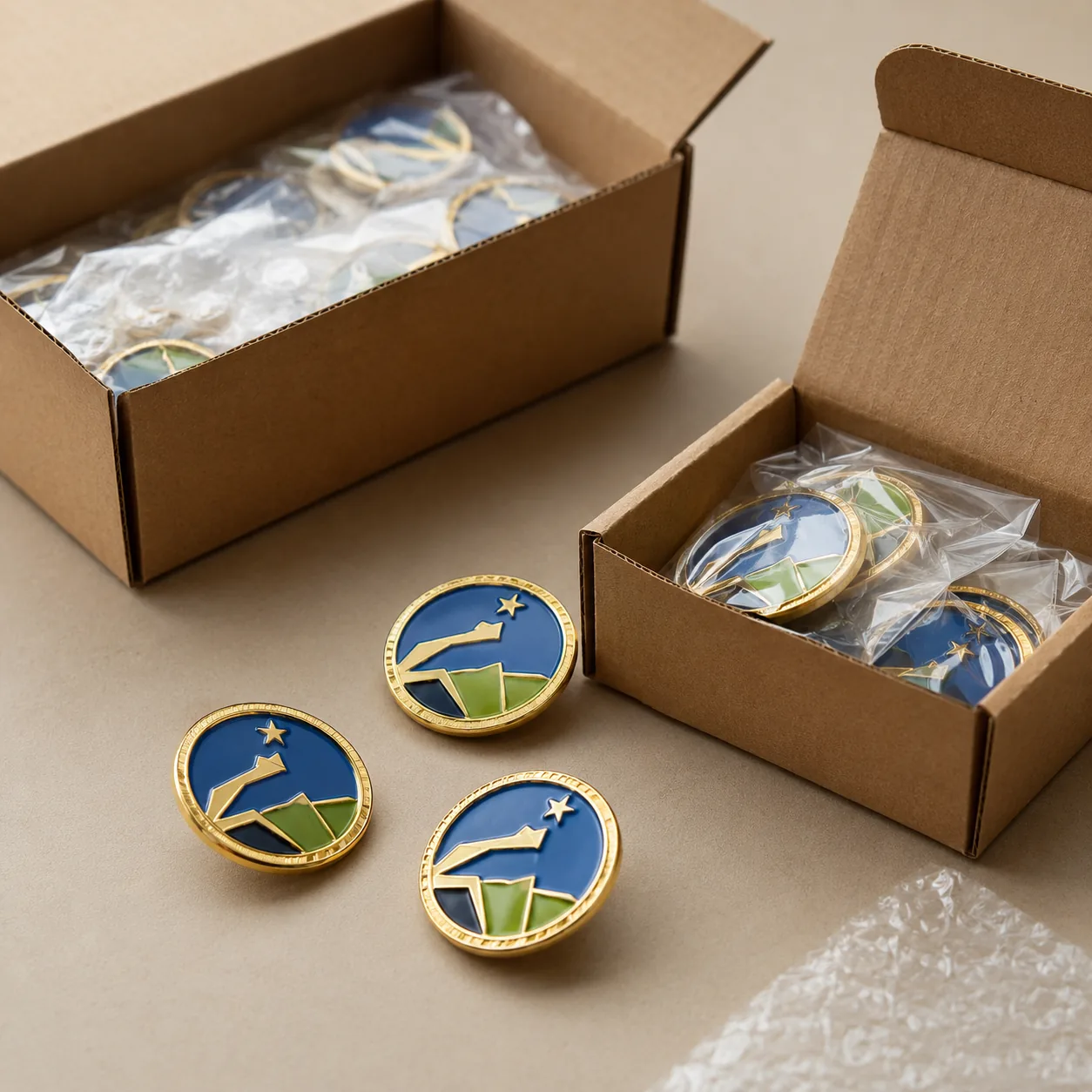
Scenario: 5,000 Launch Kits, One Hard Event Date
A distributor conference in Chicago needs branded launch kits at the booth in 18 calendar days. The purchase order is for 5,000 finished sets. Each set includes a 35 mm soft enamel pin, a 50 mm zinc alloy keychain, a 45 mm fridge magnet, a 20 mm printed polyester lanyard, a 300 gsm backing card, and an individual OPP bag. The event team needs 800 usable kits on site; the remaining 4,200 sets are for follow-up sales visits and can arrive 45 to 55 days after PO approval.
The common cost mistake is to air freight all 5,000 sets because the first deadline is urgent. For mixed metal and textile promotional goods, the FOB product value may be manageable, but courier freight can dominate landed cost. A split shipment protects the show date while keeping most cartons on a slower and cheaper route.
A split must be engineered before production starts. The PO should define Lot A and Lot B as separate logistics lots, not as an informal promise to ship partials. A practical plan is Lot A: 1,000 complete kits by express air; Lot B: 4,000 complete kits by ocean LCL or deferred air economy. Each lot needs its own carton range, packing list, inspection release, gross weight, carton dimensions, label photos, and commercial invoice line. If the factory has to reopen sealed cartons to separate lots, one to three days can be lost and the risk of short-count cartons increases.
Set the Urgent Lot by Use, Not Order Size
Start with the first-use requirement. The booth needs 800 sets, but the urgent shipment should not be exactly 800. A 10 to 25 percent buffer is normal for event stock because courier delays, customs questions, internal receiving time, booth sample use, and minor QC rejects all consume inventory. In this case, Lot A should be 900 to 1,000 complete kits.
Small custom goods also have normal production variance. For metal pins, zinc alloy keychains, magnets, and lanyards, a finished-count tolerance of plus or minus 2 percent is common unless the PO requires exact quantity after QC sorting. If 14 pins are rejected for plating dust, 8 keychains fail split-ring closure, and one inner bag is short by 20 pieces, an 800-set urgent lot has no recovery margin. A 1,000-set Lot A gives the event team protection without putting premium freight on the full order.
Confirm whether the booth truly needs full kits. A 35 mm iron soft enamel pin at 1.8 mm thickness typically weighs 6 to 9 g before carding; 1,000 packed pins may weigh only 8 to 12 kg. A complete kit with keychain, magnet, lanyard, card, OPP bag, inner packs, and master cartons can reach 70 to 100 kg per 1,000 sets. If staff can hand out pins at the booth and mail full kits later, shipping only pins by air can cut urgent chargeable weight by 70 percent or more.
Plan Around the Slowest Component
Freight cannot repair an unrealistic production sequence. The pin and keychain require mold or die preparation, stamping or die casting, polishing, plating, enamel filling, baking, and hardware assembly. The magnet may require offset printing plus epoxy doming or soft PVC molding. The lanyard requires webbing, printing or dye sublimation, heat cutting, sewing, and hook assembly. If Lot A is a complete kit, the slowest approved component controls the dispatch date.
For standard artwork after digital proof and sample approval, realistic mass-production timing is 12 to 18 days for soft enamel pins, 15 to 22 days for zinc alloy keychains with enamel or epoxy, 10 to 16 days for printed epoxy magnets, and 8 to 14 days for printed polyester lanyards. Rush production may remove two or three days when raw material, plating line, and sewing capacity are open, but it cannot remove enamel baking, epoxy curing, final inspection, or export packing.
The clean production instruction is: make and pack Lot A first as 1,000 complete kits; inspect and release Lot A; then finish packing Lot B as 4,000 complete kits. Avoid vague language such as “ship whatever is ready.” That creates mixed cartons, duplicate packing lists, and warehouse receiving disputes. Lot-based planning gives the factory a clear sorting rule and gives the buyer a clean QC record for event stock.
| Component | Scenario specification | MOQ and efficient tiers | FOB unit range at 5,000 pcs | Mass production after approval |
|---|---|---|---|---|
| Soft enamel pin | 35 mm iron, 1.8 mm thick, nickel/gold plating, butterfly clutch | MOQ 100-300; stronger pricing at 500, 1,000, 3,000 | 0.38-0.85 USD | 12-18 days |
| Zinc alloy keychain | 50 mm, 2.5-3.0 mm thick, 25-30 mm split ring, epoxy optional | MOQ 300-500; stronger pricing at 1,000 and 5,000 | 0.75-1.60 USD | 15-22 days |
| Fridge magnet | 45 mm printed epoxy or soft PVC, 0.6-1.0 mm magnet sheet | MOQ 300-500; stronger pricing at 1,000 and 3,000 | 0.35-0.95 USD | 10-16 days |
| Printed lanyard | 20 mm polyester, screen print or sublimation, metal hook, breakaway optional | MOQ 300-500; efficient tiers at 1,000 and 5,000 | 0.42-0.95 USD | 8-14 days |
| Card and bag | 300-350 gsm card, 40-60 micron OPP bag, barcode optional | MOQ usually follows main order; print minimum may apply | 0.08-0.22 USD | 3-7 days after artwork |
Compare Air, Ocean, and Hybrid Cost
Calculate freight on chargeable weight, not piece count. Express couriers bill by actual weight or volumetric weight, whichever is higher. Dense metal items are usually actual-weight shipments. Bulky retail cartons, lanyards, and display packaging may be billed by dimensional weight. A common courier formula is length x width x height in centimeters divided by 5,000 or 6,000, depending on service and lane.
Assume 5,000 complete kits pack into 120 master cartons measuring 38 x 28 x 24 cm, with total actual weight of about 420 kg. Express air from Zhejiang or Guangdong to a US warehouse may quote roughly 5.50 to 8.50 USD/kg in normal season and 8.00 to 12.00 USD/kg near peak periods, fuel surcharges, or remote-area delivery. Ocean LCL is lower per kg, but it includes origin handling, CFS fees, destination charges, customs brokerage, duties, and inland trucking. Door delivery to an inland US address commonly takes 28 to 40 days after vessel departure, and 35 to 50 days during congestion.
A split is strongest when the urgent lot is 10 to 25 percent of the order. Airing 1,000 kits at about 85 kg while sending 4,000 kits at about 335 kg by sea protects the conference without paying premium freight on stock that is not needed for another month. If the urgent need rises above 50 percent, compare full air shipment against reducing the giveaway mix, sending only a hero item, or approving a lighter urgent version.
| Shipment plan | Estimated transit after dispatch | Cost behavior | Best use case |
|---|---|---|---|
| 100% express air | 3-7 days door to door | Highest freight, simplest receiving, lowest event risk | Most goods are needed immediately |
| 20% air, 80% ocean LCL | Air 3-7 days; ocean 28-40 days to many US inland points | Balanced cost, two packing lists, two receiving events | Event needs a limited launch quantity |
| 100% ocean LCL | 28-45 days depending on port, rail, and final delivery | Lowest freight per unit, highest deadline exposure | Order is approved early with no fixed event date |
| Pins only by air, kits by sea | Pins 3-7 days; kits 28-40 days | Lowest urgent weight, incomplete booth kit | Booth can use a teaser item and fulfill kits later |
Specify Packing for Split Receiving
Once a shipment is split, packing is part of the manufacturing specification. Lot A cartons must not contain Lot B goods. Each lot needs its own carton sequence, such as A001-A025 for air and B001-B095 for sea. If one carton mixes both lots, the factory must reopen, count, relabel, and reseal it. That is how small split plans lose critical days.
For metal-heavy kits, specify double-wall K=A or K=K corrugated master cartons and keep gross weight near 12 to 15 kg where possible. A longest carton side under 45 cm is easier for courier handling and reduces crushing risk for backing cards. Fixed-count inner packs of 50 or 100 pieces simplify receiving and recounting. Every master carton should show PO number, SKU or kit code, lot, quantity, gross weight, net weight, carton dimensions, destination mark, and carton number.
Choose kit packing according to the receiving operation. One finished set per OPP bag or paper envelope is slower and slightly more expensive at the factory, but it prevents event staff from assembling kits under time pressure. Bulk packing is cheaper if a warehouse will kit locally, but it is risky when the booth team receives goods directly. For OPP bags, 40 to 60 microns is adequate for dust protection; 70 to 90 microns is safer for sharp metal edges or heavier keychains.
- Mark urgent cartons as Lot A Air Shipment and number them separately from Lot B sea cartons.
- Use fixed-count inner bags or bundles of 50 or 100 pieces for each SKU or finished kit.
- Keep metal-heavy cartons near 12-15 kg gross weight and use double-wall corrugated board.
- Apply barcode, SKU, and destination labels before export if the warehouse charges relabeling fees.
- Confirm whether kits are factory-assembled or bulk-packed for local assembly before production starts.
- Request drop-test review for retail boxes, acrylic items, epoxy magnets, or sharp metal hardware.
Inspect Lot A as Its Own Batch
For a split shipment, the urgent lot needs its own inspection result. If QC checks the full 5,000 sets as one batch and the first 1,000 leave without a lot-level record, the buyer has no clean evidence that event stock matches the approved sample. Lot A should be inspected, sealed, photographed, and documented before pickup.
A practical inspection plan is ANSI/ASQ Z1.4, general inspection level II, with AQL 2.5 for major defects and 4.0 for minor defects. Critical defects should have zero acceptance. Sharp burrs, detached pin posts, loose clutches, weak magnets, open split rings, unsafe hooks, wrong breakaways, or incorrect warnings can create customer complaints or safety issues. For complete kits, QC must inspect both the individual components and the assembled set count.
Dimensional tolerances should be measurable. For a 35 mm pin, specify outer size tolerance of plus or minus 0.5 mm and thickness tolerance of plus or minus 0.15 to 0.20 mm unless tooling requires another range. For lanyards, width tolerance of plus or minus 1 mm and finished length tolerance of plus or minus 20 mm are normally workable. Decorative flash plating may be only 0.05 to 0.10 microns; if improved wear resistance is required, specify the higher plating thickness and pay for it rather than assuming it is included.
| QC checkpoint | Lot A urgent requirement | Lot B bulk requirement |
|---|---|---|
| Artwork and color | Match approved sample; Pantone checked under consistent light | Same standard checked against golden sample |
| Quantity | 100% carton count plus random inner-pack count | Carton count plus AQL sampling |
| Hardware function | Pin post pull check, clutch fit, split-ring closure, hook operation | Same functional checks by sampling plan |
| Surface condition | No sharp burrs, plating peel, major scratches, or enamel overflow on logo areas | Same defect definitions with minor limits |
| Packaging | Correct Lot A labels, carton sequence, SKU labels, dimensions, gross weight | Correct Lot B labels and sea-shipment marks |
Write the Split Into the PO
The PO should show two delivery lines, not one broad delivery date. Each line should state quantity, lot name, packing method, inspection requirement, freight term, latest handover date, and required documents. If the order is FOB Ningbo, FOB Shanghai, or FOB Shenzhen, the supplier is usually responsible through export handover at the named port. If the order is courier door-to-door, DAP, or DDP, clarify who books freight, pays duties, answers customs questions, and absorbs storage fees if the consignee is unavailable.
Tooling and setup charges should be separate from unit price. A soft enamel pin mold is commonly 45 to 120 USD depending on size and detail. A zinc alloy keychain mold may be 80 to 250 USD. Special backing-card dielines, barcode setup, retail packaging samples, or a dedicated pre-production sample may add charges. Confirm that the unit price is based on the full 5,000-piece production batch even though dispatch is split into 1,000 and 4,000 sets.
MOQ affects quote structure. Many efficient price tiers start at 300, 500, 1,000, 3,000, and 5,000 pieces depending on product and finish. Splitting shipment should not split production into two small purchase orders unless the buyer accepts higher setup allocation and weaker unit pricing. The lowest practical cost usually comes from producing the full batch together, then sorting, inspecting, and dispatching it in two logistics lots.
- State Lot A quantity, dispatch method, carton labels, latest pickup date, and delivery address.
- State Lot B quantity, dispatch method, carton labels, and expected handover window.
- Confirm whether pricing is EXW, FOB, CIF, DAP, DDP, or courier door-to-door.
- List mold charges, sample charges, packaging setup, and tooling retention terms.
- Require Lot A QC photos, packing list, carton dimensions, gross weight, and invoice before pickup.
- Assign responsibility for extra cost caused by late artwork approval, late payment, or wrong consignee details.
Close the Risks Before Approval
The largest risk is sample approval delay. If the buyer takes four days to approve a pre-production sample, those days rarely disappear later. Plating queues, enamel baking, epoxy drying, lanyard sewing, and final packing are physical constraints. A rush request helps only when the factory has confirmed raw materials and open capacity.
The second risk is document mismatch. Air couriers, brokers, and warehouses need consistent product descriptions, HS codes, declared values, carton counts, weights, and consignee details. A shipment described as “metal gifts” on one document and “enamel pins, zinc alloy keychains, fridge magnets, and polyester lanyards” on another may still clear, but it increases the chance of questions. For US imports, confirm whether magnets, textile lanyards, and metal accessories require separate classification lines.
The third risk is visual variation between lots. If visible components are finished weeks apart, plating shade, enamel color, lanyard ink, and magnet laminate can shift. Reduce this by producing key visible components in one continuous batch where possible, retaining a golden sample at the factory, and using the same Pantone, plating, epoxy, magnet sheet, card stock, and packaging specifications for both lots.
Before approving the 5,000-set order, request two landed-cost options: 1,000 complete kits by air plus 4,000 kits by sea; and 1,000 pins by air plus 5,000 complete kits by standard freight. Compare product cost, courier chargeable weight, ocean charges, brokerage, duties, warehouse receiving, relabeling, and repacking labor. The best split shipment is not the fastest plan on paper. It is the plan that protects the first use date without converting the whole order into an emergency.
Have a project? Send your artwork and target quantity and we’ll reply with a detailed quotation within 12 working hours.
Ready to get this made?
Send your sketch, target quantity and ship-date. Detailed quotation in 12 hours.



