Split Shipments for Custom Giveaways: A Buyer Scenario
Scenario: 25,000 Sets, 18 Cities, One Launch Date
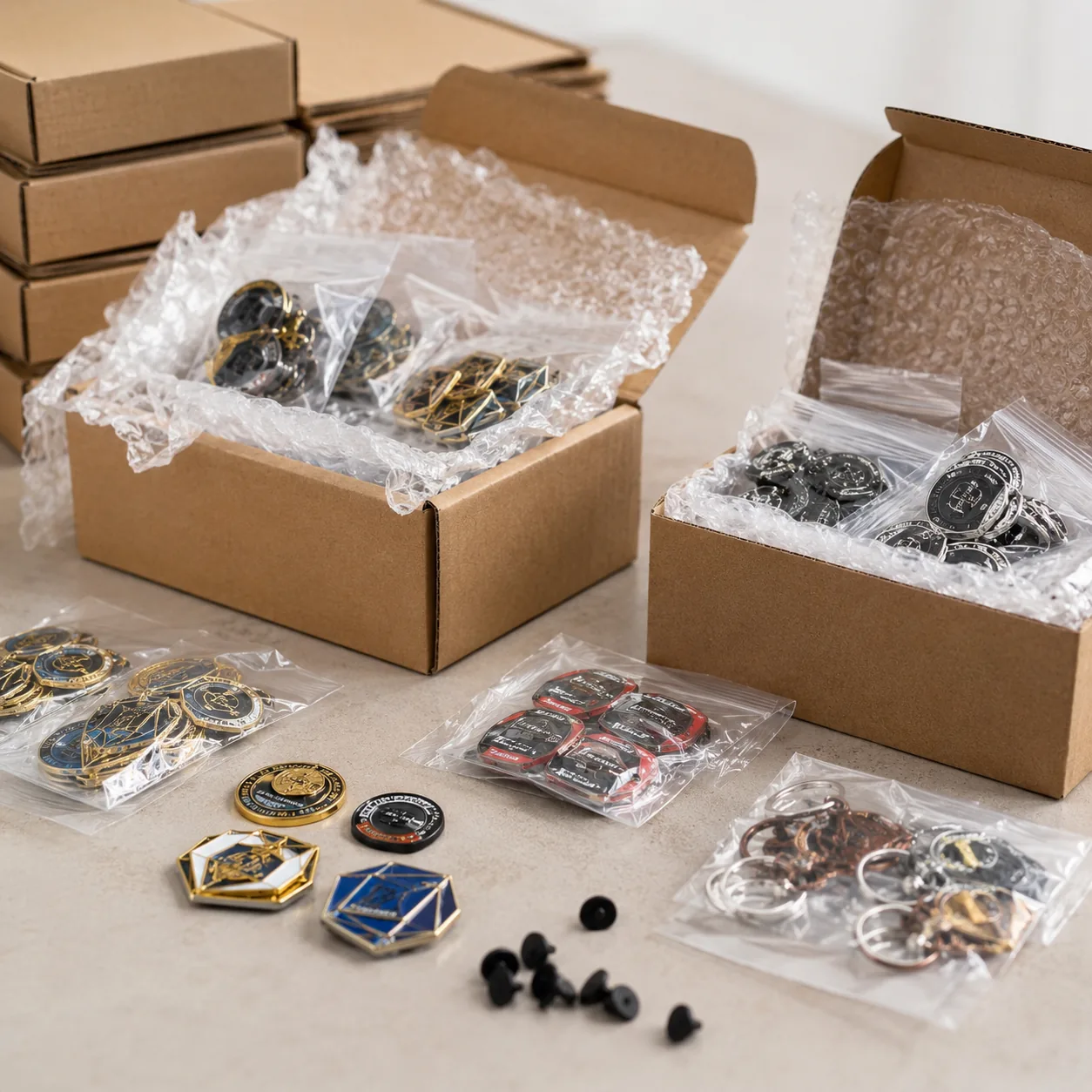
A regional marketing team orders 25,000 giveaway sets for an 18-city launch: 30 mm iron soft enamel pins, 20 mm polyester lanyards, and printed backing cards. The pin specification is straightforward: stamped iron, 1.2 mm nominal thickness, nickel plating, four enamel colors, butterfly clutch, and no epoxy. The lanyard is 20 mm flat polyester with one-color screen print, metal J-hook, and safety breakaway. The card is 300 gsm C1S coated paper, 80 x 100 mm, full-color front print, packed with the pin in an OPP bag.
The manufacturing risk is moderate; the allocation risk is high. If Chicago receives 1,800 pins and 1,200 lanyards, Miami receives unmarked mixed cartons, or two venues discover shortages after the shipment has left China, the campaign fails even if the products meet visual standards. The order must be managed as a light kitting and split-shipment project, not as three bulk promotional items.
The buyer thinks in event quantities. The factory thinks in mold cavities, print runs, inner packs, carton counts, labor stations, and sealing sequence. The forwarder thinks in carton dimensions, gross weight, consignee data, customs documents, and last-mile delivery constraints. If the RFQ only says “ship to multiple locations,” the supplier cannot price the handling correctly or control packing accuracy.
For this type of order, ZheCraft freezes the shipment matrix before mass packing starts. Reopening sealed cartons to change destination quantities usually adds 2 to 4 working days, USD 0.02 to 0.06 per piece in rework labor, and a measurable increase in count errors because the original line-counting sequence has been broken.
Freeze the Allocation Sheet Before Packing
For a single-destination order, the buyer can approve artwork first and confirm packing later. For an 18-city shipment, that sequence creates avoidable risk. The factory should receive a controlled allocation sheet before production is completed, ideally 5 to 7 working days before packing. The sheet should show a version number, issue date, file owner, and written cutoff time. Do not manage city quantities through email comments; packing supervisors work from printed or ERP-uploaded instructions, and small message-thread changes are easily missed.
A usable allocation sheet includes destination code, consignee name, full street address, receiving department, local contact, phone number, delivery deadline, item quantity, buffer quantity, shipping method, carton mark, and venue notes. For hotels, convention centers, pop-up shops, and stadiums, never list only the building name. Add event name, booth or room number, dock instructions, receiving window, and the mobile number of someone authorized to accept or trace cartons.
Use buffers at both the order level and destination level. For pins, woven patches, and lanyards, a practical production overage is 2% to 3%, with a minimum of 25 extra sets per city for small drops. For zinc alloy keychains, challenge coins, boxed medals, or serialized badges, 1% to 2% is usually enough unless the goods will be sold on-site. If the PO requires exact invoiced quantities with no overage, state it before production; otherwise, decide where surplus pieces go before cartons are sealed.
| Destination Type | Recommended Buffer | Typical Drop Size | Best Rule |
|---|---|---|---|
| Large trade show booth | 3% or 100 sets minimum | 1,000 to 5,000 sets | Pack city overage in a separate marked inner carton |
| Internal sales meeting | 2% or 25 sets minimum | 200 to 1,500 sets | Use attendee count plus staff reserve |
| Retail activation | 3% to 5% | 500 to 3,000 sets | Separate display samples from giveaway stock |
| VIP coin or badge drop | 1% to 2% | 50 to 800 pcs | Track serial ranges by destination |
| Small press kit shipment | 10 to 25 kits fixed reserve | 25 to 150 kits | Hold reserve at headquarters, not each venue |
Build the Carton Plan Around Receiving
Carton planning looks minor until a venue rejects heavy boxes, a 3PL cannot reconcile mixed cartons, or customs paperwork does not match the physical shipment. For 30 mm pins mounted on backing cards, a practical export carton is usually 35 x 25 x 20 cm to 40 x 30 x 25 cm, with 12 to 18 kg gross weight. For lanyards, 45 x 35 x 35 cm cartons are common, but event shipments should stay below 20 kg gross weight. If one person may carry cartons through a booth hall or up service stairs, specify a 15 kg maximum.
Do not instruct the factory to pack “as many as possible per carton” for split shipments. That saves cubic volume but creates uneven carton counts, short inner packs, and slow receiving. Instead, specify a standard inner pack and maximum carton quantity, then allow one short carton per destination. A clean pin packing rule is 50 pcs per polybag, 500 pcs per inner box, and 1,000 pcs per export carton for 30 mm pins on cards. Larger 45 mm pins, thick epoxy, magnetic attachments, or rigid cards may reduce capacity to 500 to 800 pcs per carton to stay within weight limits.
For lanyards, common packing is 50 pcs per bundle and 500 or 1,000 pcs per carton, depending on hook weight, safety breakaway, and whether each unit is individually bagged. If the giveaway set includes a pin, lanyard, insert card, and OPP bag, carton capacity may fall to 300 to 600 sets because air space increases. Quote packing separately from item price; destination labels, carton-level reconciliation, and city-specific packing lists are labor, not standard bulk export packing.
- Assign one destination code per carton; mixed-city cartons require written approval and a carton-level split list.
- Print carton marks on two adjacent sides with PO number, SKU, destination code, carton sequence, gross weight, net weight, and dimensions.
- Use sequential marks such as CHI-01/06 through CHI-06/06, not generic labels such as “Event Goods.”
- Keep export cartons under 20 kg gross weight, or under 15 kg when venue staff will handle cartons manually.
- Require a carton-level packing list showing SKU, quantity, inner pack count, net weight, gross weight, and carton dimensions.
- Hold one overage carton at headquarters when domestic redistribution is possible before the event.
Choose the Right Kitting Level
The cheapest packing method is bulk packing: all pins in one carton group, all lanyards in another, and all cards in another. It works when a central warehouse or distributor will assemble event packs later. It fails when venue staff must hand out complete sets immediately and do not have time to count, match, and repack items on-site.
For multi-item giveaways, use the lowest kitting level that still protects the event workflow. Carton-level allocation is enough when each city has trained staff or a 3PL. Set-level kitting is better for booths, registration desks, hotel welcome counters, and field sales teams. VIP boxed sets cost more because the packing line must control orientation, insert placement, sleeve fit, label position, and carton volume.
Typical FOB labor add-ons are small per unit but material at 25,000 sets. Simple allocation and relabeling may add USD 0.01 to 0.03 per piece. Mounting a pin on a backing card and placing it in an individual OPP bag often adds USD 0.03 to 0.08 per set, depending on card size, clutch type, barcode label, and pass-through inspection. A complete pouch containing pin, lanyard, coin, and insert card is usually USD 0.08 to 0.18 per set. VIP gift boxes range from USD 0.25 to 0.90 per set for labor and packing materials, excluding the product itself.
| Packing Level | Typical Specification | FOB Add-On | Best Use Case | Main Control Risk |
|---|---|---|---|---|
| Bulk by item | Each product packed separately by SKU | USD 0.00 to 0.01/pc | Central warehouse kits later | Local mismatch and added labor |
| Carton-level allocation | Each city receives counted cartons per item | USD 0.01 to 0.03/pc | Distributor or 3PL handles final assembly | Venue still must pair items |
| Set-level kitting | Pin, lanyard, and card packed as one set | USD 0.08 to 0.18/set | Immediate event handout | Slower packing and higher QC load |
| VIP boxed set | Coin or badge in box with insert, sleeve, and label | USD 0.25 to 0.90/set | Sponsor, executive, or paid attendee gift | Higher carton volume and freight cost |
Separate Product MOQ, Destination MOQ, and Handling Cost
Split-shipment orders are often underquoted because buyers compare only item FOB prices. At 5,000 pcs per design, a 30 mm soft enamel iron pin typically ranges from USD 0.42 to 0.85 FOB China, depending on plating, enamel count, mold complexity, epoxy, back stamp, and attachment. A 20 mm polyester lanyard with one-color screen print is commonly USD 0.28 to 0.55 FOB at 5,000 pcs. A 300 gsm printed backing card may be USD 0.03 to 0.08, depending on size, finish, print sides, and whether it needs a hang hole or barcode.
Those prices do not include city labels, carton-level allocation, barcode application, venue-specific packing lists, extra photos, or small-drop handling. Separate the production MOQ from the destination MOQ. A factory may accept 100 pcs per pin design for production, but packing 18 destinations with 80 pcs each is inefficient and easier to miscount. For clean split allocation, use at least 300 sets per destination where possible. For smaller drops, expect USD 5 to 20 per destination, or a minimum packing fee when separate carton marks and packing lists are required.
Lead time also changes. Soft enamel pin sampling usually takes 5 to 7 days after vector artwork approval, and mass production commonly takes 12 to 18 days for 1,000 to 10,000 pcs or 18 to 25 days for larger multi-design orders. Polyester lanyards are often 7 to 14 days after proof approval. Printed cards are usually 4 to 7 days, but coated stock matching, lamination, foil, or spot UV can add 3 to 6 days. Add 2 to 5 working days for kitting, carton-level QC, destination labeling, and packing-list reconciliation.
Freight time is separate from production. Express courier may take 3 to 7 days after pickup. Air freight to a hub is usually 7 to 12 days including handover, export clearance, flight, import clearance, and local delivery. Ocean freight is commonly 25 to 40 days port-to-port, plus inland trucking and warehouse receiving. Seasonal congestion, lithium battery restrictions, trademark review, and incomplete consignee data can add days even when the product is finished on time.
Inspect Allocation as Strictly as Product Quality
AQL inspection for split shipments needs two layers. The first is product quality. For custom metal pins, keychains, and coins, many buyers use AQL 2.5 for major defects, AQL 4.0 for minor defects, and zero tolerance for critical defects such as sharp edges, detached posts, unsafe magnets, or wrong trademark use. Typical checks include plating coverage, enamel fill, scratches, pin post strength, clutch fit, edge burrs, and color against approved Pantone reference or signed production sample.
Useful tolerances must be written before inspection. For a 30 mm stamped iron pin, dimensional tolerance of ±0.3 mm is realistic; thickness tolerance of ±0.2 mm is typical when the approved sample matches production tooling. Backing card trim tolerance of ±1 mm is normal for standard die cutting. Polyester lanyard width tolerance is commonly ±1 mm, and screen print position tolerance should be defined, for example ±2 mm along the webbing and ±1.5 mm from the edge. If the buyer expects tighter tolerances, the sample approval and price should reflect that requirement.
The second layer is allocation accuracy. A perfect pin is still a failed order if 600 pcs are in the wrong city carton. Allocation inspection should verify destination code, carton count, inner pack quantity, SKU mix, backing card version, barcode label, and serialized ranges where applicable. For event orders, require 100% label verification before sealing and a carton-level packing list signed by the packing supervisor.
- Check 100% of destination labels against the approved allocation sheet before cartons are sealed.
- Open at least one carton per destination to verify SKU, quantity, inner pack count, and carton mark.
- For serialized coins, medals, or badges, record the number range assigned to each destination carton.
- Use colored inspection stickers or tamper-evident seal tape to identify cartons that passed final allocation QC.
- Reject mixed-destination cartons unless the receiver has approved the split list and handling process.
- Photograph each destination carton stack with visible marks before pickup or forwarder handover.
Select Freight Without Losing Carton Control
There is no single best freight method for an 18-city campaign. The safest setup is often one international shipment to a domestic 3PL, followed by parcel, LTL, or truck delivery to each venue. It costs more than one bulk shipment to a warehouse, but it gives the buyer a recovery point if a venue changes address, a receiving window moves, or one city needs extra reserve stock.
Direct factory-to-city express works for small urgent drops. For example, 500 pins on backing cards may weigh 7 to 10 kg gross and can move by courier economically. By contrast, 2,000 boxed coins may exceed 80 kg gross, and express charges can become disproportionate. For that profile, air freight to one hub plus domestic distribution is usually more controllable. Ocean freight works only when the launch window is long enough and domestic allocation can be completed before event deadlines.
Incoterms affect control. FOB Shanghai, FOB Ningbo, or FOB Shenzhen is clean when the buyer controls the forwarder and wants export documents aligned with the PO. EXW can look cheaper but shifts China pickup, domestic trucking, export declaration, and customs coordination to the buyer or forwarder. DDP can be convenient for small parcel shipments, but confirm importer of record, duty treatment, trademark documentation, and the process if customs asks for product-use clarification.
| Freight Setup | Use It When | Avoid It When | Key Control Point |
|---|---|---|---|
| One bulk shipment to 3PL | Events are spread over several weeks | All venues need goods within two days | 3PL must receive carton-level packing list before arrival |
| Direct express to each venue | Cartons are small and deadlines are urgent | Addresses are incomplete or changing | Final labels must be locked before courier pickup |
| Air freight to hub | Medium value and tight launch schedule | Budget cannot absorb air cost | Hub needs destination codes before receiving |
| Ocean freight to warehouse | Volume is large and planning window is 45+ days | Launch date is less than 45 days away | Book after sample approval and carton estimate |
PO Checklist Before Mass Packing Starts
Treat the shipment plan as part of the product specification. Approving artwork, plating, lanyard print, and Pantone references is not enough. The PO should name the allocation sheet version, carton mark format, packing method, buffer rule, AQL level, tolerance standard, inspection method, and final address cutoff date. Without those details, the factory can make acceptable products and still deliver an unusable event shipment.
If the event schedule is fixed but city quantities may change, split the timeline into two locks. First lock artwork, total production quantity, product specifications, and approved sample. Then lock destination allocation 5 to 7 working days before packing. After that cutoff, changes should be treated as rework with separate cost and schedule impact. This prevents informal last-minute changes from disrupting the packing line.
For a practical RFQ, send three files: artwork, product specification sheet, and allocation spreadsheet. Ask the supplier to quote separate lines for product FOB price, tooling, sample fee, sample lead time, mass production lead time, kitting or allocation cost, label cost, carton estimate, and packing lead time. That structure makes quotations easier to compare and prevents the lowest unit price from hiding the highest operational risk.
- Confirm product specs: pin size, thickness, plating, enamel colors, attachment, card stock, lanyard width, hook, breakaway, and print method.
- Confirm MOQ tiers: per design, per colorway, per destination, and handling fee for drops below 300 sets.
- Confirm packing specs: inner quantity, carton quantity limit, carton dimensions, destination code, and mark layout.
- Confirm QC specs: AQL level, dimensional tolerances, allocation check method, photo record, and serialized-range control.
- Confirm commercial terms: FOB or EXW basis, tooling charge, sample charge, kitting add-on, label cost, and destination handling fee.
- Confirm timeline: sample days, mass production days, packing days, final address cutoff, forwarder handover date, and delivery deadline.
Have a project? Send your artwork and target quantity and we’ll reply with a detailed quotation within 12 working hours.
Ready to get this made?
Send your sketch, target quantity and ship-date. Detailed quotation in 12 hours.



