Split Shipment Specs for Custom Promo Product Orders
Define the split before quotation, not after packing
Split shipments fail most often in the final handling stage, not in the product itself. A factory may produce 8,000 enamel pins correctly, then ship 2,000 to a distributor warehouse, 1,500 to an event hotel, 500 to a VIP gift packer and the balance to head office. If those destinations are managed through email comments instead of a controlled allocation sheet, the wrong cartons can leave the factory and the error may not appear until the event team opens them.
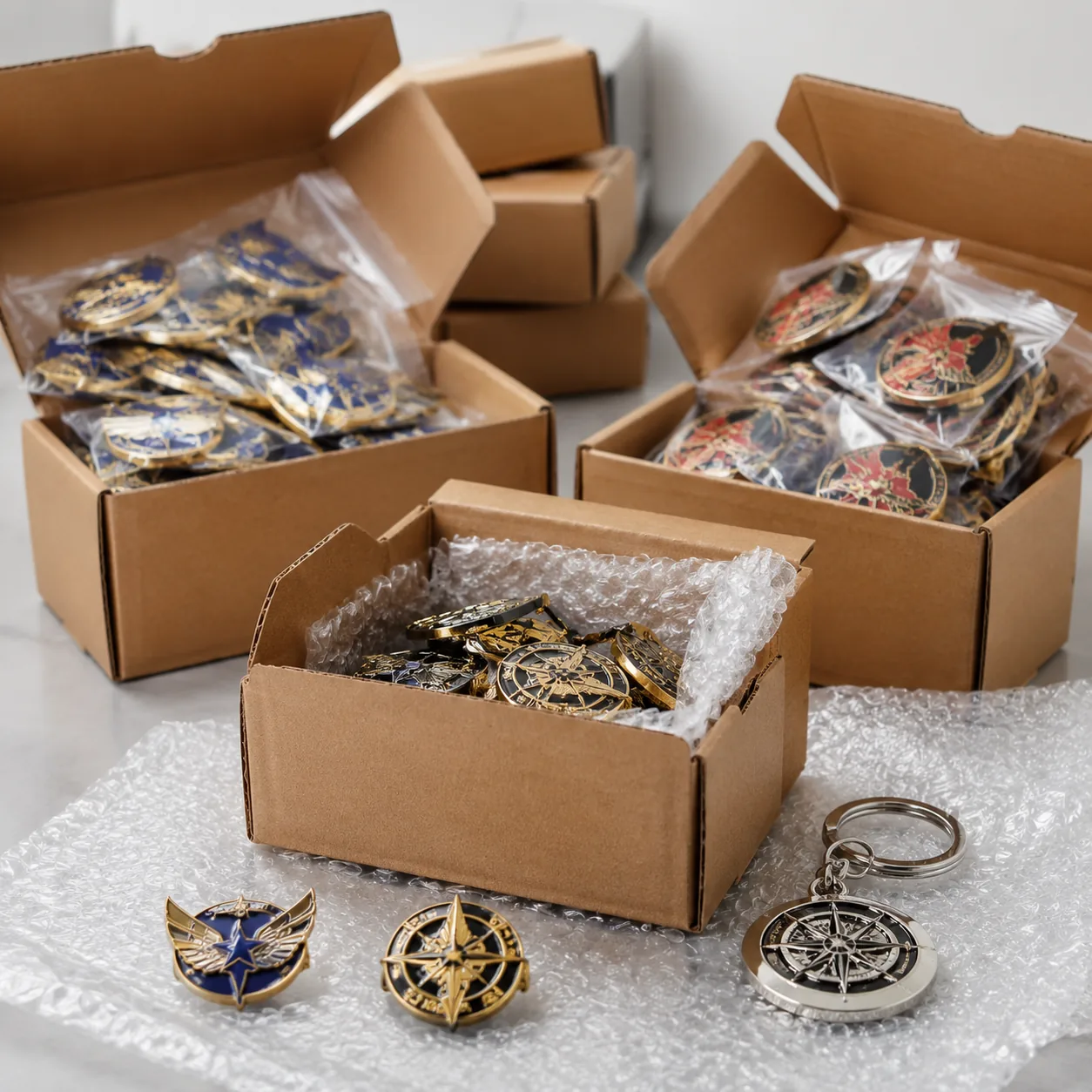
Destination-level packing is a production requirement. The factory must buy enough inner bags and cartons, print destination labels, stage cartons separately, count each lot, and sometimes prepare separate packing lists or commercial invoices. These tasks affect labor, carton quantity, inspection time and vessel or air cutoff dates. They should be quoted with the product, not negotiated after mass production.
At ZheCraft in Yiwu, we treat split shipment instructions as part of the approved specification for enamel pins, brooches, challenge coins, patches, fridge magnets, metal keychains and lanyards. One master PO can be divided into several packing lots, but each lot needs a destination code, SKU quantity, inner packing rule, carton label format and acceptance standard.
| Split method | Best use case | Typical added factory time | Typical FOB add-on |
|---|---|---|---|
| By SKU | Each design or product type ships to one warehouse | 0 to 1 day | USD 0.00 to 0.02 per piece |
| By quantity | One identical SKU is divided among destinations | 1 to 4 days | USD 0.01 to 0.05 per piece |
| By mixed kit | Pins, patches, coins or lanyards are packed in fixed sets | 3 to 7 days | USD 0.06 to 0.20 per kit |
| By courier parcel | Urgent small lots below 20 kg per address | 1 to 2 days | USD 3 to 8 per parcel handling |
Choose the right split point for the order
The cleanest split is by SKU. If PIN-A ships to the US and PIN-B ships to Germany, the packing team can keep production lots separate from the start. This usually adds little or no cost when each SKU fills at least one inner carton. Practical carton-level quantities are often 500 to 1,000 pins, 100 to 300 challenge coins, 300 to 800 metal keychains, or 500 to 1,000 lanyards, depending on weight and packaging.
The next option is a quantity split within the same SKU. For example, 10,000 identical hard enamel pins may be divided into 4,000, 3,000, 2,000 and 1,000 pieces. This is workable, but the factory must count, label and stage each destination separately. For two to four destinations, add 1 to 2 packing days. For five to ten destinations, add 2 to 4 days, especially when every piece has a backing card, barcode sticker or individual OPP bag.
The highest-risk option is mixed kitting by destination. A carton may need 100 pins, 100 woven patches and 100 printed lanyards, or a retail set may require one coin, one keychain and one insert card in the same bag. This creates tolerance stack-up across multiple production lines. Do not use factory kitting unless the supplier confirms a packing matrix, a dedicated kitting area, component overrun rules and a final count method by kit, not only by total component quantity.
For event orders, avoid micro-splits unless the value is clear. Sending 30 pieces to each of 20 locations can cost more in handling and courier administration than shipping bulk goods to one domestic distributor. As a practical rule, factory splits work best when each destination has at least 100 pieces per SKU or one full carton. Smaller quantities should be reviewed against local fulfillment cost before approval.
Build an allocation sheet the packing line can follow
A reliable allocation sheet should fit on one spreadsheet tab and use fixed columns. Include PO number, factory item code, artwork revision, product description, destination code, destination name, ship-to country, packed quantity, overrun rule, inner packing method, carton label text, shipping mark and required document set. Avoid instructions such as “send some to Germany and the rest to the US.” That wording forces a merchandiser to interpret the order and creates avoidable packing risk.
Use short destination codes everywhere. Codes such as US-01, DE-01 and HK-01 are easier to print, scan and verify than long company names. The same code should appear on the allocation sheet, carton label, packing list, pallet mark and inner bag sticker if used. For multi-item orders, keep the SKU code stable. PIN-A-30MM-HARD-NICKEL is better than “blue logo pin” because product descriptions often change between sales, artwork and warehouse teams.
Define quantity tolerance by destination, not only by total PO. For custom metal items, a common mass-production tolerance is ±2% below 1,000 pieces per SKU and ±1% above 1,000 pieces, unless exact count is paid for. If an event venue must receive exactly 500 pieces, write “500 pcs exact count, no short shipment accepted.” The factory may need to produce a 1% to 3% overrun buffer and charge added counting labor.
- Assign one destination code per ship-to address before sample approval.
- List every SKU and destination on one controlled allocation sheet.
- State whether overruns are allowed and where excess pieces must ship.
- Freeze the allocation sheet before final QC or pre-packing inspection starts.
- Keep courier, air freight and sea freight instructions in the allocation file, not only in email.
- Require carton labels to show destination code, PO, SKU, quantity and carton number.
Specify inner packing and carton limits
Inner packing should match how the receiver will use the goods. Bulk pins in 100-piece OPP bags are economical, but they are poor for retail handout if the venue team must attach backing cards on site. Individually packed pins with backing card and 30 to 40 micron OPP bag cost more, but they reduce repacking labor and prevent mixed quantities at the destination.
For enamel pins and brooches, a common structure is 1 piece per OPP bag, 50 or 100 pieces per inner bag, and 500 to 1,000 pieces per export carton. A 25 mm iron or zinc alloy pin with butterfly clutch often reaches 12 to 18 kg gross weight per 1,000 individually bagged pieces. For challenge coins, use 25 to 50 pieces per inner box and keep export cartons below 16 kg gross weight because 40 to 50 mm coins are dense and can break weak cartons during handling.
For woven or embroidered patches, flat packing is usually safe at 100 to 500 pieces per polybag, but hook-and-loop backing increases thickness and carton volume. For lanyards, pack 50 or 100 pieces per inner bag and align hooks to reduce scratching on printed polyester. For fridge magnets with epoxy domes, acrylic faces or printed paper inserts, add tissue, sleeves or dividers; glossy surfaces can scuff during ocean freight if packed face to face.
| Product | Recommended inner pack | Export carton target | When to upgrade packing |
|---|---|---|---|
| Enamel pins | 1 pc OPP bag, 50 to 100 pcs inner bag | 500 to 1,000 pcs, max 18 kg | Backing card, retail handout, mixed destinations |
| Challenge coins | 25 to 50 pcs inner box | 200 to 500 pcs, max 16 kg | Antique plating, mirror polish, coin capsule |
| Metal keychains | 1 pc OPP bag, 50 pcs bundle | 300 to 800 pcs, max 18 kg | Epoxy dome, shiny plating, sharp edges |
| Patches | 100 to 500 pcs polybag | 1,000 to 5,000 pcs, max 15 kg | Hook backing, retail header card, barcode |
| Lanyards | 50 to 100 pcs polybag | 500 to 1,000 pcs, max 16 kg | Metal hook, safety buckle, white sublimation fabric |
| Fridge magnets | 50 to 100 pcs inner box | 300 to 1,000 pcs, max 18 kg | Epoxy dome, acrylic face, brittle resin |
Use 5-ply corrugated export cartons for most metal promotional products. Common carton sizes are 35 x 25 x 25 cm for dense pins, coins and keychains, and 45 x 35 x 30 cm for lighter patches or lanyards. Gross weight matters more than carton size: keep cartons below 18 kg for pins and keychains, below 16 kg for coins and below 15 kg when the receiver is a hotel, event venue or small office without warehouse equipment.
Lock carton labels, shipping marks and documents
A split shipment carton label should be readable by a warehouse worker who has never seen the PO. At minimum, print destination code, PO number, SKU, item description, quantity in carton, carton number and total cartons for that destination. A clear format is “DE-01 | PO 45820 | PIN-A | 500 pcs | CTN 3 of 12.” This prevents one carton from being loaded with the wrong pallet when several destinations are staged together.
If cartons require distributor routing labels, FBA-style labels, retail barcodes or country-specific compliance stickers, send final artwork before mass packing starts. Carton labels should normally be at least 100 x 70 mm. Small inner bag stickers are usually workable at 30 x 20 mm if the text is short. For barcodes, keep quiet zones clear and avoid placing the barcode within 2 mm of the label edge or across a carton seam.
Document requirements should be confirmed with the freight forwarder before the goods finish. A factory can normally prepare packing lists and commercial invoices based on buyer instructions, but it should not guess HS codes, importer tax IDs, declared values or local compliance statements. If different destinations require different importers of record or declared values, confirm whether the factory is legally able to prepare separate documents before accepting the split.
Inspect by destination, not only by total order
Standard final inspection checks workmanship against the approved sample: plating color, enamel fill, print registration, attachment strength, magnet adhesion, patch stitching and lanyard print quality. For split shipments, that is not enough. The inspection must also verify destination quantity, SKU mix, carton label accuracy, inner packing and staging by destination code.
For product quality, ZheCraft commonly uses general inspection level II with AQL 2.5 for major defects and AQL 4.0 for minor defects unless the buyer specifies stricter limits. Critical defects should be zero tolerance: wrong logo, unsafe sharp edge, broken attachment, missing magnet, wrong SKU in carton or wrong destination label. For split packing, use 100% carton label verification and open at least one carton per destination code, not one carton from the whole PO.
Dimensional tolerances should stay tied to the product specification. Practical acceptance ranges are often ±0.2 mm for small stamped pin outlines, ±0.3 mm for coin diameter, ±1 mm for patch size and ±5 mm for lanyard cut length. Decorative flash plating for gold, nickel, black nickel or antique finishes is commonly around 0.05 to 0.10 microns; thicker protective plating must be quoted separately because it can change both cost and appearance.
- Check one approved sample against each production SKU before packing.
- Verify destination code on every export carton before sealing pallets.
- Open at least one carton per destination for quantity and inner pack review.
- Photograph carton labels, inner bags and staged cartons for the shipment record.
- Class wrong destination labels as critical defects, not minor paperwork issues.
- Record the allocation sheet version number on the inspection report.
Budget MOQ, FOB cost and lead-time impact
Split shipment costs are modest when planned early. For a simple enamel pin order above 3,000 pieces with two destinations, the added FOB cost may be USD 0.01 to 0.03 per piece for labels, sorting and document handling. For destination lots below 500 pieces, the cost can rise to USD 0.04 to 0.10 per piece because packing labor, label setup and checking time do not scale down proportionally.
Kitting has a different cost structure. A set with one pin, one patch and one lanyard in a printed bag may add USD 0.06 to 0.20 FOB per kit, depending on bag size, label requirements and inspection level. A rigid gift box, EVA tray or custom insert can add USD 0.35 to 1.20 per set before freight. For exact-count event kits, budget 1% to 3% extra production on each component so one short item does not block the full kitting run.
MOQ also matters by process. Custom enamel pins and metal keychains are usually practical from 100 pieces per design, challenge coins from 50 to 100 pieces, woven or embroidered patches from 100 pieces, and printed lanyards from 100 to 300 pieces depending on the method. Split shipments below these levels are possible, but the per-destination handling charge can become disproportionate.
| Requirement | Low-risk specification | Risk if omitted |
|---|---|---|
| Destination lot size | At least 100 pcs per SKU where possible | High handling cost and count errors |
| Packing lead time | Add 1 to 4 days for split packing; 3 to 7 days for kitting | Goods finish on time but miss pickup or vessel cutoff |
| Exact count | State no shortage accepted and fund 1% to 3% overrun buffer | Event venue receives short cartons |
| Carton weight | Max 15 to 18 kg depending on product | Crushed cartons and manual handling complaints |
| QC method | AQL II plus 100% carton label check | Correct product ships to wrong destination |
| Label approval | Send final label files before mass packing | Repacking after final inspection |
Know when factory split shipment is the wrong tool
Factory split shipment is not always the best choice. If addresses change weekly, the factory becomes a slow and expensive warehouse. In that case, ship bulk goods to a distributor, 3PL or regional fulfillment center that is designed for address changes, parcel labels, last-mile delivery and returns handling.
Avoid factory kitting when one component is still unstable. If the lanyard print is approved but the coin plating sample is still under correction, do not lock the kit shipment date based on the lanyard schedule. Mixed sets move at the speed of the slowest component, and one late part can block every destination carton.
Before sending the RFQ, decide whether the supplier is only manufacturing goods or also performing destination-level packing. If the answer is both, send four files with the RFQ: approved artwork, product specification sheet, allocation sheet and label file. Ask the quote to show product FOB price and split-packing cost separately. A 30 mm hard enamel pin might quote at USD 0.62 to 1.10 FOB depending on quantity, plating and backing, then add USD 0.02 per piece for three-way destination packing with carton labels.
Before balance payment or freight pickup, request a pre-packing photo set: product in inner pack, inner bag label, export carton label and staged cartons by destination code. If the factory cannot show those photos clearly, pause shipment release until the packing record is corrected. That final check is faster and cheaper than tracing one missing event carton after the goods have left the factory.
Have a project? Send your artwork and target quantity and we’ll reply with a detailed quotation within 12 working hours.
Ready to get this made?
Send your sketch, target quantity and ship-date. Detailed quotation in 12 hours.



