Split Shipment Specs for Custom Promo Orders
When a Split Shipment Actually Reduces Risk
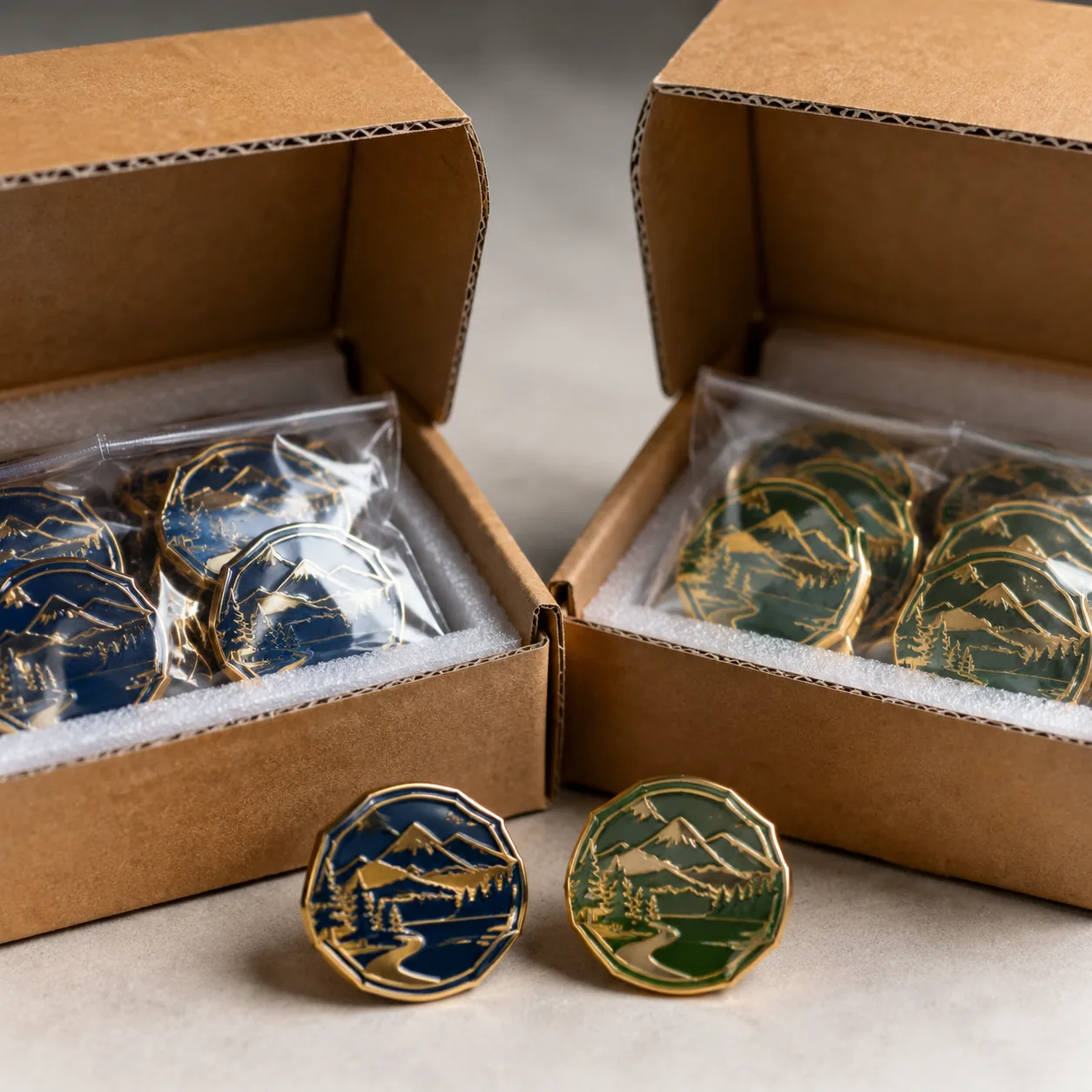
Split shipment is worth specifying when delivery risk comes from unequal production speeds, not from a poorly planned PO. A 25 to 35 mm iron soft enamel pin, 1.2 mm thick, with 3 to 5 enamel colors and standard black nickel or gold plating can often finish mass production in 12 to 18 working days after artwork, mold and pre-production sample approval. A 55 to 60 mm zinc alloy challenge coin with 3D relief on both sides, antique plating, edge numbering and enamel fill may need 22 to 32 working days. If both SKUs wait for one combined dispatch, the faster item loses 7 to 14 days for no operational benefit.
Use a split when the first leg must leave the factory at least 7 calendar days before the balance, or when an event, store launch or kit build needs only a defined usable quantity before the full PO is complete. It also applies when approvals are staggered by product type: for example, a PMS-matched woven lanyard with a metal charm and safety breakaway may still be in sample revision while a lapel pin is already approved for packing. The split must be agreed at RFQ or PO stage because QC timing, carton marks, export documents, courier quotes and forwarder booking all change when goods move in two legs.
- Use split shipment when event-critical units can hand over 7 to 14 days earlier than the remaining goods.
- Avoid splitting when all SKUs will arrive at the same receiving warehouse within one receiving week.
- Quote each leg separately for unit price, tooling, packing, domestic transfer, export handling and freight.
- Confirm Incoterm by leg: EXW factory, FCA forwarder warehouse, FOB Ningbo, FOB Shanghai, FOB Shenzhen or DDP destination.
- Do not split 50 to 100 low-value pieces unless the missed-event cost is higher than duplicate freight and handling.
MOQ, Split Quantity and Carton Economics
The manufacturing MOQ is not the same as the practical split-shipment threshold. Metal pins, medals and coins may be accepted from 100 to 300 pieces per design, but a commercially sensible split leg usually starts at 500 to 1,000 pieces because fixed charges repeat. Export handling, pickup, customs paperwork, courier collection, brokerage and destination receiving fees can make a small rush leg expensive per unit. A 300-piece rush shipment of 30 mm pins may be justified for a conference badge insert; it is rarely the lowest landed-cost option for general inventory.
For textiles, carton cube is often the constraint. Polyester lanyards packed 50 pieces per inner polybag are low in unit value but bulky in cartons. Coins are the opposite: 500 pieces may fit into two or three cartons but weigh 45 to 75 kg depending on diameter, thickness, capsule, pouch or box. A useful split instruction states piece count, gross weight and carton volume, not only PO quantity. Ask for estimated carton dimensions before approving air courier, because volumetric weight can exceed actual weight on patches, lanyards and boxed gift sets.
| Product | Factory MOQ | Practical First Leg | Carton Target | Typical FOB China Range |
|---|---|---|---|---|
| Soft enamel pins, 25 to 35 mm | 100 pcs/design | 500+ pcs | 8 to 12 kg gross/carton | USD 0.35 to 0.95/pc |
| Hard enamel pins, 25 to 35 mm | 100 to 300 pcs/design | 500+ pcs | 8 to 12 kg gross/carton | USD 0.55 to 1.35/pc |
| Zinc alloy keychains, 50 to 70 mm | 300 pcs/design | 500 to 1,000 pcs | 12 to 18 kg gross/carton | USD 0.75 to 1.80/pc |
| Challenge coins, 45 to 60 mm | 100 pcs/design | 300 to 500 pcs | 15 to 20 kg gross/carton | USD 1.20 to 3.80/pc |
| Embroidered patches, 70 to 100 mm | 100 pcs/design | 1,000+ pcs | 10 to 15 kg gross/carton | USD 0.45 to 1.50/pc |
| Polyester lanyards, 15 to 25 mm wide | 500 pcs/design | 2,000+ pcs | 12 to 16 kg gross/carton | USD 0.28 to 0.85/pc |
Write the RFQ as a Two-Leg Shipping Plan
The RFQ should identify the first-shipment SKU, quantity by leg, required factory handover date, destination and consignee for each leg. Do not hide the split in an email note after the total quantity. If the supplier sees only one 2,000-piece quantity, it may quote one export batch and later add repacking, document revision or relabeling charges when asked to ship 800 pieces early.
A clear RFQ line reads: “2,000 pcs total; Leg 1: 800 pcs by air courier to Dallas, factory handover no later than May 10; Leg 2: 1,200 pcs for ocean consolidation to Los Angeles, factory handover no later than May 25. Product: 30 mm iron soft enamel pin, 1.2 mm thickness, black nickel plating 3 to 5 microns, four enamel colors, no epoxy, rubber clutch, 350 gsm backing card plus individual OPP bag.” This tells the factory that the rush leg must use the same construction, attachment and retail pack as the balance.
Specify handover date, not only event date. A May 18 event in Chicago may require May 10 factory handover if courier transit, customs clearance, 3PL receiving and kit assembly are involved. For ocean consolidation, add domestic transfer time from the factory to Ningbo, Shanghai, Shenzhen or the named forwarder warehouse, plus the warehouse cutoff. In South China, factory-to-forwarder transfer may be 1 to 3 days; inland factories can add 3 to 5 days.
- State total PO quantity and exact quantity for each shipment leg.
- Give factory handover date, destination city, consignee and freight method by leg.
- Specify whether partial cartons are allowed or inner packs must stay intact.
- Confirm whether 1% to 2% spare units ship in the first leg or remain for replacements.
- Request separate packing lists, commercial invoices, carton labels and QC reports by leg.
- Name the forwarder, courier account or buyer warehouse before packing starts.
QC Requirements Must Match by Leg
The main quality risk is not that the order ships twice; it is that the first leg ships under a looser standard. Each leg should pass the same inspection plan. For promotional metal goods, a practical baseline is ANSI/ASQ Z1.4, general inspection level II, AQL 2.5 for major defects, AQL 4.0 for minor defects and zero acceptance for critical defects. Critical defects include sharp burrs, loose pin posts, detached magnets, broken split rings, wrong logo, missing safety warning, missing backstamp, incorrect barcode or packaging that prevents distribution.
Color and finish controls need to be explicit. Enamel pins and challenge coins should use the same plating finish and, where practical, the same enamel lot. Gold, rose gold, antique brass, antique silver and transparent enamel show visible shift more easily than black nickel or opaque hard enamel. Retain 5 to 10 approved units from the first leg as control samples for the second leg. If the buyer requires instrumental color control, specify Delta E instead of asking for a “good match.” For most promo items, Delta E 2 to 3 under D65 light is a workable target, while high-visibility retail programs may require tighter limits.
| Checkpoint | First Leg Control | Second Leg Control | Recommended Tolerance |
|---|---|---|---|
| Pantone enamel color | Check against approved sample under D65 light | Check against approved sample and retained first-leg units | Delta E 2 to 3, or no visible shift at 30 cm |
| Plating thickness | Verify finish, edges and recess coverage before packing | Repeat and compare with retained first-leg samples | 3 to 5 microns for standard decorative plating |
| Overall size | Measure 10 to 20 pcs/SKU with caliper | Repeat before release | ±0.3 mm for small pins; ±0.5 mm for coins |
| Thickness | Check before carding or bagging | Repeat before final packing | ±0.2 mm stamped items; ±0.3 mm cast items |
| Attachment strength | Hand-pull pin posts, magnets, clips, brooch bars and split rings | Repeat on packed samples | No looseness or separation under normal hand pull |
| Carton count | Reconcile shipped quantity, spares and inner packs | Reconcile balance quantity | Zero shortage against packing list |
Carton Labels and Inner Pack Rules
Many split-shipment failures happen at the receiving dock. If cartons show only the PO number, the first warehouse team may mark the order short or mix rush goods into regular stock. Every carton should show shipment leg, PO, SKU, design code, quantity, carton number and total cartons for that leg. A useful label reads: “Leg 1 of 2; PO 45821; SKU PIN-04; 500 pcs; carton 1 of 3; Dallas event kit.” The packing list and commercial invoice should use the same language.
Inner packing must support fast count and prevent finish damage. Pins are commonly packed individually in OPP bags, then 50 or 100 pieces per inner polybag. Coins should be packed 20 to 50 pieces per tray, sleeve, bubble bag or capsule group depending on weight and finish. Keychains with exposed hardware should use inner boxes or dividers so split rings do not scratch plating. For metal goods above 12 kg gross weight, use 5-ply export cartons and reinforced tape. Keep coin cartons below 20 kg where possible to reduce corner crush, courier reweigh disputes and manual handling damage.
- Use one carton-label format across all shipment legs.
- Mark partial shipment on carton labels, packing lists and commercial invoices.
- Avoid mixed-SKU cartons in rush legs unless the receiving warehouse approves them in writing.
- Use 5-ply export cartons for metal goods above 12 kg gross weight.
- Add silica gel for sea freight longer than 25 to 30 days or antique plating in humid seasons.
- Photograph sealed cartons with visible labels before handover to the forwarder.
Price the Split Before You Approve It
Split shipment rarely reduces factory unit cost. It adds duplicate work: staged QC, staged packing, extra carton labels, separate export documents, extra pickup and sometimes carton rework. The business case is schedule protection: avoiding a missed trade show, store launch penalty, employee-recognition date or emergency air shipment of the entire PO.
Price the first leg by need, not by equal percentage of the order. If an event needs 600 pins for staff kits, do not rush 1,000 units just because the PO is 2,000 pieces. For heavy coins, air courier can exceed product value. A 50 kg coin shipment may cost more to courier than the FOB value of a small reorder. For lighter pins, patches or lanyards, a targeted courier leg can be reasonable if it prevents delaying a finished kit.
| Cost Item | Typical Range | Buyer Note |
|---|---|---|
| Extra export handling | USD 20 to 60 per added leg | Charged when documents and pickup are duplicated |
| Extra QC report | Included to USD 80 | Depends on photos, sample size and report format |
| Courier for 10 kg pins | USD 70 to 180 | Varies by zone, fuel surcharge and account rate |
| Courier for 50 kg coins | USD 300 to 900 | Often higher than the product value of the rush leg |
| Reinforced cartons and labels | USD 0.50 to 2.00 per carton | Higher for heavy cartons or custom marks |
| Domestic transfer to forwarder | USD 30 to 150+ | Depends on factory location, carton count and warehouse address |
Risks Buyers Should Reject
Do not release the first leg before sample approval, attachment checks and final packaging checks are complete. An on-time shipment is still unusable if pins arrive without backing cards, coins arrive in the wrong capsule size or lanyards arrive without the required safety breakaway. Rush shipment should not mean bypassing the PO specification.
Reject any plan that changes construction between legs without written buyer approval. A second production lot can shift enamel color, antique recess darkness, plating tone or patch thread shade. Packaging changes create warehouse confusion and can affect retail presentation. If the supplier must change a material, the second leg should be treated as a controlled deviation with photos, measurements and buyer signoff before shipment.
- Reject first-leg shipment before written sample or photo approval is complete.
- Do not ship without final checks for pin posts, split rings, magnets, brooch bars, clips and breakaways.
- Avoid packaging changes between legs unless the warehouse can handle two versions.
- Do not allow forwarder relabeling that removes SKU, PO or shipment-leg information.
- Avoid long gaps between plated metal batches without retained control samples.
- Do not assume FOB includes domestic courier to a different consolidation warehouse.
Final Approval Checklist Before Handover
Before approving a split, ask the supplier for a one-page shipment plan that matches the PO. It should show SKU specs, quantity by leg, inspection date, packing date, factory handover date, Incoterm, forwarder or courier, carton-label format and document owner. If any field is blank, the shipment is not controlled enough for a time-sensitive order.
The cleanest time to lock the split is before tooling or sampling starts. Production scheduling, packing materials, QC booking and export documents can then be built around two legs. If the split is requested after mass production, it may still be possible, but carton rework, relabeling and document changes often add 1 to 3 working days. Send the supplier the event date, must-arrive quantity, destination, SKU list and acceptable freight method, then ask which items can ship first without compromising AQL, color match, carton integrity or packaging accuracy.
- Confirm the earliest usable arrival quantity, not only the total PO quantity.
- Approve one carton-label template before packing starts.
- Require separate packing lists, invoices and QC results for each shipment leg.
- Keep retained first-leg samples for second-leg batch comparison.
- Compare added split cost against the cost of missing the event, launch or kit-build date.
Have a project? Send your artwork and target quantity and we’ll reply with a detailed quotation within 12 working hours.
Ready to get this made?
Send your sketch, target quantity and ship-date. Detailed quotation in 12 hours.



