Split Shipment Specs for Custom Promo Orders Without Mix-Ups
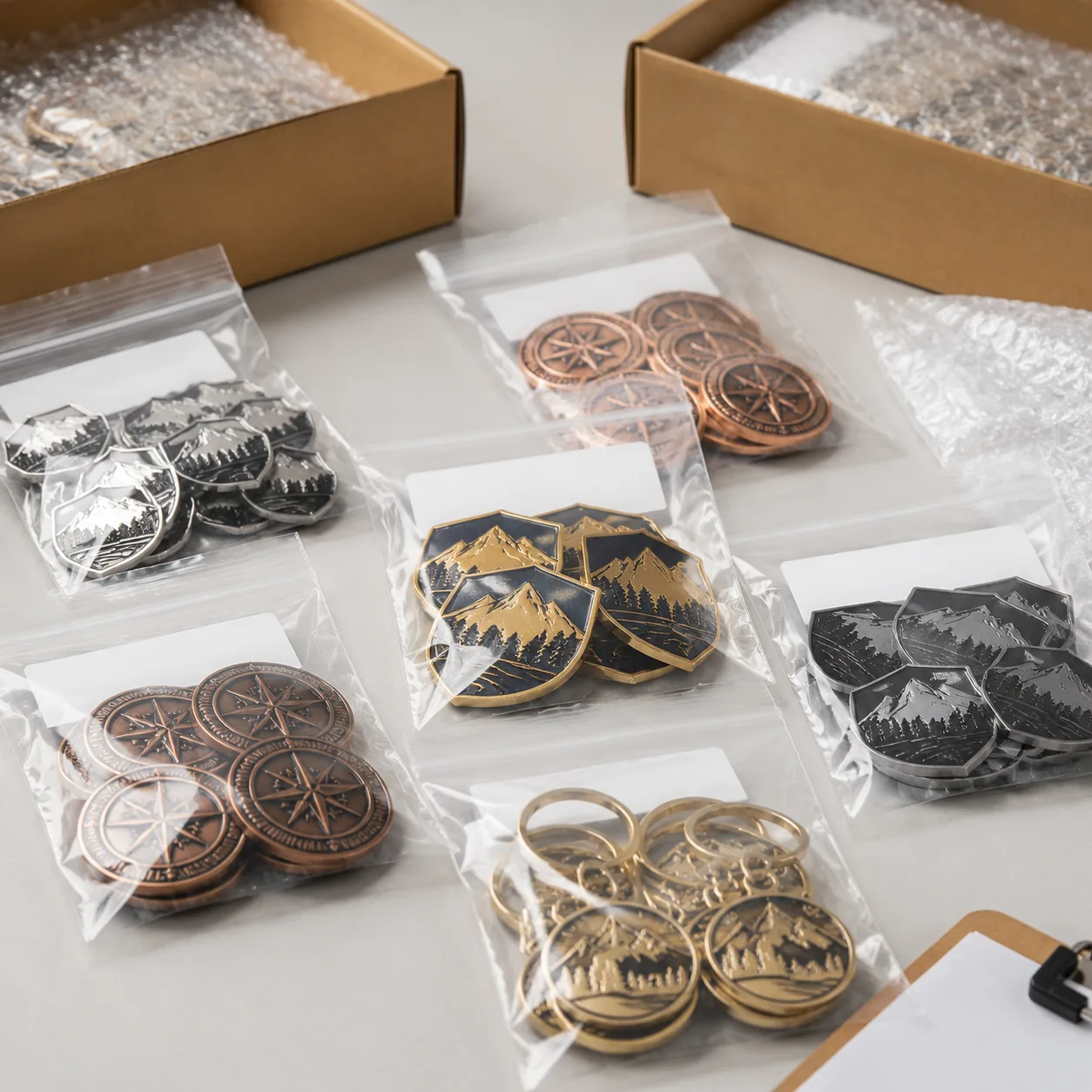
Why Split Shipments Fail After Production Looks Finished
In custom promotional orders, the product is often acceptable but the shipment is not usable on arrival. A 30-carton order of enamel pins, coins, patches or lanyards may land at a distributor warehouse, hotel dock or regional office with no clear link between cartons, cities, campaigns or departments. Staff then open cartons, count inner bags and relabel goods that should have been ready for direct dispatch.
Split shipment control must be specified before mass production, not after final QC. The factory needs destination codes, SKU codes, inner quantities, carton rules, label fields and allocation rules early enough to build the packing list around them. If packing is driven only by production convenience, similar-looking items can be mixed across cartons even when the products themselves meet approval samples.
For mixed orders such as enamel pins plus lanyards, challenge coins plus velvet boxes, or woven patches plus backing cards, packing is an engineering task. The buyer should define how goods move through receiving, not only how they look. The most useful RFQ includes carton dimensions, maximum gross weight, count tolerance, AQL level, MOQ by destination and the expected add-on time for sorting or kitting.
Start With a Destination Matrix, Not a Product List
A normal RFQ may say: 2,000 pieces, 1.25 inch hard enamel pin, gold plating, butterfly clutch. That is not enough for split shipping. The factory also needs to know how many pieces go to each destination, whether each destination has the same packaging, and whether cartons can contain more than one SKU. A destination matrix prevents last-minute assumptions during packing.
Use short destination codes such as US-NY, US-LA, DE-BER or JP-TYO. Keep each code under 12 characters so it fits on 100 x 150 mm carton labels, inner bag labels and packing lists without truncation. If one city has separate departments, use a second field such as US-NY-VIP or DE-BER-STAFF instead of long free-text notes.
State allocation tolerance separately from production tolerance. For custom metal items, a common production tolerance is +/-3% after mass production; for embroidered or woven patches, +/-5% is common unless exact quantity is quoted and accepted. For split shipments, destination totals should not fall below the approved quantity unless the buyer signs off. Any overrun should be allocated by the matrix, for example proportionally by destination or held as a central reserve.
| Order Size | Minimum Matrix Fields | Risk If Missing |
|---|---|---|
| 500 to 1,999 pcs | Destination code, SKU, quantity, packing type, delivery address | Manual sorting at the buyer warehouse |
| 2,000 to 9,999 pcs | Add inner bag quantity, carton max weight, carton label format | Mixed cartons and wrong branch allocation |
| 10,000 to 49,999 pcs | Add pallet plan, carton sequence, consignee contact, courier account | Rework cost and missed event deadlines |
| 50,000 pcs plus | Add barcode fields, ASN data, carton-level SKU data, inspection hold point | Warehouse rejection, chargebacks or relabel fees |
Build SKU Codes That Workers Can Read and Scan
A split shipment needs SKU codes that survive artwork approval, production, inspection and final packing. Avoid informal names such as blue pin, client logo 2 or coin version B. Use a structured code that a packing worker can understand without reading email history: PIN-32-GD-BLU, COIN-45-ANQ, PATCH-80-WOV or LAN-20-SUB. The code should identify product type, main size, finish or process and key color where needed.
Choose one measurement system for the full order. A 1.25 inch pin equals 31.75 mm, but factory drawings usually round this to 32.0 mm. For stamped brass or zinc alloy pins, a normal outline tolerance is +/-0.2 mm; for die-cast coins, +/-0.15 to +/-0.25 mm is realistic depending on diameter, relief depth and plating thickness. State the finished size tolerance on the artwork proof, not only in the email quotation.
If two versions differ only by plating or backing, the SKU must show it clearly. PIN-32-GD-RUB and PIN-32-NI-MAG are safer than Version A and Version B. Decorative plating for promotional pins and keychains is often 0.03 to 0.08 microns for gold-tone, nickel-tone or black nickel finishes. If the item needs heavier plating, anti-tarnish coating, stainless steel hardware or outdoor exposure resistance, specify it as a separate SKU and confirm the price impact before sampling.
For lanyards and patches, include process details that affect packing. LAN-20-SUB-MH can mean 20 mm sublimation lanyard with metal hook; PATCH-80-EMB-VEL can mean 80 mm embroidered patch with hook-and-loop backing. These codes reduce packing errors when similar items have different carton weights or inner quantities.
Lock Inner Packing Before Sample Approval
Inner packing controls count accuracy and receiving speed. For enamel pins and badges, common options are individual OPP bags at 30 to 50 microns film thickness, 50 pieces per master inner bag, or backing card plus OPP bag. For coins, PVC sleeves, acrylic capsules, velvet pouches and rigid boxes all change carton volume. A 45 mm coin in a velvet box can use four to six times the carton space of the same coin in a PVC sleeve.
Do not choose premium packaging only for appearance. A 45 mm zinc alloy challenge coin in a PVC sleeve may pack about 400 to 600 pieces per 35 x 25 x 25 cm carton, depending on weight. The same coin in a 70 x 70 x 30 mm velvet box may drop to 80 to 120 pieces per carton and push gross weight toward 16 to 20 kg. That affects freight cost, carton count and delivery appointment planning.
For lanyards, a standard plan is 50 pieces per inner polybag and 500 pieces per export carton for a 20 mm polyester sublimation strap with metal lobster hook. Gross weight is typically 14 to 18 kg. If the lanyard uses a heavy bottle opener, metal buckle or safety breakaway, confirm carton weight from a packed sample instead of relying on a generic packing estimate.
Patches are light but can become bulky with backing cards, merrowed borders, hook-and-loop backing or individual barcode labels. For embroidered patches of 70 to 90 mm, 100 pieces per inner bag is common for bulk distribution; 25 or 50 pieces per inner bag is better for event desks that need faster handout control.
- Confirm whether each SKU is bulk packed, individually bagged, carded, boxed or kitted.
- Set fixed inner quantities such as 25, 50 or 100 pieces per bag or bundle.
- Print destination code and SKU code on every inner bag label.
- Avoid mixed-SKU inner bags unless they are intentional kits with a kit code.
- Require photos of one packed carton before the full order is sealed.
Set Carton Rules: Size, Weight, Labels and Sequence
Export cartons should be strong enough for international handling but not so heavy that couriers or warehouse staff reject them. For pins, coins, keychains and patches, practical carton sizes are 35 x 25 x 25 cm and 40 x 30 x 30 cm using five-layer corrugated board. For courier shipments, keep gross weight below 18 kg where possible; for air or sea freight, 20 kg is a practical upper limit unless the receiving site approves heavier cartons.
Carton labels should be printed, not handwritten, when the shipment has more than five cartons or more than two destinations. A 100 x 150 mm label gives enough space for destination code, SKU, item name, quantity, carton number, total cartons for that destination, gross weight, net weight, dimensions, PO number and country of origin. If the warehouse uses scanners, add Code 128 or QR barcode fields for carton ID and SKU.
Carton sequence must be destination-specific. Use US-NY carton 1 of 6 and US-NY carton 2 of 6, not carton 1 of 30 for the whole production order. If a carton contains multiple SKUs, label it MIXED CARTON and show exact SKU quantities on both the carton label and packing list. Mixed cartons should be avoided for event venues, retail receiving and any operation where cartons are cross-docked without opening.
| Carton Rule | Recommended Spec | Use Case |
|---|---|---|
| 35 x 25 x 25 cm carton | Pins, small keychains, patches below 15 kg gross | Dense small goods with low volume |
| 40 x 30 x 30 cm carton | Lanyards, mixed promo kits, medium boxed items | Bulkier goods with moderate weight |
| 100 x 150 mm label | Printed destination, SKU, carton count and weights | Courier, air freight and distributor receiving |
| Five-layer corrugated board | Export-grade stacking and handling resistance | International air, sea and pallet shipments |
| One SKU per carton | Clean branch allocation and faster receiving | Retail, regional offices and event sites |
Inspect Packing Accuracy, Not Only Product Quality
Final inspection must include packing accuracy. For visual defects on custom pins, coins and keychains, many buyers use AQL 2.5 for major defects and AQL 4.0 for minor defects. For packing count, destination allocation and carton labels, use a stricter rule because one wrong carton can stop a branch launch or event desk setup.
A practical control plan is 100% verification of carton labels against the final packing list, plus sampled carton opening by destination and SKU. For fewer than 20 cartons, open at least one carton per destination. For 20 to 80 cartons, open the square root of the total carton count rounded up, while covering every destination where possible. For more than 80 cartons, use ANSI/ASQ Z1.4 or ISO 2859-1 sampling and add photo records for all destination stacks or pallet faces.
Carton count tolerance should be zero against the label. If the label says 500 pieces, the carton should contain 500 pieces, not 495 or 505. Production may have an approved overrun or underrun, but after final allocation is accepted, each carton count and destination total must match the packing list exactly.
- Check every carton label against the destination matrix before sealing.
- Open sampled cartons and count inner bags, not only loose pieces.
- Verify SKU, plating finish, backing type, packaging type and destination code.
- Photograph each destination group before loading or courier pickup.
- Hold shipment until the buyer approves the final packing list for multi-destination orders.
Budget Realistic Cost, MOQ and Lead Time
Split packing adds labor, labels, counting, documentation and sometimes courier booking. For carton-label-only sorting, a realistic add-on is USD 0.01 to 0.03 per piece FOB China for pins, patches or lanyards. Inner bag labels usually add USD 0.02 to 0.06 per piece. Unit barcode labels, destination-specific backing cards or retail kitting can add USD 0.05 to 0.18 per piece depending on quantity, label data and manual handling.
MOQ matters. A pin factory may accept 100 pieces per design, but split packing becomes inefficient if each destination receives only 10 or 20 pieces. A workable planning tier is 50 pieces per destination per SKU for simple carton sorting, 100 pieces per destination per SKU for destination-specific backing cards, and 250 pieces per destination per SKU for barcode or retail-ready packs. Below those levels, the buyer may be paying more for administration than for sorting value.
Typical FOB product ranges also affect the decision. A 32 mm hard enamel pin may run USD 0.45 to 1.20 per piece depending on mold, colors, plating and backing. A 45 mm zinc alloy challenge coin may run USD 1.20 to 3.80. A 20 mm polyester sublimation lanyard may run USD 0.35 to 0.95, and an 80 mm embroidered patch may run USD 0.40 to 1.30. Adding USD 0.08 per unit for packing is minor on a boxed coin but material on a low-cost lanyard.
Lead time also increases. Basic carton separation usually adds 1 to 2 working days. Inner labels and destination grouping add 2 to 3 working days. Barcode labeling, retail pack preparation or mixed-item kitting can add 4 to 10 working days. If base production for hard enamel pins is 12 to 18 days after artwork approval, plan 15 to 22 days for five or more destinations. Mixed orders involving lanyards, patches and coins often need 18 to 28 days because workshops finish at different times before consolidation.
| Packing Complexity | Typical Add-On Cost | Typical Add-On Time | Best Fit |
|---|---|---|---|
| Carton labels only | USD 0.01 to 0.03 per piece | 1 to 2 working days | Distributor receiving and regional allocation |
| Inner bag labels | USD 0.02 to 0.06 per piece | 2 to 3 working days | Branch kits and event desk sorting |
| Destination backing cards | USD 0.04 to 0.12 per piece | 3 to 5 working days | Sponsor-specific or retail giveaways |
| Unit barcode labels | USD 0.05 to 0.18 per piece | 4 to 7 working days | Fulfilment centres and marketplace prep |
| Full mixed-item kitting | USD 0.10 to 0.35 per kit | 5 to 10 working days | VIP packs, conference kits and staff packs |
Know When Split Shipment Is the Wrong Choice
Split packing is useful when receiving labor is expensive, the deadline is fixed or goods ship directly to multiple sites. It is not always the safest option. If allocation is still changing, packing too early by destination can create shortages in one region and overstock in another. In that case, use neutral SKU labels and postpone destination labeling until quantities are locked.
For small orders under 500 pieces, one bulk shipment to a central office is often cheaper and lower risk. The factory can still separate by SKU, print clean carton labels and provide a detailed packing list, but full destination sorting may add more cost than value. If final addresses are not confirmed, do not print city or department labels that may become obsolete before dispatch.
Avoid urgent partial dispatch before final QC unless the risk is understood. If defective lots are split across several countries, recalls become expensive and slow. For custom metal goods, resolve plating shade variation, enamel underfill, rough edges, weak magnets, loose clutches and incorrect back stamps before any destination group is released.
Send a Factory-Ready Packing Brief With the RFQ
Before requesting a price, prepare a one-page packing brief with the destination matrix, SKU codes, inner packing rules, carton label fields, carton weight limit and inspection expectations. This lets the factory quote the real handling work instead of adding emergency packing charges after production. It also gives the forwarder or warehouse enough data to confirm whether carton labels and packing lists match their receiving system.
Ask the supplier to confirm maximum carton weight, estimated carton count by destination, whether mixed cartons will be used, and how shortages or overruns will be allocated. For multi-item orders, require a pre-shipment photo set showing inner bag label, open carton, sealed carton label and destination group. For palletized freight, add pallet ID, carton range and pallet gross weight to the packing list.
The safest next step is to send artwork and the destination matrix together. If final addresses are not ready, use destination codes and estimated quantities first, then lock addresses before packing begins. Treat split shipment as a controlled specification, and the order arrives ready to distribute instead of ready to sort.
Have a project? Send your artwork and target quantity and we’ll reply with a detailed quotation within 12 working hours.
Ready to get this made?
Send your sketch, target quantity and ship-date. Detailed quotation in 12 hours.



