Split Shipment Specs for Custom Promo Orders
Q: When does a split shipment need a written spec?
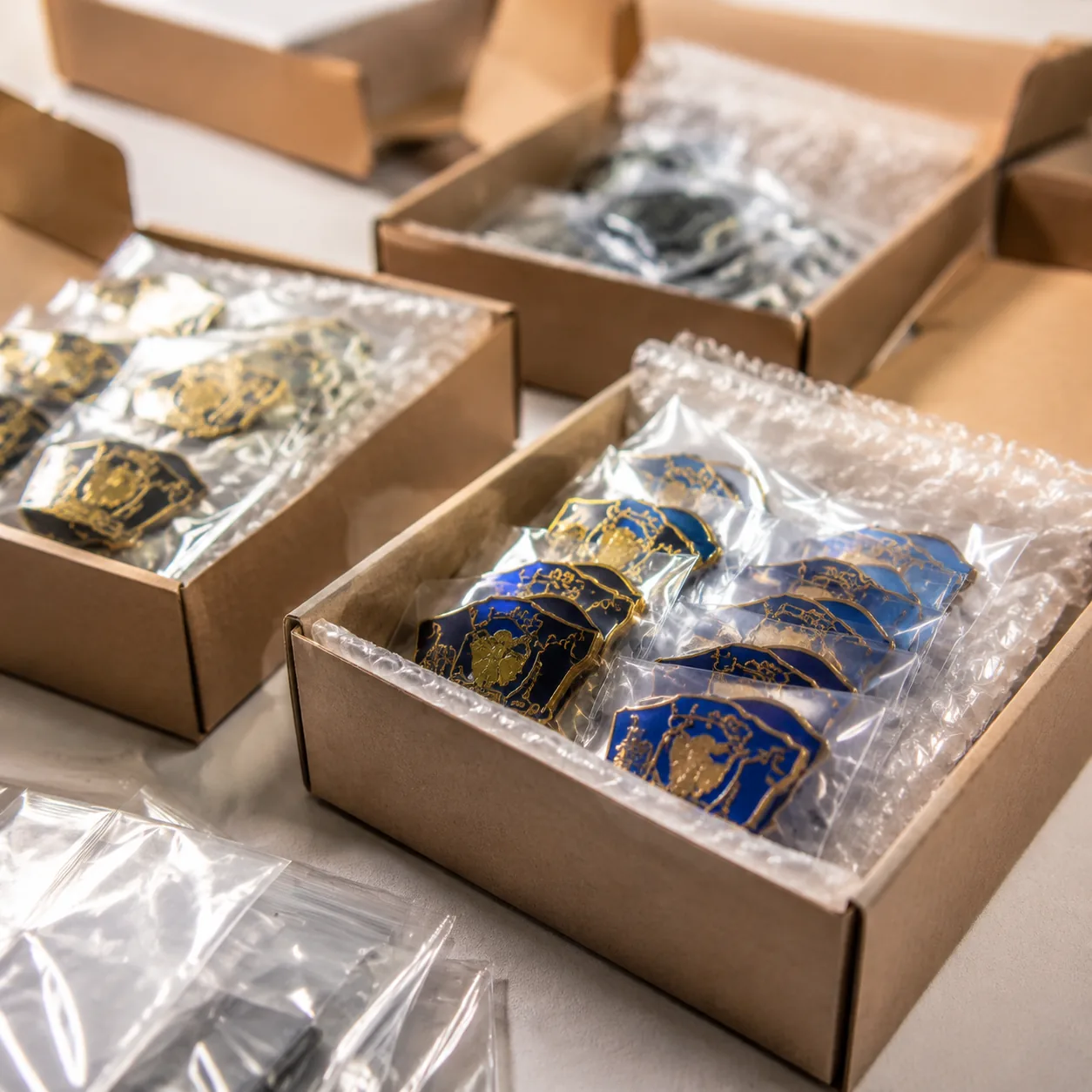
A split shipment needs a controlled packing specification as soon as the factory must pack by destination, not only by SKU. If one custom order ships to two event venues, five sales offices, or 40 distributor warehouses, the buyer is purchasing packing accuracy, carton identity and export-document discipline in addition to the product. The enamel color can match Pantone, the coin die can be correct, and the order can still fail if 1,000 Hamburg cartons arrive in Lyon because the destination split was buried in email instead of locked in a packing file.
For custom enamel pins, die-struck coins, woven patches, PVC keychains, fridge magnets, brooches and lanyards, treat split packing as a separate production-control item when there are three or more destinations, five or more SKUs, mixed-SKU cartons, destination quantities below one master carton, country-specific customs paperwork, or any fixed event arrival date. A simple carton mark may work for two destinations and one SKU. It is not enough when destinations need different quantities, backing cards, inserts, barcodes, courier labels or pallet marks.
Factory-side split packing is not always the lowest-risk option. If a US or EU distributor has a trained warehouse team and needs to build many small client kits, one bulk shipment to that warehouse may be easier to correct locally. China-side split packing makes more sense when labor cost is lower than domestic relabeling, when the order must leave as multiple express parcels, when customs routing differs by country, or when event timing leaves no room for repacking after import.
Q: What data should the factory receive before production?
Send the destination matrix with the purchase order or no later than artwork approval. Do not wait until packing begins. The matrix should list destination code, SKU code, item name, artwork version, size, finish, attachment, packaging format, consignee name, phone, address, required arrival date, selling-unit quantity, inner-pack quantity, carton quantity, buffer rule and routing method. For multi-item promo sets, state whether products ship as matched kits or as separate bulk SKUs.
Use short factory-friendly codes rather than campaign names. Good SKU codes are stable and specific, such as PIN-BLUE-25MM-NI-V3, COIN-BRASS-45MM-ANTGOLD, PATCH-WOVEN-70MM-HOOK or LANYARD-20MM-PET-BLKHOOK. Avoid labels such as “VIP pin final new” because similar designs may run at the same time in soft enamel, hard enamel, epoxy-coated, nickel-plated and gold-plated versions.
| Data field | Recommended spec | Control purpose |
|---|---|---|
| Destination code | 3 to 8 characters, such as NYC01, DE-HAM or UK-LON | Keeps labels readable and reduces address translation errors |
| SKU code | One code per artwork, size, finish, attachment and packaging format | Prevents mixing similar pins, coins, patches or lanyards |
| Minimum drop size | 100+ pcs for bulk bags, 300+ pcs for backing cards, 500+ pcs for destination-specific retail packs | Small drops create more hand counts, labels and exception cartons |
| Inner pack quantity | Usually 50, 100 or 200 pcs per polybag, tray or inner box | Lets QC count sealed packs instead of loose pieces |
| Buffer rule | 1% to 3% per destination, minimum 5 pcs below 300 pcs | Covers count variance, retained samples and event handout loss |
| Carton ID format | Destination-SKU-Carton sequence, for example DE-HAM-PIN01-C03 | Aligns cartons with the packing list and receiving checks |
| Required arrival date | Calendar date plus latest acceptable delivery date | Supports realistic routing by express, air, rail, sea or forwarder |
Q: How should inner packs and cartons be labeled?
Every inner pack should show the information a receiver cannot verify at a glance: PO number, SKU code, destination code, quantity, item description and pack number if the carton contains multiple inner packs. For small metal items, common label sizes are 60 mm x 40 mm on polybags and 100 mm x 70 mm on inner boxes. Use black print on white stock, minimum 8 pt text for inner labels and 12 pt for master-carton labels. Barcodes help only if the receiving warehouse will scan them; otherwise, clear human-readable codes matter more.
A master-carton label should include PO number, SKU code, item description, destination code, carton sequence, gross weight, net weight, carton dimensions, country of origin and carton quantity. For mixed cartons, print “MIXED SKU” in large text and place a contents sheet under the top flap. If a forwarder is involved, carton IDs must match the packing list exactly, such as DE-HAM-C01 to DE-HAM-C06. Do not reuse carton numbers across destinations unless the destination code is part of the ID.
Carton strength should match product density. Pins, magnets and keychains normally ship safely in 5-ply export cartons rated about 44 ECT, with roughly 7 mm wall thickness. Keep express cartons below 15 kg gross weight; many depots handle lighter cartons faster and with less crushing. For heavy challenge coins, 8 to 12 kg per carton is safer than filling cartons to 18 kg. Palletized sea shipments can use heavier cartons only when the pallet plan, corner protection, stretch wrap, carton stacking height and “do not double stack” rule are specified.
Q: What cost and lead time should be quoted?
Split packing adds cost because the line changes from bulk counting to order picking. The work includes separating SKUs, checking destination quantities, printing unique labels, staging cartons, building contents sheets, weighing cartons and matching packing-list data. Quote it as a separate line item so the buyer can compare factory packing against domestic relabeling or third-party kitting.
As a FOB China reference, custom soft enamel pins at 1,000 to 5,000 pcs often run USD 0.45 to 1.20 per piece depending on size, plating, enamel area, mold complexity and attachment. Hard enamel usually adds USD 0.08 to 0.35 per piece. Zinc alloy or brass challenge coins in 40 to 50 mm sizes commonly run USD 1.60 to 4.80 per piece, with 3D molds and antique plating at the higher end. Woven patches often range from USD 0.25 to 0.95 per piece, while polyester lanyards are usually USD 0.28 to 0.85 per piece at standard promotional MOQs.
| Split packing scenario | Added lead time after production | Typical FOB cost adder |
|---|---|---|
| 2 to 3 destinations, one SKU, bulk inner bags | 0 to 1 working day | USD 0.01 to 0.03 per piece |
| 4 to 10 destinations, 2 to 5 SKUs | 1 to 3 working days | USD 0.03 to 0.08 per piece |
| 10 to 30 destinations, mixed cartons and contents sheets | 3 to 5 working days | USD 0.06 to 0.15 per piece |
| Retail packs with unique backing cards or inserts | 4 to 7 working days | USD 0.12 to 0.40 per piece |
| Matched kits across pins, patches, lanyards and cards | 5 to 10 working days | USD 0.25 to 0.90 per kit |
| Unique carton labels only, no repacking | 0 to 2 working days | USD 1.00 to 3.50 per carton |
Plan split-packing time after production completion, not hidden inside the product lead time. Enamel pin and metal keychain orders usually need 12 to 20 calendar days after artwork and sample approval. Challenge coins often need 18 to 25 days, especially with 3D molds or antique plating. Woven patches and lanyards usually need 10 to 18 days depending on yarn, webbing, hooks and print method. Split packing can then add 1 to 7 working days. On an express shipment, losing two days during packing can cost more than the packing service itself.
Q: How should QC cover product and destination accuracy?
Product QC and packing QC are separate controls. Product QC checks plating, enamel fill, attachment strength, logo position, dimensions, color, surface finish, edge burrs and epoxy clarity. Packing QC checks whether the correct SKU and quantity are in the correct inner pack, carton, pallet and destination group. A shipment can pass product QC and still fail commercially if the wrong destination receives the cartons.
For promotional metal and textile items, a common inspection basis is ANSI/ASQ Z1.4 or ISO 2859-1, General Inspection Level II, with AQL 2.5 for major defects and AQL 4.0 for minor defects. Critical defects should be AQL 0. Examples include sharp exposed pin posts, unsafe magnets for the intended market, wrong artwork, incorrect plating color, missing clutch backs on a high share of units, or any destination carton packed for the wrong consignee. For destination accuracy, many buyers require zero critical errors in the inspected sample because one wrong carton can miss an event.
Set count tolerance separately from product tolerance. For destination cartons, use plus 1% and minus 0% unless the buyer accepts shortage risk. If exact counts are required, specify machine counting, scale counting with verified unit weight, or double manual count for small drops. For destinations below 500 units, a minimum 5-piece buffer is more practical than a percentage-only rule.
Keep dimensional and finish tolerances in the product spec. For die-struck or cast pins and coins below 50 mm, plus or minus 0.2 mm on width and height is usually workable. Thickness tolerance is commonly plus or minus 0.15 mm for pins and plus or minus 0.2 mm for coins. For textile patches, allow plus or minus 1.0 mm on width and height unless the patch must fit a recessed area. Decorative electroplating on promotional metal goods is often about 0.05 to 0.10 microns for gold-tone or nickel-tone finishes. If the item needs higher wear resistance, specify a thicker plating target, clear coat or epoxy dome instead of assuming an upgrade.
Q: Where do split shipments usually fail?
The first failure point is a late destination change without version control. If the buyer changes 18 addresses after labels and carton sheets are printed, old data can remain on the packing floor. Control changes with a revised matrix, version number, approval date and a clear instruction to void superseded labels and contents sheets.
The second failure is casual handling of samples, overruns and buffers. If every destination receives exact order quantity and the factory keeps no retained samples, disputes become harder to resolve. A practical rule is to approve 1% to 3% production overage and state where it goes: ship proportionally to each destination, hold at factory for 30 days, or send all spare stock to headquarters.
The third failure is mixing courier logic with forwarder logic. Courier shipments need complete phone numbers, postal codes, carton-level weights and concise item descriptions for booking systems. Forwarder shipments need pallet marks, HS code consistency, carton counts, commercial invoice values and packing-list alignment. One packing spec can support both routes, but the logistics method must be confirmed before carton labels are locked.
The fourth failure is underestimating small destination quantities. A 5,000-piece order split into ten 500-piece drops is manageable. The same order split into sixty drops of 20 to 150 pieces creates far more hand-count points, label combinations and exception cartons. If the buyer insists on very small drops, quote the extra picking labor and add a photo approval step before sealing.
Checklist: Approve these before mass packing
Use this checklist after mass production passes product QC but before cartons are sealed. This is when packing mistakes are still cheap to fix. Ask the factory for photos of the label format, one packed inner unit, one open carton, one sealed carton and the staged carton groups by destination.
- Destination matrix has a version number, approval date and named approver.
- Every SKU code matches the artwork proof, sample approval and purchase order.
- Inner pack quantity is fixed, such as 100 pcs per bag or 50 pcs per box.
- Carton label shows PO number, SKU, destination code, carton sequence and quantity.
- Mixed cartons include a printed contents sheet under the top flap.
- Gross weight stays below the agreed limit, normally 15 kg for express cartons.
- Buffer stock is assigned by destination, factory hold or one nominated address.
- QC sampling covers product defects, count accuracy and destination accuracy.
- Commercial invoice quantities match the final packing list exactly.
- Packing photos are approved before the team seals the full batch.
For high-risk event shipments, add destination staging. The factory physically separates cartons by destination before final sealing, weighing or palletizing. This is useful for mixed orders such as 3,000 enamel pins, 2,000 metal keychains, 1,500 woven patches and 800 lanyards going to several launch events. A staged photo should show destination codes and carton counts clearly enough for the buyer to compare against the matrix.
What to send for a final quote
Before requesting a final quote, send the supplier both the product RFQ and the split-shipment matrix. Ask for separate lines for product cost, tooling, pre-production sample, retail packaging, split packing, carton labeling, export cartons, palletization if needed and estimated freight. Separate quoting makes it easier to compare factory-packed shipment, domestic relabeling and third-party kitting.
If the order is urgent, freeze the destination matrix before sample approval and treat later edits as controlled revisions. For a normal custom metal or textile promotional order, allow 12 to 25 calendar days for production depending on item type, 1 to 7 working days for split packing, and 3 to 10 days for express or air freight depending on destination. Sea freight can be economical for heavy coins, magnets and large repeat orders, but it is rarely suitable for event goods unless the calendar allows 35 to 55 days of freight time.
The safest next step is to prepare a one-page packing instruction with three attachments: approved artwork proof, destination matrix and label template. Include tolerance figures, AQL level, carton weight limit, buffer rule, inner-pack quantity, carton ID format and the person authorized to approve packing photos. If you are sourcing from ZheCraft, our team can review that file before sampling and identify split-shipment risks while they are still easy to correct.
Have a project? Send your artwork and target quantity and we’ll reply with a detailed quotation within 12 working hours.
Ready to get this made?
Send your sketch, target quantity and ship-date. Detailed quotation in 12 hours.



