Split Shipment Specifications for Custom Promo Products
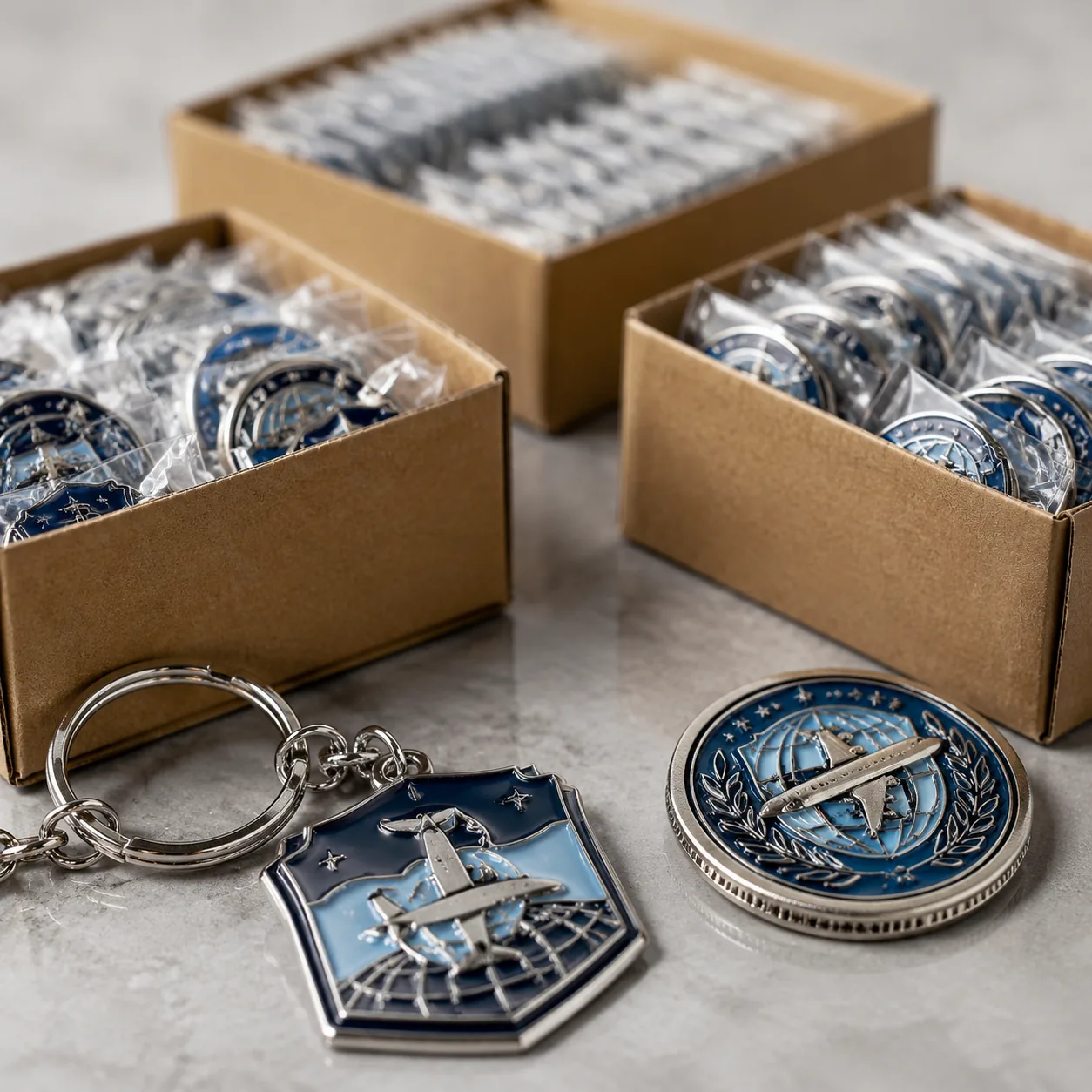
Why split shipments fail when the product is correct
Most split-shipment failures are not caused by enamel color, lanyard print, or patch stitching. They are caused by carton logic. A buyer orders 10,000 enamel pins, 3,000 challenge coins, and 8,000 lanyards for 18 regional events, but the purchase order only says “ship to multiple addresses.” The factory packs by production batch, the forwarder separates by carton count, and each event receives an incomplete or incorrect mix.
For split shipments, packing must be treated as a production specification. The approved file should define destination code, SKU, item quantity, inner pack quantity, master carton quantity, spare parts, carton label format, carton sequence, consignee details, incoterm, and required delivery date before mass production starts. At ZheCraft, we prefer receiving this file before pre-production sample approval because carton size, gross weight, and final packing labor change depending on whether goods are packed by SKU, by destination, or by event kit.
A single-destination order can tolerate simple packing, such as 100 pins per polybag and 1,000 pins per export carton. A split shipment cannot. If one carton contains mixed destinations, picking errors rise quickly, especially when SKUs look similar: nickel versus antique silver coins, gold versus brass plating, 20 mm versus 25 mm pins, or lanyards with the same base color but different hook attachments.
When destination-level packing is worth the cost
Destination-level packing is justified when the order has more than three delivery addresses, more than five SKUs, or any event date that cannot absorb a five- to seven-day correction shipment. For a 500-piece pin order going to two offices, manual separation at the buyer’s warehouse may be cheaper. For 5,000 pieces across 10 locations, factory-side split packing usually costs less than warehouse rework, replacement freight, and on-site sorting labor.
MOQ affects both manufacturing and packing. For soft enamel pins, a practical factory MOQ is 100 pieces per design, with better unit pricing at 300, 500, 1,000, and 3,000 pieces. For challenge coins, 100 pieces is possible, but 300 pieces usually gives more stable mold amortization and plating cost. For woven patches and lanyards, 300 to 500 pieces per design is more efficient because weaving, printing, cutting, sewing, and inspection are set up by batch.
| Order situation | Recommended packing method | Typical added packing cost | Best-fit use case |
|---|---|---|---|
| 1 SKU, 1 address, under 1,000 pcs | Bulk export carton by SKU | USD 0.00-0.02 per pc | Simple inventory receipt or buyer-side repacking |
| 2-5 SKUs, 2-3 addresses | SKU cartons with destination labels | USD 0.02-0.05 per pc | Small office split with flexible delivery dates |
| 5-20 SKUs, 4-20 addresses | Destination cartons with sequence numbers | USD 0.05-0.12 per pc | Regional events, school programs, store openings |
| Mixed event kits | Unit kit pack plus destination master carton | USD 0.12-0.35 per kit | Handout packs with one pin, patch, coin, or lanyard set |
| Retail or scanned receipt | Unit barcode, inner carton, destination carton | USD 0.08-0.25 per pc | 3PL receiving, retail allocation, serialized campaigns |
Small destination drops below 50 pieces can become inefficient because labels, counting, and carton handling cost more than the product margin. In those cases, combine micro-destinations into one regional carton, or ship bulk stock to the closest warehouse with a separate internal allocation list.
What the split packing file must specify
The split packing file should be a controlled spreadsheet with one row per destination and SKU combination. Do not send addresses only in email text or chat messages. Use Excel, CSV, or an ERP export, then lock the columns after approval. Field names must be unambiguous, and every revision should carry a version number, approval date, and owner.
Minimum fields are destination code, consignee name, full address, phone number, country, postal code, SKU code, artwork version, finish, attachment, unit quantity, spare quantity, inner pack quantity, master carton quantity, carton mark, incoterm, and required delivery date. For metal items, include the product build: for example, 25 mm soft enamel iron pin, 1.2 mm thickness, nickel plating target 5-8 microns, black rubber clutch, 100 pieces per inner bag. For challenge coins, specify 45 mm diameter, 3.0 mm thickness, zinc alloy or brass, 2D or 3D mold, edge style, enamel fill, pouch or capsule. For patches, specify woven or embroidered construction, backing type, border, and unit packing.
- Assign one short destination code, such as US-ATL-01 or DE-BER-02, and print it on every carton label.
- Use one SKU code per physical item; never use the same SKU for gold plating and antique brass plating.
- Specify fixed inner quantities, such as 50 pcs per bag or 100 pcs per box, not “about one bag.”
- State overrun rules clearly; common tolerance is 0-3% overage with no accepted shortage.
- Freeze the packing file before mass packing; late address changes must be logged by version number.
- Require a final packing list with net weight, gross weight, carton dimensions, and carton count by destination.
Spare-stock logic should be decided early. If the buyer allows 1-3% extra pieces, define whether extras stay at the head office, follow each destination proportionally, or go to the highest-risk event. A carton labeled “spares” is not enough; the packing list should show SKU, quantity, and receiving address for every spare unit.
Carton labels, weights, and sequence rules
Carton labels should be readable from 1 meter away and survive export handling. For most promotional products, a 100 mm x 150 mm thermal label is adequate. Use black text on white label stock, minimum 10 pt text for details and 18-24 pt for destination code and carton number. If cartons may face rain, courier depots, or multiple warehouse touches, request waterproof label stock or clear tape over the label.
A reliable carton mark includes buyer name or project code, destination code, SKU code, item description, quantity, carton number, total cartons for that destination, gross weight, net weight, and carton dimensions. A practical label reads: US-ATL-01, carton 3 of 12, SKU PIN-25-GD, soft enamel pin, 1,000 pcs, G.W. 13.5 kg, carton 42 x 32 x 28 cm. For mixed kits, label by kit quantity first, not only component quantity, because receiving teams count kits before counting individual components.
Keep carton weights realistic. For enamel pins and small keychains, 10-15 kg gross weight per carton is easier to handle and reduces burst risk. Challenge coins are denser; 8-12 kg is safer, especially for 45 mm coins at 3.0 mm thickness in capsules or boxes. Lanyards can usually run 15-18 kg per carton if packed tightly, but cartons above 55 cm on one side may attract dimensional-weight charges for air and courier freight.
Carton sequence must match the packing list. If US-ATL-01 has 12 cartons, labels should run 1/12 through 12/12 and no carton for another destination should appear in that sequence. Mixed pallets should carry a pallet label showing all destination codes and carton counts. For courier split shipments, avoid one master carton containing multiple final courier cartons unless the forwarder confirms it will be opened and scanned correctly.
Inspection rules for product and packing accuracy
Product inspection alone does not protect a split shipment. The inspection plan must include a carton audit. For standard promotional goods, a common workmanship plan is ANSI/ASQ Z1.4 general inspection level II, with critical defects at 0, major defects at AQL 2.5, and minor defects at AQL 4.0. For packing accuracy, apply a stricter rule: no wrong destination, no wrong SKU, and no shortage in sampled cartons.
The carton audit should verify item count, SKU, attachment, color, plating, backing card, barcode, carton label, carton sequence, and packing list consistency. For pins, confirm clutch type and quantity. For coins, confirm pouch, capsule, acrylic box, or velvet box count. For lanyards, verify hook type, safety breakaway, finished length, width, and print direction before master cartons are sealed. For patches, verify backing type and border style, because hook backing and iron-on backing can look similar inside polybags.
| Check point | Suggested tolerance or rule | Typical defect classification |
|---|---|---|
| Destination code on carton | Must match approved packing file exactly | Major |
| SKU inside carton | No substitution allowed | Critical if event cannot be corrected |
| Unit count per carton | Must match label; shortage not accepted | Major |
| Carton dimensions after sealing | +/-10 mm | Minor unless freight booking changes |
| Gross weight per carton | +/-0.5 kg | Minor or major if customs data changes |
| Stamped metal size | +/-0.2 mm for most pins and coins | Major if outside approved sample |
| Pin thickness | +/-0.1 mm for common 1.2-1.5 mm pins | Major if attachment or feel changes |
| Plating thickness | Nickel target 5-8 microns; gold flash often 0.03-0.10 micron unless upgraded | Major if finish differs from spec |
| Printed lanyard length | +/-10 mm finished length | Major if badge position is affected |
Pre-shipment photos should show more than the product surface. Request photos of inner packs, sealed cartons, labels, carton sequence, and at least one destination packing stack. For high-risk event kits, request a short packing-line video or first-article kit approval before the team packs thousands of units.
Lead time and FOB price impact
Split packing adds time because production, inspection, counting, labeling, and carton sealing must follow the destination file. For a standard pin or small keychain order, production after artwork approval is often 12-18 days for 300-1,000 pieces and 18-25 days for 3,000-10,000 pieces. Challenge coins usually need 18-28 days depending on 2D or 3D mold work, enamel filling, plating, polishing, and box selection. Woven patches are commonly 10-18 days after artwork approval. Polyester lanyards are often 10-16 days for screen print and 14-22 days for dye sublimation or woven designs.
Add 1-3 working days for destination-level packing when there are fewer than 10 addresses and fewer than 10 SKUs. Add 3-6 working days for 10-30 addresses, event kits, barcode labels, or mixed product categories. If items come from different workshops, such as coins, woven patches, and lanyards, buffer another 2-4 days for consolidation, carton audit, and final packing list reconciliation.
FOB pricing changes with specification and packing complexity. As broad factory ranges, a 25 mm soft enamel iron pin at 500 pieces may be USD 0.65-1.20 FOB before special packaging. A 45 mm challenge coin at 300 pieces may be USD 2.20-4.80 FOB depending on thickness, metal, plating, enamel, edge, and presentation pack. A 25 mm woven patch at 500 pieces may be USD 0.35-0.90 FOB depending on backing and border. A 20 mm polyester lanyard with one-color screen print at 500 pieces may be USD 0.45-0.95 FOB; dye sublimation or woven lanyards may run higher.
Split packing costs are usually smaller than the product cost, but they become expensive when ignored. A USD 0.08 per piece destination-packing charge can prevent courier corrections, emergency repacking, and event shortages that cost far more than the original labor.
Choosing SKU cartons, destination cartons, or event kits
Pack by SKU when the buyer’s warehouse will allocate stock later, delivery dates are flexible, or the order includes safety stock for future use. This is efficient for distributors and 3PLs because warehouse staff can scan SKU cartons into inventory. It is not the best choice for one-day events where local teams have no time or scale to sort products.
Pack by destination when each office, store, school, or event team needs a defined quantity of each item. This is the safest default for split shipments. Each destination receives sealed cartons with its own packing list. The trade-off is spare-stock management; if all extras are placed in one head-office carton, local shortages cannot be fixed instantly.
Pack by event kit when each recipient should receive the same set, for example one enamel pin, one woven patch, one lanyard, and one coin in an OPP bag, kraft envelope, or small gift box. This reduces destination labor but increases factory packing time and inspection scope. It also requires all components to be ready before final packing, so it is risky when one item has uncertain approval, such as a plated 3D coin with a new relief mold.
For complex programs, use a hybrid method: pack finished kits by destination, but keep a small SKU-level spare carton at the main address. This gives the event team ready-to-handout packs while preserving a controlled reserve for lost cartons, damaged packaging, or last-minute attendee changes.
Customs, freight, and approval checklist
Split shipments create customs risk when product descriptions and declared values do not match carton contents. A carton labeled “accessories” is weak documentation. Use specific descriptions such as iron enamel pin, zinc alloy keychain, polyester lanyard, woven polyester patch, or zinc alloy challenge coin. If shipments clear separately, the commercial invoice should match the packing list by destination, not only the total purchase order quantity.
Confirm incoterms before production starts. FOB Ningbo or FOB Shanghai is common for consolidated sea or air freight from Zhejiang. EXW can work if the buyer’s forwarder collects directly from the factory. For courier shipments, DAP or DDP quotes may be requested, but tax handling depends on destination country, product material, HS code, and declared value. A supplier should not promise duty-free delivery unless the customs route is established and documented.
Carton strength should match product density. Request 5-ply export cartons for coins, magnets, and dense metal keychains, commonly 44-48 ECT equivalent depending on carton supplier. For lighter pins, patches, and lanyards, 3-ply cartons may be acceptable for palletized freight, but 5-ply is safer for split courier shipments because cartons are handled many times. Dense coin cartons need inner cushioning; a 12 kg coin carton can crush presentation boxes if capsules or gift boxes are loose.
- Freeze artwork, SKU codes, and destination codes before sample approval.
- Ask for a packing mockup photo showing inner bag, carton label, and master carton mark.
- Set AQL II for product inspection and zero tolerance for wrong destination, wrong SKU, or shortage.
- Approve carton weights: 8-12 kg for coins, 10-15 kg for pins and keychains, up to 18 kg for lanyards.
- Reserve 1-6 extra working days for split packing depending on address count and kit complexity.
- Keep 1-3% spare stock at the highest-risk destination unless the buyer requires exact quantity only.
Before approving a split shipment order, ask the factory to confirm the packing method in writing and return a sample packing list format. Do this before paying the bulk deposit, not after production finishes. If the supplier cannot show how cartons will be coded, counted, and audited, the risk is not only late delivery; it is invisible shortage at the event site.
ZheCraft can pack custom pins, brooches, keychains, fridge magnets, challenge coins, patches, and lanyards by SKU, destination, or event kit when the packing file is approved early. The best results come from treating the packing file like artwork: version controlled, checked before mass production, and verified again before cartons leave Yiwu.
Have a project? Send your artwork and target quantity and we’ll reply with a detailed quotation within 12 working hours.
Ready to get this made?
Send your sketch, target quantity and ship-date. Detailed quotation in 12 hours.



