Split-Run Custom Pins: Factory Specs for Multiple Variants in One PO
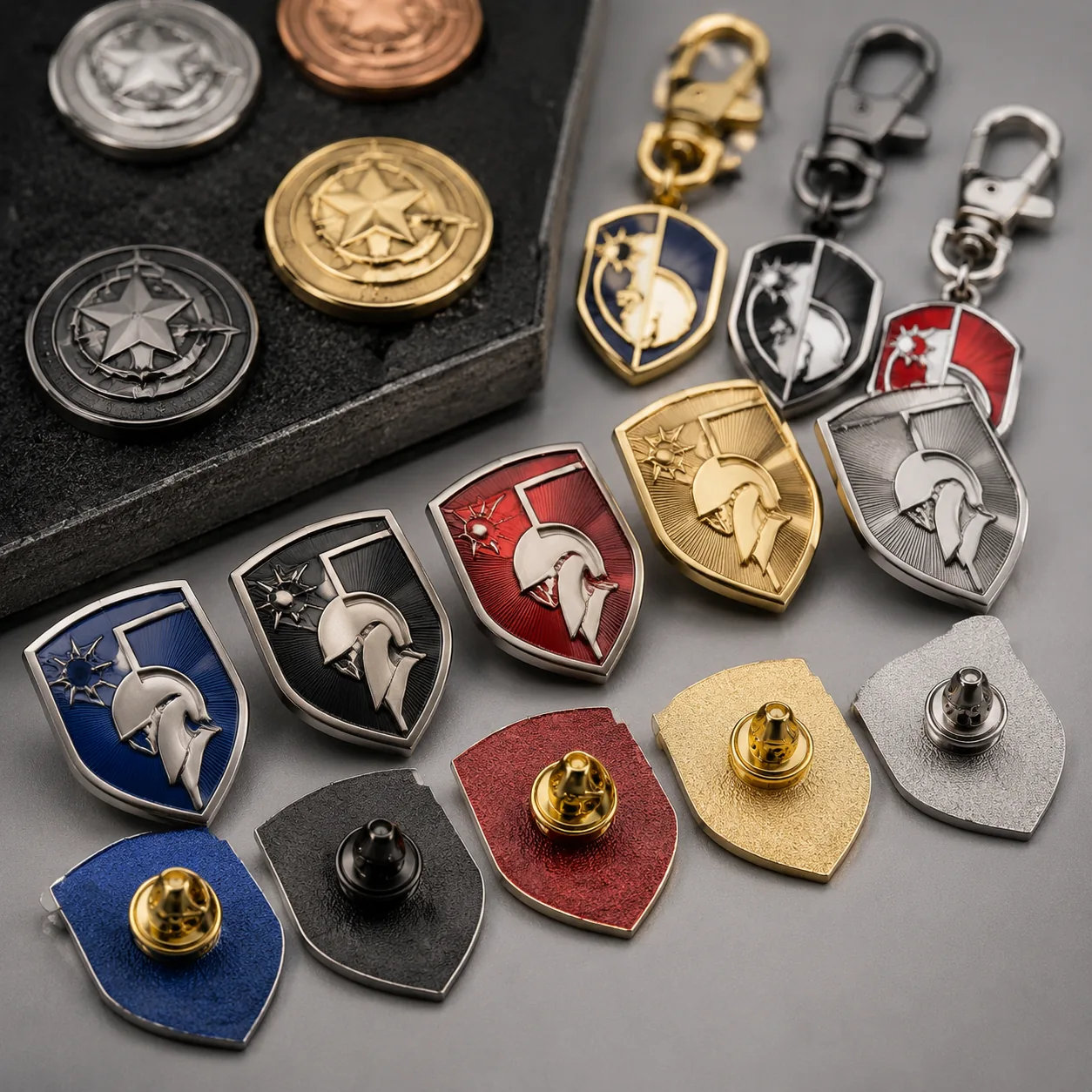
Why split-run orders fail without variant control
The difficult part of a split-run order is rarely the base pin design. It is the control of many small differences across one purchase order: 8 country flags, 12 store names, 4 membership tiers, 20 event dates, or several plating finishes using the same outline. On screen, these look like simple artwork edits. On the production floor, they become separate enamel filling instructions, plating lots, printing setups, inspection samples, packing labels, and sometimes separate molds.
If the PO says only “same design, assorted versions,” the factory must guess where the common design ends and the variant begins. That creates preventable errors: the wrong Pantone fill on one SKU, French text packed for the German market, mixed inner cartons, or a tooling quote based on one mold when raised metal text actually requires six dies. For distributors, the most expensive failure is usually not a small cosmetic defect. It is receiving 3,000 correct-looking pins that cannot be sorted by market before the event deadline.
A factory-ready split-run RFQ should separate the master specification from the variant matrix. The master spec locks the common construction: size, thickness, base metal, enamel type, plating, attachment, packaging, tolerance, and inspection level. The matrix controls each version by code, quantity, artwork change, finish, packing requirement, and sample requirement. This structure applies to enamel pins, challenge coins, metal keychains, brooches, fridge magnets with metal plates, badges, and small die-struck or cast promotional items.
Define each variant before quoting
A variant is any version that must be controlled separately in artwork, tooling, production, inspection, packing, or inventory. A Pantone color change is a variant. So is a different backstamp, printed name, serial number range, plating finish, attachment, backing card, or carton label. Even if the front silhouette stays identical, the factory still needs a separate production instruction if the finished item must be counted, inspected, or shipped separately.
For enamel pins, a color-only change normally does not require a new mold if all raised metal lines, cutouts, recessed areas, and overall dimensions remain identical. A change from 30 mm to 35 mm requires new tooling. A different outline, cutout, raised metal letter, recessed logo, or 3D relief also requires new tooling because the die cavity changes. Laser engraving can often vary rear text without a new mold, but stamped back text usually cannot.
Use stable codes before sending files. Codes such as PIN-A01, PIN-A02, and PIN-A03 are safer than market names alone because they can follow the order through proofing, production cards, inspection reports, polybag labels, and carton marks. A good code system also prevents confusion when the buyer later changes “France” to “FR Retail” or adds a second French-language version.
| Change requested | New mold normally required? | New proof required? | Main risk to control |
|---|---|---|---|
| Pantone enamel color only | No, if metal lines are identical | Yes | Wrong fill color or mixed quantity |
| UV printed name or date | No | Yes | Registration shift, abrasion, or adhesion failure |
| Raised or recessed metal text | Yes | Yes | Wrong die used or tooling cost missed |
| Laser engraved back text | No, if rear surface allows it | Yes | Wrong rear code after front QC passes |
| Stamped backstamp change | Usually yes | Yes | Rear tooling mismatch |
| Plating finish change | No | Yes | Mixed plating lots or tone variation |
| Attachment change | No, if back layout fits | Yes | Rotation, sagging, or wrong clutch packed |
| Size, outline, or cutout change | Yes | Yes | Incorrect quotation and delayed lead time |
Choose the right split-run structure
Most split-run metal products fall into one of three production structures. The first is one shared mold with color-only enamel changes. This is the cleanest and lowest-cost structure when the raised metal outline, internal walls, cutouts, text, and size stay fixed. For a 25 to 35 mm iron or zinc alloy enamel pin, a typical mold charge is USD 35 to 80 per design, while color-only variants mainly add proofing, color setup, filling control, and packing labor.
The second structure is one shared metal base with printed or engraved variable details. A 30 mm hard enamel pin, for example, can use one polished gold base and then receive UV printed store names, dates, flags, or QR codes. This avoids multiple molds and keeps small text legible when molded strokes would be too fine. It is less durable than metal-separated enamel, so specify adhesion testing, rub resistance, and optional epoxy if the item will face heavy handling, retail peg display abrasion, or outdoor use.
The third structure is true multi-tooling. It is necessary when each version has different raised lettering, silhouettes, cutouts, relief details, or molded serial ranges. Multi-tooling gives the sharpest metal detail and the best long-term durability, but it increases setup time, tooling cost, and QC complexity. For 10 variants at 100 pieces each, multi-tooling can make the order more expensive than redesigning around one common base plus printed variable fields.
- Use one shared mold when only enamel colors change and all metal walls are identical.
- Use UV print or laser engraving for variable text below 0.6 mm stroke width or very small dates.
- Use separate molds when the outline, cutouts, raised letters, recessed marks, or 3D relief change.
- Do not mix plating finishes in one low-volume run unless tone variation is acceptable.
- Ask for MOQ and price by variant, not only by total PO quantity.
- Confirm whether each variant needs a physical sample or only a digital proof.
MOQ, price, tooling, and lead-time benchmarks
A split run is not priced like one simple bulk order. A factory may receive 2,400 pieces total, but 12 variants at 200 pieces each still require 12 controlled counts, 12 proof checks, and often 12 packing labels. Handling cost rises as the quantity per variant falls. Below 50 pieces per variant, labor, setup, and QC usually matter more than the metal cost.
For custom enamel pins around 25 to 35 mm, practical MOQ is often 50 to 100 pieces per variant for soft enamel and 100 pieces per variant for hard enamel. Retail-grade hard enamel below 100 pieces per version is possible in some factories, but the price jump is usually steep because polishing, plating, and color control do not scale down cleanly. For challenge coins, MOQ is commonly 100 pieces per variant, and coin molds are usually more expensive than pin molds because diameter, thickness, and relief depth are larger.
As a working FOB China benchmark, a 30 mm soft enamel split-run pin in iron or zinc alloy usually lands around USD 0.55 to 1.30 per piece at 1,000 to 3,000 total pieces, excluding mold charges and freight. Hard enamel may run USD 0.85 to 1.80 per piece in the same size range. Add cost for antique plating, epoxy dome, backing cards, two posts, retail barcodes, or individual labeling. Separate molds can add USD 35 to 120 each for pins and more for coins, depending on size and relief.
Lead time also changes. A single-version enamel pin can often be completed in 12 to 18 production days after artwork approval and deposit. A split run with 6 to 12 variants usually needs 15 to 24 production days. Orders with separate molds, multiple plating finishes, or variant-level physical samples commonly need 22 to 35 production days. International freight, customs clearance, and buyer-side approval time are not included in these production-day estimates.
| Order structure | Typical MOQ guidance | FOB unit range | Production lead time |
|---|---|---|---|
| 1 design, 1 variant, 30 mm soft enamel | 100 pcs | USD 0.45 to 0.95 | 12 to 18 days |
| 1 mold, 4 enamel color variants, 250 pcs each | 100 pcs per variant | USD 0.55 to 1.05 | 14 to 20 days |
| 1 mold, 12 UV printed name variants, 100 pcs each | 50 to 100 pcs per variant | USD 0.70 to 1.35 | 16 to 24 days |
| 8 separate pin molds, 100 pcs each | 100 pcs per variant | USD 1.10 to 2.20 plus tooling | 20 to 30 days |
| 20 variants below 50 pcs each | Case by case | Often USD 1.80+ | 25 to 35 days |
| Challenge coin split run, 45 to 50 mm | 100 pcs per variant | USD 2.20 to 5.50 plus tooling | 25 to 40 days |
Lock artwork, tolerances, and color standards
The safest artwork package is one master technical drawing plus one variant matrix. The master drawing should show size, thickness, base metal, plating finish, enamel type, line widths, attachment position, edge treatment, backing card, and packing method. The matrix should list only the changing fields: variant code, quantity, Pantone references, printed text, date, market code, backstamp, plating change, attachment change, and carton requirement.
Use millimeters and numeric tolerances. For typical 25 to 35 mm pins, specify overall size tolerance of ±0.3 mm, thickness tolerance of ±0.2 mm, and attachment position tolerance of ±0.5 mm unless the design requires tighter control. Pin post placement should normally be shown from a fixed datum, not “centered” in words. For badges above 40 mm or asymmetric shapes, two posts spaced 18 to 25 mm apart reduce rotation.
For enamel construction, metal line width should generally be at least 0.25 mm for soft enamel and 0.30 mm for hard enamel because hard enamel polishing can thin fine metal walls. Raised borders around enamel areas should be at least 0.30 mm where possible. Very small enamel pockets under 1.5 mm wide are harder to fill consistently and may show more perceived color shift because surrounding metal reflects light into the color.
Color control should name the Pantone book and finish, such as Pantone Coated or Uncoated. For promotional pins, visual match to the approved sample is often more practical than instrument readings on tiny enamel areas. If a measurable standard is required, define Delta E only for flat printed areas large enough to read reliably; a Delta E target on a 1 mm enamel cell is usually not meaningful. For printed details, specify minimum text height, stroke width, and whether the print needs epoxy protection.
- Provide editable vector artwork plus a locked PDF proof for approval.
- Create one variant matrix with code, quantity, Pantone, text, finish, attachment, and packing ratio.
- Mark variable details as enamel, print, engraving, raised metal, or recessed metal.
- Avoid sending many separate files with inconsistent names and no master table.
- Confirm whether the proof must show every SKU or only the master plus variant callouts.
- State acceptable tolerances for size, thickness, color, attachment position, and card cutting.
Specify plating, attachment, and packaging by SKU
Plating is not a simple color swap. Gold, nickel, black nickel, rose gold, antique brass, antique copper, and matte finishes require different bath control, pretreatment, and visual standards. If one campaign uses multiple finishes, group variants by plating in the PO and expect separate production lots. For decorative electroplating on promotional pins and keychains, 3 to 5 microns is common for low-cost giveaways, while 5 to 8 microns is safer for retail pins, brooches, coins, or items handled repeatedly. Thicker plating improves wear resistance but can soften fine details and raise cost.
Attachments must be controlled in the matrix, not assumed from the artwork. A 30 mm pin typically uses one butterfly clutch or rubber clutch. A 45 mm badge, tall logo, or off-center design may need two posts to prevent rotation. Keychains need the ring diameter and chain style specified. Magnets should state magnet diameter, thickness, and expected pull strength where relevant. Brooch fittings should be approved on a rear-view drawing because placement affects how the product hangs on fabric.
Packing needs the same precision as the product. A clear packing instruction might read: one pin on a 300 gsm backing card, card size 55 × 85 mm with ±1 mm cutting tolerance, one card per OPP bag, 100 pieces per inner carton by variant only, five inner cartons per export carton, no mixed SKUs unless the carton label lists every code and quantity. Export cartons for small pins and keychains should normally stay under 15 kg gross weight to reduce crushing and handling damage.
| Spec item | Recommended control | When to avoid |
|---|---|---|
| Mixed plating finishes | Separate production groups and carton labels | Avoid when all variants must match under one retail display light |
| Black nickel with dark enamel | Check contrast on full-size proof | Avoid for small text or thin line art |
| Rubber clutch | Comfortable for event wear | Avoid when lowest unit cost is the only priority |
| Two pin posts | Use above 40 mm or on off-center shapes | Avoid on delicate fabrics unless approved |
| Magnet attachment | State magnet size and pull expectation | Avoid for thick jackets or safety-critical wearables |
| Backing cards by variant | Code card artwork separately from pin artwork | Avoid generic cards when market text differs |
Build inspection around variant risk
Inspection must reflect variant count, not just total order quantity. If 2,400 pins are split across 12 SKUs, a random carton sample can miss a version-specific error. The inspection plan should require each variant to be opened, counted, visually checked, and compared with the approved proof or golden sample. At minimum, require 100 percent verification that every variant code exists in the correct quantity before carton sealing.
A practical inspection baseline is general inspection level II with AQL 2.5 for major defects and AQL 4.0 for minor defects, plus a separate 100 percent SKU presence and carton-label check. Major defects include wrong variant, wrong plating, missing attachment, incorrect logo, severe enamel void, exposed base metal, sharp burr, unreadable required text, or packaging label mismatch. Minor defects include small dust spots, slight enamel unevenness, tiny polishing marks, or minor color variation within the approved sample range.
For high-risk split runs, request in-process photos after plating and after enamel filling, not only final packed-carton photos. This catches wrong metal finish, wrong enamel assignment, and missing variable print before the goods are sealed. Keep one factory-retained sample per variant for reorder control and dispute resolution. For repeat programs, retained samples are often more useful than chat history because they show plating tone, enamel depth, attachment, and packaging in one reference.
- Inspect at least 13 pieces per variant when the AQL sample would otherwise miss a SKU.
- Require 100 percent count verification by variant code before export cartons are sealed.
- Photograph one approved packed unit for every variant and packaging style.
- Reject carton labels that list only total quantity without SKU breakdown.
- Keep one retained sample per variant for reorder, claim, and color-reference control.
Send a quotation package factories can price accurately
Before requesting a split-run quote, reduce the project to two documents: a master specification and a variant matrix. The master spec should state product type, size, thickness, base metal, enamel type, plating thickness target, attachment, packaging, inspection level, AQL, delivery deadline, and whether the quote is FOB, EXW, or DDP. The matrix should state each variant code, quantity, color change, text change, finish change, packing requirement, and physical-sample requirement.
A strong RFQ is specific enough to remove guessing: “Please quote 1,200 pieces total of 30 mm soft enamel pins using one shared mold, 6 Pantone color variants at 200 pieces each, gold plating 5 microns target, one rubber clutch, individual OPP bag, inner cartons separated by variant, general inspection level II with AQL 2.5 major and 4.0 minor, FOB Ningbo, production lead time required within 20 days after artwork approval.” That sentence gives the factory the key cost drivers: tooling, quantity per variant, finish, packing, inspection, and delivery pressure.
If the schedule is tight, approve one master physical sample and digital proofs for minor color-only variants instead of requiring every variant as a physical pre-production sample. If text, plating, attachment, or packaging changes by SKU, sample the high-risk variants rather than only the easiest one. A factory can usually identify tooling, MOQ, lead-time, and packing risks before sampling if the variant matrix is complete; without it, the quote may look cheaper but the risk moves into production.
Have a project? Send your artwork and target quantity and we’ll reply with a detailed quotation within 12 working hours.
Ready to get this made?
Send your sketch, target quantity and ship-date. Detailed quotation in 12 hours.



