Split Rings vs Lobster Clasps for Custom Keychains
Why the Hardware Choice Drives Complaints
Most keychain returns are not caused by artwork. They happen because the load path was underspecified: the ring opens, the clasp gate sticks, the jump ring pulls apart, or the plating wears through at the moving point. A charm can pass visual approval and still fail after two weeks on a backpack zipper if the attachment hardware was selected only from a product photo.
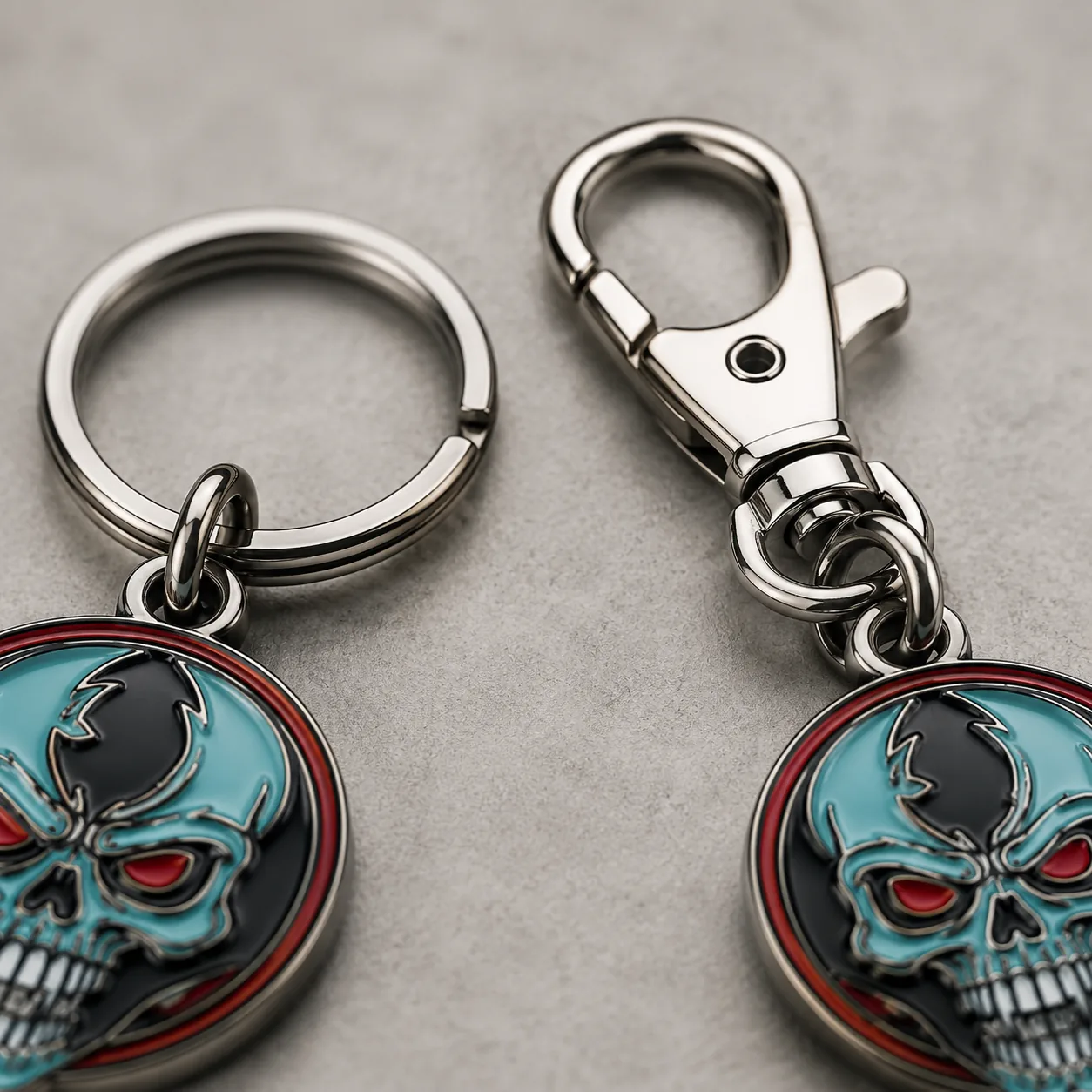
Split rings and lobster clasps solve different use cases. A 25 mm split ring made from 1.6 to 1.8 mm steel wire is normally the safer choice for real keys and heavier metal charms. A 32 to 38 mm zinc alloy lobster clasp is more convenient for bag charms, zipper pulls, event badges, lanyards and retail accessories that users attach and remove often. Neither is universally better; the right part is the one that matches the load, pull direction and handling behavior.
For custom orders from 500 to 50,000 pieces, this decision affects unit cost, MOQ, production lead time, plating consistency, carton volume and inspection time. At ZheCraft, we usually confirm the hanging scenario before quoting because the same 45 mm enamel charm may need a split ring for a souvenir keychain, a lobster clasp for a bag charm, or both for a retail program with mixed channels.
Technical Comparison Table
Use the table as a specification filter before approving artwork. The lowest quote often hides a downgrade, such as a 1.2 mm split ring instead of 1.8 mm wire, or a light lobster clasp with a weak spring gate. For B2B purchasing, the RFQ should state hardware size, material, plating, pull test and inspection level.
| Specification | Split ring | Lobster clasp |
|---|---|---|
| Common outside size | 20, 25, 28, 30, 32 mm | 25, 28, 32, 38, 45 mm overall length |
| Typical material | High-carbon or stainless steel wire | Zinc alloy body with steel spring and pin |
| Recommended thickness | 1.4 mm light duty; 1.6 mm standard; 1.8 to 2.0 mm heavy duty | 2.5 to 4.5 mm body section; reinforced models need stronger gate spring |
| Recommended charm weight | Up to 60 g for 25 to 30 mm rings when jump ring is also upgraded | 15 to 35 g for standard 32 mm clasp; 35 to 50 g only with reinforced clasp |
| Best use case | Keys, coins, bottle openers, die-cast metal charms, daily carry | Bag charms, zipper pulls, lanyards, event passes, removable retail accessories |
| Main failure mode | Ring gap opens, wire bends, burrs scratch plating or fabric | Spring fatigue, gate misalignment, hinge jam, accidental release under twisting load |
| Plating target | 0.08 to 0.15 micron flash; 0.2 to 0.3 micron for better sweat and humidity resistance | 0.08 to 0.15 micron standard; 0.2 micron target if gate clearance is controlled |
| Pull test target | 10 kgf for promotional items; 15 to 18 kgf for heavier metal keychains | 5 kgf standard; 8 to 10 kgf for reinforced clasp programs |
| FOB hardware impact | USD 0.015 to 0.06 per unit for standard ring; USD 0.03 to 0.09 with chain and upgraded plating | USD 0.06 to 0.18 per unit for 32 mm; USD 0.12 to 0.28 for 38 to 45 mm or custom finish |
| MOQ impact | Usually fits normal 500 pc custom keychain MOQ if size and finish are stock | Stock nickel may start at 500 pcs; custom finish or large clasp commonly needs 1,000 to 3,000 pcs |
| Lead-time impact | 0 to 1 added day if stocked; 2 to 3 days if custom plated | 1 to 4 added days for matching plating; 3 to 7 days if clasp model must be purchased or custom finished |
| Inspection focus | Ring gap, wire diameter, burrs, hardness, plating coverage | Gate return, spring tension, hinge alignment, casting pits, plating at moving contact points |
Strength, Load Path and Failure Modes
Split rings win on simple tensile reliability because they are continuous wire with no moving gate. For most promotional keychains, 1.6 mm steel wire is a sensible baseline. Use 1.8 mm wire for metal charms above 35 g, bottle opener keychains, challenge coin keychains or products expected to carry multiple house and car keys. Below 1.4 mm, the ring may feel cheap and can deform when users force thick keys onto it.
Lobster clasps fail in a different way. The casting may look substantial, but the spring gate determines the practical strength. A standard 32 mm zinc alloy clasp is usually acceptable for a 15 to 25 g acrylic, PVC or enamel charm clipped to a tote. It is not a good default for a 50 g die-cast keychain carrying keys unless the clasp is reinforced and tested under both straight pull and twisting movement.
The full load path matters more than the headline hardware. A strong 30 mm split ring does not protect the product if the connector jump ring is 0.8 mm soft iron wire. For metal charms above 35 g, specify a connector jump ring of at least 1.2 mm wire, preferably 1.4 mm when the charm hole allows it. The charm hole, jump ring, chain link, swivel and final ring or clasp should all be treated as load-bearing parts.
A practical pre-production test is simple: hold 10 kgf for 10 seconds on standard split-ring keychains, 15 kgf for heavier metal items, and 5 to 8 kgf for lobster clasp accessories. After testing, the split ring gap should not open more than 0.5 mm, and the clasp gate should still close fully without sideways play.
User Experience and Product Positioning
If the item is meant to hold keys permanently, choose a split ring or a split ring with a short chain. Users expect to pry keys onto it once and leave them there. A stiffer ring may be slightly inconvenient during first use, but it communicates strength and reduces accidental loss.
If the item is meant to move between a tote bag, zipper, lanyard loop, stroller hook or event pass, choose a lobster clasp. The gate lets users attach and remove the charm without tools or fingernail damage. This matters for fashion accessories, convention merchandise, school club items and retail add-ons where the charm is handled frequently but does not carry heavy keys.
Perceived value also changes. A lobster clasp can make a lightweight charm feel more giftable because it adds movement and an accessory look. However, a weak spring makes the whole item feel disposable. A split ring photographs less elegantly, but it has fewer mechanical failure points in daily carry. For mixed-use giveaways, a short chain plus split ring is often the safest compromise because it tolerates twisting and rough handling better than a decorative clasp.
Plating, Corrosion and Finish Matching
Hardware plating should be specified, not assumed. Nickel, black nickel, gold, rose gold, antique brass and gunmetal can shift between charm, ring, chain and clasp because base metals plate differently. Zinc alloy clasps, steel split rings and iron jump rings do not absorb or reflect finish in the same way, so a perfect visual match is harder than it appears on a rendering.
For low-cost indoor promotional orders, 0.08 to 0.15 micron flash plating is common. For travel souvenirs, bag charms or products exposed to sweat and humidity, specify a 0.2 to 0.3 micron target on visible hardware and request a 24-hour neutral salt spray target where corrosion resistance is important. For premium retail programs, 48 hours may be reasonable, but it adds cost and requires tighter process control.
Do not over-specify plating thickness on spring-loaded clasps without confirming gate clearance. Excess plating at the hinge or gate contact area can cause sticky opening, incomplete return or flaking at the rub point. For lobster clasps, factory control matters: rack position, cleaning, drying, spring assembly and post-plating function checks are as important as the nominal micron target.
Black finishes need the most caution. Black nickel and matte black show scratches quickly at moving contact points, especially on clasp gates and swivel joints. For items handled daily, standard nickel, antique nickel or antique brass often hides wear better than glossy black, even when black better matches the brand board.
Cost, MOQ and Lead-Time Planning
Split rings are usually the lowest-risk budget option. At 1,000 pieces, a 25 mm stock nickel split ring may add USD 0.015 to 0.035 FOB per unit. With a short chain, upgraded 1.8 mm wire or color plating, the range is closer to USD 0.03 to 0.09. At 10,000 pieces, standard hardware can drop by roughly USD 0.005 to 0.015 per unit because purchasing and plating are more efficient.
Lobster clasps cost more because they include a cast body, spring, pin, hinge and functional inspection. A standard 32 mm clasp commonly adds USD 0.06 to 0.18 FOB per unit. Larger 38 to 45 mm clasps, swivel versions, reinforced springs or custom finishes can raise the increment to USD 0.12 to 0.28. If the clasp, chain and charm must match in rose gold, antique brass or black nickel, components may need to be plated together, adding 1 to 4 production days.
MOQ depends on whether the hardware is stock or custom finished. Standard nickel split rings usually fit normal custom keychain MOQs from 500 pieces. Custom-color lobster clasps, non-standard sizes and reinforced models commonly need 1,000 to 3,000 pieces because component purchasing and plating rack setup are less flexible. For ZheCraft production planning, typical lead times after sample approval are 12 to 18 days for 500 to 3,000 pieces, 18 to 25 days for 3,000 to 10,000 pieces, and 25 to 35 days for larger or multi-SKU programs.
Inspection Checklist for Purchase Orders
The hardware comparison only helps if it becomes measurable on the purchase order. Do not approve only the charm artwork and leave the factory free to choose the attachment. That creates room for quote-driven substitutions in wire thickness, clasp model, connector size or plating quality.
- State the hardware exactly: for example, 25 mm split ring, 1.8 mm steel wire, nickel plated; or 32 mm zinc alloy lobster clasp with steel spring gate.
- Specify connector parts: jump ring minimum 1.2 mm wire for charms above 35 g; chain link thickness and length if a chain is used.
- Set pull testing: 10 kgf for standard split-ring keychains, 15 kgf for heavier metal items, 5 to 8 kgf for standard lobster clasp accessories.
- Control gaps and tolerances: split ring OD tolerance ±0.5 mm, wire tolerance ±0.1 mm, pre-test ring gap under 0.3 mm and post-test gap under 0.5 mm.
- Check clasp function: open and release each pre-production clasp sample at least 20 times with no sticking, weak return or sideways gate movement.
- Inspect touch points: no sharp burrs on ring ends, jump rings, chain links, clasp gates or charm holes, especially for children’s items or fabric use.
- Use AQL levels: AQL 2.5 for broken springs, open rings, missing parts and severe plating peel; AQL 4.0 for light scratches or minor shade variation.
For production inspection, separate functional failures from cosmetic issues. A broken spring, missing jump ring, open split ring or severe plating peel is a major defect. A tiny polishing mark on the back of a clasp may be minor if it does not affect use. This distinction keeps inspection strict where failure matters without rejecting acceptable commercial hardware for harmless marks.
RFQ Wording That Prevents Substitution
Start the RFQ by defining the use case: permanent key carrier or removable accessory. For real keys, begin with a 25 to 30 mm split ring in 1.6 to 1.8 mm steel wire. For bags, zippers and event loops, begin with a 32 to 38 mm lobster clasp and require spring function testing.
A clear split-ring RFQ line would read: custom enamel keychain, 45 mm charm, estimated finished weight under 35 g, 25 mm split ring, 1.8 mm steel wire, matching nickel plating with 0.2 micron target, connector jump ring minimum 1.2 mm wire, pull test 10 kgf for 10 seconds, split ring gap under 0.5 mm after test, AQL 2.5 major and AQL 4.0 minor.
A clear clasp RFQ line would read: custom acrylic or enamel bag charm, finished weight under 25 g, 32 mm zinc alloy lobster clasp with steel spring gate, matching plating, open-close cycle test 20 times on pre-production sample, pull test 5 kgf for 10 seconds, no gate sticking after plating, AQL 2.5 for broken spring or gate failure.
When comparing supplier quotes, ask each factory to confirm hardware size, material, wire thickness or clasp model, plating target, pull-test standard, MOQ and whether the hardware is stock or custom plated. ZheCraft can quote both hardware options on the same charm artwork, including FOB price difference, sample photos, pull-test targets and packing method, so buyers approve the attachment before tooling and mass production begin.
Have a project? Send your artwork and target quantity and we’ll reply with a detailed quotation within 12 working hours.
Ready to get this made?
Send your sketch, target quantity and ship-date. Detailed quotation in 12 hours.



