Specifying Custom Pins for Air vs Sea vs Express: 2026 Freight Guide
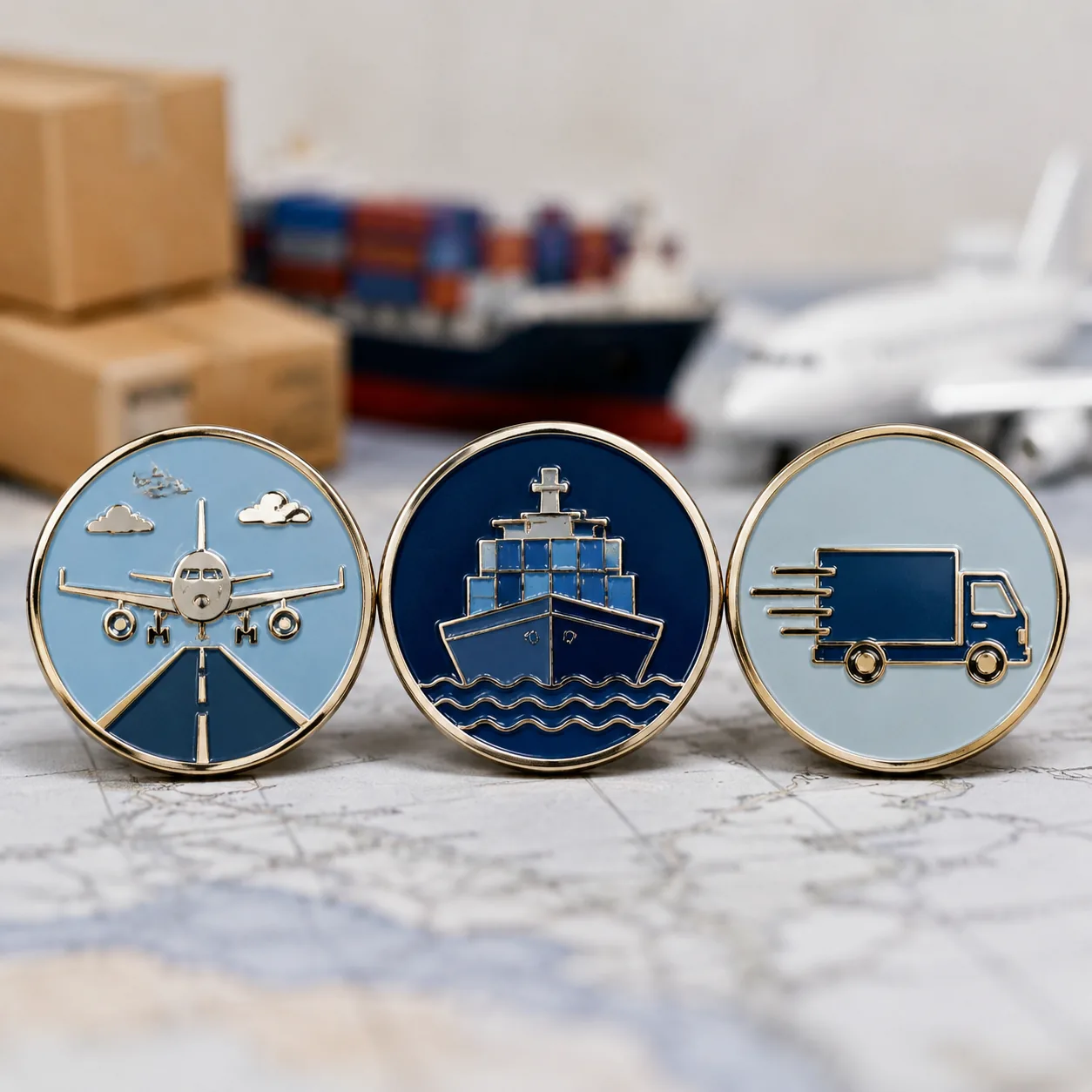
Set Freight Assumptions in the RFQ Before Tooling Starts
Freight mode is not a back-end logistics choice for custom metal accessories. It affects product construction, packaging, carton plan, and landed margin, so it needs to be fixed at RFQ stage. The variables that matter most are packed unit weight, packed cube, retail-pack requirement, and required in-hands date. If those stay vague until after samples are approved, the quote is usually built on optimistic packing assumptions that do not survive production.
A standard 1.25 in soft enamel pin in stamped iron, 1.2-1.5 mm thick, with butterfly clutch and individual OPP bag typically ships at about 9-13 g packed. Add a 300 gsm backing card and that often rises to 11-16 g. Add a velvet pouch and the same item can reach 18-24 g packed while taking 2.5-4.0 times the volume. That difference matters modestly on ocean freight, but it materially raises chargeable weight for air cargo and courier because both modes bill on dimensional rules as well as scale weight.
The mode should therefore shape the product spec. If 300-800 pcs must arrive within 7-12 calendar days, the design should be engineered for express from the start: simple polybag, no rigid gift box, minimal inserts, compact carton geometry, and no decorative packaging that is not sale-critical. If 5,000-20,000 pcs are buying stock for a distributor or event calendar with a 35-60 day delivery window, the product should be engineered for sea: denser inner packing, moisture control, carton compression limits, and pallet instructions if the warehouse requires palletized receipt.
MOQ also interacts with freight earlier than many buyers expect. For 2026 sourcing, common factory MOQs are roughly 100-300 pcs for standard enamel pins, 100-250 pcs for zinc-alloy keychains, and 50-100 pcs for challenge coins, but those MOQs say nothing about the efficient shipping mode. A 300-pc coin order can already be heavy enough for air rather than express, while a 1,500-pc pin order may still move economically by air if packed loose and dense.
Sea Freight Wins on Larger, Heavier, or Retail-Packed Orders
Sea freight is usually the lowest landed-cost option once the order is heavy, bulky, or packaged for retail. For custom pins, that commonly means 3,000+ pcs in simple bags or 1,500+ pcs when each unit includes a card, pouch, or display box. The switch point is lower for heavier products. A 2.0 in zinc-alloy keychain often packs at 28-42 g per unit, while a 1.75 in challenge coin at 3.0-3.5 mm thickness commonly packs at 45-75 g, or 60-95 g if a capsule or presentation box is included.
For 2026 planning, China to US West Coast ocean transit is typically 18-25 days port to port, but buyers should model 28-40 days total for LCL after origin pickup, CFS receiving, export customs, deconsolidation, destination handling, import clearance, and final delivery. Coastal China to North Europe is more realistically 32-45 days total, and to the UK about 30-42 days. If routing uses transshipment or the shipment moves during pre-holiday peaks, add 5-7 days buffer.
LCL is normal for pins because most orders do not justify a full container, but small LCL shipments can look cheaper than they are. In 2026, origin LCL charges are often around USD 55-120 per CBM, yet destination CFS, terminal, documentation, and broker fees frequently add USD 180-450 per shipment. That means a 0.25 CBM shipment can carry a worse per-unit freight cost than a 0.90 CBM shipment, even though the line-haul rate itself is low.
Carton discipline matters because LCL cargo is handled more often than FCL freight. A practical master carton limit for pins and keychains is 40 x 30 x 25 cm or 45 x 35 x 30 cm, with gross weight capped at 12-15 kg. For challenge coins, many importers cap at 10-12 kg because dense cartons are harder on handlers and more prone to corner crush if overfilled. A dense 1.25 in pin in OPP bags only may fit roughly 1,200-1,800 pcs per master carton. Add card plus pouch and capacity often falls to 350-700 pcs.
FOB benchmarks should be read together with freight mode. In 2026, a standard 1.25 in soft enamel pin with 4 fill colors, stamped iron or zinc alloy base, butterfly clutch, and individual bag is commonly around USD 0.30-0.58 at 300 pcs, USD 0.20-0.36 at 1,000 pcs, USD 0.15-0.28 at 3,000 pcs, and USD 0.13-0.24 at 5,000 pcs FOB China. Sea freight usually becomes the better landed-cost choice once the shipment is above about 70-90 kg gross, 0.55-0.75 CBM, or uses packaging that inflates cube faster than metal cost declines.
Air Cargo Works for Mid-Size Urgent Orders if You Control Cube
Air cargo fills the gap between courier speed and ocean economics. For custom metal accessories, it is typically the right fit for about 500-4,000 pins, 300-2,000 keychains, or 200-1,500 coins when the goods need to arrive in roughly 8-18 days from factory ready date. Airport-to-airport transit may be only 3-6 days, but the realistic total cycle is usually 8-14 days after booking, security screening, export handling, import clearance, and delivery. During peak periods, 15-18 days is a safer planning number.
In 2026, general air cargo ex-Shanghai, Ningbo, Shenzhen, or Hong Kong to major US gateways often runs around USD 4.80-7.80 per kg for 45 kg+ chargeable-weight shipments, with higher minimum rates for consignments under 45 kg. To Western Europe, a common planning range is USD 4.60-7.20 per kg on similar weight breaks. Those figures usually exclude customs brokerage, terminal fees, and local delivery.
The core risk is dimensional billing. Air cargo commonly uses a 6000 cm3 per kg divisor. A carton at 50 x 40 x 30 cm equals 60,000 cm3, so it bills as 10.0 kg even if the actual scale weight is only 7.1 kg. Repack the same goods into 40 x 35 x 25 cm and chargeable weight falls to 5.8 kg. On a USD 6.20 per kg lane, that is about USD 26 lower on a single carton before origin and destination handling. Multiply that across a 20-carton shipment and the packaging decision is worth more than a small FOB concession.
For air orders, keep the spec dense and mechanical. Use backing cards only if the customer needs them for final sale. Avoid velvet pouches, blister shells, and rigid boxes unless they are part of the sellable SKU. When geometry allows, 1.5 mm stamped iron can save meaningful weight versus 2.0 mm die-cast zinc alloy. As a practical factory benchmark, stamped outlines often hold about +/-0.15 mm to +/-0.20 mm, while die-cast zinc is more often +/-0.20 mm to +/-0.30 mm depending on part shape, cutouts, and polishing load.
Express Courier Is Best for Samples, Replacements, and Small Launch Lots
Express courier is usually the right choice for pre-production samples, golden samples, urgent replacements, and small commercial launches. DHL, FedEx, and UPS commonly deliver China-origin parcels to the US or Europe in 3-6 business days, with customs holds stretching some shipments to 7-9 business days. For shipments below about 2-3 kg, express is often simpler than airport freight because pickup, export paperwork, customs handoff, and final delivery are integrated.
Courier pricing is driven heavily by dimensional weight. Most integrators use a 5000 cm3 per kg divisor. A 20 x 15 x 10 cm parcel bills at 0.6 kg. A loose sample pack in a 30 x 25 x 20 cm carton bills at 3.0 kg even if the metal parts weigh less than 1.0 kg. This is why sample freight often exceeds sample making cost when the factory uses oversized cartons or too much void fill.
For 2026 budgeting, small express shipments from China to the US commonly run about USD 38-70 for 0.5-2.0 kg, USD 60-120 for 2-5 kg, and USD 110-190 for 5-10 kg on normal commercial accounts, excluding duty, brokerage disbursement, and remote-area surcharges. A plated pin sample set may cost USD 30-90 FOB for tooling and sample making, then another USD 40-80 to courier if sent alone. Consolidating 3-5 designs into one parcel often reduces total courier spend by 25-40 percent compared with separate shipments.
The right courier pack is minimal but controlled: one close-fit outer carton, E-flute corrugated at roughly 32 ECT, grouped inner bags, and only enough foam, tissue, or paper to stop metal-to-metal contact. For polished coins, 1 mm foam sheets or tissue separators are usually enough to protect mirrored faces. For keychains, nested split rings reduce abrasion. If printed cards require approval, it is often cheaper to ship cards flat and pins loose in protected bundles than to courier fully assembled retail packs.
Mode Benchmarks by Quantity, Weight, and Pack Style
| Mode | Typical Order Profile | Chargeable Weight Trigger | Transit Lead Time | Indicative 2026 Freight Cost | Recommended Spec |
|---|---|---|---|---|---|
| Sea LCL | 2,500-30,000 pins; 0.4-5.0 CBM; mixed SKUs or retail-ready packs | Usually favorable above about 70-90 kg gross or 0.55-0.75 CBM | 28-45 days total | Often about USD 0.01-0.05 per standard pin on dense orders; small LCL lots can be distorted by USD 180-450 destination charges | Polybag or retail pack in inner cartons; 12-15 kg max master carton; 10-20 g desiccant or VCI paper per carton |
| Sea FCL | 40,000+ pins or broad mixed accessory programs with displays, pouches, or domestic fulfillment stock | Container cube utilization matters more than unit weight | 25-40 days total | Lowest unit freight cost when load efficiency is high | Pallet pattern approved in advance; carton labels by SKU; moisture barrier and compression standard defined |
| Air Cargo | 500-4,000 pins; roughly 20-200 kg chargeable; urgent replenishment | Plan on 6000 cm3/kg divisor; target dim weight within 10-15 percent of actual | 8-18 days total | USD 4.80-7.80 per kg plus origin and destination handling | Bulk packed, compact cartons, no pouch unless mandatory, limited void fill |
| Express Courier | 1-500 pins; sample sets; replacements; 0.5-10 kg | Plan on 5000 cm3/kg divisor | 3-9 business days | USD 38-190 typical parcel band depending on weight | Smallest practical carton, grouped loose pack, combined designs, no rigid retail shell |
| Hybrid Split Shipment | Main order by sea with approval set or launch quantity by express | Useful when launch date is fixed but full stock can follow later | Express 3-9 business days plus sea 28-45 days | Higher total logistics spend but lower stockout or event risk | Courier 5-100 pcs for launch or approval; balance packed for sea |
Packaging Specs Usually Matter More Than a Few Cents of FOB
Packaging changes freight cost, carton count, and damage rate at the same time. Buyers often negotiate USD 0.02-0.04 off unit FOB, then accept a pack format that adds more than that back through board, pouch, labor, and dimensional freight. On small metal accessories, packed cube often costs more than the metal itself once the shipment moves by air or express.
- Individual OPP bag: typically adds about 0.4-0.8 g per pin. Usually sufficient for export separation and basic corrosion control.
- Backing card: common sizes from 5 x 5 cm to 5 x 9 cm in 250-350 gsm board add about 1.2-3.0 g and increase cube materially. Use when retail presentation or barcode application requires it.
- Velvet pouch: commonly adds 5-9 g and several times the packed volume of a loose pin. Better suited to sea freight or post-import kitting.
- Rigid display box or acrylic case: can add 20-60 g per unit and sharply raise dim weight. Source locally unless it is core to the SKU.
- Carton construction: E-flute or light B-flute is usually adequate for air and express. BC flute or double-wall should be reserved for heavier coin programs or cartons above 12 kg gross.
- Moisture control: for sea freight, use 10-20 g desiccant per master carton or VCI paper for tarnish-sensitive finishes such as black nickel, imitation gold, and antique copper.
- Carton limits: many importers cap courier cartons at 60 cm maximum side length and export masters at 15 kg gross to reduce damage, reweigh claims, and manual-handling issues.
A concrete example shows the tradeoff. A 2,000-pc pin order at USD 0.22 FOB looks competitive. Add a card and pouch that increase packed weight by 8 g and packed cube by roughly 18-25 cm3 per unit, and the shipment can move from one dense air consignment to two or three higher-chargeable cartons. That packaging decision can add several hundred dollars in freight and handling, which is more than the savings from shaving USD 0.02 off unit price.
Match Plating, Protection, and Inspection to Transit Risk
Freight mode changes the likely defect pattern. Sea freight means longer exposure to humidity, carton compression, and salt-laden environments. Air and express reduce corrosion exposure but add more handling points, conveyor contact, and abrasion risk. The finish spec therefore needs to cover measurable plating, anti-tarnish protection, pack separation, and inspection thresholds.
For sea shipments, ask for the plating stack in measurable terms. On iron or zinc-alloy pins, a practical commercial benchmark is nickel underplating at about 3-5 microns, followed by a decorative finish that may be around 0.03-0.10 microns depending on bright nickel, imitation gold, black nickel, or antique effect. Decorative layers are thin by nature, so the relevant question is not only color but whether an anti-tarnish lacquer is applied and whether the goods are sealed in inner bags. For black nickel, imitation gold, and antique copper, anti-tarnish coating plus sealed bags is prudent when transit exceeds 30 days.
For soft enamel, an epoxy dome around 0.3-0.5 mm can reduce abrasion on filled surfaces during bulk transit, though it adds thickness and some cube. For hard enamel or polished challenge coins, specify polished edges, no burrs, and no plating voids visible at arm's length under 600-1000 lux inspection light. If there are cutouts or pointed details, require deburring because rough edges scratch adjacent pieces in transit and create avoidable complaints.
Inspection language should be explicit. A practical acceptance standard for branded metal accessories is often AQL 2.5 for major defects, AQL 4.0 for minor defects, and zero tolerance for critical defects. Major defects typically include wrong plating color, missing attachment, exposed base metal, deep scratches on the front face, incorrect logo details, or attachment failure. Minor defects usually include slight color spread, light polishing haze, or small backside marks outside the primary visual area. Typical production tolerances are thickness +/-0.10 mm to +/-0.15 mm, attachment placement +/-1.0 mm, and outline tolerance by process: tighter on stamped parts, looser on die-cast parts with complex geometry.
Put Freight Language Into the RFQ and PO So Quotes Stay Comparable
Do not let each supplier assume its own default logistics rules. Your RFQ and PO should specify mode, incoterm, target ready date, mandatory packaging, carton limits, pallet rules, and pre-shipment reporting. Otherwise two suppliers can quote the same FOB unit price against different assumptions on pack-out, carton size, and handover point, which makes the comparison unreliable.
At minimum, define the freight mode, the incoterm, whether retail packaging is mandatory, the maximum carton dimensions and gross weight, and whether pallets are allowed. For air and express, require final carton dimensions and actual gross weight before dispatch so chargeable weight can be verified. For sea, state whether pallets are prohibited for LCL or required by the destination warehouse, because that decision changes cube and handling cost materially.
A usable PO clause is operational, not generic: Freight mode: Air Cargo. Incoterm: FOB Shanghai. Ready date: no later than 2026-05-12. Carton max: 55 x 35 x 30 cm, 12 kg gross. Packaging: bulk pack by design, no pouch, no blister shell, backing cards flat-packed only. Moisture protection: not required. Pre-shipment report: carton count, dimensions, gross and net weight, photos of carton markings, and invoice value before handover. Inspection standard: AQL 2.5/4.0. Repacking or carton resizing without written approval: not permitted.
That level of detail blocks common cost leakage: late repacking, oversized cartons, excess void fill, and surprise dimensional-weight charges. When packaging is changed after production, factories often charge about USD 0.03-0.10 per unit for repacking depending on insert complexity, labor, and whether printed materials must be remade. On low-value pins, that charge can erase the entire unit-price negotiation.
Choose by Landed Cost per Saleable Unit, Not Habit
The decision rule is straightforward. Use express for sample approvals, replacements, and small urgent quantities. Use air when the launch window is tight but the goods can be packed densely enough that chargeable weight stays close to actual weight. Use sea when unit weight is high, packaging is retail-heavy, or order size is large enough that per-unit freight matters more than speed.
For a standard 1.25 in pin program, the real decision zone is often 1,000-5,000 pcs. In that range, packing density is usually more important than unit count. A 2,000-pc order packed loose in compact cartons may still work by air if the launch date is near and the chargeable weight stays controlled. The same order packed with card, pouch, and gift box will usually land cheaper by sea even though FOB unit price is unchanged. For keychains and challenge coins, sea tends to become favorable at lower piece counts because metal mass pushes freight cost up faster.
When comparing suppliers, always ask for three figures together: FOB unit price, final packed carton details, and estimated shipment gross weight. Without all three, landed-cost modeling is incomplete. Buyers who treat freight as part of the product specification generally save more than buyers who focus only on a few cents of FOB and ignore how the goods will actually move.
Have a project? Send your artwork and target quantity and we’ll reply with a detailed quotation within 12 working hours.
Ready to get this made?
Send your sketch, target quantity and ship-date. Detailed quotation in 12 hours.



