Sourcing Lower-Impact Custom Pins and Keychains in 2026
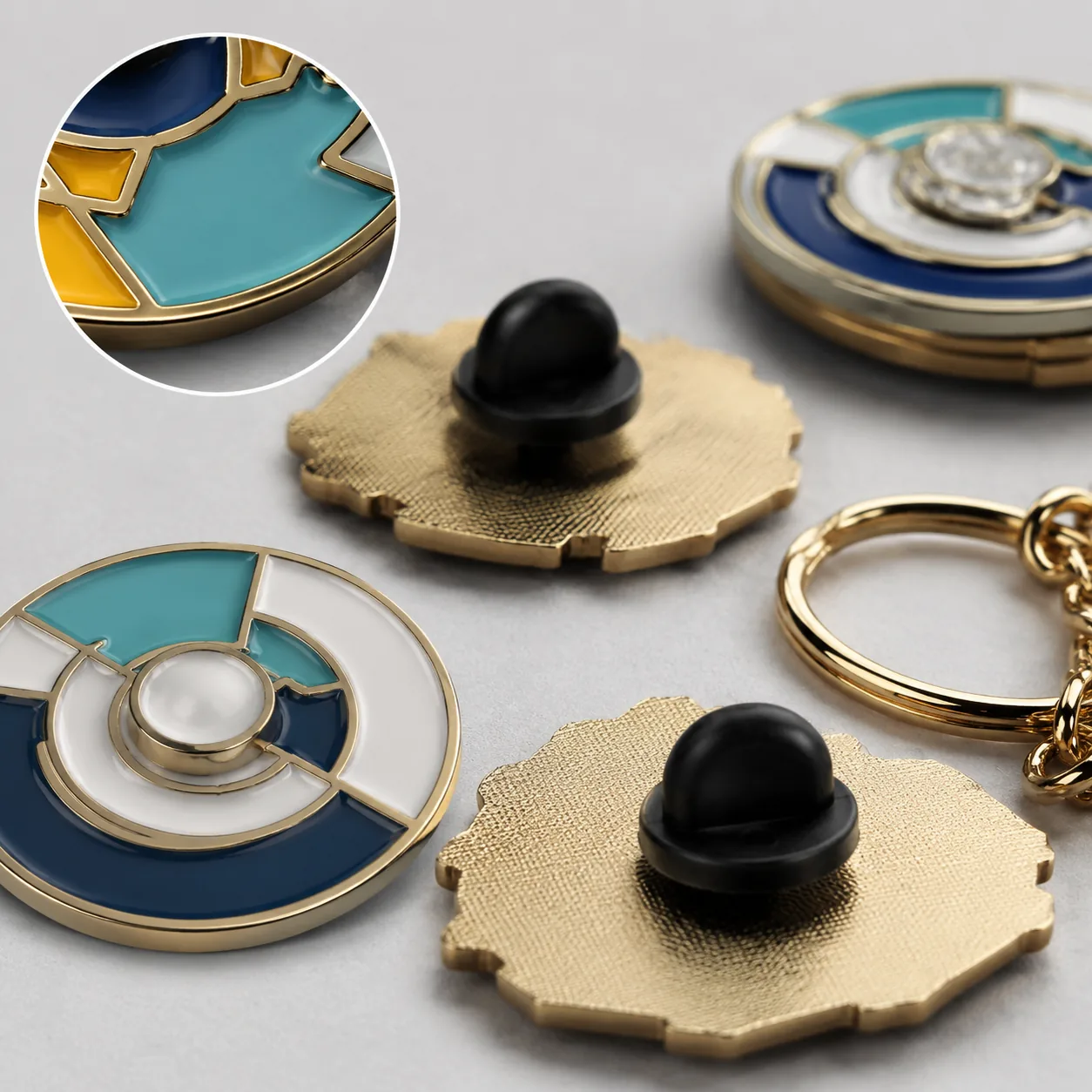
Start with the specifications that move both impact and landed cost
Most custom pin and keychain RFQs still overemphasize visible details such as logo size, plating color, and attachment style, then add an "eco" request at the end. That usually produces a standard zinc-alloy item with a recycled-paper card and no meaningful change to packaging waste, defect rate, or freight mode. If the RFQ does not define material declaration, card stock, unit pack, inner pack, carton limits, and shipping mode, the supplier has little room to optimize anything beyond appearance.
For 2026, the practical target is not a theoretical zero-impact promotional item. It is a lower-impact specification the factory can quote, sample, inspect, and repeat at production scale. In most B2B programs, the biggest controllable reductions come from five variables: switching virgin backing cards to 300-350 gsm recycled or FSC-certified stock, eliminating individual OPP bags where finish risk permits, consolidating inner packs to 50 or 100 pieces, shifting freight from air to sea or rail when schedule allows, and using recycled-content components only where the supplier can support the claim in writing.
Ask for the same design in structured build paths, not for an undefined eco version. For example, quote one 40 mm soft enamel pin, 1.5 mm thick, four Pantone colors, butterfly clutch, at 1,000 pieces as: Option A, zinc alloy with standard OPP bag; Option B, zinc alloy with 350 gsm recycled card and bulk pack of 50; Option C, stamped iron body with recycled card and sea freight. Once quoted that way, FOB price, MOQ, lead time, AQL risk, and claim support become directly comparable.
Build the RFQ by component, not by claim language
A strong RFQ separates the product into components the factory and its sub-suppliers actually control: base metal, forming method, thickness, plating finish, color fill, attachment, backing card, inner pack, export carton, and freight mode. This line-item structure reveals where a lower-impact substitution is normal and where it is likely to create cosmetic fallout, sampling delay, or a sustainability claim the supplier cannot document.
Reasonable requests include 300-350 gsm recycled board, FSC-certified card, paper sleeves, soy-based offset ink where the printer offers it, removal of individual polybags on matte or lightly textured finishes, and RPET webbing on strap keychains. Less realistic asks include biodegradable plating, exact post-consumer recycled percentages on mixed foundry metal, or full traceability for every upstream alloy lot. On zinc alloy, many factories can only declare a broad recycled-input range such as 20-50% mixed recycled feed from the die-casting supplier rather than a fixed audited percentage.
- Define the item fully: for example 40 mm soft enamel pin, 1.5 mm thick, 4 Pantone colors, butterfly clutch, 1,000 pcs
- Request 2-3 quoted build options with separate line items for metal body, plating, card, packing, carton, and freight
- Ask for measurable specs: card gsm, split-ring wire diameter, RPET webbing width, plating type, declared recycled-content range, carton gross weight limit
- State non-negotiables: logo legibility, Pantone match tolerance, post alignment tolerance, approved finish appearance, no unauthorized packing changes
- Rank packing priorities clearly: no individual OPP bag, paper sleeve preferred, bulk pack by 50 or 100, retail card only if required
- Ask only for relevant compliance documents such as REACH, CPSIA, Prop 65 screening, or EN71 depending on market and product use
This format also speeds up engineering review. A supplier can reject weak combinations early, such as loose bulk packing for a mirror-polished black-nickel keychain or kraft sleeves for an epoxy dome that has not fully cured. Procurement then compares suppliers on the same commercial logic instead of on vague sustainability wording.
Match the material substitution to the product geometry
Different product types tolerate different substitutions. Pins, badges, and challenge coins are finish-sensitive, so the visible metal surface usually drives perceived quality more than the card or unit pack does. Keychains, bag charms, and lanyard-style items give more flexibility because straps, inserts, paper cards, and outer packing can be changed without altering the core metal component.
For flat 2D enamel pins, stamped iron is often the most practical alternative to die-cast zinc alloy. Iron commonly runs at 0.8-1.2 mm before plating and color fill and works well on simple outlines, shallow recesses, and limited cut-through. It is usually less suitable for deep relief, rounded sculptural forms, large internal cutouts, or 3D surfaces. Zinc alloy remains easier for those geometries at 1.5-2.5 mm because die casting handles thicker sections, undercuts, and smoother contoured edges with less hand correction.
On strap keychains, RPET webbing in 15 mm, 20 mm, or 25 mm width is now widely available, but buyers should expect slightly more lot-to-lot color drift than virgin polyester and an added dye lead time on non-stock shades. For premium jewelry-like pins or keychains, the safer lower-impact path is often to keep the zinc-alloy body unchanged and reduce impact through paper card, bulk pack, and slower freight rather than force a body-material change that increases scrap or cosmetic defects.
| Component | Common Standard Spec | Lower-Impact Option | Technical Trade-Off | Typical MOQ / Cost Effect |
|---|---|---|---|---|
| Pin body | Zinc alloy die cast, 1.5-2.0 mm | Stamped iron, 0.8-1.2 mm for flat 2D designs | Not ideal for deep relief, heavy cut-through, or rounded sculpted forms | MOQ usually unchanged above 500 pcs; FOB often decreases by USD 0.03-0.10/pc |
| Keychain strap | Virgin polyester webbing, 20 mm | RPET webbing, 15-25 mm | Slightly higher color variation; custom dye lots may add 3-7 days | Practical MOQ often rises to 300-500 pcs per color; FOB usually increases by USD 0.04-0.12/pc |
| Backing card | 300 gsm coated virgin card | 300-350 gsm recycled or FSC board | More visible fiber specking, lower smoothness, small whiteness shift | MOQ usually unchanged; FOB often increases by USD 0.01-0.03/pc |
| Unit pack | 1 pc per OPP bag | Paper sleeve or bulk pack 50-100 pcs with tissue/dividers | Higher scratch risk on polished, dark, or epoxy-free finishes | No MOQ effect; can save USD 0.02-0.05/pc |
| Adhesive part | Standard hot-melt or solvent pad | Water-based adhesive after bond testing | Bond strength varies with substrate, humidity, and cure time | May require test lot; MOQ usually unchanged |
| Freight mode | Air express, 3-7 days transit | Sea or rail, 18-40 days transit depending on lane | Longer planning cycle and less rush flexibility | No MOQ effect; logistics cost usually drops 40-80% versus express air on most lanes |
Quote finish and packing together to avoid false savings
A frequent sourcing mistake is to approve the item first and treat pack-out later as an admin decision. On pins and keychains, finish sensitivity and packing method are linked. A polished black-nickel keychain packed loose in a master carton may remove plastic, but if it drives scratches, rework, replacement shipments, or air reshipments, the net result is higher cost and more waste.
Quote finish and packing as one combined specification. For example: bright nickel over copper flash with decorative top plating around 0.03-0.05 micron, packed 50 pieces per inner with tissue separators; or matte black electrophoretic finish, packed 100 pieces per inner with paper dividers. Decorative plating on promotional hardware is chosen mainly for appearance. At these thicknesses it should not be treated as high-abrasion protection comparable to jewelry, door hardware, or marine fittings.
Typical 2026 FOB pricing for a 40 mm soft enamel pin at 500 pieces is about USD 0.55-0.95 each with four colors, one post, butterfly clutch, and backing card. At 1,000 pieces, the same build often lands around USD 0.38-0.72 FOB depending on plating, epoxy dome, cutouts, and carding. A 50 mm die-cast zinc keychain with epoxy dome is commonly USD 0.85-1.60 FOB at 500 pieces and USD 0.68-1.25 at 1,000 pieces. Removing the individual polybag usually saves only USD 0.02-0.05 per piece, but on 5,000 pieces that still removes USD 100-250 of direct packaging cost.
The trade-off is defect exposure. Black nickel, imitation gold, mirror silver, and epoxy-free polished surfaces typically need tissue, divider paper, or smaller bulk counts to stay within agreed AQL. Less packaging is not automatically lower waste if the reject rate rises from about 2% to 6-8% because of abrasion or edge rubbing.
Use sampling to verify tolerances, adhesion, and transit durability
The pre-production sample should verify appearance, repeatability, and material performance. Buyers often approve only the artwork and finish color. For lower-impact builds, that is not enough. The sample must prove that the substituted card, strap, adhesive, or bulk pack survives assembly, handling, and transport without creating hidden production failures.
Record measurable tolerances on the approved sample. A thin stamped iron pin can often hold thickness within +/-0.10 mm, while die-cast zinc is more commonly controlled around +/-0.15 mm unless a tighter tolerance is specifically quoted. On a 40 mm promotional pin, overall size tolerance of +/-0.20 mm is typical. Post position tolerance of +/-0.50 mm is common. Enamel fill can show a slight meniscus, but recessed areas should remain clean and legible, with no major underfill, overflow, or exposed burrs visible at normal inspection distance.
For magnets and closures, ask for actual component data instead of generic terms such as strong magnet. A common fridge magnet may use ferrite sheet at 0.7-1.0 mm, while a premium closure may use NdFeB such as N35 or N42 in a stated diameter and thickness. Adhesive performance should be checked after 24-72 hours of cure and, where relevant, after exposure to 40-50 degrees Celsius to simulate warm-container or parcel transit. For butterfly clutches, split rings, and jump rings, a simple pull or twist test on the approved sample is more useful than visual approval alone.
For recycled cards and RPET straps, inspect fiber specking, edge fuzz, print sharpness, shade consistency, and color drift against approved artwork. If strap color is brand-critical, agree the tolerance up front, such as visual approval to lab dip under D65 lighting or a Delta E target if the vendor can support it. For bulk-pack proposals, require the supplier to sample the actual production pack-out rather than a one-off protected sample.
- Approve against the real production pack-out, not a sample-only protected pack
- Record exact sample specs: size, thickness, plating, card gsm, webbing width, ring wire diameter, magnet grade, inner-pack quantity
- Set inspection basis early, such as AQL 2.5 major and 4.0 minor for promotional hardware cosmetics
- Photograph edge finish, enamel fill, attachment alignment, card stock, and packing method for the golden sample file
- Confirm lead-time drivers in writing, including recycled cards, non-stock plating colors, RPET dye lots, custom cartons, and sea-booking cutoffs
Freeze the bulk order with a one-page control sheet
After sample approval, many buyers rely only on the PI and artwork proof. That is risky when the program includes material substitutions, because packaging and accessory components are exactly where a factory may revert to standard stock if the instruction is buried in email. A one-page control sheet attached to the PO is the simplest way to align sales, purchasing, production, and QC.
The control sheet should list SKU, approved sample date, forming method, base material, thickness, plating, Pantone count, attachment, backing card specification, inner-pack format, export carton dimensions, carton quantity, carton gross-weight cap, declared recycled-content note, and freight mode. It should also state the inspection basis: appearance to golden sample, dimensions within tolerance, attachment secure, count correct, no unauthorized material or packing substitution, and no shipping-mode change without written approval.
This is not paperwork for its own sake. It prevents the failures that appear most often on mixed-SKU orders: standard OPP bags substituted for paper sleeves, virgin white card replacing recycled stock, non-approved split rings used because they were available line-side, or inner-pack counts changed in a way that damages polished surfaces.
Plan MOQ and lead time around the slowest component
Lower-impact sourcing does not always mean a longer factory cycle, but the bottleneck often shifts from metal production to accessories, print, or freight planning. For many 2026 custom pin and keychain orders, normal timing is still about 2-4 days for artwork proof and mold layout, 7-10 days for a pre-production sample after artwork approval, and 12-20 days for mass production after sample sign-off on standard complexity. Simple stamped pins may run faster. Multi-part die-cast keychains with epoxy, carding, and assembly usually run longer.
Accessory substitutions add time more often than the metal body does. Custom recycled backing cards, kraft sleeves, RPET webbing colors, paper dividers, and special carton labels typically add 3-7 calendar days and can add 7-12 days in peak season or before major holidays. The metal item itself may have a nominal MOQ of 100-300 pieces, but the practical MOQ rises when accessory vendors have their own minimums. A custom RPET strap shade may require 500-1,000 meters, which can push the effective order quantity well beyond the original keychain count.
Freight planning usually matters more than minor material substitutions. Air express may arrive in 3-7 days, but sea freight commonly needs 18-40 days port-to-port depending on lane, with customs, drayage, and delivery adding more time. If the buyer can approve samples 10-14 days earlier and move the shipment from express air to sea or rail, that often has a larger commercial and environmental effect than changing one small packaging component. Procurement cannot control every upstream material variable, but it can control approval timing and whether the order becomes a rush shipment.
Compare suppliers with a simple decision matrix
For the next RFQ, ask each supplier for one standard build and two lower-impact options at the same quantity and artwork. Keep every quote line-by-line: metal body, finish, attachment, card, unit pack, inner pack, export carton, and freight. Then compare the decision points that matter in production: FOB delta, MOQ effect, added lead time in days, likely reject risk, and whether the supplier can support the claim in writing.
If appearance is critical, keep the visible metal close to the standard build and target paper, packing, and logistics first. If the item is a high-volume giveaway, campaign insert, or event handout, broader substitutions such as stamped iron bodies, RPET straps, or paper-sleeve packing are easier to justify because small cosmetic differences are less commercially sensitive. In both cases, validate the exact build through the sample, lock every approved substitution into the control sheet, and inspect the bulk order against that file rather than against memory.
That process is less dramatic than asking for a green product, but it is far more repeatable. The factory can build what it quoted, QC can inspect against measurable criteria, procurement can compare bids on equal terms, and the buyer reduces waste without paying later for avoidable defects, reshipments, or unverifiable claims.
Have a project? Send your artwork and target quantity and we’ll reply with a detailed quotation within 12 working hours.
Ready to get this made?
Send your sketch, target quantity and ship-date. Detailed quotation in 12 hours.



