Sourcing Lower-Impact Custom Giveaways in 2026: RFQ to Bulk
Start with a substitution map, not the word “eco”
Most sustainability discussions fail at RFQ stage because the brief is vague. A buyer asks for “eco-friendly pins” or “sustainable keychains,” the supplier replies with generic claims, and the build defaults back to zinc alloy, virgin polyester, EVA inserts and individual OPP bags because event date, finish quality and landed cost still decide the order. The practical sourcing question is narrower: which components can be changed to lower-impact alternatives without failing appearance, durability, compliance, transit protection or target FOB?
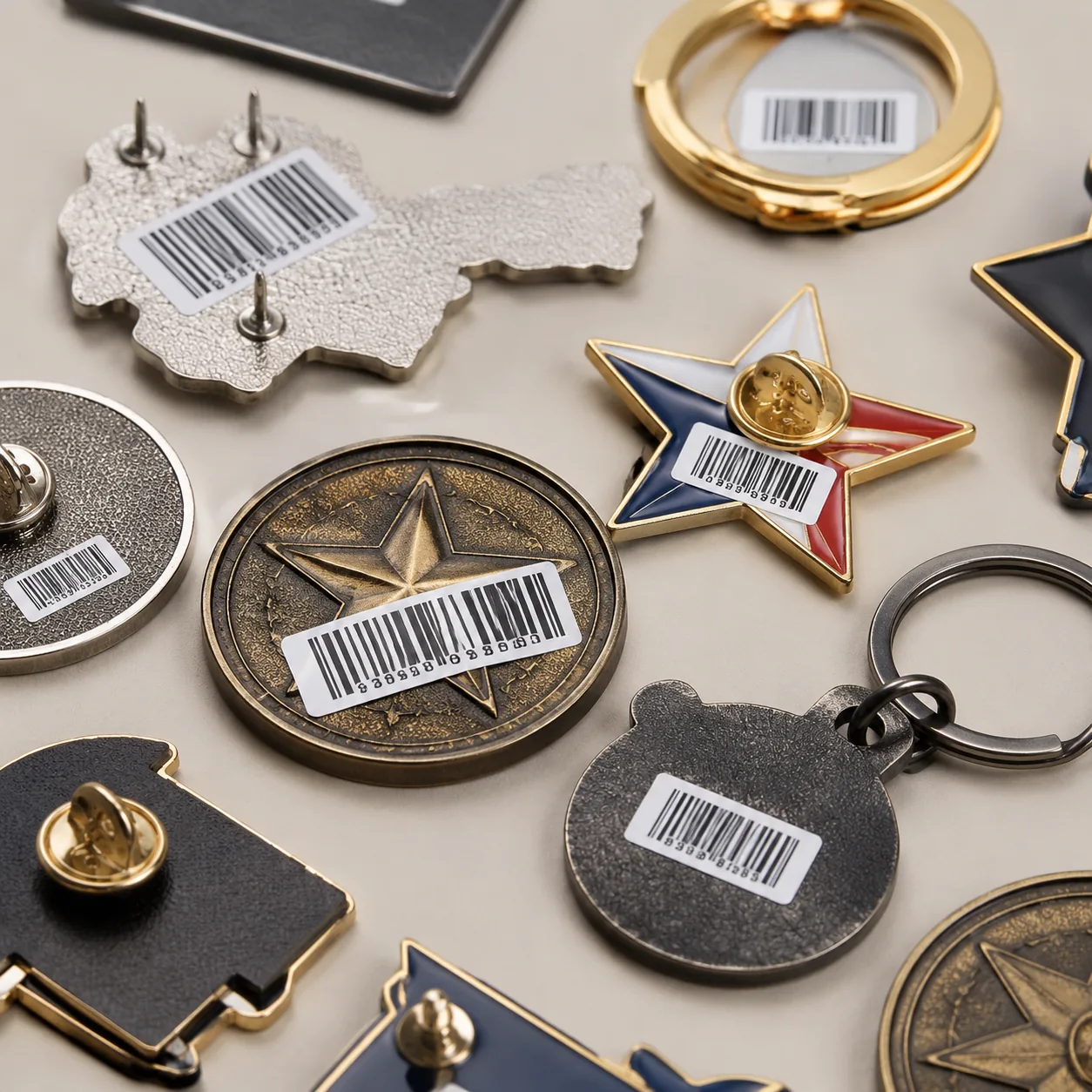
For custom giveaways, the highest-probability swap zones are packaging, lanyard webbing, paper cards, acrylic sheet source, patch backing choice, and leather alternatives for trims or tags. For die-struck pins, soft enamel badges, challenge coins and plated keychains, the product remains metal-first. In those categories, a realistic improvement is usually reduced plastic packing, lower mixed-material count, nickel-free plating where skin contact matters, lighter pack-out, or design for longer use. It is usually not credible to position the metal body itself as “sustainable” unless you can document alloy source, recycled content and process control.
Before sending an RFQ, write a one-line decision hierarchy and repeat it in every email and PO draft. Example: 50 mm keychain, 12-month retail use, Pantone-critical logo, FOB under USD 0.85, no PVC, no EVA, paper-based individual protection only, bulk lead time under 18 calendar days after sample approval, AQL 2.5/4.0. That hierarchy prevents attractive but unusable substitutions from entering the quote stage.
Build the RFQ around fixed specs and controlled swap zones
A workable lower-impact RFQ separates fixed build data from approved substitution areas. Fixed specs should include size, thickness, process, color count, attachment hardware, packaging format, inspection standard, destination market, quantity tier and required ex-factory date. Optional substitutions should be limited to zones where you will accept alternates: RPET webbing instead of virgin polyester, 300-350 gsm recycled board instead of coated SBS card, glassine sleeve instead of OPP, recycled-content acrylic sheet instead of virgin acrylic, or washable paper instead of PU for a non-structural trim.
This is also where terminology needs to be corrected. Recycled content is not the same as recyclable after use. Biodegradable is not the same as industrially compostable. Water-based ink is not automatically lower risk if crocking resistance drops below the use case. A paper envelope is not an upgrade if plated metal arrives face-scratched. Ask the supplier to state exactly what is changing, the declared recycled-content percentage or range, the test basis if any, and the performance difference introduced by the change.
- State product type, dimensions and process exactly: for example, 45.0 mm x 1.5 mm stamped iron pin, soft enamel fill, butterfly clutch, sandblast back.
- Request two quote columns: standard build and lower-impact alternate build, using the same quantity tiers.
- Ask for MOQ by option. Stock RPET lanyard webbing may start at 100 pcs, but recycled acrylic colors, washable paper trims and custom molded pulp structures often start at 500, 1,000 or 3,000 pcs.
- Specify packaging separately from product build: no individual bag, glassine sleeve, tissue wrap + divider tray, paper card + belly band, or master-bag only.
- Set QC terms up front: AQL 2.5 major / 4.0 minor is common for promo; AQL 1.5 / 2.5 is more suitable for retail presentation or e-commerce gift sets.
- Require plating, paint, ink and adhesive details, not only visual language such as shiny gold or strong glue.
- Ask for lead time in calendar days from artwork approval and from pre-production sample approval, because suppliers often count these differently.
Compare quotes by process fit, MOQ tiers and real 2026 cost deltas
When quotes return, check process fit before price. Switching a metal enamel pin from an individual OPP bag to tissue wrap plus divided inner carton is a manageable change if plating is matte or satin and there is no epoxy dome. Replacing a zinc alloy keychain body with cork, layered board or bamboo is not a like-for-like substitution. It changes machining route, edge durability, logo sharpness, hardware retention, breakage rate and batch consistency. If a supplier prices those as direct equivalents, they are not costing the process risk correctly.
Good quotes show where the lower-impact option is cost-neutral, cost-add or cost-saving by quantity tier. In 2026, packaging simplification and stock-color RPET lanyard webbing are often low-delta changes at 1,000 pcs. Structural material swaps, non-stock recycled acrylic, specialty paper engineering and washable-paper trims create larger deltas and usually add sampling time. At 300-500 pcs, setup cost is spread across too few units, so the delta widens. At 3,000-5,000 pcs, many option premiums compress because die-line cost, print setup and raw-material minimums are amortized.
| Component or spec | Standard option | Lower-impact option | Typical MOQ | Typical FOB at 1,000 pcs | Lead-time effect | Main trade-off |
|---|---|---|---|---|---|---|
| 20 mm lanyard webbing | Virgin polyester, heat-transfer or sublimation print | RPET polyester, sublimation printed | 100 pcs standard / 300-500 pcs for some yarn colors | USD 0.32-0.48 standard vs USD 0.35-0.56 RPET | Usually +0-2 days if stock yarn available | Check color fastness, edge flatness and slightly softer handfeel |
| Soft enamel pin packaging | OPP bag + 300 gsm backing card | Glassine sleeve, tissue wrap or no individual bag with divider trays | Usually no MOQ change | USD 0.00 to +0.03 vs standard, or save about USD 0.01-0.02 if no individual pack | Usually none | Higher scuff risk on mirror plating or epoxy-domed faces |
| Patch backing card | 300 gsm coated card | 300-350 gsm uncoated recycled board | Usually no MOQ change | Near neutral to +USD 0.01 | Usually none | Print appears duller; die-cut slots can crack if grain direction is wrong |
| Acrylic charm body | Virgin clear acrylic 2.5-3.0 mm | Recycled-content acrylic sheet where available | 500-1,000 pcs common | Add USD 0.04-0.10 | Often +2-4 days | Possible haze, micro-inclusions and color variation |
| Leather-look tag | PU or genuine leather | Recycled leather fiber sheet or washable paper | 500+ common | Add USD 0.05-0.15 | Often +3-5 days if non-stock sheet | Different emboss depth, edge wear and water response |
| Gift-set packing | Rigid box + EVA insert | Folding carton 800-1200 gsm + paper insert or molded pulp | 300+ common | Save USD 0.10 or add up to USD 0.20 depending on structure | Usually +1-3 days for die-line approval | Lower cube and easier material recovery, but less premium unboxing feel |
Use quantity tiers in the RFQ so the cost picture is not distorted. For example, a 20 mm RPET lanyard with metal hook may quote at USD 0.62-0.78 FOB at 300 pcs, USD 0.35-0.56 at 1,000 pcs, and USD 0.28-0.44 at 5,000 pcs depending on print method and breakaway buckle. A 45 mm soft enamel pin in iron may quote around USD 0.42-0.68 FOB at 1,000 pcs with standard packing, while divider-tray paper-only packing can move the number by only a few cents if the tray is well optimized.
Treat broad wording as a warning sign. Terms such as sustainable metal, eco plating, green ink or biodegradable acrylic are not useful without composition, process notes or a test basis. Ask for measurable details instead: nickel-free plating, 60-80% post-consumer board content, elimination of individual bags, reduced mixed-material assembly, 350 gsm uncoated board, or molded pulp replacing EVA.
Use sample approval to test failure points, not just appearance
The sample stage is where lower-impact projects usually fail quietly. The photo sample looks acceptable, but nobody checks whether uncoated board curls at 65-75% relative humidity, whether RPET webbing edge-frays after repeated badge-clip use, or whether a paper sleeve rubs against imitation-gold plating during transit. A useful sample plan targets the weakness introduced by the substitution instead of rechecking features that were never at risk.
For pins, badges and coins, the main risk is often packaging protection rather than the metal body. Request one packed transit sample using the exact sleeve, insert, divider, inner box and master-carton arrangement planned for mass production. For lanyards, ask for width tolerance of +/-0.5 mm on 15-25 mm webbing, print registration tolerance of +/-1.0 mm, hardware pull test of at least 8 kgf for standard swivel hook assemblies and 10-12 kgf for heavier trigger hooks, plus dry and wet rub testing after full ink cure. For patches, confirm thread density, edge consistency, merrow width, laser-cut edge char level if applicable, and heat-backing adhesion after 150-160°C press application for the supplier’s stated dwell time. For acrylic charms, specify 3.0 mm sheet thickness tolerance of +/-0.2 mm, hole-position tolerance of +/-0.5 mm, edge polish standard and protective film status.
For orders above roughly USD 3,000 goods value, approve two samples: one aesthetic sample and one abuse sample. The aesthetic sample confirms color, finish and logo fidelity. The abuse sample checks rub, drop, compression and packed handling. This split is especially useful when replacing polybags with paper-only protection, because hidden damage usually appears after packed movement, not on a desk photo.
Freeze the production spec sheet before the PO is issued
Once a sample is approved, every lower-impact detail must be locked in writing. Buyers often approve RPET webbing or paper sleeves, then issue a PO that says only “custom lanyard 20 mm” or “custom pin with backing card.” That gap is where the alternate disappears during internal handover or raw-material purchasing. The final spec sheet should read like a factory work instruction, not a marketing summary.
Include exact dimensions, material callouts, tolerances, finish, hardware, carton limits, packing sequence and cosmetic standard. For metal items, specify whether the body is stamped iron or die-cast zinc alloy, nominal thickness and tolerance, and whether the back may show tool marks. Typical tolerances are +/-0.10 mm for stamped thickness, +/-0.15 mm for cast thickness, and around +/-0.30 mm on finished face size depending on geometry. For paper components, specify board weight and finish, for example 350 gsm uncoated recycled board, no lamination, 1-color black print, die-cut slot width 3.2 mm, grain direction parallel to long edge to reduce cracking. If the destination warehouse rejects heavy cartons, note gross-weight limits clearly.
- Item size and tolerance, for example 40.0 mm +/-0.3 mm overall face size.
- Thickness and process, for example 1.5 mm stamped iron, 2.0 mm die-cast zinc alloy or 3.0 mm laser-cut acrylic.
- Plating finish and skin-contact restriction: shiny nickel, matte black nickel, imitation gold or nickel-free if required.
- Color standard: Pantone references, acceptable visual shift and whether absorbency shift on uncoated stock is allowed.
- Hardware spec, for example 25 mm lobster clasp, 8 mm split ring with 1.6 mm wire or trigger hook with spring gate.
- Packaging stack: no OPP, glassine sleeve, 50 pcs per inner bag, divider every 10 pcs, 500 pcs per export carton.
- Carton limits: target 45-55 cm carton length and under 15-18 kg gross weight for easier handling.
- Approved sample date, revision number and control photos used for final inspection.
Control in-process variables where lower-impact builds drift
In production, the biggest risk is rarely the headline material claim. It is the process drift around it. RPET webbing can print cleanly, but if web tension or cure temperature shifts, edge waviness and color inconsistency appear. Recycled board can die-cut well, but unstable moisture content can cause slot cracking and card bowing. Paper sleeves can replace polybags, but if metal parts are packed before enamel or topcoat is fully cured, scuffing and offset marks rise quickly.
Ask the factory which controls they will actually run in line, and ask for frequency. For lanyards, useful controls include width checks by lot, print-registration checks every 100-200 pcs, stitching verification at attachment points, hardware pull testing per batch and cure confirmation before rewinding. For pins and keychains, ask for paint cure hold time before packing, plating appearance checks under fixed light, separator use for polished faces and random packed-drop checks from inner-carton level. For paper cards and cartons, ask for moisture stability checks, die-cut crack inspection and slot-fit verification using actual product, not only CAD dimensions.
Typical 2026 bulk lead times remain manageable if alternates are defined early. After sample approval, custom lanyards are commonly 7-10 calendar days, enamel pins and plated keychains 10-15 days, embroidered or woven patches 7-12 days, acrylic charms 8-12 days, and mixed-material gift sets 12-18 days. The delays usually come from non-stock board structures, custom recycled acrylic color sourcing, alternate webbing yarn availability, or a second approval round after print appearance changes on uncoated stock.
Inspect finished goods against the new risks you introduced
Final inspection on a lower-impact order should not simply reuse the standard checklist. If you removed individual polybags, inspect face rub, contact marks and plating abrasion at a meaningful sample size. If you switched to uncoated recycled board, inspect fiber shedding, die-cut cracking, print-density variation and warping. If you specified recycled-content acrylic, inspect haze, micro-speck inclusions, edge polish consistency and whether protective film has been removed or left in place as specified.
For B2B promo orders, AQL 2.5 major and 4.0 minor remains common, but defect definitions should reflect use impact. A small fiber fleck on uncoated card may be minor. Rub-through on a front plating face is major. A lanyard hook gate that does not close is major. A backing card warped enough to block peg display is also major even if the print is acceptable. The inspection logic should classify defects by function and presentation risk, not by how attractive the alternate material sounds.
Carton review matters more when individual protection is reduced. Confirm divider use, inner-pack counts, carton burst quality, gross weight and dimensions. For many promo shipments, cartons in the 45-55 cm range and below 15-18 kg gross weight reduce handling complaints and transit damage. If the order will be drop-shipped to multiple sites, also verify outer-carton marking, assortment accuracy and pack-count control.
Best next step: issue a two-column RFQ and approve one risk at a time
If you want lower-impact custom giveaways in 2026 without adding avoidable supply-chain risk, do not ask for a fully sustainable product category. Issue a two-column RFQ: standard build and approved lower-impact alternatives. Limit substitutions to one or two zones that matter most, such as packaging, lanyard webbing or a non-structural trim. Require the supplier to state exact MOQ, FOB delta, lead-time delta and performance trade-off for each option.
Then approve one risk at a time. First approve the substitution itself. Next approve the packed or abuse sample. Then freeze the production spec sheet so marketing, procurement and the factory are all controlling the same build. That usually adds one disciplined email round and one more sample checkpoint, but it is far faster than recovering from vague green claims after a failed sample or a damaged bulk shipment.
For most international buyers, the practical path is straightforward: keep the part that must perform, reduce the part that only adds waste, and document the result with enough manufacturing detail that the factory can repeat it consistently at bulk scale.
Have a project? Send your artwork and target quantity and we’ll reply with a detailed quotation within 12 working hours.
Ready to get this made?
Send your sketch, target quantity and ship-date. Detailed quotation in 12 hours.



