Sourcing Custom Woven Patches From RFQ to Bulk Shipment
1. Confirm Woven Construction Before Sending the RFQ
Woven patches are the right choice when the artwork needs fine lettering, tight outlines, small icons, or a clean retail surface at 50 to 90 mm. They are produced by weaving polyester yarns into the design rather than stitching thread onto twill, so they can hold smaller details than embroidery at the same size. A practical minimum for readable block letters is 4 mm high; simple sans-serif fonts can sometimes work at 3.5 mm, but thin serifs, condensed fonts, and multi-color outlines around small text should be avoided.
Do not specify woven patches when the buyer expects raised texture, thick tactical styling, or rubber-like outdoor performance. A standard woven patch is flat and relatively thin: 0.45 to 0.75 mm without backing, 0.75 to 1.20 mm with iron-on film, and 1.80 to 2.50 mm with hook-and-loop. Most are made from polyester yarn, laser cut or heat cut, then finished with sew-on, heat-seal, pressure-sensitive adhesive, hook, loop, or hook-and-loop backing.
| Patch type | Best use | Typical FOB range at 500 pcs | Key sourcing limit |
|---|---|---|---|
| Woven polyester | Small text, detailed logos, retail badges | USD 0.38 to 0.95 each for 60 to 80 mm | Flat surface; no raised embroidery texture |
| Embroidered twill | Bold logos, school badges, uniforms | USD 0.32 to 0.85 each for 60 to 80 mm | Fine strokes below 1.2 mm may close up |
| PVC rubber | Outdoor gear, luggage, tactical patches | USD 0.75 to 1.80 each for 60 to 80 mm | Higher tooling cost and heavier hand feel |
| Printed fabric | Photos, gradients, low-cost giveaways | USD 0.22 to 0.65 each for 60 to 80 mm | Less dimensional and depends heavily on edge sealing |
2. Build an RFQ Around Cost Drivers
A quote request that says only “70 mm woven patch, 500 pcs” will produce incomplete or misleading pricing. The factory needs the finished size, shape, backing, border, thread color count, packing method, inspection level, shipping term, and delivery deadline. The cheapest reply may exclude iron-on film, individual bags, barcode labels, carton marks, or hook backing.
For ZheCraft patch quotations, the fastest RFQs include vector artwork, target Pantone references, finished size in millimeters, quantity breaks, intended use, and washing requirement. A normal MOQ is 100 pcs per design for simple woven patches, but pricing becomes more stable at 300, 500, 1,000, and 3,000 pcs because loom setup, artwork programming, cutting, and QC are spread across more units. For complex silhouettes, multiple internal cutouts, or retail packing, 300 pcs per design is a more realistic starting point.
- State finished size and tolerance, for example 75 x 52 mm with ±1.5 mm tolerance.
- Specify backing: sew-on, iron-on, pressure-sensitive adhesive, hook only, loop only, or hook-and-loop set.
- Define the border: merrowed edge for simple circles, ovals, shields, and rectangles; laser-cut edge for irregular shapes.
- Limit thread colors where possible; 8 colors or fewer is efficient, while 9 to 12 colors may increase setup time.
- Confirm packaging: bulk 100 pcs per polybag, individual OPP bag, barcode bag, backing card, or retail header card.
- Set inspection terms before production, such as general inspection level II with AQL 2.5 major and 4.0 minor.
3. Compare Quotes by Construction, Not Unit Price
Two suppliers can quote the same drawing 30 percent apart because they are not quoting the same patch. One may price a sew-on laser-cut patch in bulk packing, while another includes heat-seal backing, individual bags, barcode stickers, stronger edge coating, and pre-shipment inspection. Ask each factory to state the included backing, border process, sample charge, setup charge, packing, and Incoterm.
For a 70 mm woven patch at 500 pcs, a workable China FOB range is USD 0.40 to 0.80 for sew-on, USD 0.46 to 0.90 for iron-on, USD 0.55 to 1.05 for pressure-sensitive adhesive, and USD 0.65 to 1.20 for hook-and-loop. Sample fees usually run USD 30 to 80 per design and may be credited after bulk confirmation at agreed quantities. Physical samples typically ship by courier in 3 to 6 days after dispatch; sea or rail consolidation is only economical for larger mixed orders.
| Specification item | Low-risk requirement | Why it matters |
|---|---|---|
| Size tolerance | ±1.5 mm for patches under 80 mm; ±2.0 mm above 80 mm | Prevents disputes caused by normal cutting, heat, and yarn shrinkage |
| Small text | Minimum 4 mm letter height; avoid strokes below 0.35 mm | Protects readability after weaving and heat finishing |
| Thread colors | Approve nearest stock-thread match against Pantone target | Polyester yarn is not liquid ink, so exact Pantone matching is not guaranteed |
| Iron-on film | 0.12 to 0.18 mm film; press at 150 to 160 C for 12 to 15 seconds | Controls adhesion and consumer application performance |
| Hook backing | Nylon hook, 0.9 to 1.2 mm hook height, stitched or laminated as approved | Low-grade hook can peel, curl, or lose grip after repeated use |
| Inspection level | General level II; AQL 2.5 major, 4.0 minor | Creates a shared acceptance standard before shipment |
4. Approve Artwork Within Loom Limits
Artwork approval is where many woven patch delays begin. The loom can reproduce fine detail better than embroidery, but it still has physical limits. Strokes below 0.35 mm may disappear, open gaps below 0.40 mm may fill, and color traps around tiny letters often blur. For patches under 60 mm wide, simplify text, remove unnecessary shadows, and reduce outlines around small elements.
Color planning should be handled before sampling. Most factories use stocked polyester thread charts for promotional and uniform orders; custom-dyed yarn is usually not justified unless the order is several thousand pieces per color. If brand color is critical, approve the nearest thread under D65 daylight or request lab-dipped yarn with an added 7 to 12 days and a separate yarn MOQ.
ZheCraft normally converts buyer artwork into a production stitch map before sample weaving. This file should show simplified lines, border width, backing type, cut path, and finished size. Check trademark marks, mirror orientation, text spacing, and edge thickness at this stage. A practical merrowed border is 2.0 to 3.0 mm wide; a laser-cut border with heat sealing can be 1.0 to 1.5 mm, but it needs enough margin to avoid cutting into the design.
5. Sample the Details That Can Fail in Bulk
A woven patch sample is not only a color proof. It verifies loom density, edge sealing, backing adhesion, cut accuracy, thickness, and text readability at actual size. Standard sample lead time is 5 to 7 working days after artwork approval. Hook-and-loop sets, retail cards, several related designs, or special thread matching may need 7 to 10 working days.
Evaluate the sample physically, not only from photos. Measure width and height at the longest points with a ruler or caliper, check border width, and compare colors against the approved thread chart or golden sample. Rub the surface with a dry white cloth for loose fibers, flex the patch 20 times to check edge coating, and inspect for glue overflow, scorch marks, or loose threads longer than 2 mm.
For iron-on patches, test on the intended fabric. Press at 150 to 160 C for 12 to 15 seconds using medium pressure unless the factory gives a different film-specific setting. Let the patch cool fully, then perform a peel check after 24 hours. Weak adhesion often appears after cooling or washing, not immediately after pressing. For washable garments, agree whether the patch must pass one home wash at 30 C, five wash cycles, or only visual adhesion after application.
- Finished size is within approved tolerance, normally ±1.5 mm below 80 mm.
- Text remains readable at normal viewing distance, especially 4 to 6 mm letters.
- Edges show no burnt marks, glue overflow, major waviness, or loose threads over 2 mm.
- Backing is centered within ±1.5 mm and does not make the patch too stiff for the garment.
- Color is within the approved stock-thread match or signed golden sample.
- Retail packing matches barcode, suffocation warning, backing card direction, and SKU label.
6. Lock the PO to Prevent Production Drift
After sample approval, the purchase order should lock the construction. Do not leave the production team to interpret scattered emails between sales, design, and procurement. The PO should state the approved sample date, revision code, finished size, tolerance, backing, border process, packaging, carton mark, AQL level, Incoterm, and latest ship date.
Bulk production lead time for woven patches is normally 10 to 16 working days after deposit and sample approval for 500 to 3,000 pcs. Orders above 10,000 pcs, mixed-SKU programs, retail packing, barcode labeling, or added backing cards usually require 18 to 28 working days. Rush production may be possible in quiet periods, but it can increase the risk of weak heat-seal bonding, incomplete drying, rushed trimming, or inconsistent sorting.
Common payment terms for new custom orders are 30 percent deposit and 70 percent before shipment because the patch uses buyer-specific artwork and has little resale value. Repeat distributors with stable monthly demand may negotiate rolling purchase orders, consolidated shipments, or fixed reorder pricing if thread colors, backing, and packing remain unchanged. Reorder POs should still refer to the original golden sample because small artwork edits can trigger a new sample.
7. Inspect Bulk by Defect Class
Bulk inspection should separate major and minor defects. Major defects include wrong artwork, wrong backing, missing hook side, unreadable logo text, severe size deviation, backing peeling, oil stains, mold, mixed SKUs, or incorrect retail labeling. Minor defects include slight thread fuzz, small edge unevenness, or shade variation within the approved range.
For promotional programs, general inspection level II with AQL 2.5 major and 4.0 minor is a practical default. For retail brands, uniforms, or safety-related identification, use AQL 1.5 major and 2.5 minor, understanding that tighter sorting may add time and cost. Dimensional checks should include at least 13 pcs for small lots and 32 pcs or more for mid-size lots, recording width, height, border width, backing placement, and thickness where relevant.
Packing is also a QC item. Bulk patches are commonly packed 50 or 100 pcs per inner polybag, then 1,000 to 2,000 pcs per export carton depending on size and backing. Keep carton gross weight under 15 kg for warehouse handling, use five-layer corrugated cartons for export, and add desiccant for sea shipments during humid months. For retail orders, confirm scan readability of barcodes before carton sealing, not after arrival.
8. Plan Shipment Backward From the Delivery Date
A controlled woven patch order needs one final spec sheet and one approved sample path. The buyer should send the factory a vector file, target size, quantity table, backing requirement, packing method, inspection level, and shipping term. Ask for price breaks at 300, 500, 1,000, and 3,000 pcs, with separate lines for sew-on, iron-on, adhesive, and hook-and-loop if those options are still open.
For event or retail launch dates, count backward from the required delivery date. Allow 2 to 3 days for RFQ clarification, 5 to 7 working days for sampling, 1 to 2 days for sample review, 10 to 16 working days for bulk production, and 3 to 7 days for air express after dispatch. Add at least 5 working days of buffer for artwork correction, thread rematching, customs delay, or buyer-side approval lag.
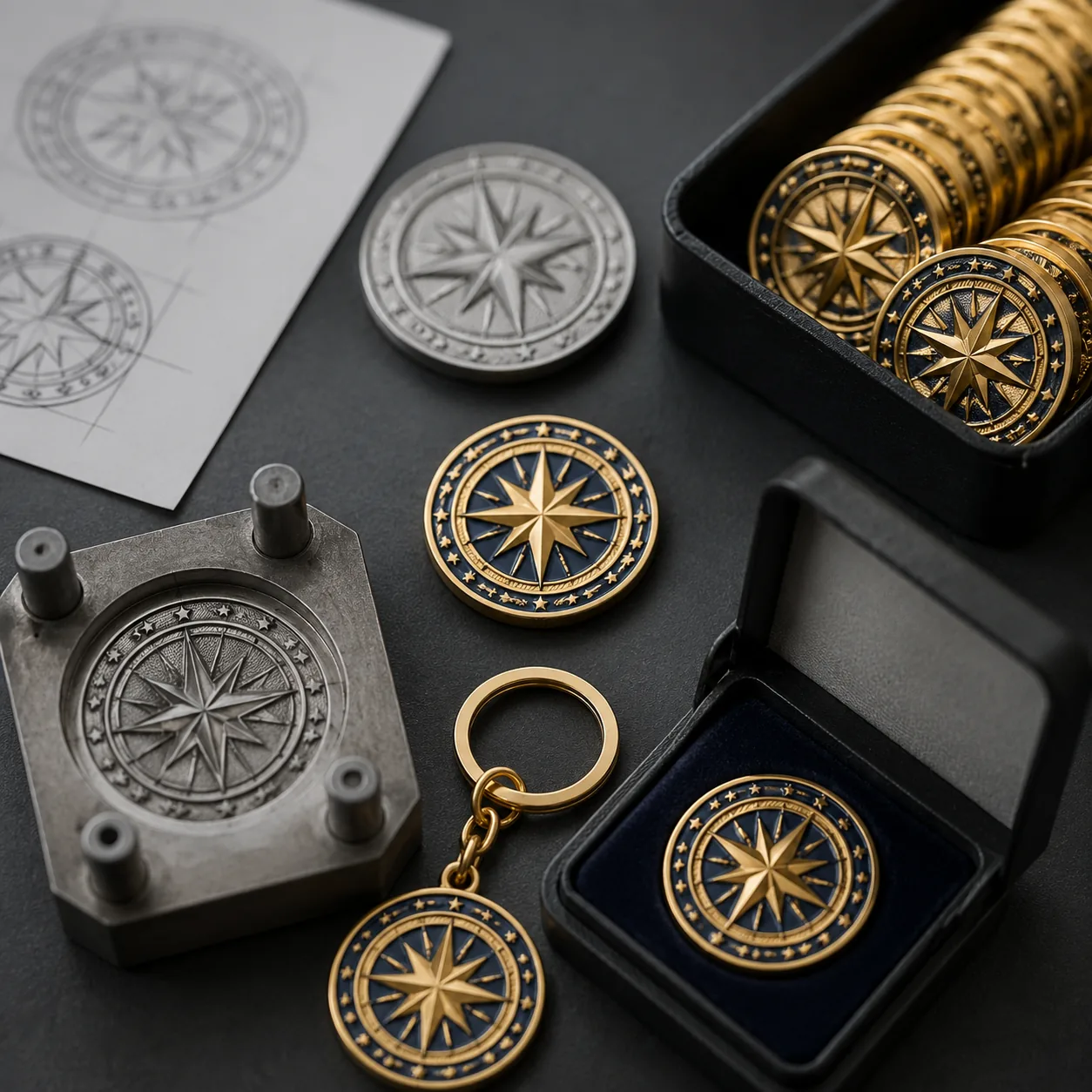
When patches are part of a broader merchandise program, coordinate them with pins, coins, keychains, lanyards, backing cards, and printed packaging before sampling. Matching brand colors, barcode data, carton labels, and delivery windows across products reduces rework. ZheCraft can quote woven patches as standalone SKUs or as part of a matched promotional set when buyers need consistent artwork control across multiple custom items.
Have a project? Send your artwork and target quantity and we’ll reply with a detailed quotation within 12 working hours.
Ready to get this made?
Send your sketch, target quantity and ship-date. Detailed quotation in 12 hours.



