Sourcing Custom Metal Keychains From RFQ to Bulk Shipment
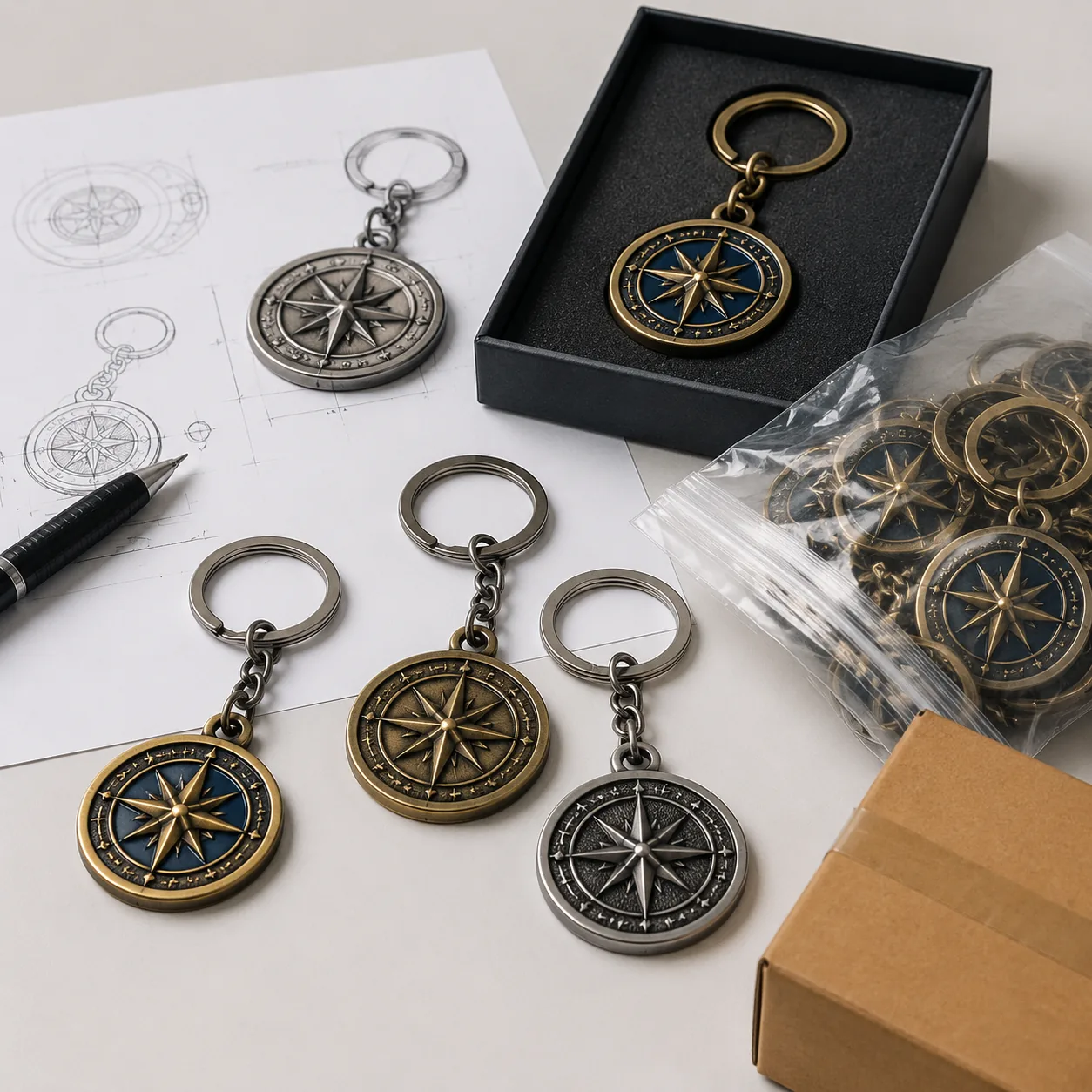
1. Build an RFQ the Factory Can Price Accurately
Most cost problems in custom metal keychains start before production: the supplier quotes one construction while the buyer imagines another. A 45 mm zinc alloy keychain at 2.5 mm thickness with bright nickel plating and OPP bag packing may price at USD 1.05 to 1.65 FOB China at 1,000 pcs. Change that same item to 60 mm, 4.0 mm thickness, antique brass, soft enamel on both sides, epoxy dome, laser numbering, and a rigid gift box, and the realistic FOB cost can move to USD 2.60 to 5.40 per piece before freight.
A usable RFQ should define finished size in millimeters, target thickness, base metal, finish, decoration method, attachment hardware, packaging, quantity tiers, Incoterm, destination port, and required ship date. Send vector AI, EPS, PDF, or SVG artwork with Pantone Solid Coated numbers. JPG mockups are useful for visual intent but not enough for mold cutting, enamel separation, or quotation. If the design includes cutouts, a bottle opener, spinner plate, rotating coin, QR code, glow enamel, glitter, epoxy, or individual numbering, list it in the RFQ instead of assuming it is visible in the artwork.
For practical comparison, ask suppliers to quote at 100, 300, 500, 1,000, and 3,000 pcs, with tooling, sample fee, unit price, packaging, and freight separated. At ZheCraft, standard 45 to 55 mm zinc alloy or iron soft enamel keychains normally start from 100 to 300 pcs MOQ. At 500 pcs, common FOB China ranges are USD 0.85 to 2.20 for stamped iron, USD 1.20 to 3.20 for zinc alloy die cast, and USD 1.80 to 4.80 for brass or heavier antique-finish work. Prices below these ranges usually mean thinner metal, simpler plating, lighter hardware, or excluded packaging.
| RFQ line item | Factory-ready specification | Risk if omitted |
|---|---|---|
| Finished size | 52 mm H x 38 mm W, tolerance ±0.30 mm | Supplier prices a smaller or easier outline |
| Body thickness | 3.0 mm nominal, tolerance ±0.20 mm | Bulk feels lighter than the approved concept |
| Base metal | Zinc alloy die cast for 3D relief; iron stamped for flat soft enamel | Wrong tooling route and unreliable unit price |
| Finish | Bright nickel, black nickel, gold flash, antique brass, matte nickel, or two-tone | Sample approval becomes subjective |
| Hardware | 25 mm split ring, 25 mm chain, 1.8 mm ring wire | Weak ring opens or chain twists |
| Packing | Individual OPP bag, backing card, pouch, or rigid box | Labor, carton volume, and freight are underquoted |
2. Select the Manufacturing Route Before Decoration
The body process determines cost, durability, detail, and lead time. Zinc alloy die casting is the usual choice for irregular outlines, 2D or 3D relief, bottle opener edges, openwork, and thicker bodies from 2.5 to 5.0 mm. Iron stamping is better for flat promotional pieces from 1.2 to 2.0 mm where low cost, clean outlines, and soft enamel color are the priority. Brass stamping costs more but gives a heavier hand feel and sharper detail for premium programs, especially with antique plating.
Stainless steel suits thin tags, brushed finishes, laser engraving, and corrosion-resistant applications, but it is less efficient for deep soft enamel cavities. PVC and acrylic are not metal alternatives in performance; they are different products. They may be better when the keychain must be large, lightweight, flexible, child-friendly, or full-color printed.
Do not choose from a rendering alone. A 55 mm zinc alloy keychain at 4.0 mm can weigh 35 to 60 g depending on cutouts and relief depth. A 1.5 mm stamped iron version of the same outline may weigh 12 to 24 g. That difference affects ring stress, carton weight, air freight cost, and whether the product feels like a retail accessory or a disposable event item.
| Route | Best use | Typical MOQ | Lead time after drawing approval | FOB range at 500 pcs |
|---|---|---|---|---|
| Zinc alloy die cast | 3D relief, thick body, bottle opener, complex outline | 100 to 300 pcs | 18 to 28 days | USD 1.20 to 3.20 |
| Iron stamped | Flat logo, soft enamel, low-cost promotion | 100 to 300 pcs | 15 to 24 days | USD 0.85 to 2.20 |
| Brass stamped | Premium flat design, fine raised lines, antique finish | 100 to 300 pcs | 18 to 30 days | USD 1.80 to 4.80 |
| Stainless steel etched | Thin tag, brushed finish, laser engraving | 300 to 500 pcs | 18 to 30 days | USD 1.50 to 3.80 |
| PVC molded | Soft flexible cartoon or large lightweight shape | 300 to 500 pcs | 20 to 32 days | USD 0.90 to 2.60 |
3. Lock the Drawing and Tooling Standard
Tooling should not start until the technical drawing is frozen. The drawing needs front and back views, outer dimensions, thickness, enamel areas, raised metal line widths, hole position, plating, backstamp, laser area, attachment direction, and edge treatment. For most metal keychains, keep the ring hole at least 3.0 mm from the outer edge and use a 3.0 to 4.5 mm hole diameter depending on the jump ring or chain connection. Thin bridges under 1.0 mm should be avoided on zinc alloy because they can deform during polishing or plating.
For soft enamel, raised metal walls should normally be at least 0.25 mm wide, and enamel cavities should not be narrower than 0.35 mm. For imitation hard enamel or polished enamel, 0.30 to 0.40 mm metal separations are safer because polishing can reduce line definition. Printed QR codes need more space than buyers expect: reserve at least 18 x 18 mm for basic scan reliability, use high-contrast black on light plating or print, and keep a clear quiet zone around the code.
Tooling cost is usually USD 45 to 120 for simple single-sided stamped iron or zinc alloy designs, USD 120 to 280 for double-sided, thicker, or 3D molds, and higher for spinner assemblies or multi-part bottle openers. The approved drawing, mold number, Pantone list, plating finish, and hardware bill should be stored under one item code. This is what prevents reorder drift six or twelve months later.
- Confirm finished size, not only logo size.
- Specify front, back, edge, and attachment direction separately.
- Mark each enamel or print color with Pantone Solid Coated references.
- Define hole diameter, hole offset, chain length, and ring wire diameter.
- Approve tooling only after the 2D or 3D drawing matches the RFQ.
- Create a new item code for any change in metal, thickness, finish, or packaging.
4. Sample the Highest-Risk Features
A pre-production sample should test the risky features, not just produce a good-looking photograph. For a flat iron soft enamel keychain, the risk is usually Pantone match, enamel fill height, plating brightness, and front-face scratches. For a zinc alloy bottle opener, the risk is opener geometry, torque resistance, edge comfort, plating adhesion around the opener cut, and whether the ring interferes with use.
Normal sample lead time is 7 to 12 days after drawing approval for standard stamped or die-cast keychains, and 12 to 18 days for 3D relief, translucent enamel, glitter, epoxy domes, moving parts, dual plating, or custom packaging. Sample charges often include tooling plus USD 20 to 60 handling for one to three pieces. A digital proof is enough to check layout, but it cannot approve antique tone, enamel level, epoxy clarity, spinner movement, or retail box fit.
Measure the sample before approval. Use calipers for size and thickness, check ring closure, and inspect the front face under consistent lighting. A common production tolerance is ±0.30 mm for outer dimensions and ±0.20 mm for thickness. For plating, specify no peeling, burning, exposed base metal, or visible front rack marks. For enamel, define acceptable minor pinholes outside the logo focal area, because zero cosmetic variation is unrealistic on low-volume promotional metalwork.
| Sample check | Recommended acceptance point | Reject condition |
|---|---|---|
| Size | Within ±0.30 mm of approved drawing | Shape is stretched or does not fit packaging |
| Thickness | Within ±0.20 mm | Item bends easily or feels materially lighter |
| Plating | Even coverage, no front peeling, burning, or exposed base metal | Black spots, cloudy gold, bare edges |
| Enamel | No major overflow, underfill, or color leakage on front | Color crosses raised lines or leaves sharp cavities |
| Hardware | Ring closes cleanly; chain links fully formed | Open ring gap above 0.30 mm or weak jump ring |
| Function | Bottle opener or moving part works for 10 repeated trials | Jamming, scraping, deformation, or plating damage |
5. Freeze the Bulk Order File
Many disputes happen because the buyer approves a sample but releases a vague purchase order. The bulk file should combine the approved drawing, sample photos, Pantone list, plating standard, hardware specification, packaging method, carton mark, barcode requirements, inspection level, and agreed tolerances. A PO that says “custom keychain, 1,000 pcs, as sample” leaves too many decisions open when the factory buys rings, bags, cards, cartons, and plating chemicals.
For plating, specify the visible finish and any minimum practical layer requirement. Promotional keychains commonly use a 3 to 5 micron nickel underlayer for bright nickel, black nickel, or gold flash. Decorative gold flash is often only 0.03 to 0.08 micron over nickel; thicker gold plating costs much more and is rarely used for giveaways. Antique brass, antique copper, and antique silver rely on darkened recesses and surface polishing, so buyers should allow slight tone variation between pieces and batches.
Packaging affects cost and carton volume more than many buyers expect. Individual OPP bags usually add USD 0.02 to 0.05 per piece. A printed backing card with bag may add USD 0.08 to 0.18. Velvet pouches often add USD 0.12 to 0.30, while rigid gift boxes can add USD 0.45 to 1.20 depending on paper, insert, and size. For master cartons, target 12 to 18 kg gross weight where possible; dense metal parts packed above that range are harder to handle and can crush inner retail packaging.
- Attach the approved drawing and sample photos to the PO.
- List metal, finish, enamel, hardware, and packing as a bill of materials.
- Define AQL level, tolerances, and critical defects before production.
- State whether slight antique tone or enamel shade variation is acceptable.
- Confirm inner bag, backing card, barcode, carton mark, and carton quantity.
- Write the latest acceptable ship date, not only the event date.
6. Inspect With AQL and Defect Classes
Inspection should be based on defect classes, not opinions. For most B2B promotional keychain orders, ANSI/ASQ Z1.4 general inspection level II with AQL 2.5 for major defects and AQL 4.0 for minor defects is a practical standard. Critical defects should be zero tolerance. Examples include sharp burrs that can cut skin, broken hardware, unsafe edges, toxic contamination concern, or an incorrect brand logo.
Major defects include wrong plating, missing enamel color, cracked enamel, severe front scratches, incorrect size outside tolerance, non-working bottle opener, broken ring, wrong packaging, or an incorrect carton mark that affects distribution. Minor defects include small back-side polishing marks, slight antique tone variation, tiny enamel pinholes outside the focal area, or minor carton scuffing. Buyers should decide in advance whether back-side cosmetic marks matter as much as front-side marks; treating hidden process marks as major defects raises cost and reject risk.
For a 1,000 pc order inspected under general level II, the sample size is typically 80 pcs. Under AQL 2.5, the major defect acceptance number is usually 5 and rejection number 6; under AQL 4.0, the minor acceptance number is usually 7 and rejection number 8. Retail or safety-sensitive programs may require 100 percent checks for rings, clips, bottle openers, magnets, or moving parts. That extra labor should be priced before PO release, not added at the packing table.
| Defect class | Examples | Typical acceptance |
|---|---|---|
| Critical | Sharp cutting burr, broken hardware, unsafe edge, wrong brand logo | 0 allowed |
| Major | Wrong plating, missing color, cracked enamel, function failure | AQL 2.5 |
| Minor | Tiny back scratch, slight shade shift, small non-focal pinhole | AQL 4.0 |
| Measurement | Size, thickness, hole, or ring wire outside agreed tolerance | Judge against drawing |
| Packaging | Wrong bag, missing card, incorrect carton mark | Major if sale or distribution is affected |
7. Control Cartons, Freight, and Transit Risk
After inspection, the main risks are scratches, moisture, carton damage, and freight delay. Metal-to-metal contact must be prevented. Individual OPP bags, paper sleeves, or cavity trays are simple but important; loose keychains in a carton will scratch during truck or air vibration. For sea freight, use moisture-resistant export cartons and avoid placing unprotected metal directly against uncoated paper inserts in humid seasons.
Ask for carton dimensions, gross weight, and packing quantity before booking freight. A typical master carton might hold 200 to 500 pcs depending on item weight and packaging, with gross weight kept near 12 to 18 kg. For express shipments, dimensional weight can make gift boxes expensive even when the metal item is small. For air freight, heavier zinc alloy keychains can move the freight cost by several cents to more than USD 0.30 per piece depending on carton density and destination.
A realistic RFQ-to-ship-ready timeline for a standard order with one sample round is 25 to 40 days: 1 to 3 days for quotation and drawing, 7 to 12 days for sample making, 2 to 4 days for sample approval and deposit, 12 to 22 days for bulk production, and 1 to 3 days for final inspection and packing. Complex projects with 3D molds, dual plating, moving parts, several colorways, or gift boxes should be planned at 40 to 60 days before international transit. Rush production can work for simple stamped items, but it increases the risk of plating bottlenecks and skipped sample corrections.
8. Preserve the Reorder File Before Closing the Project
A reorder is only simple if the first order was documented. Store the approved physical sample, final drawing, mold number, Pantone list, plating note, hardware specification, packaging dieline, carton mark, inspection report, and shipment photos. The reorder PO should cite the old item code and state whether anything changes. If the buyer wants the same product, silence is not enough; ring diameter, gold tone, enamel height, backing card paper, and pouch material can all drift when a factory buys replacement components months later.
Before placing the first order, decide what the keychain must survive: one-day trade show use, retail resale, daily pocket use, outdoor exposure, or premium corporate gifting. That decision drives metal thickness, plating quality, hardware strength, epoxy protection, packaging, and inspection strictness. A 1.2 mm stamped iron giveaway can be correct for a short event. It is the wrong construction for a retail product expected to remain attractive after months of use.
The safest sourcing path is straightforward: send a complete RFQ, choose the manufacturing route, lock the drawing, sample the risky features, freeze the bulk file, inspect with AQL, and preserve the reorder record. If working with ZheCraft, send the vector artwork, intended use, target quantity, packaging expectation, delivery deadline, and destination first. From there, the factory can recommend zinc alloy, iron, brass, stainless steel, PVC, or acrylic before quoting a price that reflects the actual product rather than an optimistic assumption.
- Keep one approved sample with the buyer and one at the factory.
- Record split ring diameter, wire diameter, chain length, and hardware supplier spec.
- Photograph the packing layout before cartons are sealed.
- Request carton dimensions and gross weight before freight booking.
- Reference the mold number and approved sample number on every reorder.
- Do not change plating, hardware, or packaging silently to reduce cost.
Have a project? Send your artwork and target quantity and we’ll reply with a detailed quotation within 12 working hours.
Ready to get this made?
Send your sketch, target quantity and ship-date. Detailed quotation in 12 hours.



